
Developer tool pricing is written to be hard to compare. One vendor bills per host, the next per GB, a third per committer or per virtual-user hour, and the number on the pricing page rarely matches what a real team pays once the workload is plugged in.
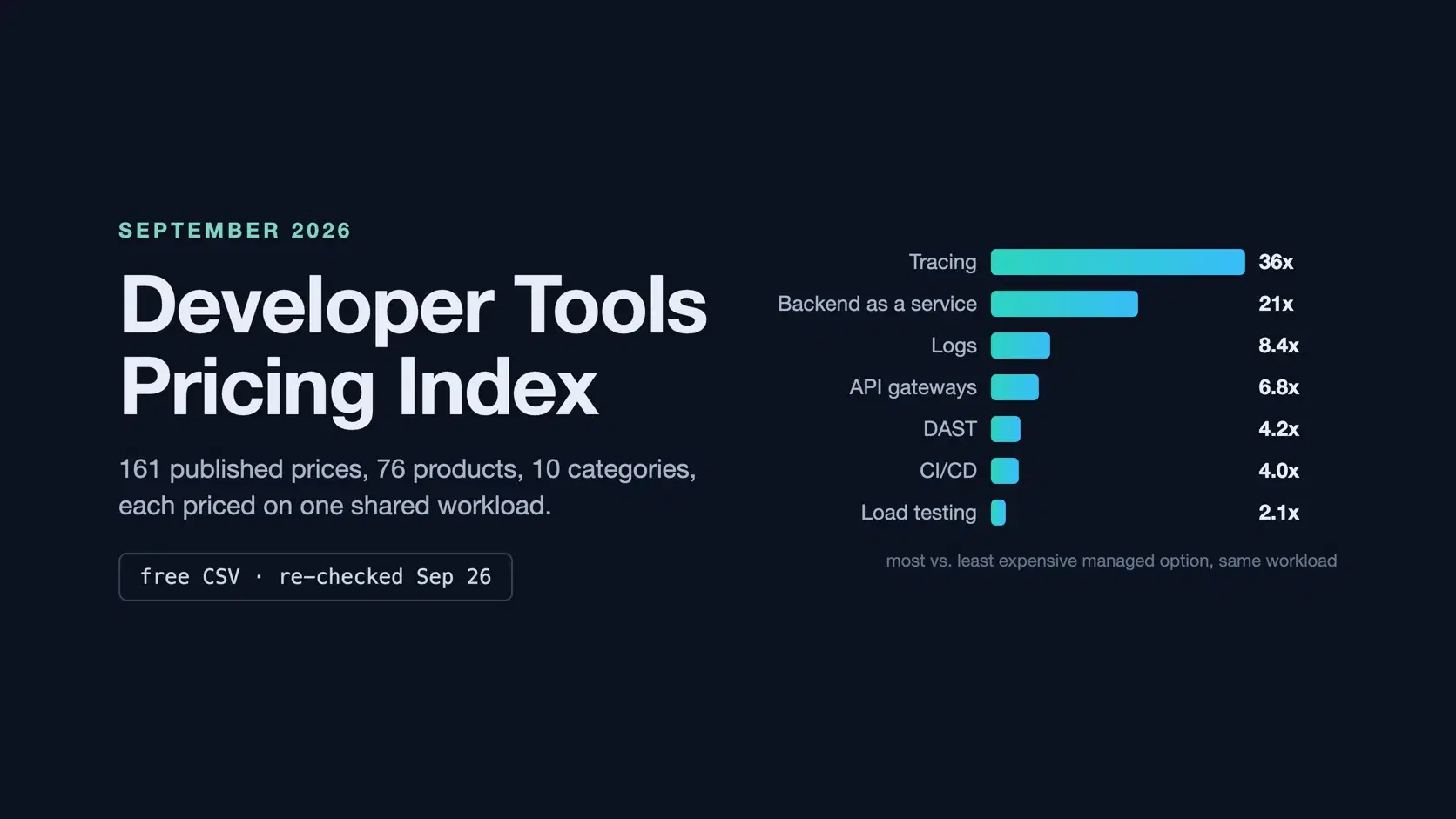
We priced 76 products on one shared workload per category and checked every price against the vendor's own pricing page on September 26, 2026, twice. On the same workload, the most expensive managed option costs 36x the cheapest for distributed tracing, 21x for a backend as a service and 8.4x for log management. The full dataset is a free CSV you can download, filter and cite.
Key Findings
- On 500 million spans and 24 hosts a month, standalone Datadog APM costs $1,673.20 and AWS CloudWatch Transaction Search costs $46.55, a 36x spread for the same traces (September 26, 2026).
- On 500 GB of monthly log ingest, Elastic Cloud Serverless costs $43.50 and Datadog's cheapest log plan, Flex Logs Starter, costs $364.57, an 8.4x spread (September 26, 2026).
- For a 20-developer team with 50,000 monthly active users, Appwrite Pro costs $25 a month and Convex Professional costs $518, because Convex charges $25 per developer (September 26, 2026).
- Two categories have a free managed plan that covers the whole workload: Checkly Hobby watches 10 endpoints every 2 minutes, a mean detection time of 60 seconds, and GitGuardian Starter scans for up to 25 developers.
- Every one of the 10 categories has at least one open-source option with a $0 license, 34 of the 161 rows in total, though self-hosting still costs compute and someone's time.
How We Priced Every Tool on the Same Workload
Each category comes from a DevToolLab comparison published in September 2026, and each of those posts picked one workload and priced every vendor on it: 500 GB of logs, 500 million spans, 50 million API requests, 12,000 build minutes. Pricing the workload rather than the plan is the only way a per-host bill and a per-GB bill end up in the same column.
For this index we pulled every published price from those 10 posts, then checked each one against the vendor's pricing page on September 26, 2026, reading the raw page text or a real browser rendering, never a summary. A second, independent pass re-checked all 161 rows and recomputed every workload total from the unit prices. Every row in the CSV is now verified; the one page behind a Cloudflare challenge (Semaphore) was confirmed from a Wayback Machine snapshot taken September 17, 2026. The checks also caught mistakes in five of our own source posts, all corrected the same day and listed in the changelog.
A few rules apply to every row. Prices are list prices in USD for the US region, billed annually where the vendor publishes an annual price, and before any negotiated discount. Artillery is the one exception: it publishes only a monthly price with 20% off for annual billing, so its $199 stays monthly. Data volumes use decimal gigabytes, vendors that publish only "contact sales" show up as quote-only rows with no number, and Gatling and Detectify, the two vendors that publish in euros only, keep their euro price in the CSV with the currency marked. Open-source rows record the license, not the cost of the servers you'll actually run them on.
What the Same Workload Costs in Each Category
| Category | Shared workload | Cheapest managed | Most expensive managed | Spread | Open-source options |
|---|---|---|---|---|---|
| Distributed tracing | 500M spans, 24 hosts a month | CloudWatch Transaction Search $46.55/mo | Datadog APM $1,673.20/mo | 36x | Jaeger, Grafana Tempo, SigNoz |
| Backend as a service | 50k MAU, 20 GB database, 200 GB egress, 20 devs | Appwrite Pro $25/mo | Convex Professional $518/mo | 21x | PocketBase (MIT) |
| Log management | 500 GB ingest a month | Elastic Cloud Serverless $43.50/mo | Datadog Flex Logs $364.57/mo | 8.4x | Loki, OpenSearch, VictoriaLogs, Graylog |
| API gateways | 50M requests, 3 KB responses, us-east-1 | Amazon API Gateway HTTP $63.50/mo | API7 Cloud $430/mo | 6.8x | Kong, Traefik, APISIX, KrakenD, Tyk |
| DAST | 20 developers, one year | StackHawk $2,400/yr | Burp Suite Professional $9,980/yr | 4.2x | ZAP, Nuclei, Wapiti |
| CI/CD | 10 devs, 12,000 Linux minutes a month | GitHub Actions Team $94/mo | Buildkite Pro hosted $380/mo | 4.0x | Jenkins, Woodpecker, Semaphore CE |
| Load testing | 500 VUs, 30 min, 8 runs a month | Artillery Team $199/mo (monthly) | Gatling Team $412.68/mo | 2.1x | k6, Gatling, Locust, JMeter, Artillery |
| Uptime monitoring | 10 endpoints, 60 s or less mean detection | Checkly Hobby $0 | Checkly Starter $24/mo | free fits | Uptime Kuma, Gatus, Upptime |
| Secret scanning | 25 committers, one year | GitGuardian Starter $0 | GitHub Secret Protection $5,700/yr | free fits | Gitleaks, Betterleaks, TruffleHog, Kingfisher |
| Usage-based billing | no shared workload | Stripe Billing 0.7% of volume | Orb, Amberflo: quote only | n/a | Lago, OpenMeter, Kill Bill |
The spread column compares each vendor's cheapest paid plan that covers the workload, so a vendor's own premium tiers don't inflate it. Datadog's log number, for example, uses Flex Logs Starter at $364.57 rather than 30-day standard indexing at $1,360.72, and its tracing number uses standalone APM rather than the Infrastructure Pro bundle ($1,913.20). Kong Konnect is missing from the API gateway row because its Plus plan caps at 10 million requests a month, so 50 million needs an Enterprise quote.
Observability Has the Widest Spreads
Tracing and logging sit near the top because the expensive vendors bill on a different unit from the cheap ones. Standalone Datadog APM is $36 per host per month billed annually. Each host includes 1 million indexed spans before indexing costs $1.70 per million, so 24 hosts sending 500 million spans pay $864 in host fees plus $809.20 in indexing. AWS CloudWatch Transaction Search charges $0.35 per GB of spans ingested, so the same month is $46.55. SigNoz Cloud at a $49 minimum and Grafana Cloud Traces at $56.35 land in the same band as AWS, and self-hosted Grafana Tempo on S3 Standard storage costs $3.06 a month in storage alone.
Logs follow the same pattern with a twist: the ingest price is rarely the problem. Datadog charges $0.10 per GB to ingest, which is $50 of the 500 GB month, and the rest of its bill is indexing. Elastic Cloud Serverless lists "as low as" $0.07 per GB ingested plus $0.017 per GB retained per month, so its $43.50 is a floor rather than a quote.
Seats Drive the Backend and Security Bills
Per-developer pricing is the other reason spreads get large. Convex Professional charges $25 per developer per month plus $0.12 per GB of egress past 50 GB, so it costs $93 for a three-person team and $518 for twenty. Supabase Pro stays flat at $26.50, Appwrite Pro at $25 and Nhost Pro at $42 on the same 50,000-user app, no matter the headcount. Firebase's Blaze plan is metered with no flat fee, so its cost depends on usage the source post did not model; it is left out of the spread.
Security tools price the same way. GitHub Secret Protection costs $19 per active committer per month, which is $5,700 a year for 25 committers, while GitGuardian's Starter plan is free for teams of up to 25 developers. Burp Suite Professional costs $499 per user per year, and StackHawk's Wingman plan is $10 per user per month, so a 20-person team pays $9,980 or $2,400 a year. ZAP, Nuclei and Wapiti, meanwhile, cost nothing to license.
Where List Prices Mislead
Four details changed numbers in this index, and each one will change a quote you get.
Region. Better Stack prices its log bundles by data region. The Micro bundle is $150 a month billed yearly in the US region and $350 in Singapore, which is the price one of our own posts had quoted until today.
Plan caps. Kong Konnect Plus looks like a flat $25 control plane, but it includes 1 million requests, charges $200 for each additional million and stops at 10 million a month. At 5 million requests it costs $945 against $6.35 for an AWS HTTP API, and at 50 million it is an Enterprise negotiation.
Currency. Gatling (€89 and €356 a month) and Detectify (from €2,500 a year) publish in euros only. The load-testing table converts Gatling's €356 to $412.68 at the European Central Bank rate for September 11, 2026, the rate the source post used.
Quote-only plans. Orb, Amberflo, Lago Premium, GitLab Ultimate and Flexprice Mission Critical publish no price and appear in the CSV as quote-only rows, so you can see who is missing a number. TruffleHog Enterprise and GitGuardian's paid tiers publish none either and are left out.
Check the Numbers Yourself
Download the dataset: devtools-pricing-index-2026-09.csv. It has one row per price, 161 in all, with the category, vendor, plan, published price, currency, unit, license, the shared workload, the workload cost where the source post computed one, the pricing page URL and the date checked.
This script reproduces the spread column from the CSV. It keeps each vendor's cheapest paid, managed plan per category and skips categories where a free plan already covers the workload:
Pythonimport csv from collections import defaultdict # Each vendor's cheapest paid, managed plan on its category's shared workload. best = defaultdict(dict) free_fits = {} with open("devtools-pricing-index-2026-09.csv") as f: for row in csv.DictReader(f): cost = row["worked_example_cost_usd"] if not cost or row["open_source_self_hosted"] == "yes": continue if float(cost) == 0: free_fits[row["category"]] = f"{row['vendor']} {row['plan']}" continue vendors = best[row["category"]] vendors[row["vendor"]] = min(float(cost), vendors.get(row["vendor"], float("inf"))) vendors["_period"] = row["cost_period"] results = [] for category, vendors in best.items(): period = vendors.pop("_period") if len(vendors) < 2 or category in free_fits: continue (lo_name, lo), (hi_name, hi) = min(vendors.items(), key=lambda v: v[1]), max(vendors.items(), key=lambda v: v[1]) results.append((hi / lo, category, lo_name, lo, hi_name, hi, period)) for ratio, category, lo_name, lo, hi_name, hi, period in sorted(results, reverse=True): print(f"{category[:20]:<20} {lo_name[:24]:<24} ${lo:>8,.2f} {hi_name[:18]:<18} ${hi:>8,.2f} {ratio:4.1f}x per {period}") for category, plan in sorted(free_fits.items()): print(f"{category[:20]:<20} a free managed plan covers the workload: {plan}")
Output, run on September 26, 2026:
textDistributed tracing AWS CloudWatch Transacti $ 46.55 Datadog APM $1,673.20 35.9x per month Backend as a service Appwrite $ 25.00 Convex $ 518.00 20.7x per month Log management Elastic Cloud Serverless $ 43.50 Datadog $ 364.57 8.4x per month API gateways Amazon API Gateway $ 63.50 API7 Cloud $ 430.00 6.8x per month DAST (dynamic applic StackHawk $2,400.00 Burp Suite Profess $9,980.00 4.2x per year CI/CD GitHub Actions $ 94.00 Buildkite $ 380.00 4.0x per month Load testing Artillery Cloud $ 199.00 Gatling $ 412.68 2.1x per month Secret scanning a free managed plan covers the workload: GitGuardian Starter Uptime monitoring a free managed plan covers the workload: Checkly Hobby
How to Use This Index Before You Buy
- Find your category and compare your workload to ours. If you ingest 50 GB of logs rather than 500 GB, the order can change; each category links to the full post with the pricing script.
- Swap in your own numbers. Every source post includes a runnable script. Replace the workload constants with last month's real usage and rerun it.
- Check the unit before the price. Per-host, per-GB and per-seat pricing all scale with something different. Figure out which one your team is growing fastest.
- Ask about region and plan caps. The Better Stack and Kong examples above show how much a list price can move.
- Price the open-source option honestly. A $0 license still needs servers, upgrades and an on-call rotation. Add those before you compare.
Which Numbers Should You Trust?
Buying observability: the per-host versus per-GB split matters more than any discount. Price your real host count and GB volume on both models before you talk to sales.
Small team, tight budget: start with the free plans that cover real workloads, Checkly Hobby for uptime and GitGuardian Starter for secret scanning, and the open-source engines in every row.
Writing about developer tools: use the CSV, link this page as the source and give the check date. Prices in this index are dated so a reader can tell when a number went stale.
How to Cite This Index
The data is free to reuse under CC BY 4.0: you can copy, chart and republish it as long as you credit the source. Suggested citation: DevToolLab, "Developer Tools Pricing Index 2026," September 26, 2026, https://devtoollab.com/blog/developer-tools-pricing-index. We re-check the index every quarter and keep this URL, so a link to it stays current. Corrections go to contact@devtoollab.com.
Changelog
September 26, 2026: first edition. 161 prices from 10 comparison posts, every row checked twice against the vendor's pricing page. The checks found mistakes in five of our own source posts, all corrected the same day:
- Log management: Better Stack's bundles were Singapore-region prices. US Micro is $150 a month, not $350.
- Distributed tracing: Datadog APM does not require Infrastructure Monitoring. Standalone APM is $36 per host, so the 500-million-span month is $1,673.20, not $1,913.20.
- API gateways: Kong Konnect Plus meters requests at $200 per million past the first million and caps at 10 million a month. It is not $145 at 50 million requests.
- CI/CD: CircleCI's $15 is a credit purchase, not a platform fee. The 10-developer month is $129, not $144.
- Backend as a service: Appwrite's $10 Micro is a database add-on, and a 20-person team needs Pro at $25. Nhost comes to $42 and Convex to $518 once database and egress overage are counted.
Related DevToolLab Tools
- CSV Viewer - open the index CSV from its URL and sort or filter the 161 rows by category, vendor or license without a spreadsheet.
- CSV Diff Checker - compare this edition's CSV with the next quarter's to see exactly which vendor changed a price.
- CSV to SQL - turn the dataset into
INSERTstatements and query it next to your own usage data. - Uptime SLA Calculator - turn a 99.9% or 99.99% SLA into allowed minutes of downtime, which tells you how short a monitoring plan's check interval has to be.
Related Guides
- Best Log Management Tools in 2026 has the full script behind the 500 GB log comparison, including Better Stack's bundles.
- Best CI/CD Tools in 2026 covers when self-hosted runners beat per-minute pricing.
- 7 Datadog Alternatives and What They Cost goes deeper on replacing the most expensive observability line in this index.
- Best API Gateways in 2026 prices the gateway workload at 500 million requests as well as 50 million.