

Billing an AI or API product means charging for a stream of events rather than a monthly seat count: tokens in and out, agent runs, GPU seconds. Each event has to be deduplicated, aggregated into a period, priced against the contract, and defended when a customer disputes the invoice.
In the ten months to July 2026, all three best-known independent vendors doing that job were acquired: Kong announced its acquisition of OpenMeter on September 3, 2025, Stripe completed its purchase of Metronome on January 14, 2026, and Adyen announced a $335 million agreement to buy Orb on June 11, 2026, closing July 1. The shortlist most comparison posts recommend is no longer independent.
Who Actually Charges by Usage
In a January 2025 survey of 100 SaaS companies run by Metronome with its investor Greyhound Capital, 85 percent of respondents had already adopted usage-based pricing and 77 percent of the largest software companies had some level of it. That survey came from a billing vendor, which is worth holding in mind, but it matches what the acquisitions say.
Stripe did not disclose what it paid for Metronome, though Upstarts Media and PYMNTS both reported roughly $1 billion. Adyen's $335 million for Orb is public, and Adyen said Orb would become an indirect wholly owned subsidiary under an incubator model, with the intent being convergence into one experience across billing and payments. Orb's homepage now reads "an adyen company".
Commercial independents do remain. Amberflo pairs metering with per-customer cost tracking, though its pricing page showed only Essential and Custom tiers behind a demo form as of September 22, 2026.
What the Same Month Costs on Each Platform
Exactly two platforms here publish a price you can read without a sales call: Stripe Billing at 0.7 percent of billing volume, and Flexprice, whose top self-serve plan is $1,000 per month. Everything else is a demo form.
So the decision is structural: a percentage of revenue forever, or a fixed cost you carry. This script prices it using Stripe Billing's published rate, checked on its US pricing page on September 22, 2026, against three self-hosted budgets.
jsconst PCT = 0.007; const BUDGETS = [1500, 3000, 6000]; const VOLUMES = [50_000, 100_000, 250_000, 500_000, 1_000_000, 2_000_000]; const usd = (n) => n.toLocaleString("en-US", { style: "currency", currency: "USD", maximumFractionDigits: 0 }); console.log( "Volume".padEnd(12) + "Stripe 0.7%".padStart(13) + BUDGETS.map((b) => `vs ${usd(b)}/mo`.padStart(16)).join("") ); for (const v of VOLUMES) { const fee = v * PCT; const cells = BUDGETS.map((b) => { const d = fee - b; return `${d >= 0 ? "+" : "-"}${usd(Math.abs(d))}`.padStart(16); }); console.log(usd(v).padEnd(12) + usd(fee).padStart(13) + cells.join("")); } for (const b of BUDGETS) { console.log(` ${usd(b)}/mo of ops and infra -> ${usd(b / PCT)}/mo of billing volume`); }
Real output:
textVolume Stripe 0.7% vs $1,500/mo vs $3,000/mo vs $6,000/mo $50,000 $350 -$1,150 -$2,650 -$5,650 $100,000 $700 -$800 -$2,300 -$5,300 $250,000 $1,750 +$250 -$1,250 -$4,250 $500,000 $3,500 +$2,000 +$500 -$2,500 $1,000,000 $7,000 +$5,500 +$4,000 +$1,000 $2,000,000 $14,000 +$12,500 +$11,000 +$8,000 $1,500/mo of ops and infra -> $214,286/mo of billing volume $3,000/mo of ops and infra -> $428,571/mo of billing volume $6,000/mo of ops and infra -> $857,143/mo of billing volume
Managed wins early: at $50,000 a month, 0.7 percent is $350 and no engineer is cheaper. The line moves fast. If self-hosting Lago or Kill Bill costs $3,000 a month in infrastructure and attention, the percentage fee overtakes it around $429,000 of monthly billing volume, a $5.1 million annual run rate.
Stripe Billing
Stripe Billing is the default for teams already on Stripe, and since January 2026 it is where Metronome went.
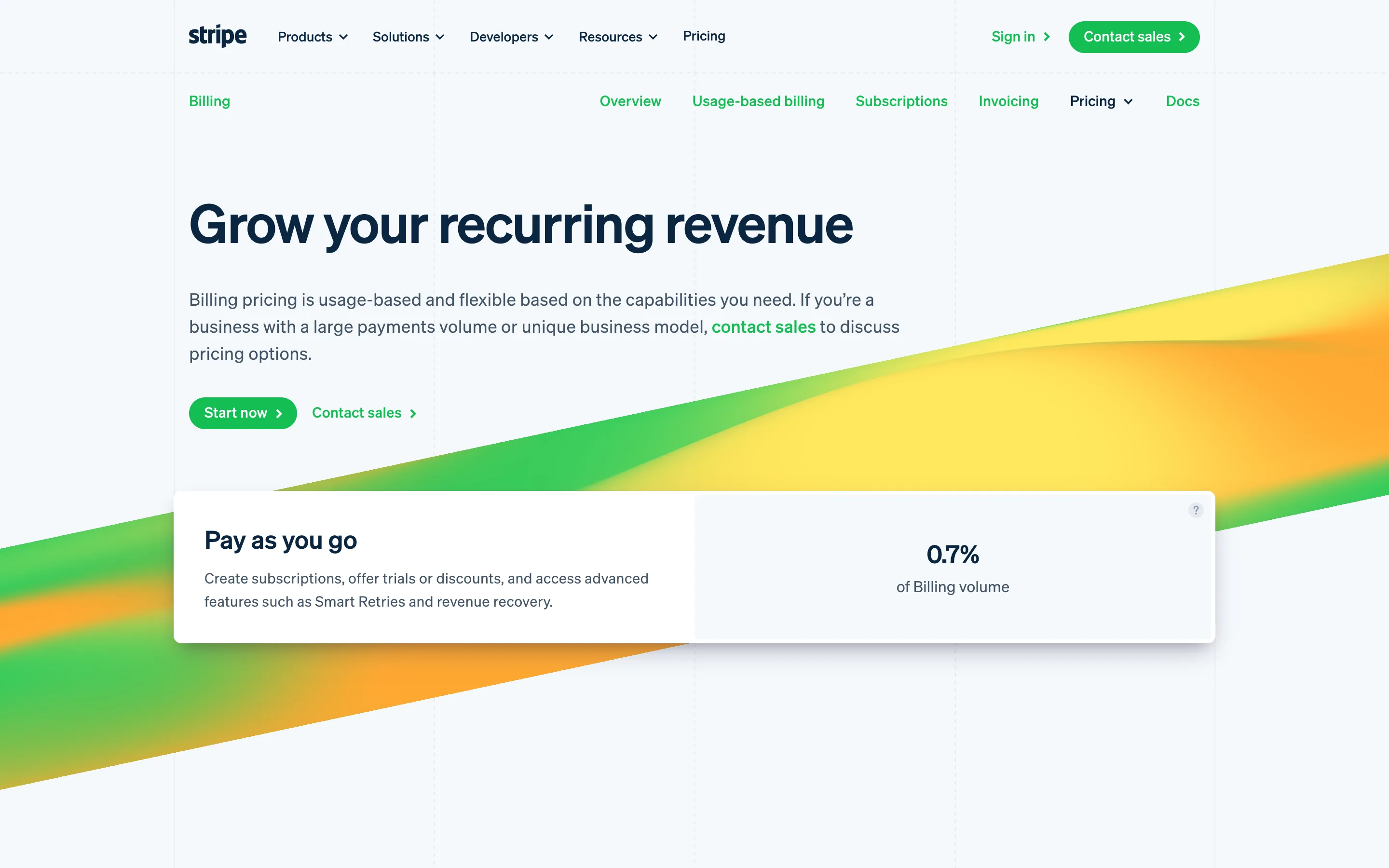
The published rate is 0.7 percent of billing volume, pay as you go, applied to transactions processed both on and off Stripe and excluding one-off invoices. Metering is bundled rather than sold separately: basic usage-based billing stays in Stripe's Meters API as part of Billing pricing, with up to 100 million events per month included.
It does not handle complicated contracts self-serve. The pricing page routes advanced usage-based billing, meaning multidimensional rates, negotiated contracts and marketplace transactions, to Metronome behind a Contact Metronome button. The 0.7 percent never stops scaling with revenue either.
Pricing: 0.7% of billing volume · up to 100M events/month included · advanced features quote-only, as of September 22, 2026.
Orb
Orb is the platform recommended most for genuinely complicated pricing, and since July 2026 it has been an Adyen company.
Orb models pricing that does not fit a rate card: hybrid plans, matrix rates, tiered pricing with minimums and commitments, recomputed when a contract changes mid-period. Its customers include Vercel, Replit, Supabase, Redis and LaunchDarkly. Ingestion carries idempotency guarantees and is stress-tested to volumes such as 250,000 events per second, which matters because deduplicating replayed events is where homegrown meters break.
There is no published price: Orb charges on billings and events plus a platform fee, and every call to action is Contact Sales. Adyen was candid that the incubator model preserves continuity now while the intent is convergence, so multi-PSP support is a first-phase promise.
Pricing: Quote only, billings plus events plus a platform fee, as of September 22, 2026.
Lago
Lago is the open-source platform most teams reach for when they want the metering engine without the revenue share.
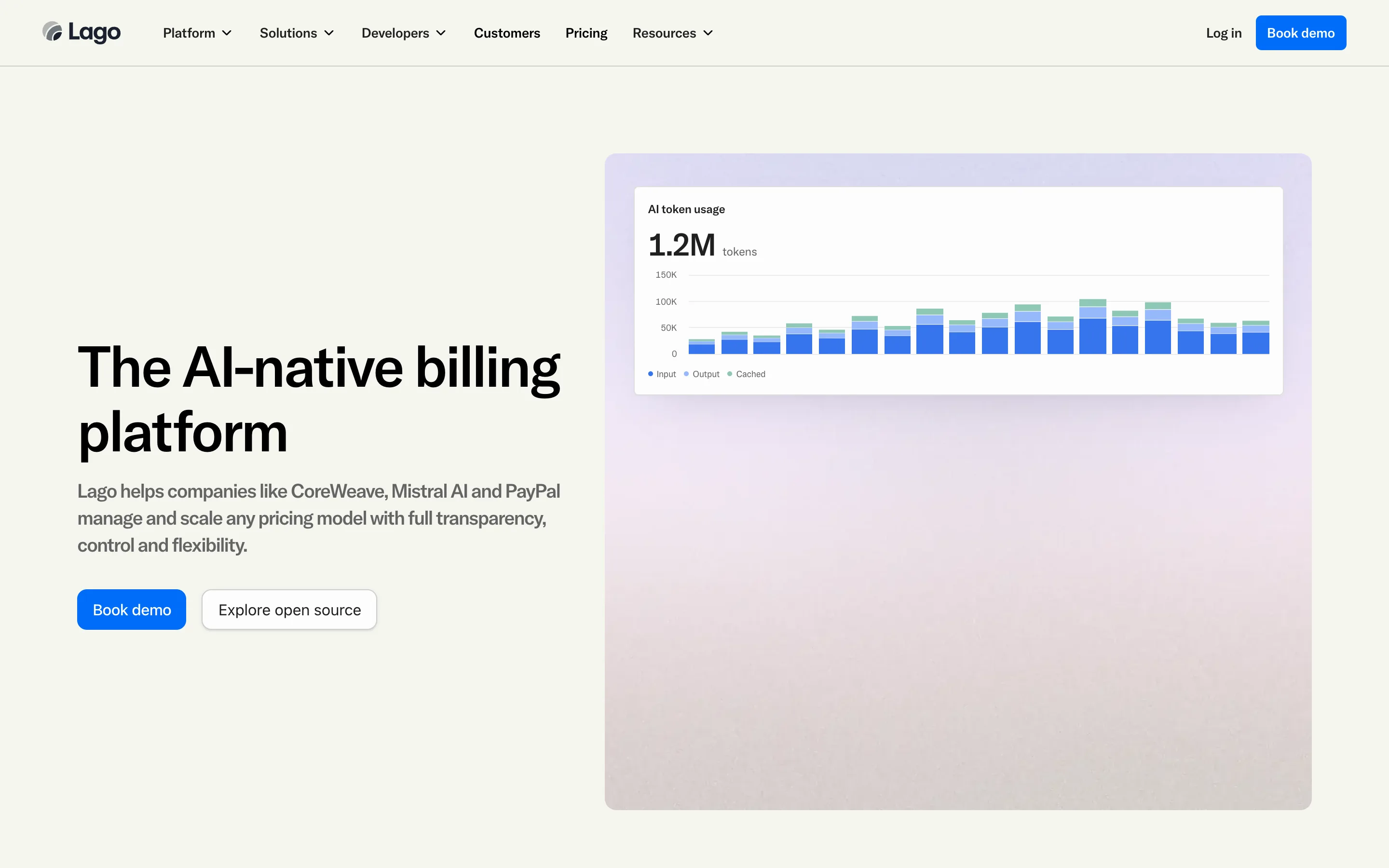
Lago is AGPL-3.0, sits at 10,593 GitHub stars, and shipped v1.53.0 on September 8, 2026, with commits landing the day this was written. It covers billable metrics, usage ingestion, per-customer plan overrides, prepaid credits, entitlements and a customer portal, and leans into AI billing: the homepage dashboard splits token usage by input, output and cached, and names CoreWeave, Mistral AI and PayPal as users.
Two caveats. Lago Premium, where prepaid credits, entitlements and the customer portal live, has no public price; that page is a feature grid ending in Contact us. And AGPL-3.0 is copyleft that some legal teams will not accept.
Pricing: Free self-hosted under AGPL-3.0 · Premium quote only · v1.53.0, September 8, 2026.
Flexprice
Flexprice is the rare open-source billing vendor that publishes cloud prices you can read.

Plans are priced on metering events rather than a cut of revenue, which is the structural difference that matters. Basic is free with 100,000 events per month, Build is $500 per month with 1 million, Scale is $1,000 per month with 5 million and up to $1.2 million in cumulative billing, and Mission Critical is custom. The code is AGPL-3.0 at 6,201 stars, with v2.1.31 released September 18, 2026.
Those ceilings are low for a token-metered product. Five million events a month puts a real AI workload into the custom tier quickly, and plans gate on cumulative rather than monthly billing, so a growing account crosses a threshold and stays across it.
Pricing: Free · Build $500/month · Scale $1,000/month · custom above that · AGPL-3.0, v2.1.31, September 18, 2026.
OpenMeter
OpenMeter is a metering layer rather than a full billing suite, and it is now a Kong product.
Kong announced the acquisition on September 3, 2025 and said OpenMeter would stay open source, which has held: the repository is Apache-2.0, sits at 2,331 stars and was pushed to on September 22, 2026. Apache-2.0 is the friendliest license here by a distance, and the scope is narrow and well chosen, aggregating high-volume usage events accurately enough to bill from.
The catch is the version number: the latest release is v1.0.0-beta.233, published September 18, 2026, so a project started in 2023 still has not cut a 1.0. OpenMeter Cloud is now Konnect Metering and Billing, so the managed path means adopting Kong Konnect.
Pricing: Free self-hosted under Apache-2.0 · managed via Kong Konnect · v1.0.0-beta.233, September 18, 2026.
Kill Bill
Kill Bill is the oldest option here and argues most directly against paying a percentage of revenue.
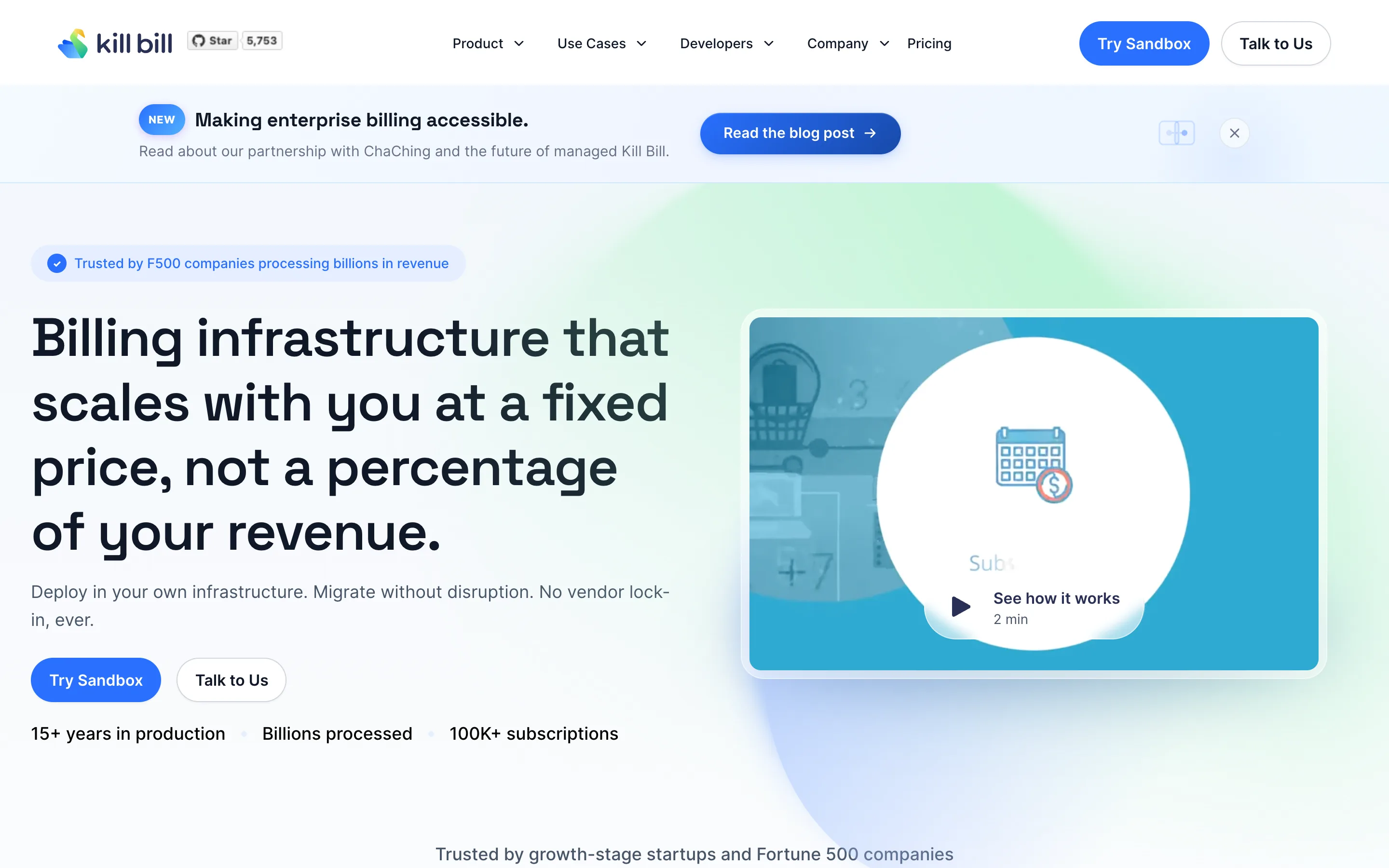
The headline is the thesis: billing infrastructure at a fixed price, in your own infrastructure, no lock-in. It is Apache-2.0 with 5,753 stars, its current release is killbill-0.24.21 from August 12, 2026, and it claims 15 years in production and more than 100,000 subscriptions. For strict data residency, or an auditor who wants the ledger in-house, that is hard to match.
It is also the heaviest lift. Kill Bill is a Java platform with a plugin architecture, its usage metering is less polished than a purpose-built meter, and the operational burden is yours unless you take the managed route via its ChaChing partnership.
Pricing: Free self-hosted under Apache-2.0 · managed via partner · killbill-0.24.21, August 12, 2026.
Side by Side
| Platform | Model | Entry price | Self-host | License |
|---|---|---|---|---|
| Stripe Billing | Percent of revenue | 0.7% of billing volume | No | Proprietary |
| Orb | Billings + events + platform fee | Quote only | No | Proprietary |
| Lago | Open core | $0 self-hosted | Yes | AGPL-3.0 |
| Flexprice | Per event | Free, then $500/mo | Yes | AGPL-3.0 |
| OpenMeter | Open core, Kong Konnect | $0 self-hosted | Yes | Apache-2.0 |
| Kill Bill | Fixed cost, self-run | $0 self-hosted | Yes | Apache-2.0 |
How to Choose Without Migrating Twice
- Run the script above on your own billing volume. Compare the 0.7 percent line against a self-hosted stack, including the engineer paged when aggregation lags. Under $200,000 a month, stop here and take the managed option.
- Count your events before reading any pricing page. Event volume, not revenue, breaks the published tiers. A product generating 40 million events a month is outside every self-serve plan here, which means a sales call regardless of vendor.
- Write down the one pricing model you cannot express. Expiring prepaid credits, committed spend with overage, per-seat plus per-token hybrids. Build that case in a trial account first, because it is what forces the migration you are avoiding.
- Check the license against legal review, not preference. Lago and Flexprice are AGPL-3.0; OpenMeter and Kill Bill are Apache-2.0. If AGPL is a blocker you have two open-source options, not four.
- Ask what happens after the incubator period. Adyen has said convergence with its payments stack is the intent for Orb. Get the multi-PSP commitment and exit terms in writing before migrating.
Which One Should You Actually Use?
Already on Stripe and under roughly $200,000 a month: Stripe Billing. The 0.7 percent is cheaper than the engineering time, the Meters API covers 100 million events a month, and you avoid a second system that has to agree with your processor about what a customer owes.
An AI product with complicated contracts and enterprise buyers: Orb, with the acquisition questions asked up front. Nothing else models commitments, matrix rates and mid-period changes as completely.
Growing fast and allergic to revenue-share pricing: Lago. The most complete open-source platform here, focused on AI billing, and self-hosting caps cost at infrastructure plus attention. Budget for the AGPL conversation.
You need metering, not invoicing: OpenMeter. Apache-2.0, narrow scope, high volume, composes with whatever issues your invoices. Accept that it is pre-1.0.
Regulated, data-resident, or done with vendors: Kill Bill. Apache-2.0, fixed cost, everything in your infrastructure, and more engineering than anything else here.
Conclusion
What changed in 2026 is ownership, not feature depth. Two payments companies and an API gateway company bought their way into metering inside ten months, and the independent middle of this market is now mostly open source. That is survivable, because Lago, Flexprice, OpenMeter and Kill Bill are all usable. It does change the renewal question: ask what billing costs at three times your revenue, and whether that number is a percentage that grows with you or a bill you control.
Related DevToolLab Tools
- Invoice Generator - draft and check an invoice layout before wiring a billing platform up to real customers.
- Margin Calculator - work out what a 0.7 percent revenue share and a variable model bill leave you per customer.
- UUID Generator - mint the idempotency keys that stop a replayed usage event from being billed twice.
- Webhook Receiver - inspect the invoice and usage-threshold webhooks a billing platform fires before writing a handler.
Related Guides
- Best Merchant of Record Platforms in 2026 covers the tax and legal-seller layer next to billing.
- Best LLM Gateways and API Routers in 2026 is where token spend gets measured before it reaches an invoice.
- Prompt Caching in 2026 attacks the cost side of the same margin problem.
- Best API Gateways in 2026 explains the quota enforcement usage pricing depends on.