

The moment a solo SaaS founder sells a subscription to a customer in Germany, they owe German VAT. Sell to Ontario and GST or HST applies. Cross a sales threshold in a growing list of US states and a registration is due there too, each with its own filing calendar and its own penalty for getting it wrong. None of that is optional, and almost none of it is something a two-person team has the time or legal footing to handle itself.
That is why a merchant of record exists, and why Stripe, which already processes card payments for a huge share of the internet, decided the safest way into this niche was to buy one of the incumbents first. Stripe acquired Lemon Squeezy on July 26, 2024, and in February 2026 shipped its own first-party product, Stripe Managed Payments, into public preview.
Why This Is Not Optional Anymore
A merchant of record is not a payment processor. It becomes the legal seller of record for a transaction, taking on the sales tax, VAT, and GST registration, collection, and remittance obligations in every jurisdiction it sells into, plus the paperwork and audit exposure that comes with them. A plain payment facilitator still owns every tax registration itself.
The pressure only grows. Effective January 1, 2026, Mauritius extended its 15 percent VAT to foreign digital providers with no revenue threshold, and Azerbaijan added a VAT registration requirement for foreign digital sellers the same day. Countries keep adding rules that assume a business is already handling this, not deciding whether to start.
What a $49 Sale Actually Nets You
Every one of these platforms publishes a headline "5% + 50 cents" rate, but the fine print differs enough to matter. Running the same two price points through each platform's own published formula:
--- $49 sale ---
Paddle                       fee $2.95  net $46.05  effective 6.0%
Lemon Squeezy                fee $2.95  net $46.05  effective 6.0%
Polar (Starter)               fee $2.95  net $46.05  effective 6.0%
Polar (Pro, $20/mo)           fee $2.26  net $46.74  effective 4.6%
Stripe Managed Payments       fee $3.44  net $45.56  effective 7.0%

--- $499 sale ---
Paddle                       fee $25.45  net $473.55  effective 5.1%
Lemon Squeezy                fee $25.45  net $473.55  effective 5.1%
Polar (Starter)               fee $25.45  net $473.55  effective 5.1%
Polar (Pro, $20/mo)           fee $19.36  net $479.64  effective 3.9%
Stripe Managed Payments       fee $32.24  net $466.76  effective 6.5%
Paddle and Lemon Squeezy land on the same all-in 5% + $0.50 rate, checked against each platform's own pricing page on September 12, 2026. Polar starts there too on its free Starter plan, but its $20 a month Pro tier drops to 3.8% + $0.40, paying for itself once a store clears roughly $180 a month in sales. Stripe Managed Payments differs: a 3.5% surcharge on top of Stripe's standard 2.9% + $0.30 card rate, coming out slightly higher at both price points.
Paddle
Paddle has run as a dedicated merchant of record for software and digital products since well before the category had a name, and its homepage still leads with that framing: "As the Merchant of Record for digital product businesses, Paddle manages payments, tax, compliance, and billing across 300+ markets."
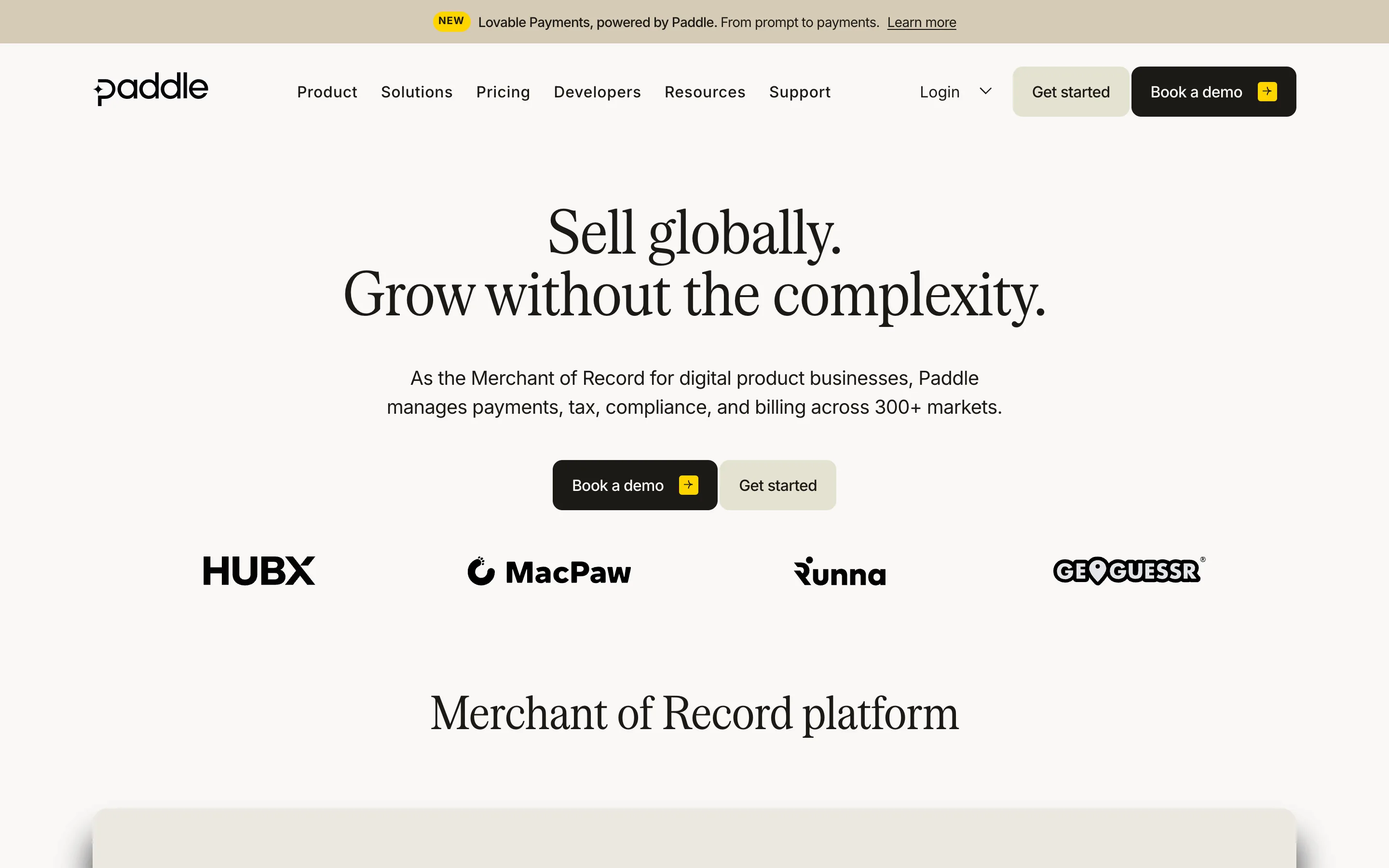
What it does well: the single fee is genuinely all-inclusive, covering checkout, billing, tax, fraud protection, and support with, per its own pricing page, no migration or monthly fees. That flat simplicity is the whole pitch.
What it does not do: there is no lower-cost tier for growing volume the way Polar offers, so a seven-figure business pays the same percentage as one doing a few hundred dollars a month, and selling under $10 a unit or needing invoicing requires talking to sales instead of self-serve.
Pricing: 5% + $0.50 per transaction, flat, no monthly fee, checked September 12, 2026.
Lemon Squeezy
Lemon Squeezy is the platform Stripe bought to get into this market, and two years after the July 2024 acquisition it still operates as its own product. Its 2026 update post frames the relationship directly: "When Stripe acquired Lemon Squeezy last year, we knew it was the start of something special... now, we're excited to share the first major milestone in that journey," referring to shared checkout localization work.

What it does well: the fee matches Paddle's with no monthly charge, and being Stripe-owned means it inherits Stripe's fraud tooling and payment coverage, plus PayPal subscriptions as a second rail.
What it does not do: its own FAQ admits fees "could exceed 5% + 50 cents" in edge cases, adding 0.5% to 1% for non-US currency handling, and 10% to 30% more for abandoned cart and failed payment recovery, so a store leaning on those features pays meaningfully more.
Pricing: 5% + $0.50 per transaction base rate, checked September 12, 2026.
Polar
Polar is the newest of the three digital-product-focused platforms and the only one with public, tiered pricing that gets cheaper as volume grows, laid out on its own fees documentation.

What it does well: four transparent tiers, free Starter at 5% + $0.50, up through Pro ($20/mo, 3.8% + $0.40), Growth ($100/mo, 3.6% + $0.35), to Scale ($400/mo, 3.4% + $0.30). Organizations created before May 27, 2026 keep a legacy 4% + $0.40 Early Member rate indefinitely, unless they upgrade to a paid plan.
What it does not do: international cards carry an extra 1.5% on every tier, disputes cost a flat $15 regardless of outcome, and upgrading out of the Early Member rate to chase a lower percentage gives it up for good, an easy trap for a team that upgrades before running the numbers.
Pricing: 5% + $0.50 (Starter) down to 3.4% + $0.30 (Scale, $400/mo), checked September 12, 2026.
Stripe Managed Payments
Stripe Managed Payments is Stripe's own answer to the category it entered by buying Lemon Squeezy, for businesses already on Stripe that want tax liability handled without moving platforms. It describes itself as a way to "sell globally without the complexity," covering tax collection across more than 80 countries.
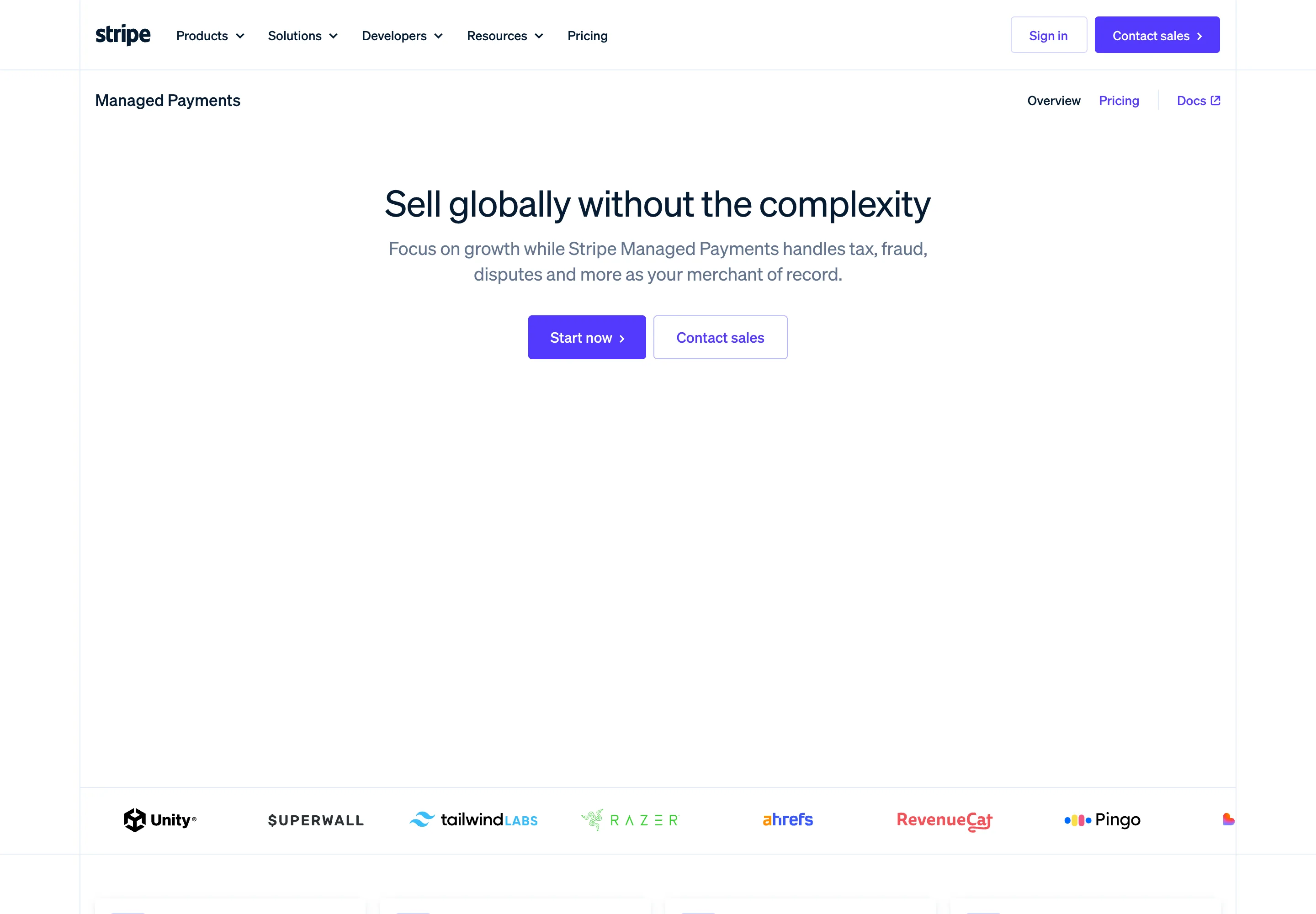
What it does well: it sits on top of an integration a team likely already has, no new checkout or API to learn, and Stripe cites a 38 percent average fraud reduction plus payouts up to four times faster than a typical cycle.
What it does not do: the 3.5% fee stacks on top of Stripe's standard rate instead of replacing it, why it came out most expensive above at both price points, and as a public preview product it has the least track record here.
Pricing: Stripe's standard processing rate (2.9% + $0.30 for US cards) plus a 3.5% merchant of record surcharge, checked September 12, 2026.
FastSpring
FastSpring is the oldest name here, running as a full merchant of record since before Paddle or Lemon Squeezy existed, and the one platform that will not quote a rate without a sales conversation.

What it does well: its pricing page states that "FastSpring's team will work with you to determine simple, flat-rate pricing based on transaction type and your volume of business," a negotiated rate covering B2B invoicing and interactive quotes alongside subscription and tax handling.
What it does not do: no self-serve rate, no free tier, no way to estimate cost before a sales call, ruling it out for a founder who wants a number first.
Pricing: Custom, negotiated by volume and transaction type; no public rate published, checked September 12, 2026.
Why There Is No Open Source Merchant of Record
Every other category on this site has a self-hosted answer. This one does not, and the reason is structural: being a merchant of record means being the legal seller registered to collect and remit tax in dozens of jurisdictions, a regulatory status a company earns and maintains, not software anyone can clone and run. Lago is a genuinely open source, MIT-licensed billing engine a team can self-host, but it stops at usage tracking and invoicing; the business running it never becomes the seller of record, so every tax filing still belongs to them. The honest DIY path is Stripe Billing paired with a dedicated tax tool like Stripe Tax or Anrok, doing the compliance work in-house instead of transferring it, which only makes sense once a team can justify hiring the tax expertise a merchant of record exists to replace.
Side by Side
| Platform | Base fee | Model | Notable |
|---|---|---|---|
| Paddle | 5% + $0.50 | Flat, all-inclusive | No tiers, no monthly fee |
| Lemon Squeezy | 5% + $0.50 | Flat, Stripe-owned | Recovery features add 10-30% |
| Polar | 5% + $0.50 to 3.4% + $0.30 | Tiered by monthly plan | Legacy 4% + $0.40 rate pre-May 2026 |
| Stripe Managed Payments | 2.9% + $0.30 plus 3.5% | Surcharge on Stripe processing | Public preview, Feb 2026 |
| FastSpring | Custom | Negotiated by volume | B2B invoicing, no self-serve rate |
How to Choose Without Migrating Twice
- Run your last three months of real sales through the table above, not a projected number. Ordering can flip between price points, so use your own average order value.
- Check whether you already process on Stripe. If most volume runs through Stripe, price Managed Payments against a true migration before assuming staying put is cheaper.
- Estimate your monthly volume against Polar's tier breakpoints. Pro pays for itself around $180 a month; below that, its Starter rate matches Paddle and Lemon Squeezy exactly.
- Ask each platform how it handles B2B and reverse-charge VAT. It varies more than the headline fee, and is where FastSpring's negotiated model earns its keep.
- Read the recovery and dispute fine print before signing: Lemon Squeezy's 10-30% surcharge on cart and payment recovery, Polar's flat $15 dispute fee. Either can turn a competitive headline rate into the most expensive option.
Which One Should You Actually Use?
Already all-in on Stripe: Stripe Managed Payments, even though it is not the cheapest option here, because it adds tax liability transfer to an integration you already built instead of a full migration.
Want one flat number and nothing to negotiate: Paddle or Lemon Squeezy, both 5% + $0.50 with no monthly fee. Pick Lemon Squeezy for its abandoned cart and PayPal tooling if you accept the extra fees those carry; pick Paddle for the flattest possible structure with no add-ons.
Growing past a few hundred dollars a month: Polar's Pro tier is the only one that gets cheaper as you grow without a sales call, and its breakeven is easy to calculate.
Selling mainly to other businesses: FastSpring is built for that motion, and its refusal to publish a rate reflects a genuinely different kind of deal.
No revenue yet: Paddle, Lemon Squeezy, or Polar's Starter tier ships a checkout in an afternoon at the same fee. Stop evaluating and pick whichever dashboard felt least annoying to sign up for.
Conclusion
The headline rate has converged hard on 5% + $0.50, so the real decision sits in the fine print: Polar's volume tiers, Lemon Squeezy's recovery surcharges, Stripe's surcharge-on-surcharge, and FastSpring's refusal to publish a number at all. Before signing anything, run your own last quarter of sales through the formula each platform actually publishes, not its homepage percentage.
Related DevToolLab Tools
- Sales Tax Calculator - check what a US state's sales tax adds before deciding if a merchant of record is worth its fee there.
- VAT Calculator - add or remove VAT instantly when quoting a European customer a number that matches what a merchant of record will collect.
- Invoice Generator - produce a compliant invoice for the B2B deals FastSpring is built around, without waiting on its dashboard.
- Currency Converter - convert a payout currency back to your own to sanity-check the net figures above.
Related Guides
- Best SOC 2 Compliance Automation Platforms in 2026 - the same buy-the-compliance logic, applied to security audits instead of tax.
- Best Secrets Management Tools in 2026 - another infrastructure decision every SaaS team outgrows its first DIY answer for.
- Best Email API Providers in 2026 - the other "money APIs" a small SaaS team rents instead of building.
- Best Serverless Postgres in 2026 - the same buy-versus-build tradeoff, one layer down at the database.