
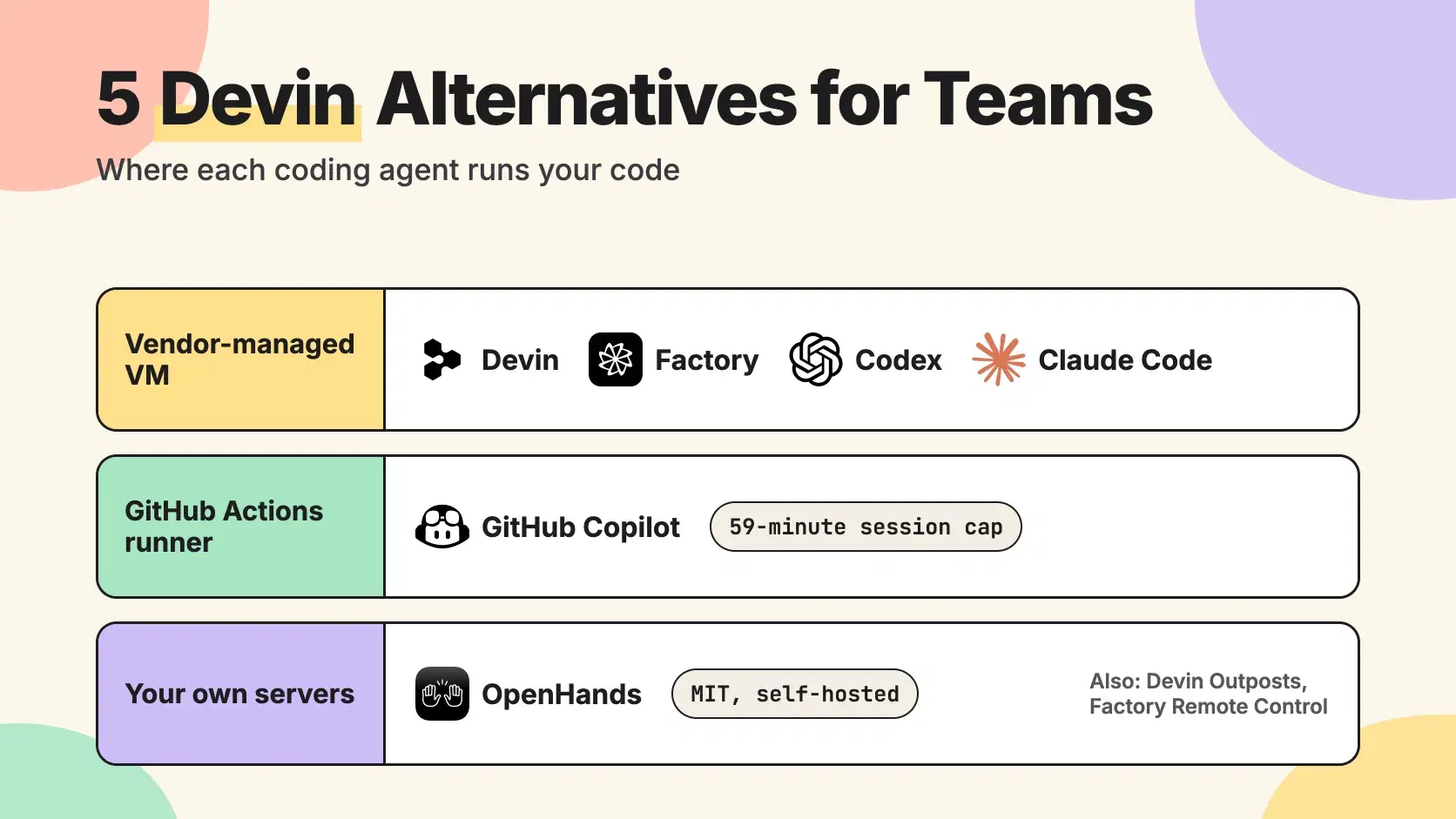
An agent that clones your repo into its own machine, runs the tests and opens a pull request is now table stakes. What bites later is whose machine holds your code and credentials, how long one task may run, and what happens when the allowance runs out.
On September 8, 2026, Cognition raised over $2 billion at a $48 billion valuation to scale Devin, and on September 15, Factory raised $200 million at a $5 billion valuation for its Droids. Yet in the 2026 Stack Overflow Developer Survey, only 360 of 12,255 respondents (2.9%) had used Devin in the past year. Most teams shopping for a Devin alternative already pay for a tool that can run a cloud agent.
Who Uses Devin, and What They Use Instead
The 2026 Stack Overflow Developer Survey, published October 6, 2026, asked which coding agents or assistants people had used in the past year, and 12,255 respondents answered. Claude Code led at 65.5%, GitHub Copilot followed at 58.7% and OpenAI Codex reached 29.5%. Devin sat at 2.9% and Google Jules at 2.5%.
Those shares count developers, not contracts: Cognition says its run-rate revenue grew from $492 million in May to almost $900 million by September.
Every entry is judged against one worked example: a five-engineer US SaaS team with a TypeScript monorepo on GitHub, delegating dependency upgrades and flaky-test fixes to a cloud agent that returns draft pull requests. Prices were checked on October 25, 2026.
Where the Agent's Machine Lives
Every agent here plans, edits code and runs commands; the difference is where those commands execute. Devin, Factory, Codex and Claude Code run commands on a VM the vendor manages by default, though Devin Outposts, Factory Remote Control and Claude Code's self-hosted environments can move execution onto your own machines. Copilot uses a GitHub Actions runner that can be your own, and OpenHands runs wherever you deploy it. That decides what the agent can reach: a vendor VM cannot see your private registry or staging database unless you hand it credentials, while a runner inside your network can.
Devin: Snapshot VMs, Plus Your Own Machines
Devin is Cognition's autonomous software engineer, and its docs set a useful bar: "if you can do it in three hours, Devin can most likely do it." Work arrives from Slack, Microsoft Teams, Linear, Jira or the web app, and pull requests go to GitHub, GitLab or Bitbucket.
Each session boots a fresh copy of a Linux VM snapshot with your repos cloned and dependencies installed. Outposts, available on Pro, Max and Teams, runs sessions on your own VMs, Kubernetes clusters or even a Mac Mini, which solves the private-registry problem in the worked example.
What it does not do: even on Outposts, "inference and planning" stay in Devin's cloud. Usage is a quota that refreshes daily and weekly, with extra usage at API pricing, so a heavy month is hard to forecast.
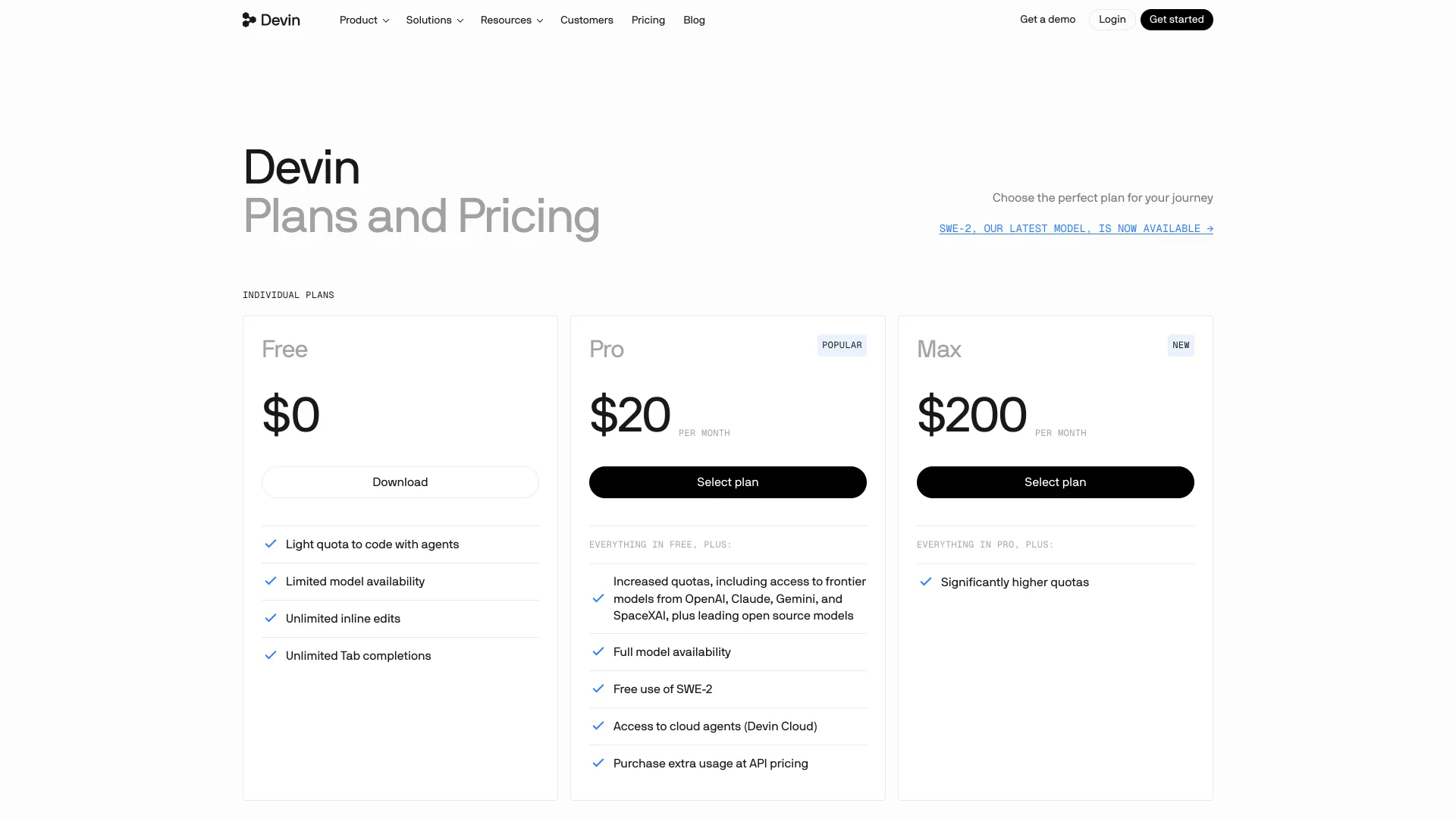
Pricing: Free · Pro $20/month with Devin Cloud · Max $200/month · Teams $80/month plus $40 per full seat, up to 200 users · Enterprise billed in Agent Compute Units.
Factory: Droids With Persistent Cloud Computers
Factory builds Droid, a coding agent that works the same way in its desktop app, the droid CLI, the web and mobile.
The difference from Devin is state. Droid Computers "retain state: installed packages, files, running services, and configuration all persist between sessions," so a dev database survives between tasks, and Remote Control attaches a server you already run. Droid runs GPT, Claude, Gemini and open-weight models, and past a rate limit you can switch free to Droid Core, its open-weight tier.
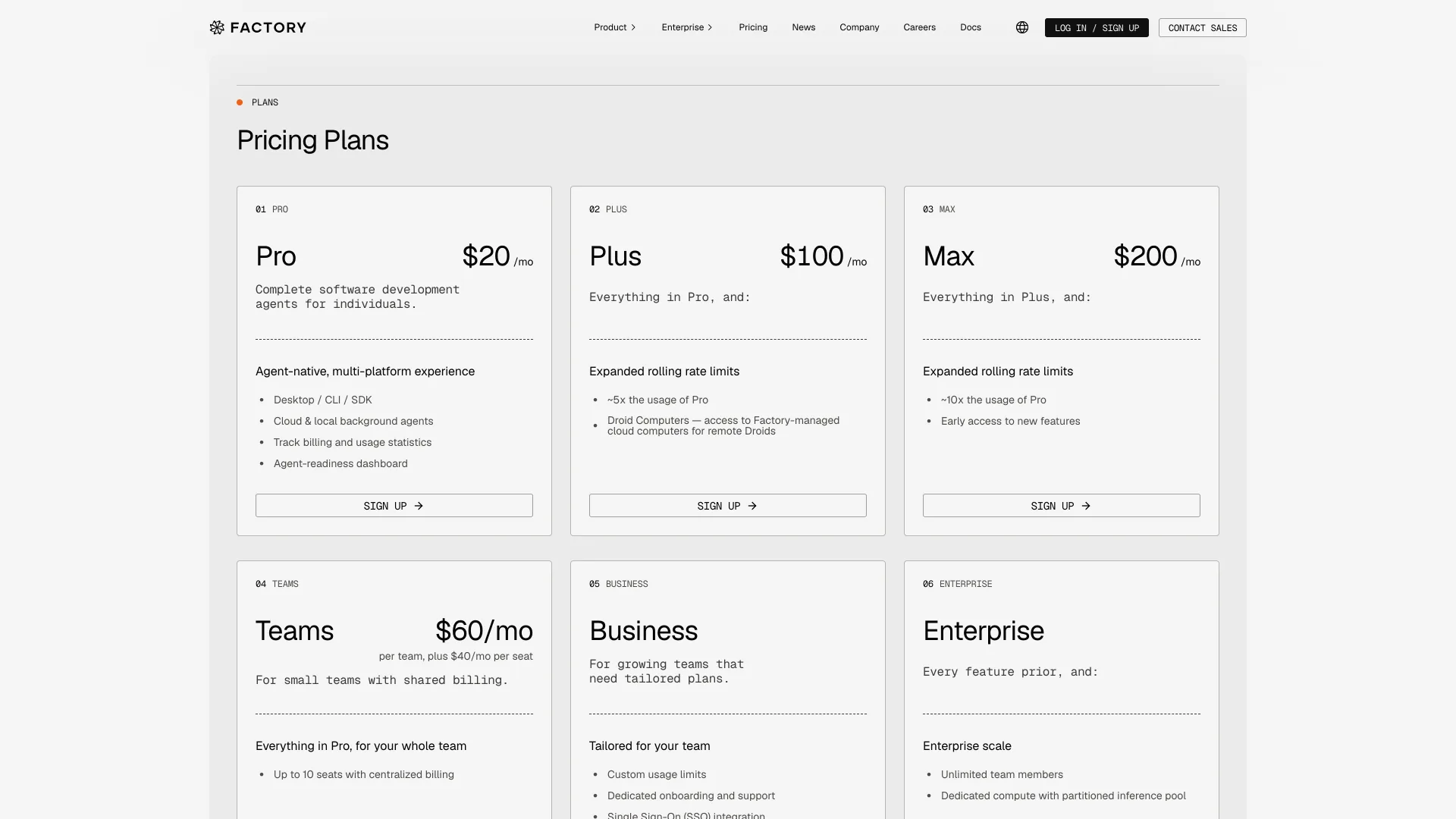
What it does not do: Teams covers "everything in Pro," while Droid Computers are listed from Plus up. Teams stops at 10 seats, SSO starts at Business, and on-premises or air-gapped deployment is an Enterprise option.
Pricing: Pro $20/month · Plus $100/month · Max $200/month · Teams $60/month plus $40 per seat, up to 10 seats · Business and Enterprise by quote.
OpenAI Codex: Cloud Tasks Inside ChatGPT Business
Codex is OpenAI's coding agent, included in ChatGPT plans from Free through Enterprise, and its cloud mode is the Devin-style agent a team may already own.
You pick GitHub repositories, Codex inspects them, installs dependencies and tests the workflow, and you review the setup and publish it as a cloud environment. Each task gets its own workspace "and can keep working while your computer is asleep," with internet access and network secrets set per environment. Business adds larger VMs and SAML SSO.
What it does not do: cloud tasks run OpenAI's models only (the local CLI can also run open-weight models), and signing in with an API key gives you the CLI, SDK and IDE extension but "no cloud-based features." OpenAI estimates 15 to 160 local GPT-6.1 Sol messages per five hours on a standard Business seat, and cloud tasks "may use more."
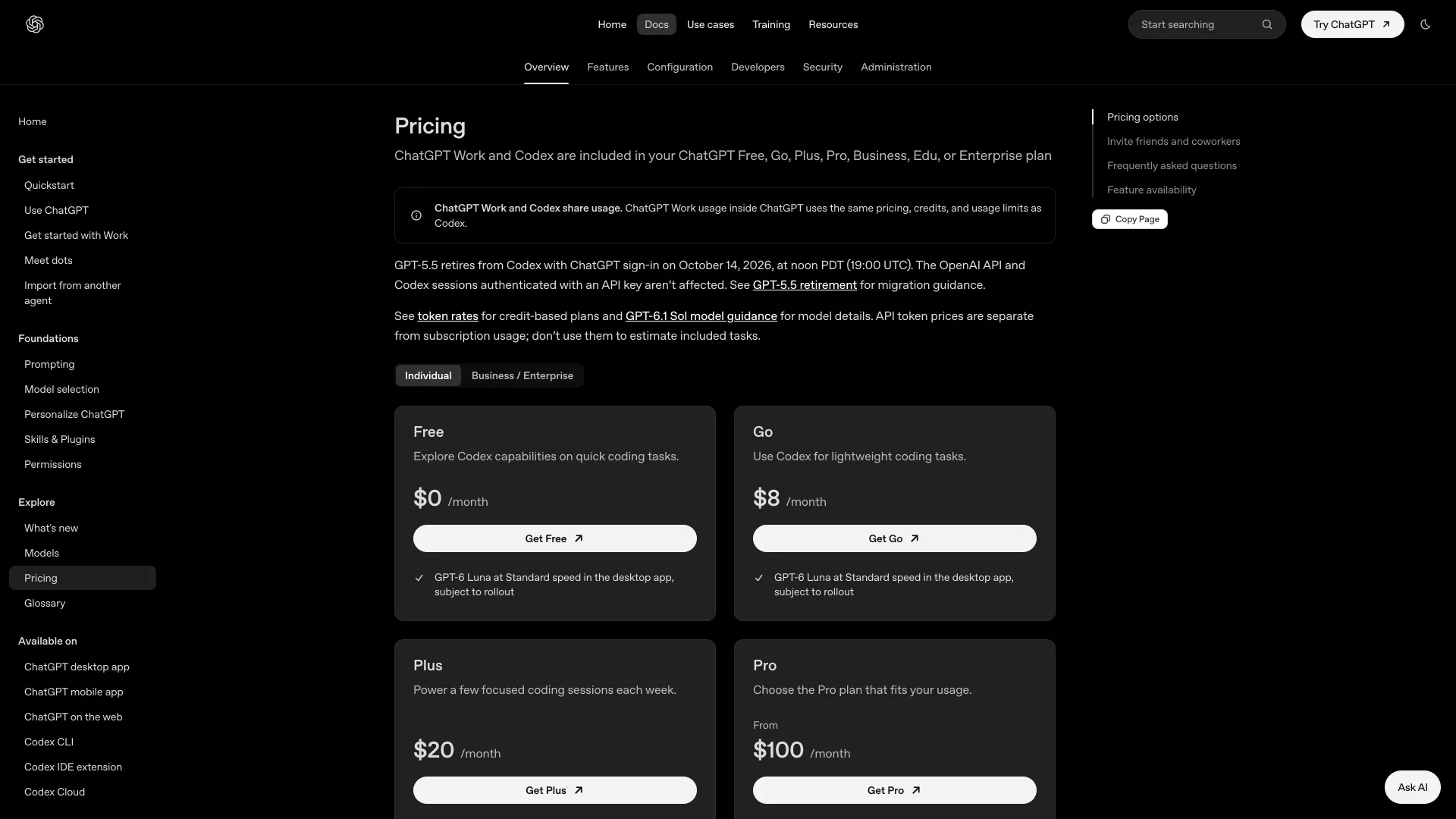
Pricing: Plus $20/month · Pro from $100/month · Business $25 per user monthly, or $20 billed annually, 2 users minimum · Enterprise by quote.
GitHub Copilot Cloud Agent: An Actions Runner With a Time Limit
GitHub Copilot has a cloud agent that researches the repo, plans and implements changes in the background, started from an issue, a pull request, Slack, Jira or Linear.
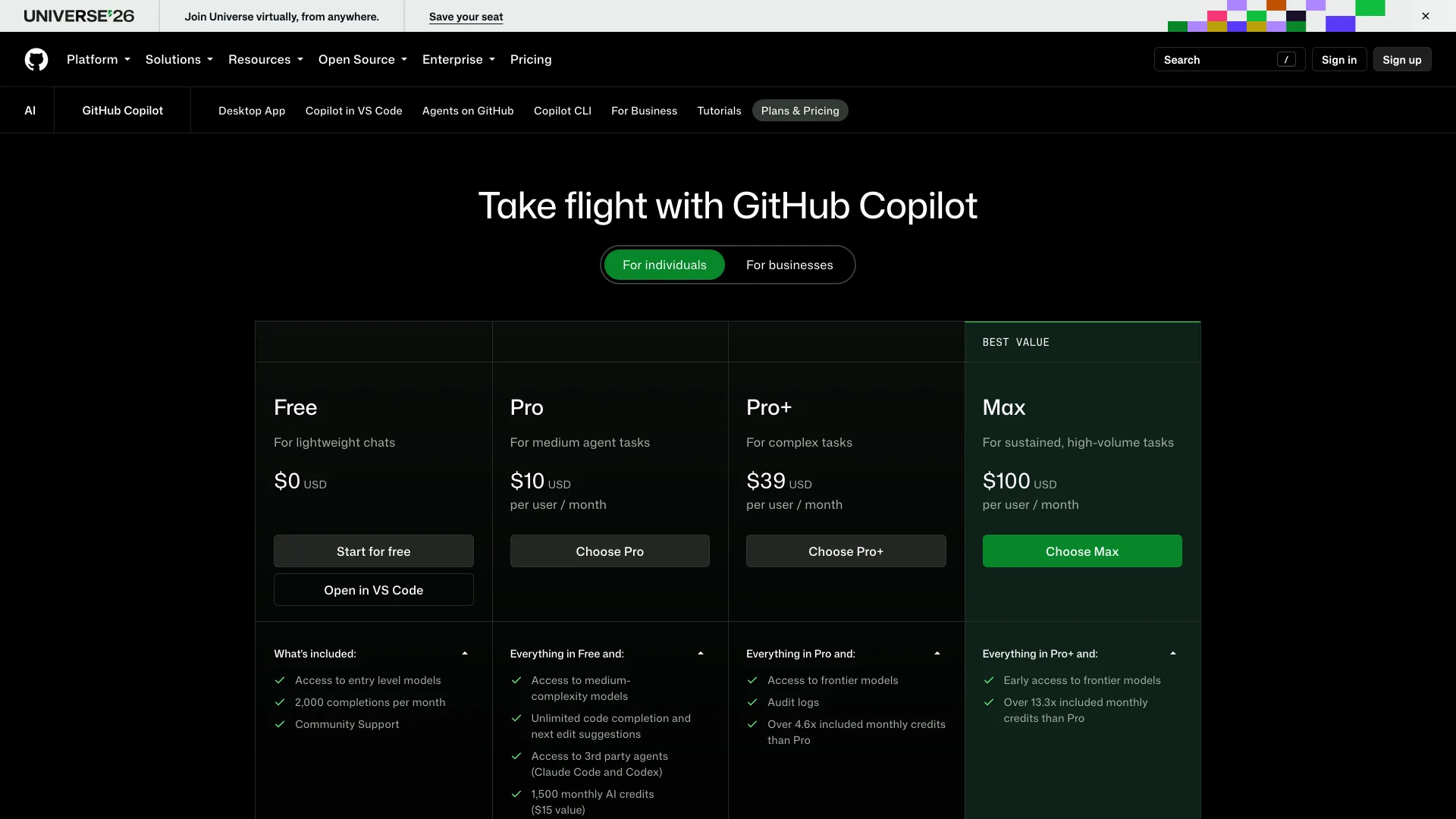
Its environment is an ephemeral machine "powered by GitHub Actions," and GitHub documents moving it to larger or self-hosted runners, so in the worked example the agent can run inside your network. By design it pushes to a single branch, a new copilot/ branch unless it was asked to work on an existing pull request, and branch protections and required checks still apply.
What it does not do: "Each Copilot cloud agent session has a maximum execution time of 59 minutes. This limit cannot be extended or bypassed." It also only works on GitHub-hosted repositories.
Pricing: Pro $10/month · Pro+ $39 · Business $19 per seat with 1,900 AI credits per user, pooled across the organization · Enterprise $39 per seat · extra usage $0.01 per credit.
Claude Code Cloud Sessions: No VM Charge, GitHub Only
Claude Code is Anthropic's coding agent, and its cloud sessions run on infrastructure Anthropic manages or on your organization's self-hosted environment, a public beta on Team and Enterprise plans that is off by default.
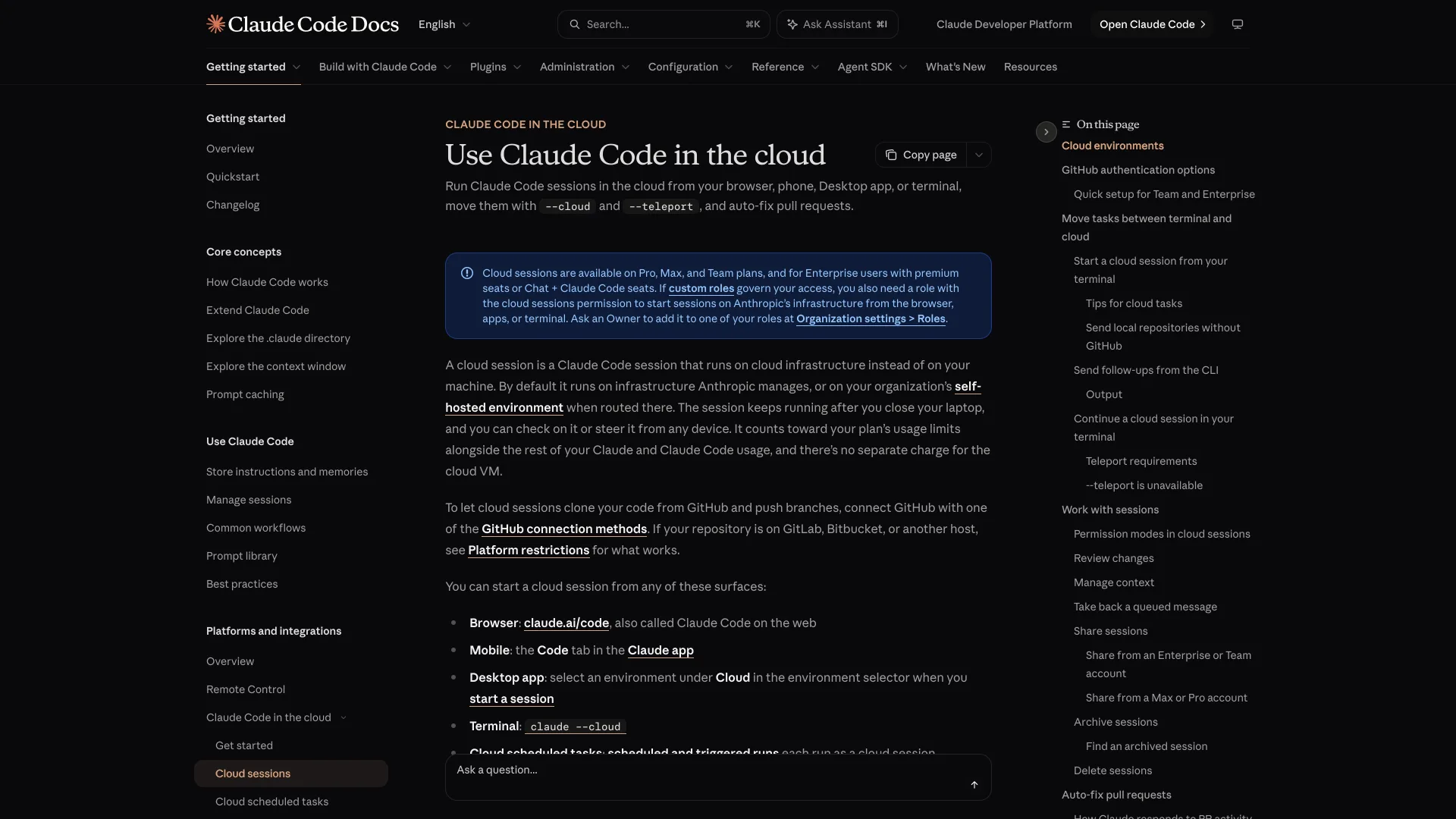
A session keeps running after you close your laptop; start one from claude.ai/code, the apps or claude --cloud, and pull it into your terminal with --teleport. It counts against your plan's usage, and "there's no separate charge for the cloud VM."
What it does not do: "repository cloning and pull request creation require GitHub"; a GitLab or Bitbucket repo can go in as a bundle, but the session cannot push back. Models are Anthropic's only.
Pricing: Pro $20/month · Team standard seat $25 monthly or $20 annual · Team premium seat $125 monthly or $100 annual, with 5x the usage · Enterprise $20/seat billed annually, 20-seat minimum, plus API-rate usage.
OpenHands: The MIT Agent You Host Yourself
OpenHands is the open-source entry: MIT licensed, about 91,800 GitHub stars as of October 25, 2026, and v1.33.0 released October 23, 2026. Agent Canvas is its browser control center, backed by an Agent Server that runs the agent locally, in Docker or on a VM.
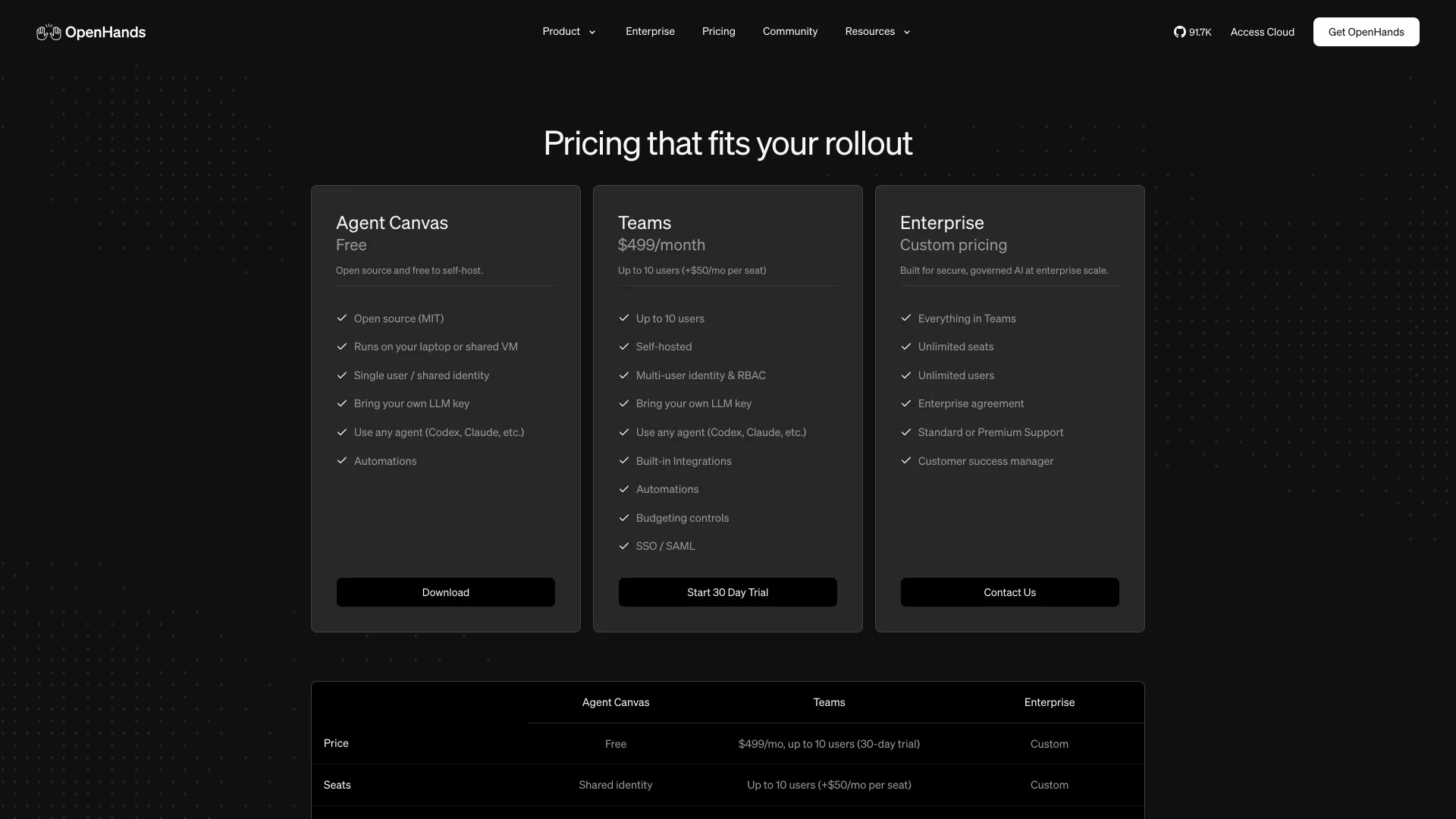
You bring your own model key and can run "any agent (Codex, Claude, etc.)," so the stack is tied to no model vendor. It is the only option here you can self-host for free, session logs included.
What it does not do: you run the sandbox infrastructure, and model spend is a separate bill. The free tier is single user with a shared identity; RBAC and SSO need Teams, which is capped at 5,000 sessions a month.
Pricing: Agent Canvas free (MIT) · Teams $499/month for up to 10 users, self-hosted, 30-day trial · Enterprise custom. OpenHands Cloud is a separate managed service.
Side by Side
| Agent | Where commands run | Hard limit worth knowing | Models | Team plan, 5 seats |
|---|---|---|---|---|
| Devin | Cognition VM snapshot, or your machines via Outposts | Inference stays in Cognition's cloud | Multi-vendor plus SWE-2 | $280/month |
| Factory | Persistent Droid Computers (Plus and up), or your server via Remote Control | Teams caps at 10 seats | Multi-vendor plus open-weight | $260/month |
| OpenAI Codex | OpenAI cloud workspace per task | No cloud tasks with an API key | OpenAI only in the cloud | $125/month |
| GitHub Copilot | GitHub Actions runner, hosted or self-hosted | 59-minute session cap | Multi-vendor | $95/month |
| Claude Code | Anthropic cloud, or your self-hosted environment (beta) | GitHub required to push | Anthropic only | $125/month |
| OpenHands | Your laptop, VM or cluster | You run the sandboxes | Any, bring your own key | Free, or $499 to $749/month |
What Five Engineers Pay Before Overage
Seat prices are the only part of an agent bill every vendor publishes. This script prices each team plan, billed monthly:
js// team-cost.mjs - list prices checked October 25, 2026, overage excluded const plans = [ { name: "GitHub Copilot Business", base: 0, seat: 19 }, { name: "ChatGPT Business (Codex)", base: 0, seat: 25 }, { name: "Claude Team, standard seats", base: 0, seat: 25 }, { name: "Factory Teams", base: 60, seat: 40, maxSeats: 10 }, { name: "Devin Teams", base: 80, seat: 40, maxSeats: 200 }, // "Up to 10 users (+$50/mo per seat)": the page does not say whether the // $50 applies inside the 10, so print both readings. { name: "OpenHands Teams (self-hosted)", base: 499, seat: 0, maxSeats: 10, altSeat: 50 }, ]; const engineers = Number(process.argv[2] ?? 5); for (const p of plans) { if (p.maxSeats && engineers > p.maxSeats) { console.log(`${p.name.padEnd(31)} over the ${p.maxSeats}-seat cap`); continue; } const total = p.base + p.seat * engineers; const high = p.altSeat ? ` to $${p.base + p.altSeat * engineers}` : ""; console.log(`${p.name.padEnd(31)} $${total}${high} per month, $${(total / engineers).toFixed(2)} per engineer`); }
text$ node team-cost.mjs 5 GitHub Copilot Business $95 per month, $19.00 per engineer ChatGPT Business (Codex) $125 per month, $25.00 per engineer Claude Team, standard seats $125 per month, $25.00 per engineer Factory Teams $260 per month, $52.00 per engineer Devin Teams $280 per month, $56.00 per engineer OpenHands Teams (self-hosted) $499 to $749 per month, $99.80 per engineer
What it cannot price is the month the allowance runs out: Copilot bills $0.01 per credit, Devin bills extra usage at API rates, Factory lets you switch to Droid Core for free or buy Extra Usage to stay on standard models, and OpenHands leaves model spend on your provider's invoice.
How to Choose Without Migrating Twice
- List what the agent must reach. If tasks need a private registry, a staging database or an internal API, favor Copilot on self-hosted runners, Devin Outposts, Factory Remote Control, a Claude Code self-hosted environment or OpenHands.
- Time your longest real ticket. If a dependency upgrade with tests runs past an hour, Copilot's 59-minute cap will cut it off; check every other vendor's session limit during the pilot.
- Check what you already pay for. Copilot Business, ChatGPT Business and Claude Team all include a cloud agent (on Copilot Business an organization owner has to enable it first), so run a week of tickets on those seats first.
- Pilot two agents on the same five tickets and compare merged pull requests, not demos.
- Read the overage line before signing. Ask what one heavy week costs past the allowance, in dollars.
For a codebase-wide migration, Blitzy, which raised $200 million at a $1.4 billion valuation on May 5, 2026, sells days-long runs of thousands of parallel agents to enterprises. Its site blocked our checks, so it is not priced here.
Which One Should You Actually Use?
Already on GitHub Copilot Business: start with the cloud agent on a self-hosted runner, on seats you already pay for.
Already paying for Claude or ChatGPT: use Claude Code cloud sessions or Codex Cloud on the seats you have.
Long-running work that needs a stateful dev environment: Factory with Droid Computers, which keep services and data between sessions.
Enterprise backlog, many integrations, one vendor to call: Devin Teams or Enterprise, with Outposts so commands run next to your private services.
Code and logs cannot leave your VPC: OpenHands with a model endpoint you already approved, or Factory Enterprise on-premises.
Conclusion
The money is flowing to Cognition and Factory, but most developers use an agent bundled into a tool they already pay for. Run one week of real tickets on your Copilot, Claude or ChatGPT seats, and buy a dedicated platform only for what those seats cannot reach.
Related DevToolLab Tools
- AGENTS.md Generator - write the instructions file an agent reads before its first task.
- CODEOWNERS Tester - check which reviewers an agent's pull request will request.
- Secret Scanner - find committed keys before you clone the repo into a vendor-managed VM.
- Git Conflict Resolver - untangle conflicts when several agent pull requests touch the same files.
Related Guides
- Best Background Coding Agents compares Devin, Codex Cloud and Jules on entry prices and free tiers.
- Cursor Alternatives compares Cursor's rivals, including Devin Desktop, the former Windsurf.
- Best AI Code Execution Sandboxes explains why agent-written code needs a microVM sandbox.
- Open Source Claude Code Alternatives lists OpenHands' terminal-first neighbors and their licenses.