
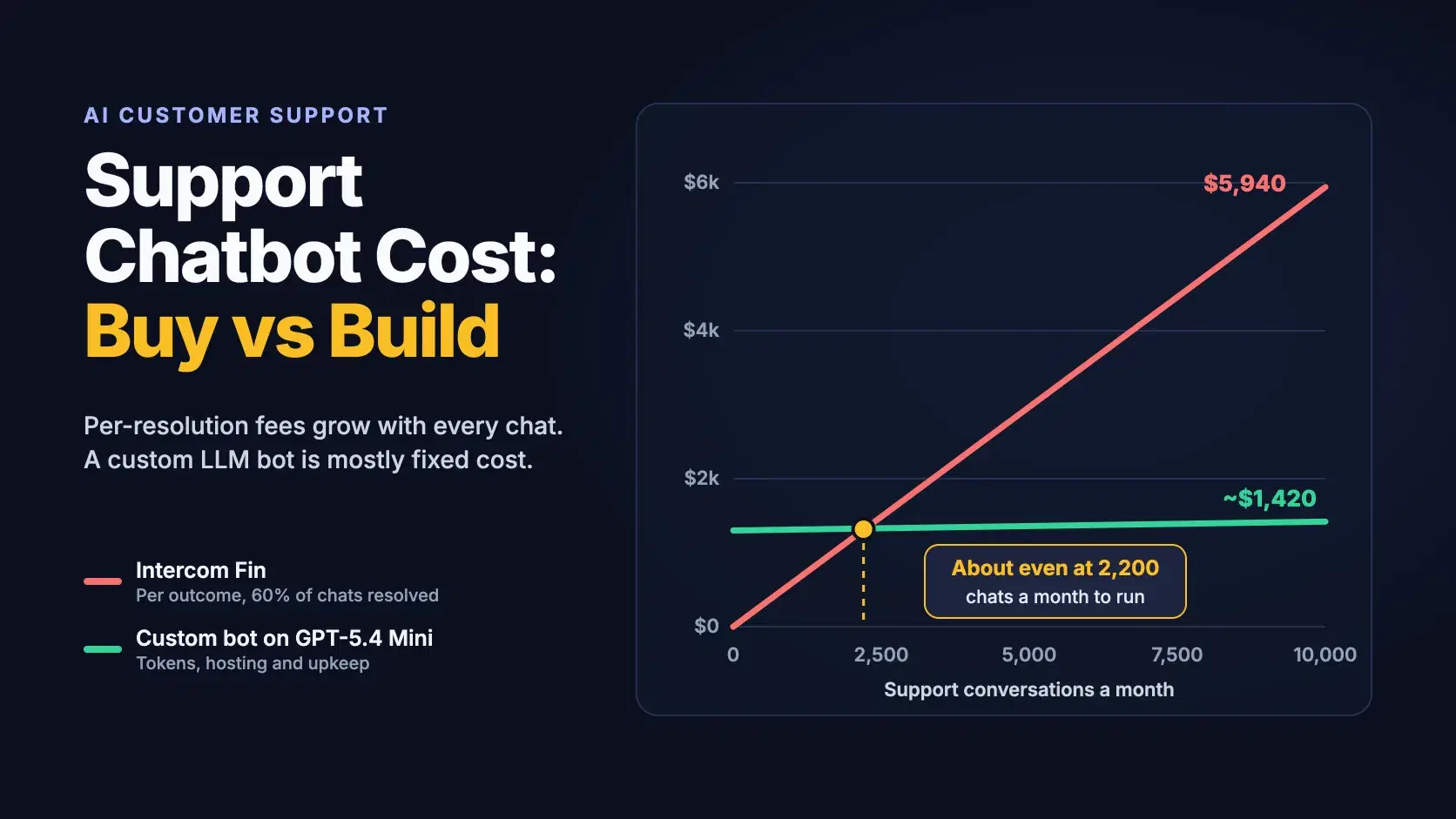
A support team handling 10,000 chats a month can pay about $5,900 a month for an off-the-shelf AI agent, or about $1,400 a month to run one it built itself. The custom route also carries a one-time build cost.
Off-the-shelf support bots now charge per resolved conversation. A custom bot built on an LLM API charges per token, which is a much smaller unit. Which one costs less depends almost entirely on volume.
This guide prices both routes against one job: 10,000 support conversations a month, with 60% resolved by AI and the rest handed to a human. Vendor prices were checked against published pricing pages and recent pricing guides in October 2026.
How Support Chatbots Are Priced
The two routes bill on different units, so the first step is converting both to a monthly figure.
- Per resolution: you pay each time the bot closes a conversation without a human. Intercom Fin and Zendesk AI agents both use this model.
- Per seat: a monthly fee for each human agent on the helpdesk, charged on top of resolutions.
- Per token: a custom bot pays the LLM provider for text in and text out. One support conversation is usually a few thousand tokens, which costs a fraction of a cent on a small model.
Per-resolution pricing is simple to start with, but the bill grows in a straight line with volume. Token pricing stays cheap per conversation, but you also pay for hosting, retrieval and maintenance.
Off-the-Shelf Option 1: Intercom Fin
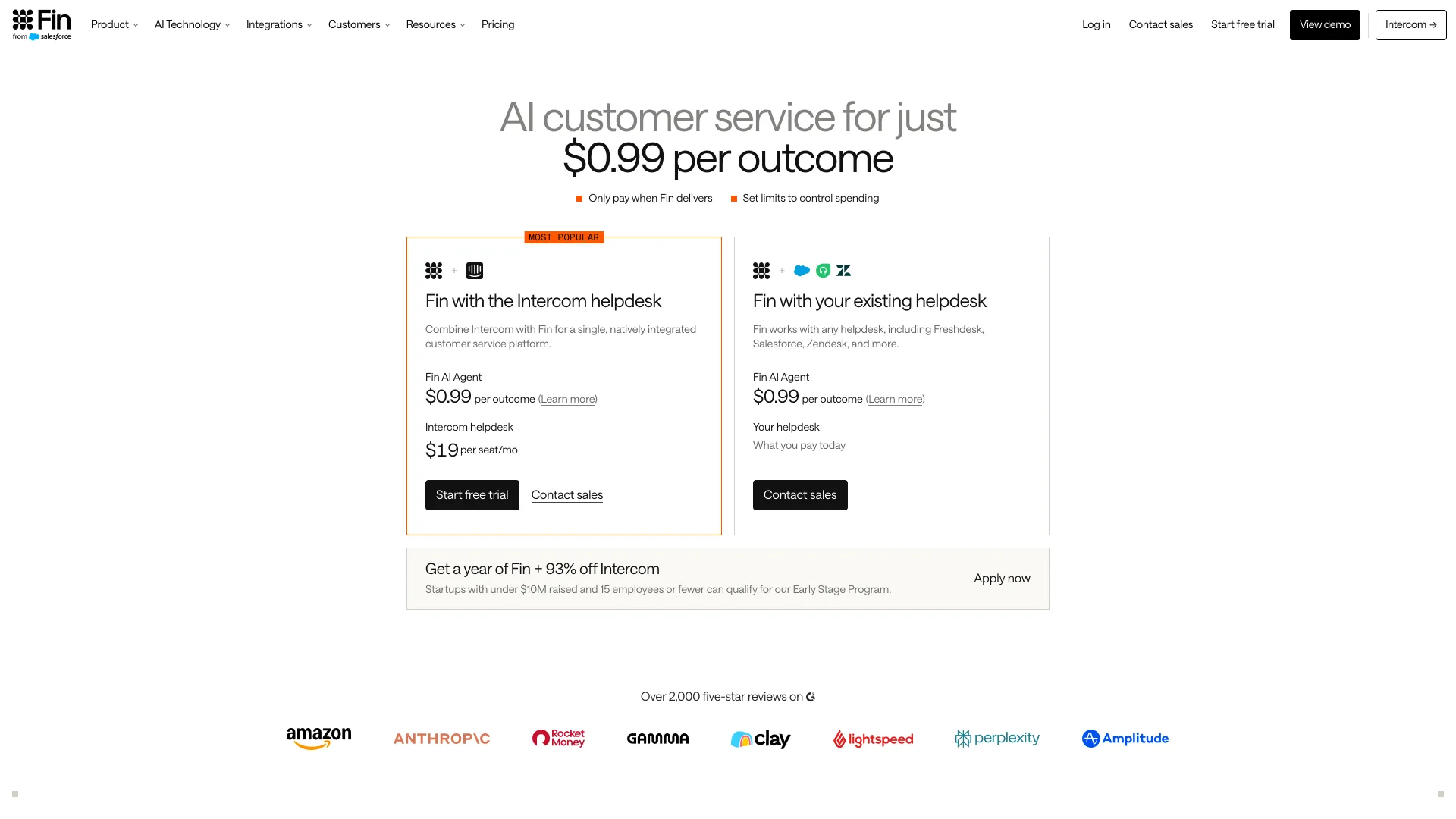
Fin charges $0.99 per outcome: a conversation it resolves or a workflow it completes, billed at most once per conversation. That sits on top of Intercom seats at $29, $85 or $132 per seat a month on annual billing. Fin can also run on another helpdesk at the same $0.99 per outcome, with no Intercom seats.
At 6,000 resolutions a month, Fin alone costs $5,940 a month, before seats.
Off-the-Shelf Option 2: Zendesk AI Agents
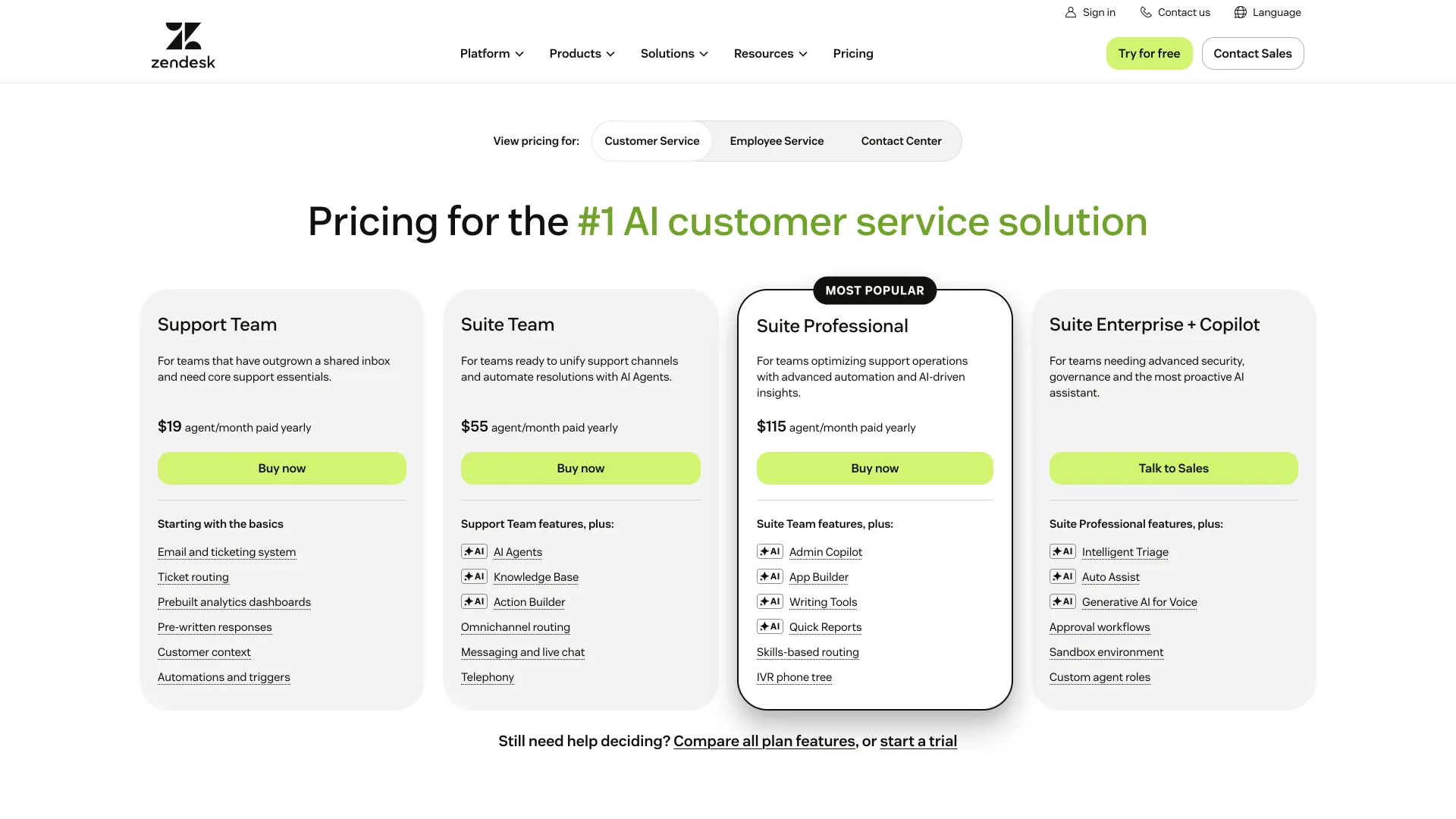
Zendesk includes AI agents in every Suite and Support plan and bills them per automated resolution, after a small allowance of 5 to 15 resolutions per agent a month. Zendesk does not publish the per-resolution rate. Third-party analyses report about $1.50 on committed volume and $2.00 pay-as-you-go.
At 6,000 resolutions and the reported $1.50 rate, the meter comes to about $9,000 a month, plus Suite seats. Treat this as an estimate and get the rate in writing.
What You Get Without Building Anything
Both products ship a working bot in days, with a help-center connection, human handoff and reporting. You do not manage prompts, models or infrastructure. The trade-off is limited control over how answers are generated and a bill tied to every resolution.
The Custom Route: What a Self-Built Bot Costs to Run
A custom support bot is usually a retrieval-augmented setup: help-center content is embedded into a vector database, and an LLM answers from the retrieved passages. Teams without in-house LLM experience often hand the build to a partner offering AI chatbot development services, then run it themselves. Running costs come from four places.
1. Model Tokens
GPT-5.4 Mini lists $0.75 per million input tokens and $4.50 per million output tokens on OpenAI's API pricing page. Assume four model calls per conversation, each with 1,500 input tokens (instructions, history, retrieved text) and 400 output tokens.
| Item | Calculation | Monthly cost |
|---|---|---|
| Model calls | 10,000 conversations × 4 calls | 40,000 calls |
| Input tokens | 40,000 × 1,500 = 60M tokens × $0.75 per 1M | $45 |
| Output tokens | 40,000 × 400 = 16M tokens × $4.50 per 1M | $72 |
| Total model tokens | $117 |
That is about $0.012 per conversation. Claude Haiku 4.5, at $1 input and $5 output per million tokens, lands in the same range.
2. Embeddings
text-embedding-3-small costs $0.02 per million tokens, so embedding user queries adds well under $1 a month at this volume.
3. Hosting and Vector Database
This varies by stack. Budget about $300 a month for an API server, a managed vector database and logging (an assumption, not a quoted price).
4. Maintenance
Someone has to update prompts, re-index content, review failed answers and plan a fallback for provider outages (DevToolLab's 90-day LLM API outage data). Budget about 20 hours a month, roughly $1,000 at $50 an hour (also an assumption).
Running total: about $1,420 a month. The one-time build sits on top. A production-ready support bot with handoff, analytics and guardrails is commonly a multi-week project; this example assumes $40,000.
Side by Side at 10,000 Conversations a Month
At this volume, the custom build costs about $4,500 a month less to run than Fin, so a $40,000 build pays back in about 9 months.
| Route | Billing unit | AI cost per month | Upfront | Payback vs Fin |
|---|---|---|---|---|
| Intercom Fin | $0.99 per outcome | $5,940 + seats | None | n/a |
| Zendesk AI agents | ~$1.50 per resolution (reported) | ~$9,000 + seats | None | n/a |
| Custom bot on GPT-5.4 Mini | Tokens + hosting + upkeep | ~$1,420 | ~$40,000 (assumed) | ~9 months |
The picture flips at low volume, because the custom bot carries about $1,300 a month in fixed hosting and upkeep.
| Conversations a month | Fin cost (60% resolved) | Custom bot running cost | Cheaper to run |
|---|---|---|---|
| 1,000 | $594 | ~$1,310 | Fin |
| 2,200 | ~$1,307 | ~$1,326 | About even |
| 8,000 | $4,752 | ~$1,394 | Custom; recovers a $40,000 build in about 12 months |
| 10,000 | $5,940 | ~$1,420 | Custom; recovers a $40,000 build in about 9 months |
When a Custom Build Pays Off
Volume decides most of it, but four other signals push teams toward building.
- High, steady volume. Above several thousand conversations a month, per-resolution fees outgrow token costs quickly.
- Actions, not just answers. Refunds, order changes and account updates need deep access to internal systems. Custom code can call those APIs directly with your own permission checks, or hand them to a workflow tool such as n8n.
- Data control. Regulated teams may need to choose the model provider, the region or a self-hosted model. Packaged bots decide this for you.
- One bot across channels. A custom backend can serve chat, email and in-app help from the same retrieval index and logs.
Stay with an off-the-shelf bot when volume is low or unpredictable, when no one can own maintenance, or when you need a bot live this month. Many teams start packaged, measure their real resolution rate, and build only once the monthly bill justifies it.
Conclusion
Per-resolution bots tend to suit teams that need speed or have low volume, while custom LLM bots can cost less once volume is high and steady. Price your own month first: conversations, realistic resolution rate and the per-resolution fee, then compare it with token costs plus hosting and upkeep.
Related DevToolLab Tools
- LLM Token Cost Calculator - rerun the token math above with your own conversation volume, call count and model.
- AI Token Counter - paste a real support transcript and system prompt to replace the 1,500-token assumption with a measured number.
- Prompt Caching Calculator - see how much caching the instructions repeated on every call would cut from the input token bill.
- Uptime SLA Calculator - turn the uptime you promise customers into allowed downtime, then size the provider fallback to match.
Related Guides
- LLM API Outages in 2026: 90 Days of Data - how often each provider went down, the input for the fallback a custom bot needs
- Best RAG Platforms and Tools - the frameworks and managed services behind the retrieval half of a custom support bot
- Claude Prompt Caching Pricing - cache writes, reads and the break-even point for long system prompts
- Best LLM Observability Tools - trace failed answers and track token spend once the bot is live