
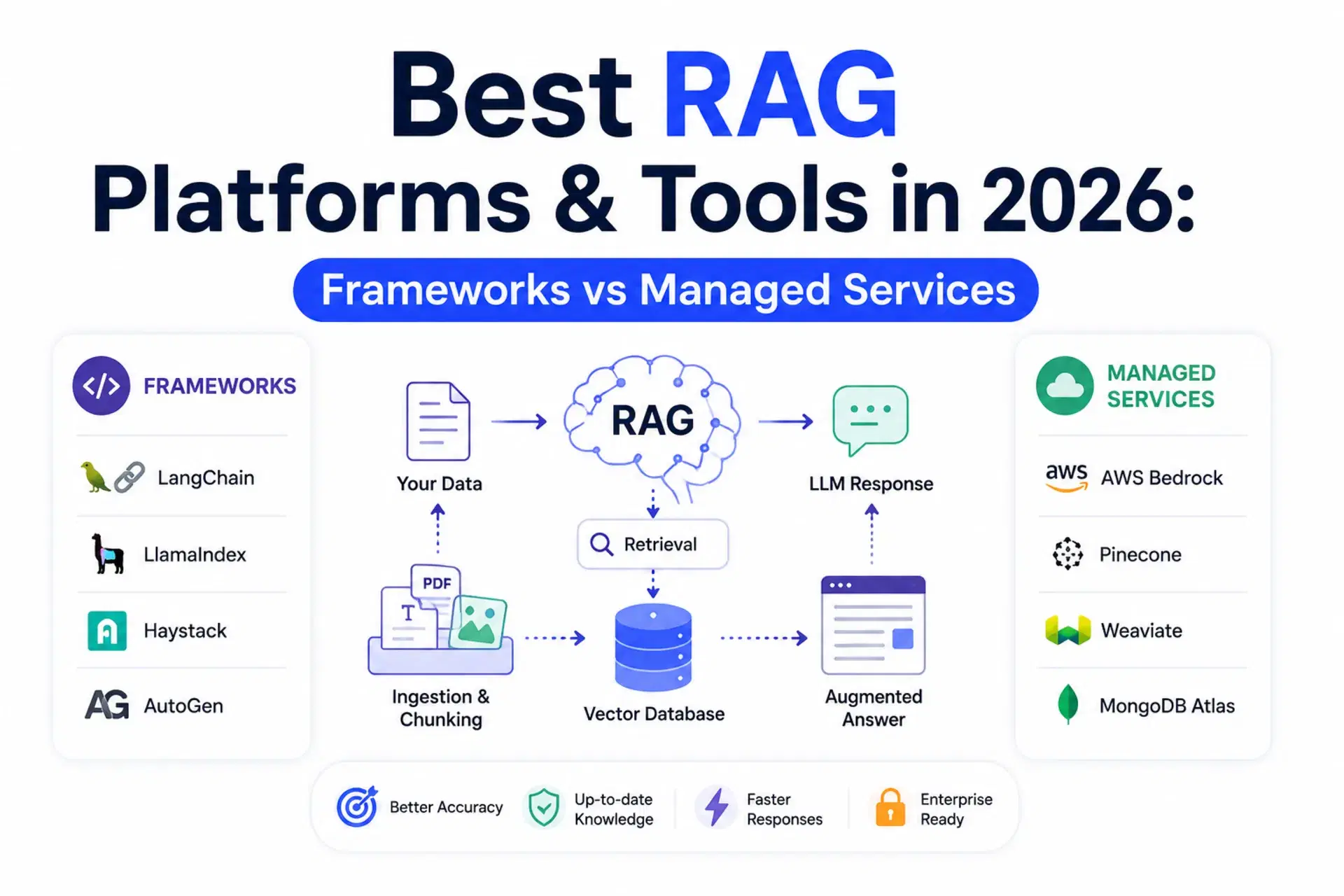
In Menlo Ventures' 2025 State of Generative AI report, published December 9, 2025 and based on a survey of nearly 500 US enterprise decision-makers, retrieval-augmented generation (RAG) powered 51% of production LLM deployments, against just 9% for fine-tuning (Menlo Ventures). For all the noise about long context windows making retrieval obsolete, RAG remains the single most common way enterprises customize an LLM with their own data, second only to plain prompt design.
What changed is not whether teams do RAG, but how. The framing that stuck in 2026 is that RAG "didn't die, it moved up the stack": naive chunk-and-retrieve pipelines are fading, and retrieval is becoming a behavior an agent invokes on demand rather than a fixed preprocessing step. At the same time, Menlo found 76% of enterprise AI solutions are now bought rather than built, so a wave of managed RAG platforms now competes with the open-source frameworks.
This guide covers both. It is about the RAG orchestration layer - the frameworks and platforms that handle ingestion, chunking, embedding, retrieval, reranking, and generation - not the vector database underneath. If you are still choosing where to store your vectors, that is a separate decision covered in our best vector databases guide; this post is about everything that sits on top of it.
"Editor's Pick: Kapa.ai for teams whose knowledge is documentation, code, and support tickets, and not just a folder of files. It syncs those sources continuously and exposes them to your own agents over a hosted MCP server or retrieval API, with citations back to the original page. Jump to the full writeup.
What a RAG Platform Actually Does
Every RAG system is the same pipeline, and the differences between tools come down to how much of it they handle for you:
- Ingest documents from files, databases, and APIs (PDFs, HTML, Office docs, Notion, S3).
- Parse and chunk them into passages small enough to retrieve but large enough to be meaningful.
- Embed each chunk into a vector and store it (this is where the vector database lives).
- Retrieve the most relevant chunks for a query, usually with hybrid search (dense vectors plus keyword/BM25).
- Rerank those candidates so the best few land at the top of the context window.
- Generate a grounded answer, ideally with citations back to the source.
An open-source framework gives you composable pieces for each step and full control. A managed platform hides most of them behind an API: you upload documents and ask questions. The right choice depends on how much control you need and how much infrastructure you want to run.
Build vs Buy: The Two Categories
- Open-source frameworks (LlamaIndex, LangChain, Haystack, DSPy, txtai, R2R): maximum control, run them yourself, free to start. This is where the innovation and the customization live.
- Managed RAG-as-a-service (Amazon Bedrock Knowledge Bases, Google Vertex AI RAG Engine, Azure AI Search, Pinecone Assistant, Contextual AI): upload data, call an API, skip the infrastructure. Fastest path to a working system, at the cost of flexibility and some lock-in.
Quick Comparison
| Tool | Type | Language / Access | License | Best For |
|---|---|---|---|---|
| LlamaIndex | OSS framework | Python, TS | MIT | Ingestion + indexing ergonomics |
| LangChain / LangGraph | OSS framework | Python, JS/TS | MIT | Breadth of integrations, agentic RAG |
| Haystack | OSS framework | Python | Apache 2.0 | Typed, production-grade pipelines |
| DSPy | OSS framework | Python | MIT | Optimizing pipelines instead of prompts |
| txtai | OSS framework | Python | Apache 2.0 | Lightweight all-in-one, self-hosted |
| R2R | OSS RAG engine | Python | MIT | A deployable RAG server with a REST API |
| Kapa.ai | Managed platform | API, MCP, SDK | Proprietary | Docs and support knowledge as an agent tool |
| Bedrock Knowledge Bases | Managed (AWS) | API | Proprietary | Managed RAG on AWS |
| Vertex AI RAG Engine | Managed (Google) | API | Proprietary | Managed RAG on Gemini/GCP |
| Azure AI Search | Managed (Azure) | API | Proprietary | Enterprise hybrid retrieval |
| Pinecone Assistant | Managed (API) | API | Proprietary | Documents-to-answers, fast |
| Contextual AI | Managed platform | API | Proprietary | Groundedness for regulated work |
The Open-Source Frameworks
LlamaIndex

LlamaIndex is the framework most teams reach for when the hard part is the data. Its connector and parser ecosystem (LlamaHub, the LlamaParse document parser, LlamaCloud) is the richest here, and its Workflows primitive handles agentic orchestration. It is MIT-licensed Python with a TypeScript port, and around 51,000 GitHub stars. In June 2026 the company raised a $19M Series A led by Norwest.
Best at: ingestion and indexing ergonomics, and parsing messy real-world documents. Weakness: a large, fast-moving API surface, and the split between the open framework and the LlamaCloud managed service can be confusing.
LangChain and LangGraph

LangChain is the general-purpose LLM framework with the largest integration ecosystem (roughly 142,000 stars), and LangGraph is its stateful graph layer for agents. Both reached 1.0 on October 22, 2025, and the company raised $125M at a ~$1.25B valuation to build "the platform for agent engineering." For RAG specifically, LangGraph shines when retrieval is agentic - the model decides whether and what to retrieve, loops, and reformulates queries.
Best at: ecosystem breadth and stateful, agentic RAG with human-in-the-loop steps, plus LangSmith for tracing. Weakness: a long-standing reputation for heavy abstraction; for a plain retrieve-then-answer pipeline it can be more machinery than you need.
Haystack

Haystack from deepset is the production-minded option: it models RAG as typed Components wired into explicit Pipelines, with an async runtime, branching and cycles, YAML serialization, and a built-in evaluation framework. It is Apache 2.0 Python at around 26,000 stars. If LangChain feels like notebook glue, Haystack feels like software you can actually deploy and test.
Best at: clean, explicit, testable pipeline architecture for teams that want engineering rigor. Weakness: a smaller community and fewer third-party tutorials than LangChain or LlamaIndex.
DSPy

DSPy from Stanford NLP takes a genuinely different angle: you program the pipeline with declarative modules and input/output signatures, then let optimizers (MIPROv2, GEPA, and others) compile the actual prompts and few-shot examples for you. Instead of hand-tuning prompts, you define the behavior and let DSPy tune it. It is MIT-licensed with around 36,000 stars.
Best at: systematically squeezing accuracy out of a RAG pipeline without manual prompt engineering. Weakness: the "compile your program" mental model has a real learning curve and is overkill for a quick demo.
txtai and R2R

Two lighter options worth knowing. txtai (Apache 2.0, ~12,700 stars) is an all-in-one embeddings database that bundles vector, graph, and relational indexes with RAG and agents in a single library, ideal when you want batteries-included semantic search without standing up a separate vector DB. R2R (MIT, ~7,900 stars) is a "RAG engine" that exposes ingestion, hybrid search, knowledge graphs, and agentic retrieval behind a REST API - a deployable RAG-server-in-a-box rather than a library you wire together yourself. Both trade ecosystem size for simplicity, so weigh the smaller communities against the lower setup cost.
The Managed Platforms
If you would rather not run any of this, the hyperscalers and a few focused startups will do it for you.
Kapa.ai
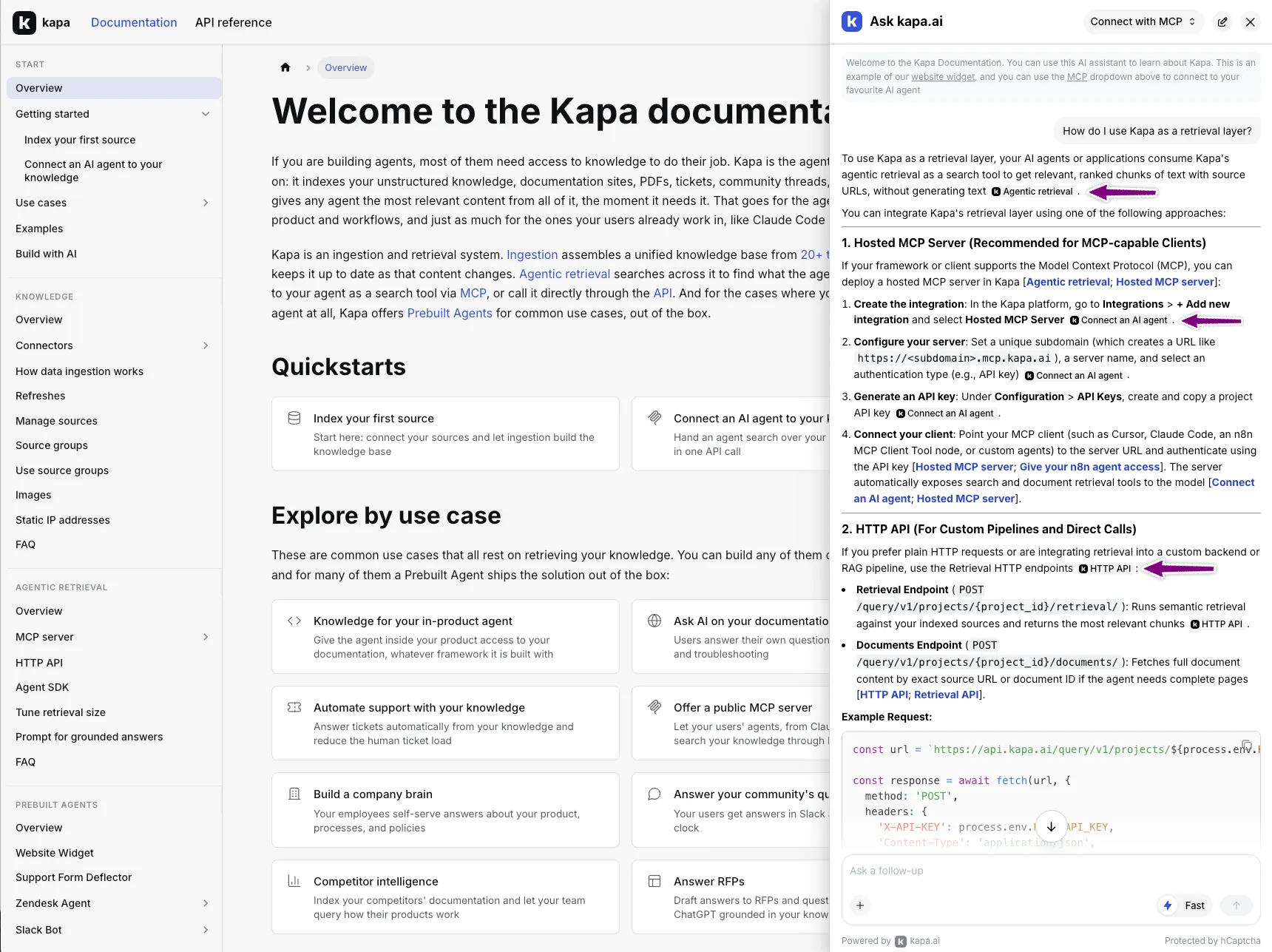
Kapa.ai starts from a different premise than the hyperscaler services below it. Rather than treating knowledge as a single corpus to configure for retrieval, Kapa is built for technical knowledge already scattered across a living product ecosystem: documentation sites, code, API specifications, PDFs, support tickets, and community threads. It pulls those in through 30+ prebuilt connectors, keeps them continuously synced by detecting and re-processing only what changed rather than re-indexing everything, and answers against them with citations back to the original source. n8n, monday.com, Netlify, and Nordic Semiconductor all run it in production.
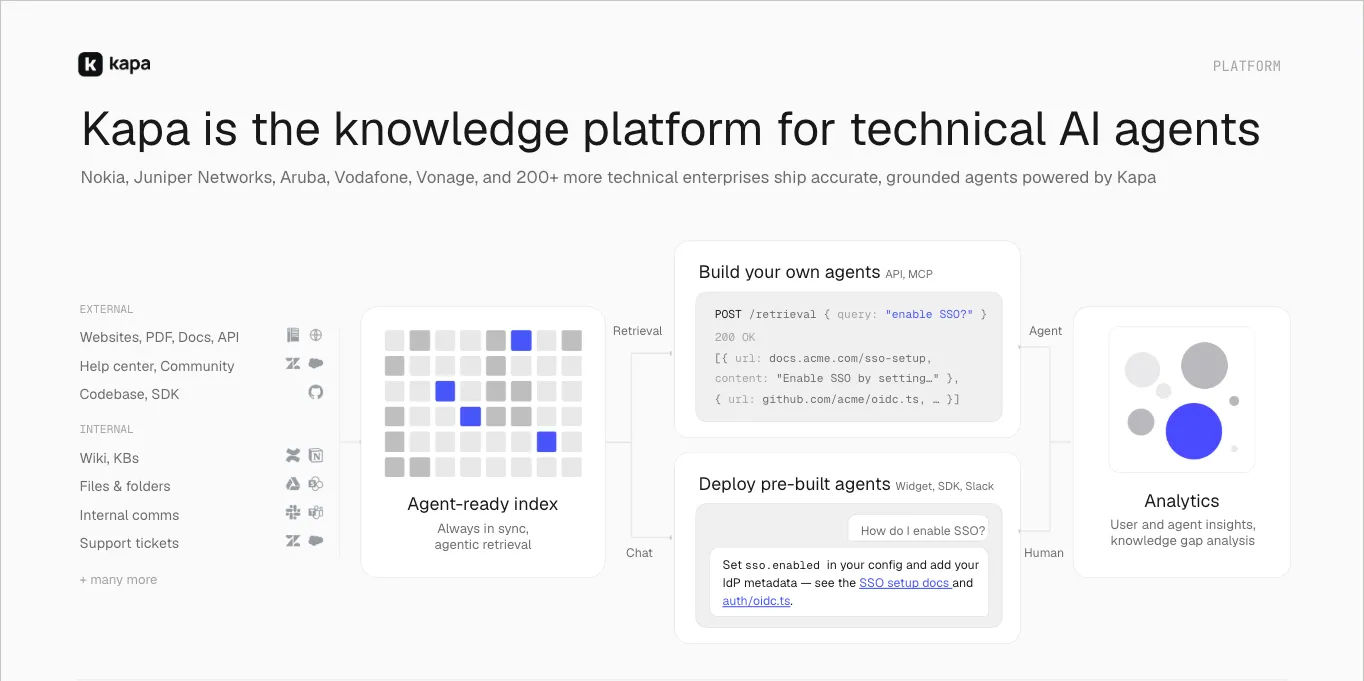
The more interesting half is where the retrieval ends up. Kapa exposes that unified knowledge base as a tool your own agents can call, over a hosted MCP server, a Retrieval API, or its Agent SDK. That is precisely the "retrieval moved up the stack" pattern this guide opened with: rather than owning a pipeline, you hand an agent a knowledge tool and let it decide when to reach for it. If you would rather not build the agent either, Kapa ships prebuilt ones for documentation search, support ticket deflection, Slack and Discord community answering, and internal team use.
The genuinely uncommon piece is the analytics. Its dashboard surfaces Top Questions, Coverage Gaps, and Source Analytics, so the questions users asked and did not get answered come back as a documentation backlog instead of disappearing into a chat log. Most RAG platforms report what was retrieved; very few report what was missing.
Pricing is a 14-day free trial, then usage-based tiers that scale on query volume and data indexed, quoted rather than published. Scope is the thing to check before committing: Kapa is built for unstructured technical knowledge, so if your retrieval targets structured or transactional data, or you need to own the pipeline internals yourself, this sits at the wrong layer for you.
Amazon Bedrock Knowledge Bases

Amazon Bedrock Knowledge Bases is AWS's fully managed RAG service. GraphRAG (backed by Neptune Analytics) went generally available in March 2025, and by re:Invent 2025 it added multimodal retrieval across text, image, audio, and video, cost-optimized S3 Vectors storage, and structured-data retrieval with text-to-SQL. It is the default if you already live in Bedrock, at the cost of AWS lock-in.
Google Vertex AI RAG Engine

Google Vertex AI RAG Engine is the GCP equivalent, tightly integrated with Gemini. It is GA, recently added a serverless mode with a fully managed database, and notably lets you plug in different vector backends (its own Vector Search, plus Pinecone and Weaviate). The main friction is the shifting product naming as Google folds it into its wider agent platform.
Azure AI Search

Azure AI Search (renamed from Azure Cognitive Search) is Microsoft's retrieval backbone, and its hybrid search plus semantic ranker is best-in-class. Its 2026 headline is agentic retrieval - the service uses an LLM to break a query into parallel subqueries and rerank each - which reached GA in the 2026-04-01 REST API. Note it is a retrieval engine, not an end-to-end app, so you still assemble the generation step.
Pinecone Assistant

Pinecone Assistant went GA in February 2026 as a managed RAG API on top of Pinecone's vector database: upload documents, and its Chat API returns grounded, cited answers with an evaluation API built in. It is the fastest documents-to-answers path if you are already on Pinecone.
Contextual AI

Contextual AI, founded by Douwe Kiela (a co-author of the original RAG paper), sells an enterprise platform built on "RAG 2.0," jointly optimizing the retriever and generator as one system. Its platform reached GA in January 2025, backed by roughly $100M in funding, and it targets accuracy-critical, regulated knowledge work.
One cautionary note on the startup end of this market: Ragie, a developer-focused managed RAG service, posted a notice that its service ends July 19, 2026. Managed platforms remove infrastructure work, but a smaller vendor can also remove itself, so weigh continuity risk against convenience.
The Supporting Tools You Will Bolt On
Whichever platform you choose, three categories of specialist tools reliably lift RAG quality:
- Rerankers and embeddings. A reranker reorders retrieved candidates so the best passages land in context, and it is often the cheapest accuracy win in the whole pipeline. Cohere Rerank is the common default; Voyage AI's embedding and reranker models are another strong choice (MongoDB acquired Voyage in February 2025, and the models remain available via its APIs).
- Document parsing. Garbage in, garbage out starts at parsing. IBM's Docling is a free, local, high-accuracy converter (around 63,000 stars, now under the Linux Foundation), Unstructured covers the broadest range of formats as an open ingestion layer, and managed options like LlamaParse and Reducto handle complex tables, charts, and scans.
- Evaluation. You cannot improve what you do not measure. Ragas provides RAG-specific metrics (faithfulness, context precision and recall, answer relevance) without needing labeled data, and TruLens (maintained by Snowflake) adds tracing and feedback-function evals.
2026 Trends Worth Building Around
- Agentic RAG is the dominant pattern now: the model decides whether, what, and how to retrieve, iterating instead of running one fixed lookup. It is first-class in Azure AI Search, Vertex RAG Engine, R2R, and any LangGraph-based agent.
- Multimodal RAG (retrieval over images, tables, and charts inside documents) went mainstream in the managed platforms this year.
- GraphRAG, popularized by Microsoft's open-source GraphRAG project, backs retrieval with a knowledge graph for multi-hop, explainable answers, and is now productized in Bedrock Knowledge Bases.
- Buy over build. With 76% of enterprise AI now purchased rather than built, even the framework vendors are moving up-market into managed clouds. For many teams, the honest answer is to start on a managed platform and only drop to a framework when you hit a wall.
The One Step No Platform Fully Solves: Chunking
Retrieval quality is decided long before the LLM sees anything, at the chunking step. Chunks that are too big dilute relevance; too small and they lose context. A fixed-size window with overlap is the sane default, and it is worth understanding even when a platform does it for you. Here is the core idea in dependency-free Python that runs locally as-is:
Pythondef chunk_text(text, chunk_size=200, overlap=40): """Split text into overlapping word chunks for embedding.""" if overlap >= chunk_size: raise ValueError("overlap must be smaller than chunk_size") words = text.split() step = chunk_size - overlap chunks = [] for start in range(0, len(words), step): chunk = words[start:start + chunk_size] if chunk: chunks.append(" ".join(chunk)) if start + chunk_size >= len(words): break return chunks doc = " ".join(f"word{i}" for i in range(1, 26)) # 25-word stand-in for i, c in enumerate(chunk_text(doc, chunk_size=10, overlap=3)): print(f"chunk {i}: {c}")
The overlap is what keeps a sentence that straddles a chunk boundary from being split away from its context - each chunk repeats the last few words of the previous one. Production systems get smarter (splitting on sentences or semantic boundaries, sizing by tokens rather than words), but this is the shape of what every RAG pipeline does first.
How to Choose
- Do you want to run infrastructure at all? If not, start with a managed platform on your existing cloud: Bedrock on AWS, Vertex on GCP, Azure AI Search on Azure, or Pinecone Assistant if you are already on Pinecone.
- Is your knowledge documentation, code, and support history rather than files? Kapa.ai, which keeps those sources synced and hands them to your agents over MCP or a retrieval API.
- Is the hard part your data (messy PDFs, many sources)? LlamaIndex, for its parsing and connector ecosystem.
- Do you need production rigor and testable pipelines? Haystack.
- Is retrieval agentic - the model deciding what to fetch and looping? LangGraph.
- Do you want to optimize accuracy systematically rather than hand-tune prompts? DSPy.
- Do you want the whole thing self-hosted and lightweight? txtai, or R2R if you want a REST API in front of it.
Whatever you pick, budget real effort for the parts no platform fully owns: parsing quality, chunking strategy, a reranker, and an evaluation loop. Those decide whether your RAG system is trustworthy far more than the brand on the box.
Related DevToolLab Tools
- Cosine Similarity Calculator - Sanity-check the similarity scores behind your retrieval step, the exact math a vector store runs at scale.
- AI Token Counter - Size your chunks and check how much retrieved context fits in the model's window before it truncates.
- Word & Character Counter - Measure document and chunk length while tuning your splitting strategy.
- PDF to Text Extractor - Pull plain text out of PDFs in your browser to test ingestion before wiring up a parser.
- Markdown to Text Converter - Strip formatting from Markdown docs so you embed clean text, not syntax noise.
- MCP Server Config Generator - Wire a RAG retrieval tool into Claude or Cursor over MCP without hand-writing the config.
Conclusion
RAG is not going anywhere - it runs a majority of enterprise LLM deployments, and the tooling in 2026 is better than it has ever been. The real decision is build versus buy. If you want control and your value is in custom retrieval logic, reach for an open-source framework: LlamaIndex for data-heavy work, Haystack for production rigor, LangGraph for agentic retrieval, DSPy to optimize accuracy. If you want speed and your value is elsewhere, a managed platform on your existing cloud will get you to a grounded, cited answer in an afternoon. Either way, the parts that actually determine quality - parsing, chunking, reranking, and evaluation - are yours to own. Get those right and the framework or platform underneath matters far less than the debate suggests.
Versions, funding, star counts, and platform features reflect the state of these projects as of July 2026 and change quickly. Confirm current details on each project's repository or docs before you commit.