

Building against a payment provider, a Git host or a CRM means waiting for an event you do not control, then guessing at what its JSON looked like. A throwaway URL that records every request, headers and body included, turns that guess into something you can read.
Webhook.site is the default answer, but its free URLs stop working after 7 days or 100 requests, whichever comes first. The best alternative depends on what you need next: a longer-lived inspector, a way to forward events to localhost, a mock that answers back, or production delivery with retries. This guide compares 11 options on the limits and prices their own sites published as of October 11, 2026.
What Webhook.site Does and Where Its Free Plan Stops
Webhook.site gives every visitor a random URL and email address and shows anything sent to them in real time. According to its documentation, free URLs expire after 7 days and stop accepting new requests after 100, while a paid account removes both limits and adds custom aliases and actions. The core app is also MIT-licensed on GitHub and can be self-hosted with Docker, minus the paid features.
That makes the free tier fine for a quick look and awkward for anything longer: a staging integration that runs for two weeks, or a load of a few hundred test events, outlives the URL.
Quick Comparison Table
| Tool | Type | Free plan | Paid from | Open source |
|---|---|---|---|---|
| DevToolLab Webhook Receiver | Hosted inspector | URL lasts 3 days, 500 requests | $2.99/month (Pro) | No |
| Smee.io | Forward to localhost | Free, no signup | None | Yes (MIT) |
| Beeceptor | Inspector and mock | 50 requests/day per endpoint | $10/month | No |
| Pipedream | Workflow platform | Development only | $99/month, billed annually | No |
| Postman Mock Servers | API mocking | Included in Free plan | $9/month, billed annually | No |
| Hookdeck | Inbound event gateway | 10,000 events, 3-day retention | $39/month | No |
| Svix | Webhook sending, plus Svix Play tester | 50,000 messages/month | $20/month | Server is MIT |
| ngrok | Tunnel to localhost | $5 one-time credit, 20,000 requests | $10/month | No |
| Webhook.site OSS | Self-hosted inspector | Free | None | Yes (MIT) |
| Webhook Tester | Self-hosted inspector | Free | None | Yes (MIT) |
| Request Baskets | Self-hosted inspector | Free | None | Yes (MIT) |
Prices and limits come from each vendor's pricing page or source code, checked October 11, 2026.
1. DevToolLab Webhook Receiver

The DevToolLab Webhook Receiver is our own tool, so read this entry with that in mind. Open the page and you get a URL on backend.devtoollab.com that accepts any HTTP method and any sub-path, then lists each request with its headers, query string and body as JSON, XML, form data or raw text. A free URL and its requests last 3 days and accept 500 requests in total, five times webhook.site's free cap. Pro removes the expiry, keeps requests until you delete them, and allows 50,000 requests a day across up to 10 active URLs.
It does not forward requests to your machine, send custom responses or retry deliveries, so pair it with Smee.io or ngrok when the handler under test runs locally.
Pricing (October 2026): Free · Pro $2.99/month or $23.88/year
2. Smee.io
Smee.io, made by the Probot team behind the open-source framework for GitHub Apps, solves a different half of the problem: getting a webhook to code running on localhost. Its page describes it as a service that "uses Server-Sent Events to proxy payloads from the webhook source, then transmit them to your locally running application." You open a channel, point the provider at it, and run the client:
Bashnpm install -g smee-client smee -u https://smee.io/Gh4tR7d02ikZ1kue -t http://localhost:3456/webhook
textForwarding https://smee.io/Gh4tR7d02ikZ1kue to http://localhost:3456/webhook Connected https://smee.io/Gh4tR7d02ikZ1kue POST http://localhost:3456/webhook - 200
That was smee-client 4.4.3 relaying a test order.created event to a local Node.js listener. Channels need no account, which also means anyone who has the URL can watch the payloads, so keep production secrets out of it.
Pricing (October 2026): Free · server MIT-licensed, client ISC-licensed
3. Beeceptor

Beeceptor gives you a free HTTPS endpoint that both records incoming requests and answers them with rules you define, so you can test how a sender reacts to a 500. The free plan allows 50 requests per day per endpoint and 3 mock rules. That daily cap is the main thing pushing people to a paid plan once a provider starts sending real traffic.
Pricing (October 2026): Free · Individual $10/month (15,000 requests/month) · Team $25/month · Scale $99/month
4. Pipedream

Pipedream is now "A Workday Company" and pitches itself as "the integration layer for AI agents," with 3,000+ connectors. RequestBin, which used to hold second place on this list, no longer has its own product: both requestbin.com and pipedream.com/requestbin redirected to Pipedream's home page on October 11, 2026. Capturing requests now means a workflow with an HTTP trigger. According to Pipedream's docs, that trigger accepts any method on any path and is public unless you add authorization.
The free plan covers development only, so it is a poor fit for a long-running test endpoint that someone else sends to.
Pricing (October 2026): Free for development · Startup $99/month billed annually, $150 billed monthly
5. Postman Mock Servers

Postman Mock Servers answer requests instead of recording strangers' payloads. Postman's page describes them as a way to "create a mock from a specification or collection, add dynamic behavior and state, and run it locally or in the cloud." Use one when your code calls an API that does not exist yet. For inspecting what a provider sends you, a request inspector above is the better tool.
Pricing (October 2026): Free plan includes mock servers · Solo $9/month and Team $19/user/month, both billed annually
6. Hookdeck

Hookdeck sits in front of your production endpoint as an event gateway that queues, filters, rate-limits and replays inbound webhooks. Its free Developer plan covers up to 10,000 events with 3-day retention for one user. For testing alone, Hookdeck also offers a Console that previews and inspects payloads and a CLI that receives webhooks on localhost.
It is more infrastructure than a quick test needs, and the jump from free to Team is meaningful once events pile up.
Pricing (October 2026): Developer $0 · Team from $39/month · Growth from $499/month
7. Svix

Svix is mainly for sending webhooks: your app hands Svix the event, Svix delivers it to your customers' endpoints, and Svix Portal gives those customers an embeddable webhooks UI. Contrary to this list's earlier version, it has a free plan, with up to 50,000 messages a month, 7-day payload retention and no credit card. The server is open source as svix-webhooks under the MIT license.
For receiving test webhooks, Svix Play is the closer webhook.site match. Svix bills it as "free forever, no signup required" and gives each visitor a persistent URL, with the Svix CLI covering localhost.
Pricing (October 2026): Free · Basic from $20/month · Professional from $490/month · Svix Play free
8. ngrok

ngrok opens a public HTTPS URL that tunnels to a port on your machine, and its Traffic Inspector keeps each request for 24 hours on the free plan and 72 hours on Hobbyist. That makes it the standard way to test a real handler rather than a stand-in. The free plan comes with $5 of one-time usage, up to 3 online endpoints, 1 GB of data transfer and 20,000 HTTP requests, and it shows an interstitial page on HTTP endpoints. Hobbyist removes the interstitial.
Pricing (October 2026): Free · Hobbyist $10/month · Pay-as-you-go with $20 of monthly usage included
9. Webhook.site OSS

The open-source Webhook.site is the same request viewer you use in the browser, which you can run on your own server. Its README calls it "the completely open-source, MIT-licensed version," self-hostable with Docker but without hosted features such as Custom Actions. The last tagged release, 1.3, dates from June 2023, though the repository received commits as recently as September 25, 2026.
Pricing (October 2026): Free · MIT license · about 6,800 GitHub stars
10. Webhook Tester
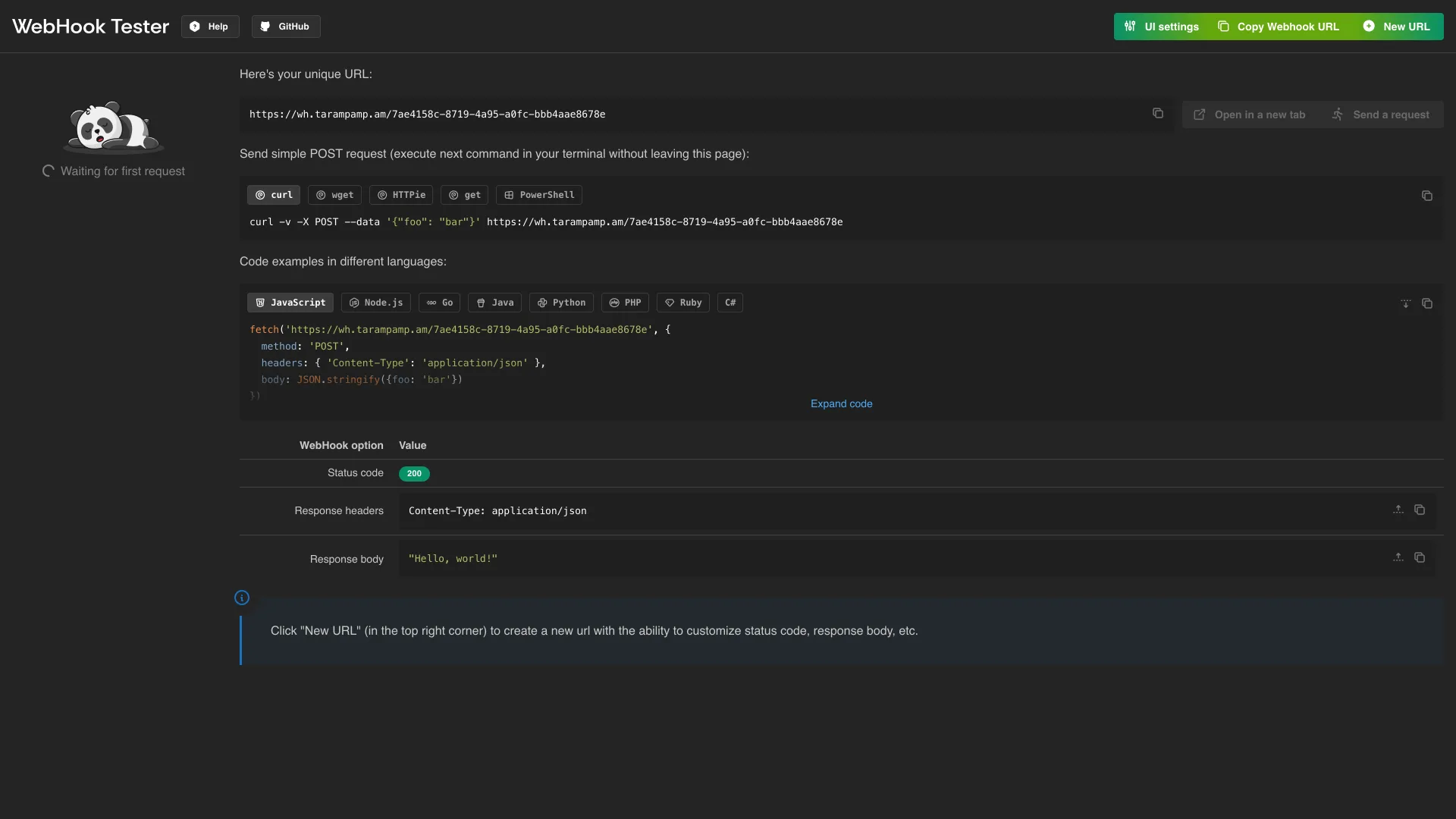
Webhook Tester is a single Go binary or Docker image that gives you webhook.site's core loop on your own infrastructure. It records requests in real time and lets you set the status code, headers and body each URL returns. It stores requests in memory, in Redis or on the file system, so you choose between throwaway debugging and history that survives a restart.
Version 2.3.0 shipped April 13, 2026, and the repository was still getting commits on October 11. It replaces Mockbin in this list: Kong's Insomnia Mockbin now ships under the Kong Software License Agreement rather than an open-source license.
Pricing (October 2026): Free · MIT license
11. Request Baskets

Request Baskets collects HTTP requests into named "baskets" you can inspect in a small web UI, and it can forward them to another URL. It is light enough for an internal network. The catch is maintenance: the latest release, v1.2.3, is from May 1, 2023, and the last commit landed in June 2024.
Pricing (October 2026): Free · MIT license
Choosing the Right Tool
Start with where the request needs to end up:
- You only need to see the payload. DevToolLab Webhook Receiver or Svix Play. Both are free with no signup. DevToolLab's free URL takes 500 requests over 3 days, and Pro keeps the URL permanently.
- Your handler runs on localhost. Smee.io for a free, no-account relay, or ngrok when you also want its Traffic Inspector and a public HTTPS endpoint.
- The sender needs a specific response back. Beeceptor, or Webhook Tester if you would rather host it.
- Production webhooks need retries and monitoring. Hookdeck for receiving, Svix for sending.
- Payloads cannot leave your network. Self-host Webhook.site OSS or Webhook Tester. Request Baskets works, but it has not shipped a release since 2023.
Conclusion
For a fast look at what a provider sends, the DevToolLab Webhook Receiver gives a free URL that takes 500 requests over 3 days, and Svix Play is a no-signup alternative. To run those events against real code, pair either one with Smee.io or ngrok. Teams that cannot send payloads to a third party should self-host Webhook Tester, the most actively maintained open-source option here, and production traffic belongs on Hookdeck or Svix rather than on any test bin.
Related DevToolLab Tools
- Webhook Receiver - get a URL that records every request's headers, query string and body, free for 3 days and 500 requests.
- HMAC Generator - recompute a payload's HMAC-SHA256 to check the signature header a provider attached to a captured webhook.
- HTTP Header Parser - paste the raw headers from a captured request to read content type, user agent and custom provider headers one by one.
- Multipart Form Data Parser - split a multipart/form-data webhook body, the format providers use when a webhook carries file attachments, into its fields and files.
Related Guides
- What Is a Webhook? - how webhooks work before you pick a tool to test them.
- How to Verify a HubSpot Webhook Signature - the next step once a captured payload looks right.
- Best ngrok Alternatives - more ways to expose localhost when a tunnel fits better than a relay.
- Webhooks vs APIs - when to push events and when to poll.