
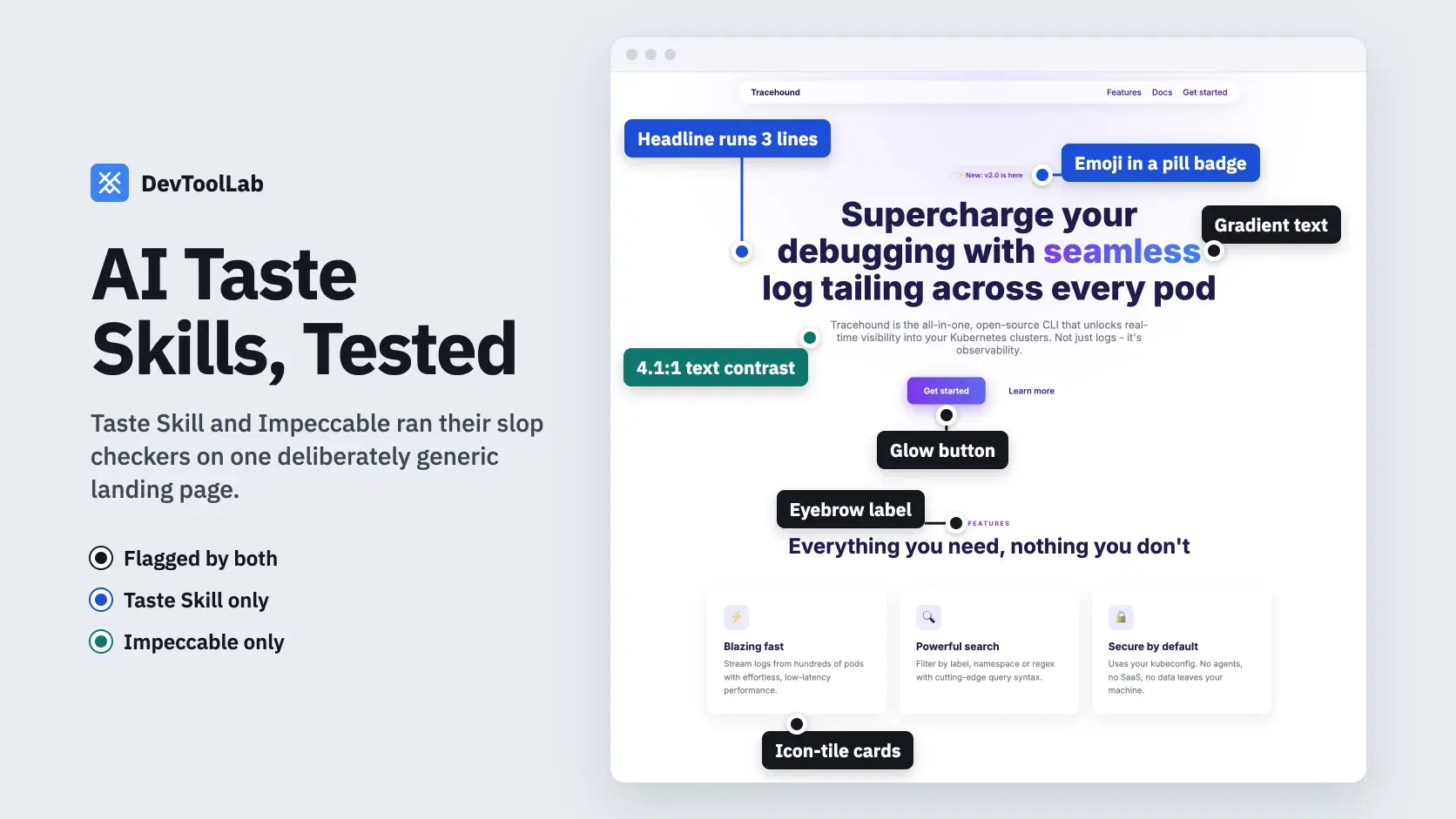
Ask a coding agent for a landing page and you get the same page almost every time: a three-line centered headline, a violet gradient, a "New" pill and three cards with an icon in a rounded square. Every part works, and no part looks chosen. That gap is what developers started calling "taste" in 2026.
The fix the internet has rallied around is an agent skill, a folder of instructions (and sometimes scripts) that Claude Code, Codex or Cursor loads when a task matches. Taste Skill went from a new repo on February 19, 2026 to 97,734 GitHub stars on October 16, 2026. Five popular design skills split into two kinds: three are instructions only, and two ship a deterministic checker that fails a page on measurable tells. On one deliberately generic page, both caught the familiar tells, Taste Skill caught more layout and copy problems, and Impeccable caught more contrast failures. Neither proves taste: in Taste Skill's own blind test, its pages scored 7.7 against 7.8 for no skill at all.
Why AI-Built Pages Look the Same
Left to choose, a model reaches for the most common pattern, which is the average of every SaaS template it trained on. These skills keep dated lists of those defaults, called tells. Taste Skill's tells.md sorts them into waves: violet gradients and glass cards (2023 to 2024), eyebrow labels and pill badges (2025), and a third wave where the published remedy became the look, a cream background with a terracotta accent.
Anthropic's own frontend-design skill, updated September 3, 2026, lists that cream-and-terracotta pairing first and notes that the accent near #D97757 is Anthropic's own Claude color, "so on a user's brief it reads as a tell."
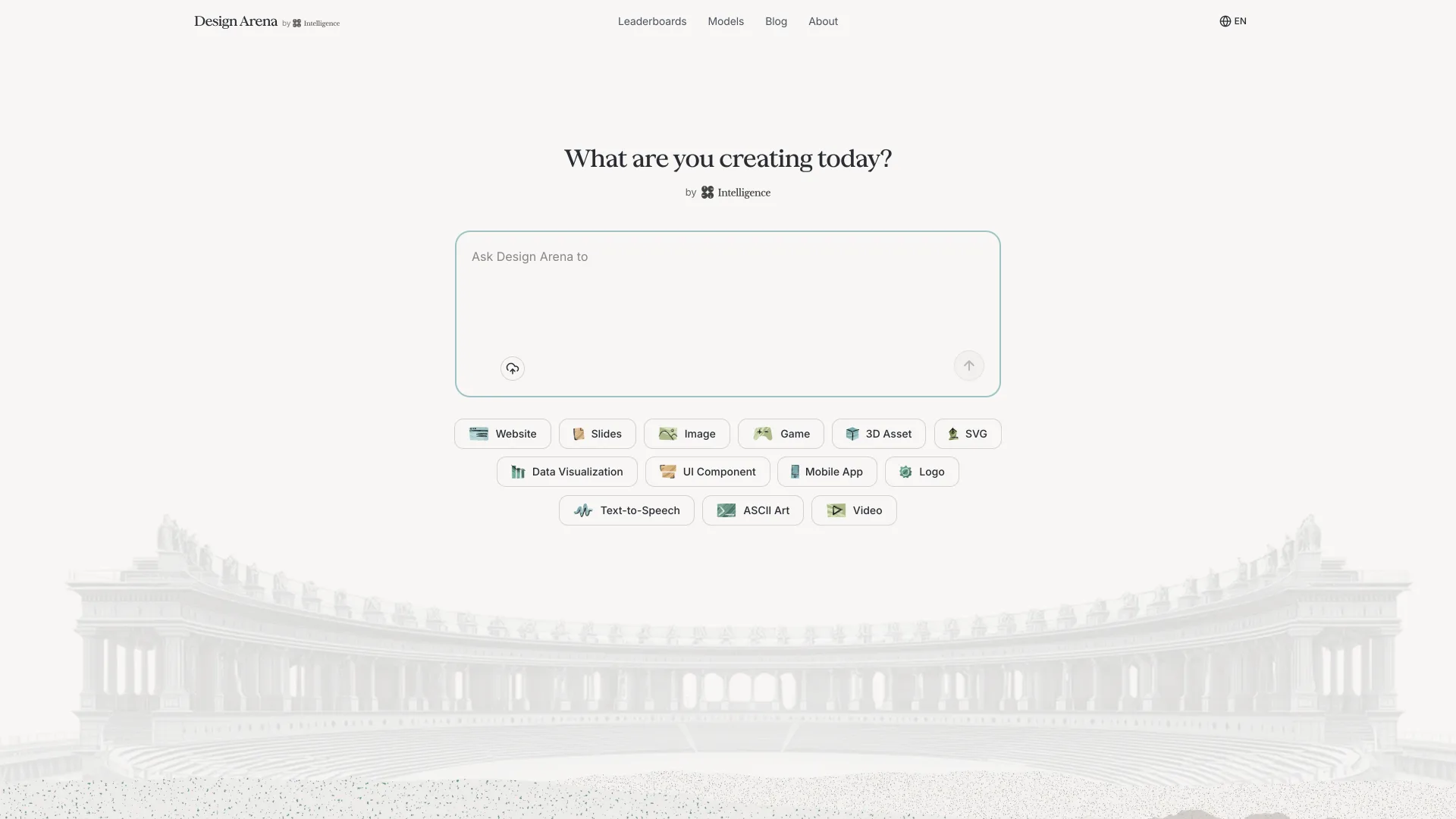
Labs also pay to measure taste. Design Arena renders one prompt with hidden models and has people rank the results in A versus B rounds. TechCrunch reported on August 3, 2026 that its maker, Intelligence, raised a $7.9 million seed round led by Index Ventures, that 5.3 million people use it, and that the company says it generates $60 million in ARR, with frontier labs paying for that feedback.
How a Taste Skill Changes What the Agent Does
A skill is a SKILL.md file with a name and a description. The agent reads only descriptions up front and loads the full file when a request matches, so a design skill costs only its short description until you ask for a page. The Agent Skills format works across Claude Code, Codex, Cursor, Gemini CLI and others, and three of the five skills here install with Vercel's npx skills CLI (v1.7.2 as of October 2026).
An instruction-only skill changes the prompt: which defaults to avoid, how to reason about the brief. A skill with a checker adds a gate the model cannot talk its way past: a script measures the page and exits non-zero on a banned pattern, and the agent has to fix it before calling the job done. Only the second kind is testable. The most-starred design skill, UI UX Pro Max (136,412 stars, MIT), is left out on purpose: it generates a design system from databases of 192 palettes, 74 font pairings and 119 UX guidelines rather than checking for tells.
What Two Checkers Caught on One Generic Page
I wrote one deliberately generic landing page for a made-up open-source CLI, Tracehound, which tails logs from every Kubernetes pod at once. It uses the targeted defaults on purpose, from Inter everywhere to icon cards with soft shadows.
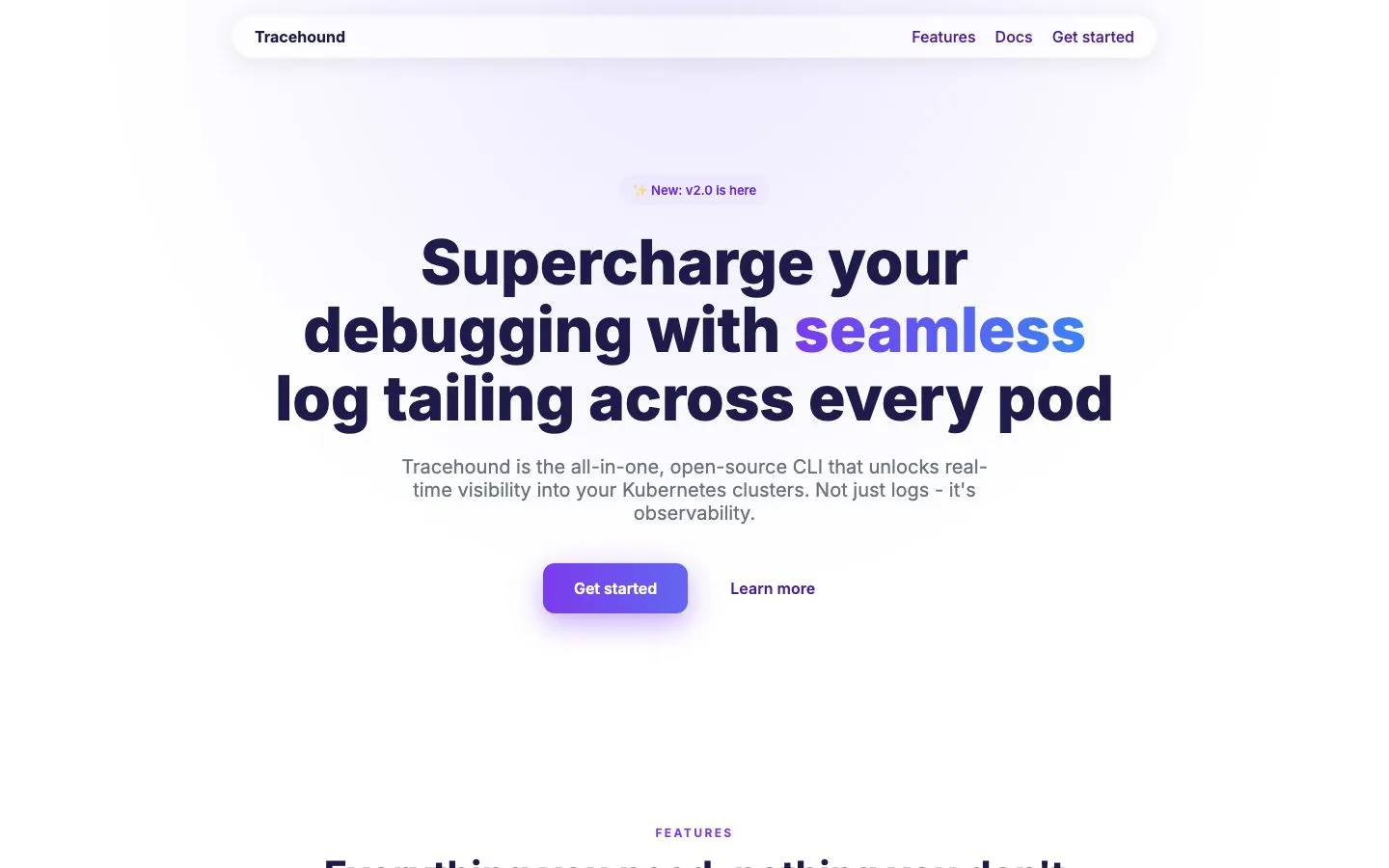
I ran Taste Skill v2.0.0's two checker scripts and Impeccable 4.6.0's detector on it (Node 25.5.0, Chrome installed) and counted findings from their JSON output. None of them calls a model or needs an API key.
Bashnode taste-skill/skills/taste-skill/scripts/lint.mjs index.html --json > lint.json node taste-skill/skills/taste-skill/scripts/inspect.mjs index.html --json > inspect.json DO_NOT_TRACK=1 npx impeccable@4.6.0 detect --no-config --json index.html > imp.json node tally.mjs
js// tally.mjs: count each checker's findings from its --json output. import { readFileSync } from "node:fs" const load = (f) => JSON.parse(readFileSync(f, "utf8")) const tally = (items, key) => items.reduce((n, x) => ({ ...n, [x[key]]: (n[x[key]] || 0) + 1 }), {}) console.log("taste-skill lint ", tally(load("lint.json").findings, "level")) console.log("taste-skill inspect", tally(load("inspect.json").findings, "level")) console.log("impeccable detect ", tally(load("imp.json"), "severity"))
texttaste-skill lint { WARN: 12, FAIL: 21 } taste-skill inspect { FAIL: 16, WARN: 4 } impeccable detect { warning: 19, advisory: 2 }
Each tool counts repeats differently, so the totals are not scores. The per-tell breakdown is the useful part:
| Tell on the Tracehound page | Taste Skill (lint + inspect) | Impeccable detect |
|---|---|---|
| Violet accent colors | Fail | Flagged |
| Radial gradient behind the hero | Fail | Not flagged |
| Gradient headline text | Fail | Flagged |
| Eyebrow labels above headings | Fail (4, counting the pill) | Flagged (3) |
| Three icon-in-a-tile cards | Fail | Flagged (3 tiles) |
| Inter as the only typeface | Warn | Flagged |
| Stock marketing phrases | Warn (5) | Flagged (2) |
| Emoji used as icons | Fail | Not flagged |
| Headline wrapping past two lines | Fail at 1440, 768 and 390px | Not flagged |
| Generic "Get started" button labels | Warn | Not flagged |
| Floating pill nav with blur | Warn | Not flagged |
| Colored glow under the button | Fail (shadows at rest) | Flagged (dark glow) |
| Footer text at 2.5:1 contrast | Fail | Flagged |
| Hero text at 4.1:1 and eyebrow at 3.4:1 | Not flagged | Flagged |
| No pictures, nothing moves | Fail | Not checked |
Both agree on violet, gradient text, eyebrow labels, icon cards and Inter. Taste Skill measures structure, like headline lines at three widths. Both check contrast, but Taste Skill skips text over a background image like the hero gradient, and once any text falls under 2.6:1 it reports only those lines, so the 4.1:1 and 3.4:1 pairs never surfaced. The last row is a house rule: Taste Skill fails any page with under four real pictures or under eight moving elements.
Taste Skill: Dealt Directions and a Browser Gate
Taste Skill v2 is MIT licensed and built from a study of 247 sites from One Page Love and Awwwards Sites of the Day. Instead of letting the model invent a look, its draw.mjs script deals three of 20 researched directions, then fills the chosen one from a library of 48 hero compositions, 172 section compositions, 44 type systems and 56 palettes. For Tracehound it dealt "One motif", "Dressed as something else" and "The quiet instrument". The draw is random, so yours will differ.
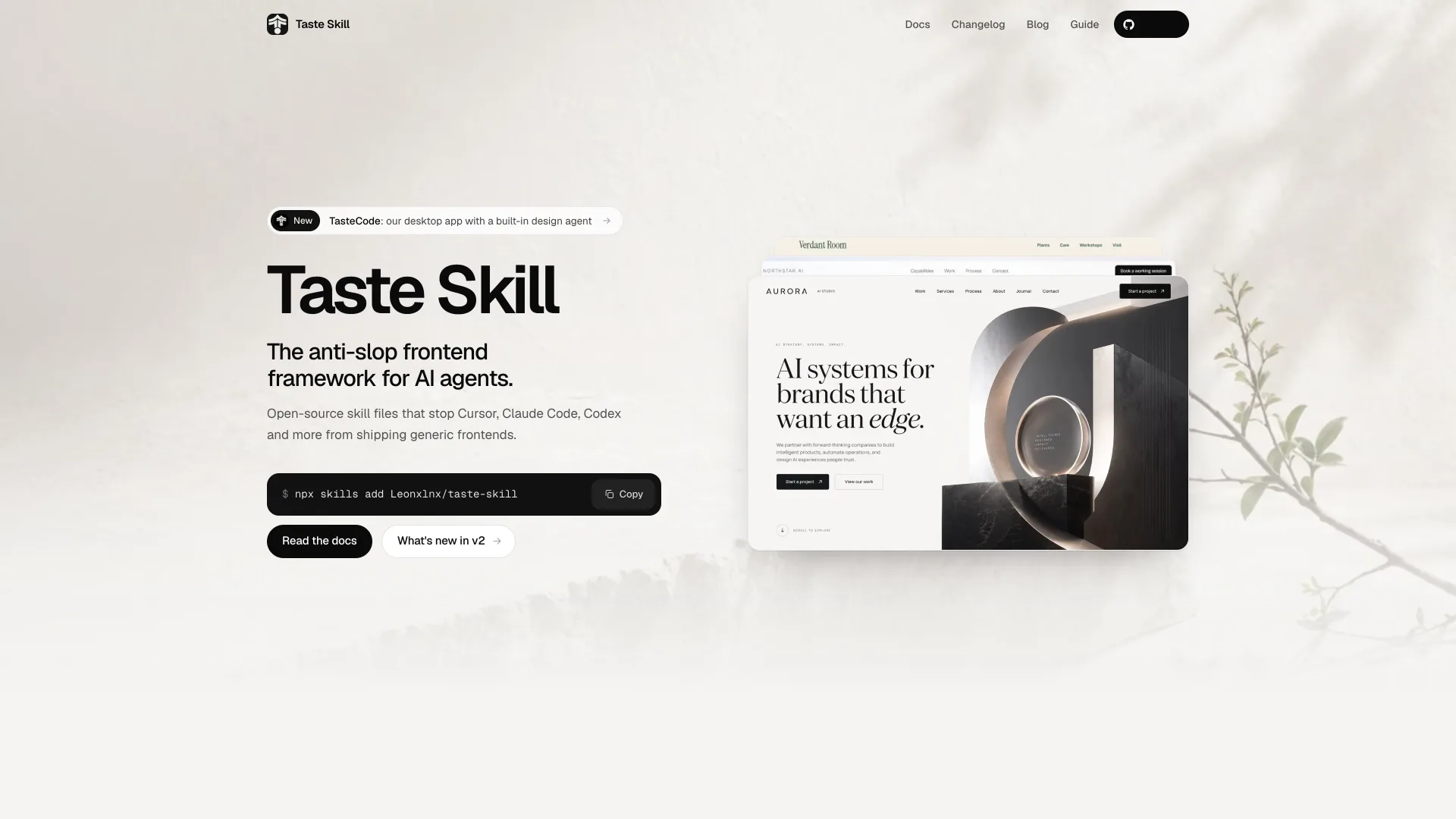
The agent then lists what only this client has, builds with credited pictures from open collections such as Wikimedia Commons, runs the lint and the inspector (at three widths), and critiques its own screenshots for up to three rounds. The README puts a run at 30 to 45 minutes and a few hundred thousand tokens.
What it does not do: dashboards and app screens are out of scope. It bans monospace outside literal code, which a CLI page like Tracehound will feel, and it requires pictures and motion. Its changelog is candid: in the final blind round, a separate agent judged anonymous screenshots of three briefs and scored v2 at 7.7, no skill at 7.8 and another design skill at 7.2, with v2 first on two of three. The v2 pages had zero inspector failures, but that inspector is the skill's own rulebook. Install only v2 with npx skills add https://github.com/Leonxlnx/taste-skill --skill "design-taste-frontend"; without --skill you get all 14 skills in the repo.
Impeccable: 24 Commands and a 59-Rule Detector
Impeccable, by Paul Bakaus, is Apache-2.0 licensed, had 81,802 stars on October 16, 2026, and released skill v4.6.0 on October 15. Its README says it started from Anthropic's frontend-design. It is one skill with 24 commands (audit, critique, polish, bolder, quieter, animate and more), and /impeccable init writes a PRODUCT.md with the audience and constraints, so later commands know Tracehound is a CLI for platform engineers.
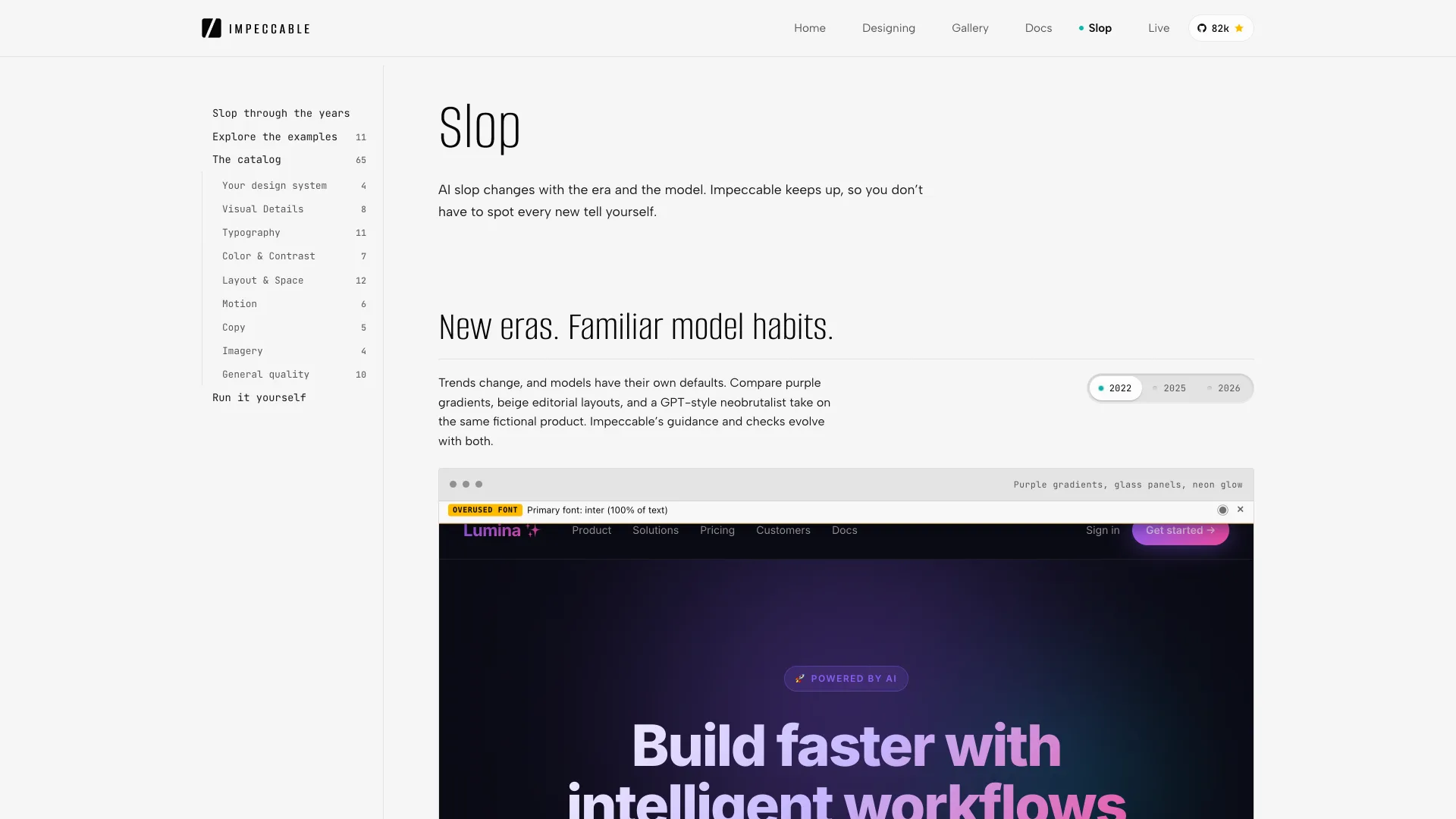
The detector runs 59 deterministic rules. On Claude Code, Codex, Cursor, GitHub Copilot and Grok Build, npx impeccable install also adds a hook that runs it on direct UI file edits and surfaces findings to the agent, so the gate runs during the work, not only at the end.
What it does not do: in my test it missed the emoji icons, the three-line headline and the generic button labels. The skill also calls a roll API at impeccable.style to deal visual directions, and unless you opt out with DO_NOT_TRACK=1 or npx impeccable telemetry off, it records which option won (never your code or files, per the README). Install with npx impeccable install.
Anthropic frontend-design: The 9 KB Baseline
Anthropic's frontend-design is a single 9,390-byte, Apache-2.0 SKILL.md with no scripts, and its Claude marketplace page showed 1,134,112 installs on October 16, 2026. It casts the agent as a studio design lead whose client rejected templated work, grounds the design in the subject, and lists five clusters of current AI defaults. It starts with a plan: four to six named hex values, typefaces, a layout concept and principles.
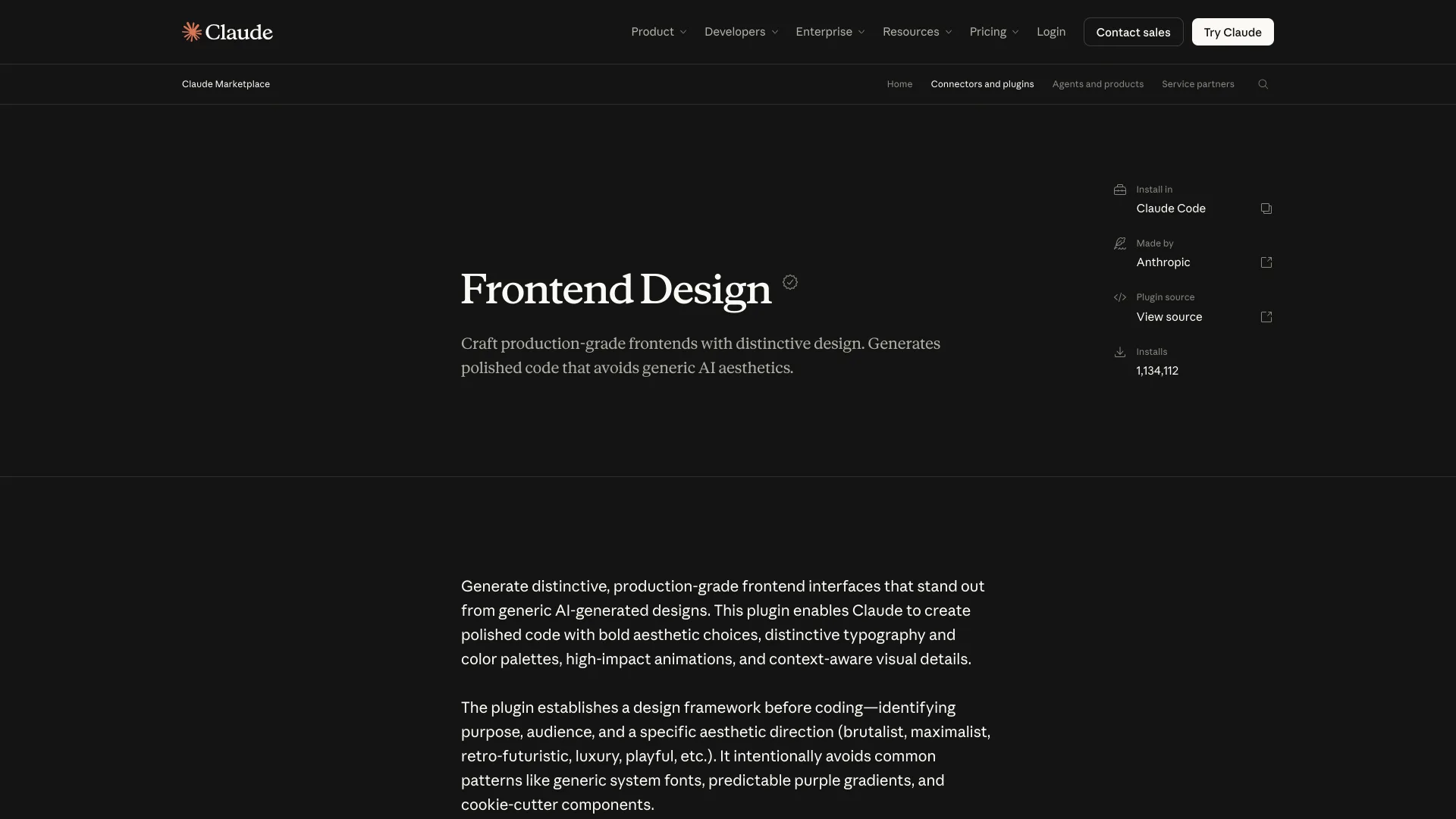
What it does not do: nothing measures the result, so Tracehound's tells get caught only if the model notices them. It is the lightest file here. Install with claude plugin install frontend-design@claude-plugins-official.
Emil Kowalski's Skills: Motion Rules With Reasons
Emil Kowalski, a design engineer who has worked at Vercel and Linear, publishes 15 MIT-licensed skills (46,591 stars as of October 16, 2026), led by emil-design-eng. His essay "Agents with Taste" argues that almost every taste decision has a reason you can write down. The skill does it in tables: enter from scale(0.95), not scale(0), press buttons to scale(0.97) on :active, and pick easing from a flowchart (entering or exiting means ease-out, a hover change means ease).
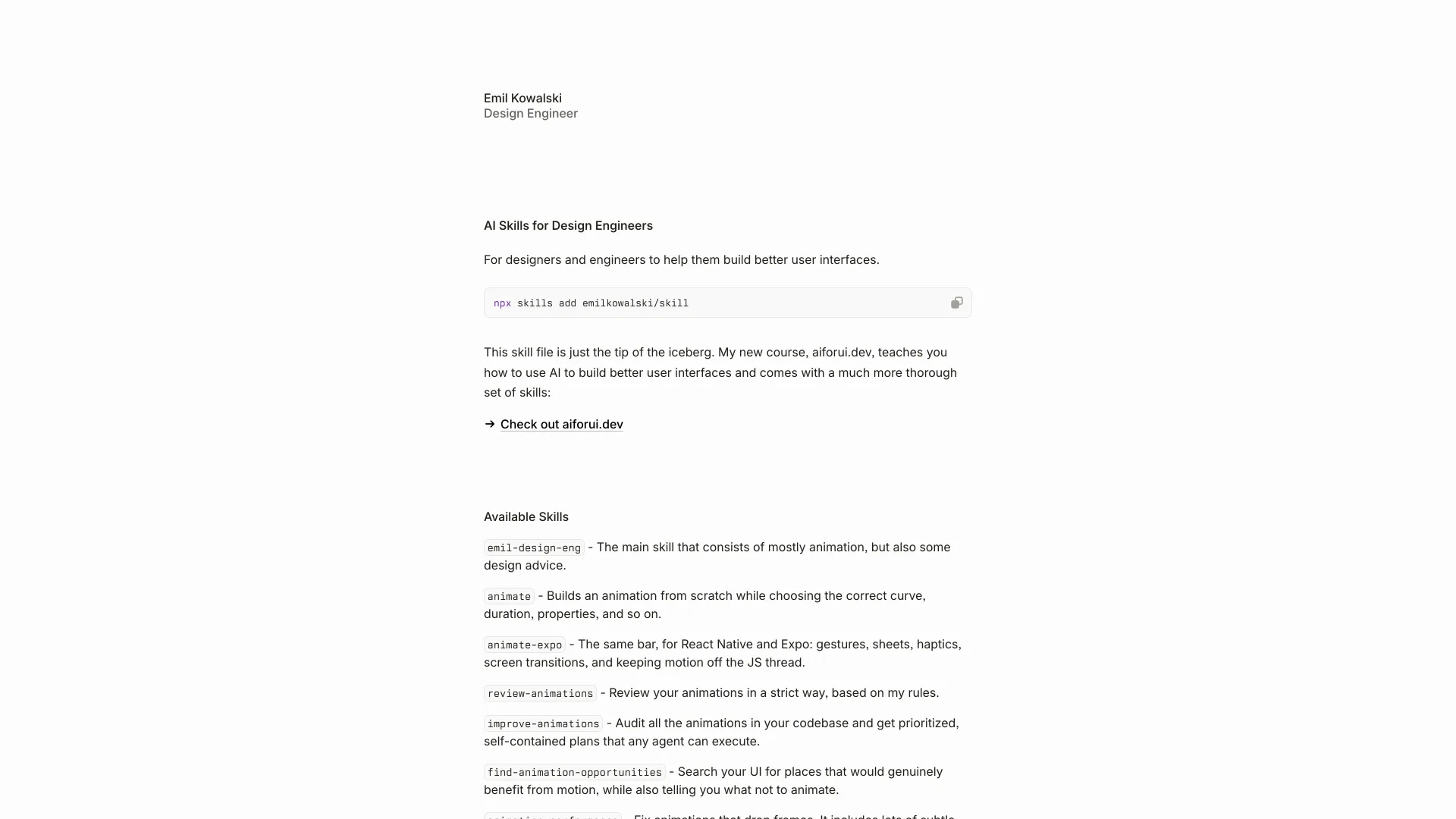
What it does not do: it is mostly about animation, with some design advice, and has no checker. On Tracehound it has rules for the card hover and the button press, not the violet palette. Install with npx skills@latest add emilkowalski/skills.
Hallmark: 21 Themes and a Model-Run Slop Test
Hallmark, from Together AI, is MIT licensed with 30,184 stars on October 16, 2026. It picks a macrostructure for the brief, dresses it in one of 21 named themes (or a custom one), scores its plan on six axes and runs a slop test before handing back. Its slop-test.md lists 58 gates; the README and site still say 57. It also has audit, redesign (new structure, same copy and brand) and study, which extracts the structure and type pairing of a design you admire.
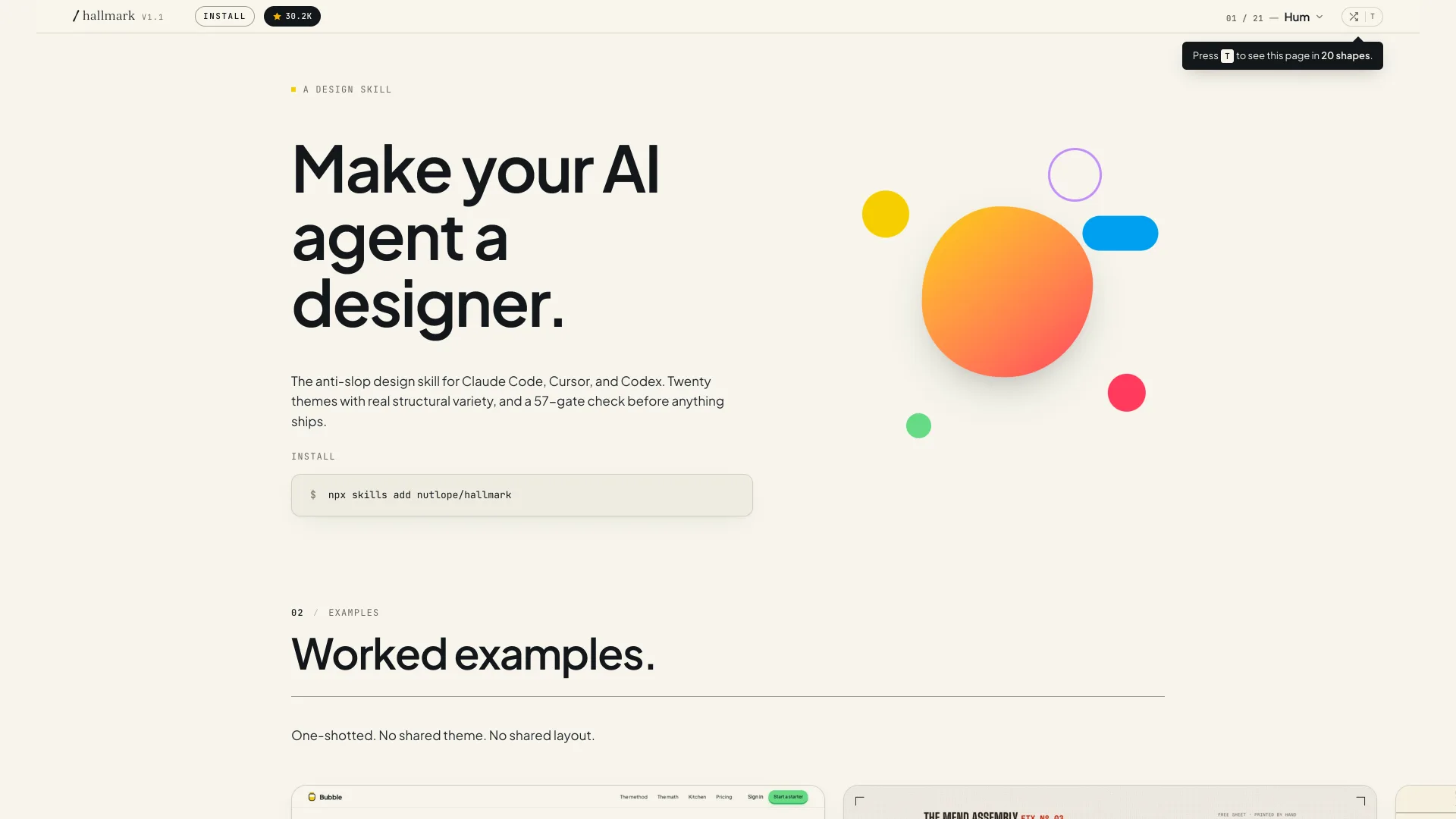
What it does not do: the gates are questions the model answers about its own output, so they are as reliable as its self-review. Its SKILL.md is 67,460 bytes, the largest here, and the last commit was August 6, 2026. Install with npx skills add nutlope/hallmark.
Side by Side
Stars and versions as of October 16, 2026.
| Skill | License | GitHub stars | Main SKILL.md | Deterministic checker | Scope |
|---|---|---|---|---|---|
| Taste Skill v2.0.0 | MIT | 97,734 | 29,312 bytes | Yes: source lint and browser inspector | Public pages, not dashboards |
| Impeccable 4.6.0 | Apache-2.0 | 81,802 | 12,510 bytes | Yes: 59 rules, runs on every edit | Any UI, 24 commands |
| frontend-design | Apache-2.0 | 181,493 (whole repo) | 9,390 bytes | No | Any UI |
| Emil Kowalski's skills | MIT | 46,591 | 27,123 bytes | No | Mostly motion, plus UI and Swift |
| Hallmark | MIT | 30,184 | 67,460 bytes | No: 58 gates the model answers | New pages, audits, redesigns |
How to Choose a Taste Skill
- Decide whether you need proof or guidance. For pages that must pass review in CI, pick a skill with a checker.
- Match the scope to the screen. Marketing pages suit Taste Skill. Product UI and an existing design system suit Impeccable or frontend-design.
- Count the context. A 67 KB skill competes with your code for context.
- Add motion rules separately. Emil Kowalski's skills stack with any of the others.
Verdict
- Building a public landing page from scratch: Taste Skill, if you can spend 30 to 45 minutes and a few hundred thousand tokens per page.
- Polishing an existing product UI: Impeccable, for the per-edit hook and the
auditandpolishcommands. - Minimal setup in Claude Code: Anthropic's frontend-design.
- Animations that feel wrong: Emil Kowalski's skills.
- Want a catalog of themes to start from: Hallmark.
Conclusion
"AI taste" is trending because agents made decent output cheap and identical. The best skills that answer it also measure the result. On the Tracehound page, the two checkers agreed on the familiar tells and split on structure and contrast, so run both on pages you care about. Just remember what they prove: a page with zero tells is not yet a page with an idea, and Taste Skill's own blind test showed exactly that.
Related DevToolLab Tools
- Color Contrast Checker - test gray-on-tint text like Tracehound's 4.1:1 hero copy before a detector does.
- Color Palette Generator - build a ground, ink and accent set to replace the violet defaults both checkers flag.
- Google Fonts Previewer - compare typefaces side by side when Inter gets flagged as the only face.
- CSS Cubic Bezier Generator - shape the ease-out curves Emil Kowalski's easing flowchart asks for.