
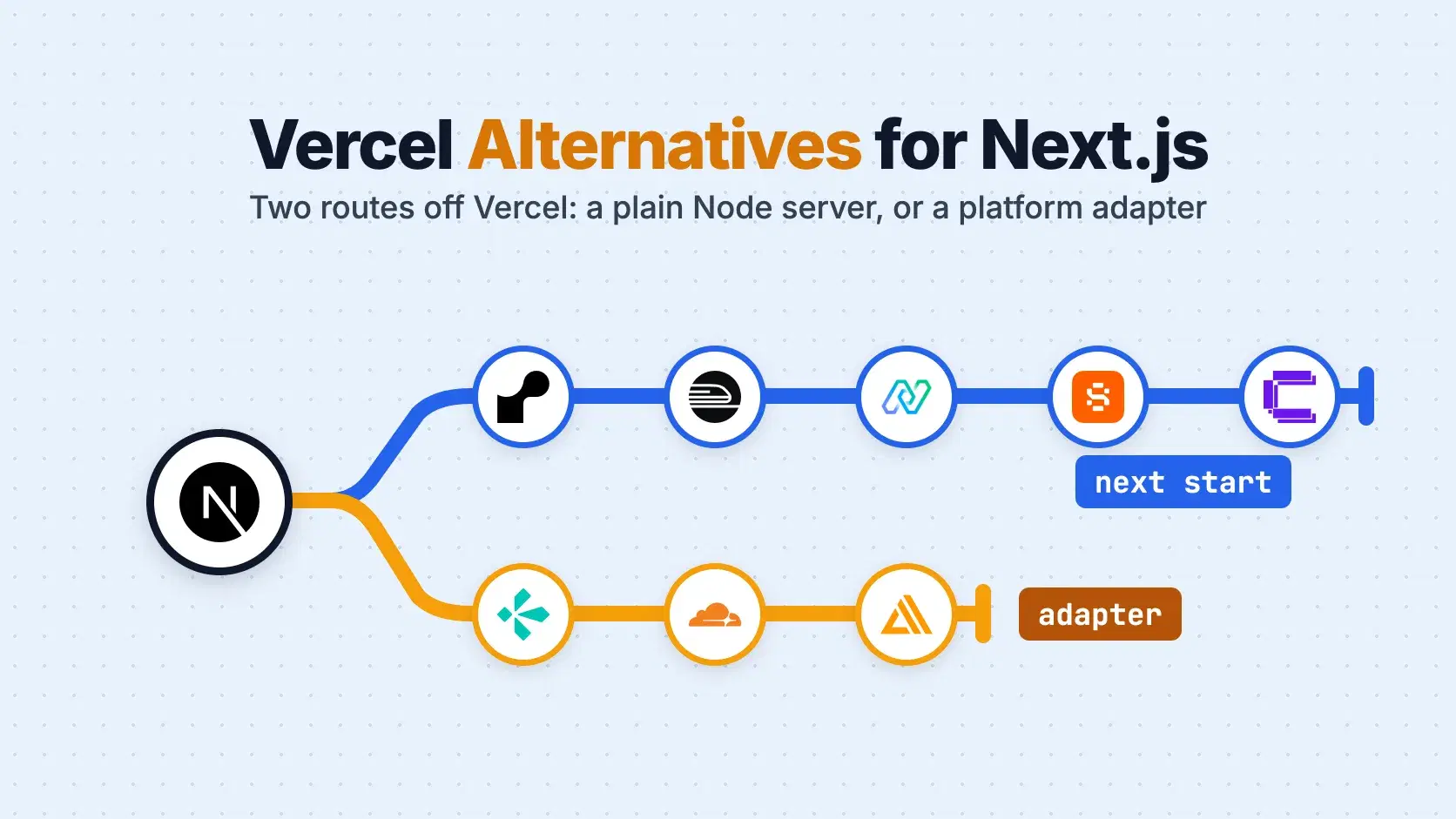
Vercel is the default home for Next.js because the framework and the host come from the same company. The bill is where that comfort gets tested: a seat for every developer who deploys, CDN capacity tiers, function CPU, and now the builds themselves.
On November 25, 2026, Vercel moved existing Pro teams' Standard builds to usage-based billing at $0.014 per build minute, eight days after it did the same for new teams. The build slot that came with every Pro plan is gone, and build time now draws down the same $20 monthly credit as everything else.
Leaving is easier than it was a year ago. Below are eight hosts, what each one does to a Next.js app, and what the same app costs on all of them.
What Next.js Actually Needs From a Host
The Next.js deployment guide says it in one line: "To run Next.js, your platform needs a Node.js server. That's it." A single next start process handles Server Components, ISR, Partial Prerendering, Cache Components, Server Actions, Proxy and after(), and the guide marks streaming as required for Server Components, PPR, Cache Components and Server Actions. Next.js 16.2 shipped March 18, 2026, and a week later the team declared its Adapter API stable for platforms that want more than a Node server.
The catch is scale. Each instance keeps its own cache, so an on-demand revalidateTag() on one instance does not reach the others unless you configure a shared cacheHandler, usually backed by Redis.
That splits the alternatives into two families. Container hosts (Render, Railway, Northflank, Sevalla, Coolify) run next start unchanged, so every feature works, served from the region you pick. Edge and serverless hosts (Netlify, Cloudflare, AWS Amplify) spread your app across a CDN, but each translates Next.js through its own adapter. The Next.js Deploying page, updated August 6, 2026, lists only Vercel's and Bun's adapters as verified against the full test suite.
What One App Costs on Each Platform
We priced one workload everywhere: a three-developer team's Next.js 16 storefront serving 300 GB and 2 million requests a month, with 150 production deploys of four build minutes each (600 build minutes). Rates come from each vendor's pricing page, read November 25, 2026.
| Platform | Plan + traffic | With a 1 vCPU / 2 GB server | Where the money goes |
|---|---|---|---|
| Vercel | $80.00 | - | Three $20 seats, $20 Flat Rate CDN tier; $8.40 of builds fits in the $20 credit |
| Netlify | $60.00 | - | 8,650 credits: $20 Pro (3,000 credits) plus four $10 packs of 1,500 |
| Cloudflare Workers | $5.00 | - | Inside every included allowance |
| AWS Amplify | $51.60 | - | $6 builds, $45 data out, $0.60 SSR requests |
| Render | $66.25 | $91.25 | $25 Pro, $41.25 bandwidth past 25 GB, $25 server |
| Railway | $15.00 | $55.02 | $15 egress, $40.02 server at full CPU |
| Northflank | $18.00 | $42.00 | $18 egress, $24 server |
| Sevalla | $42.00 | $82.00 | $30 bandwidth, $12 builds, $40 server |
| Coolify Cloud | $5.00 | - | Control plane for 2 servers; the servers are yours |
The serverless rows still owe function compute, which depends on how much traffic renders dynamically. The container rows include one always-on server; Railway's figure is a ceiling that assumes the CPU is busy all month. Northflank publishes no per-minute build rate, so its row leaves builds out.
Vercel needs one caveat. Its Flat Rate CDN docs, on by default for new Pro teams, include 1 million requests and move a team that stays above that for a billing cycle onto the $20 tier for 10 million; you can also turn Flat Rate CDN off and pay per request from the credit. The public pricing page still shows 10 million requests included, which would make the bill $60.
Netlify
Netlify is the closest match to Vercel's workflow: git push, preview URLs per branch, and a Next.js runtime you never configure. Its open-source adapter, built on OpenNext, supports Next.js 13.5 and later (@netlify/plugin-nextjs 5.16.9, November 23, 2026).
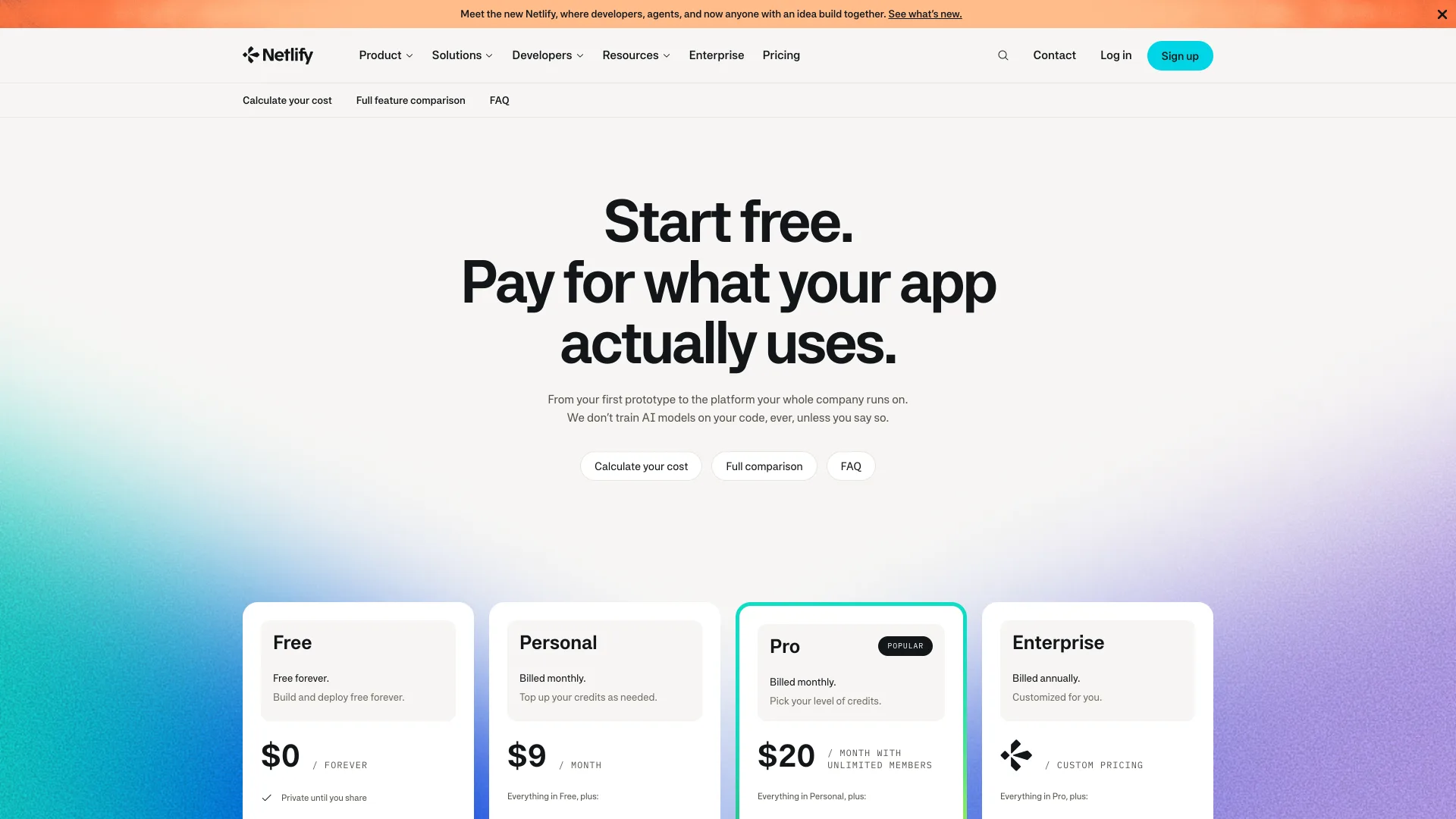
Netlify's feature table lists full support for on-demand ISR, Server Actions, streaming, after() and Cache Components; Node.js middleware has a documented limitation.
The meter is the catch. Since September 4, 2025, new accounts run on credits: Pro is $20 a month with unlimited members and 3,000 credits, a GB of bandwidth costs 20 credits and each production deploy costs 15. Our storefront burns 8,650 credits, and a team shipping ten times a day spends 4,500 a month on deploys alone.
Pricing: Free (300 credits) · Personal $9/month · Pro $20/month, 3,000 credits, unlimited members · extra 1,500 credits $10
Cloudflare Workers
Cloudflare's Next.js guide for Workers points new projects at vinext, a Vite plugin that reimplements the Next.js API surface, instead of OpenNext. vinext 1.4.6 (MIT, November 16, 2026) keeps your app/ and next.config.js, and npx vinext check reports what it cannot run yet.
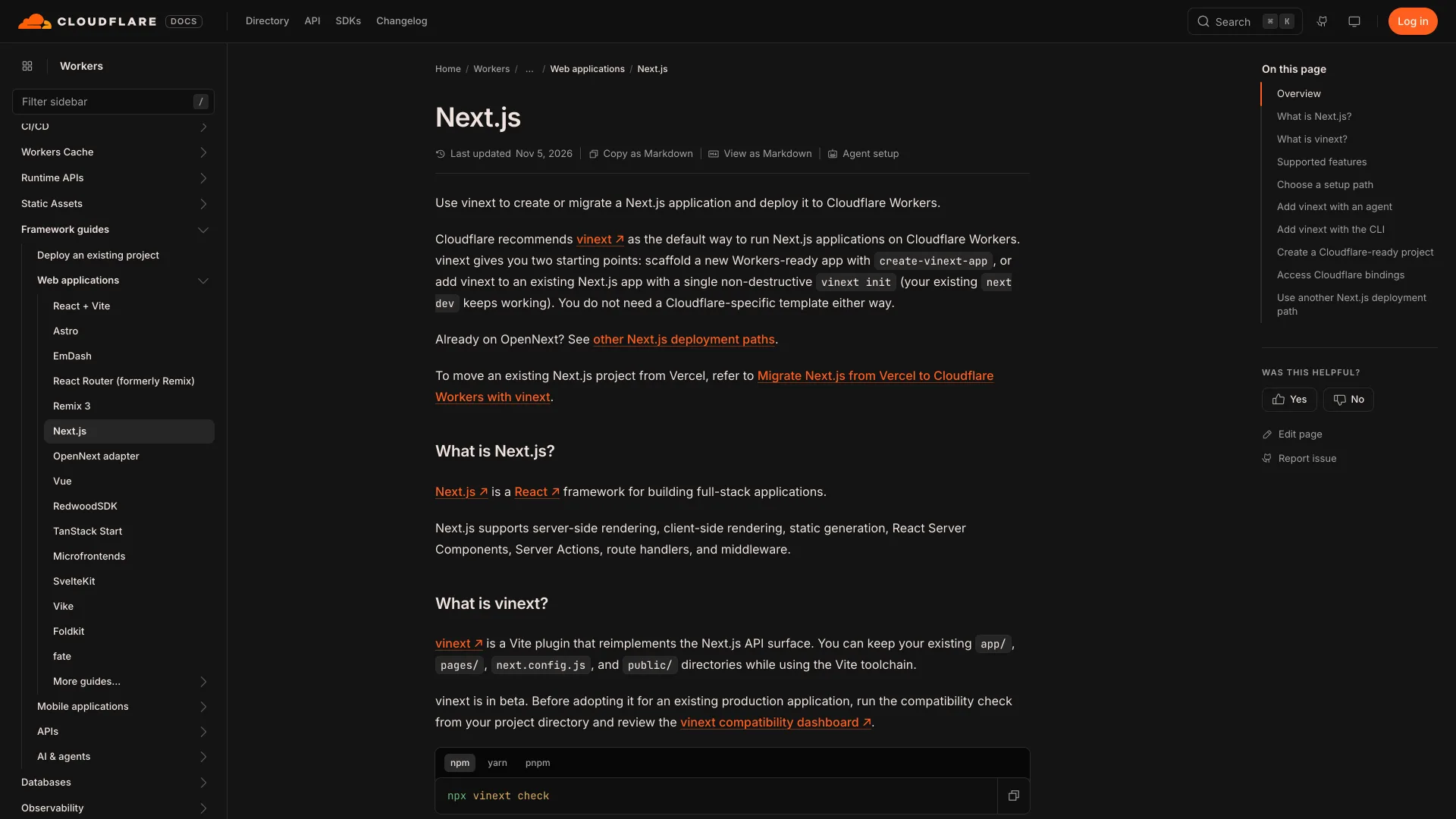
Workers Paid has a $5 monthly minimum, includes 10 million requests and 30 million CPU milliseconds, charges nothing for egress, and serves static asset requests free. Builds include 6,000 minutes a month, then $0.005 a minute.
vinext is a reimplementation, labeled beta, and image optimization is only partly supported. The older OpenNext adapter (@opennextjs/cloudflare 1.20.19) stays the fallback for apps vinext cannot run yet. It supports PPR, while Node.js middleware (proxy.ts) is still experimental. Code that uses KV or R2 bindings also ties you to Cloudflare.
Pricing: Workers Free · Workers Paid $5/month minimum, then $0.30 per million requests and $0.02 per million CPU ms
Render
Render runs Next.js the way the docs describe it: a Node.js web service running next start, so every feature works without an adapter.
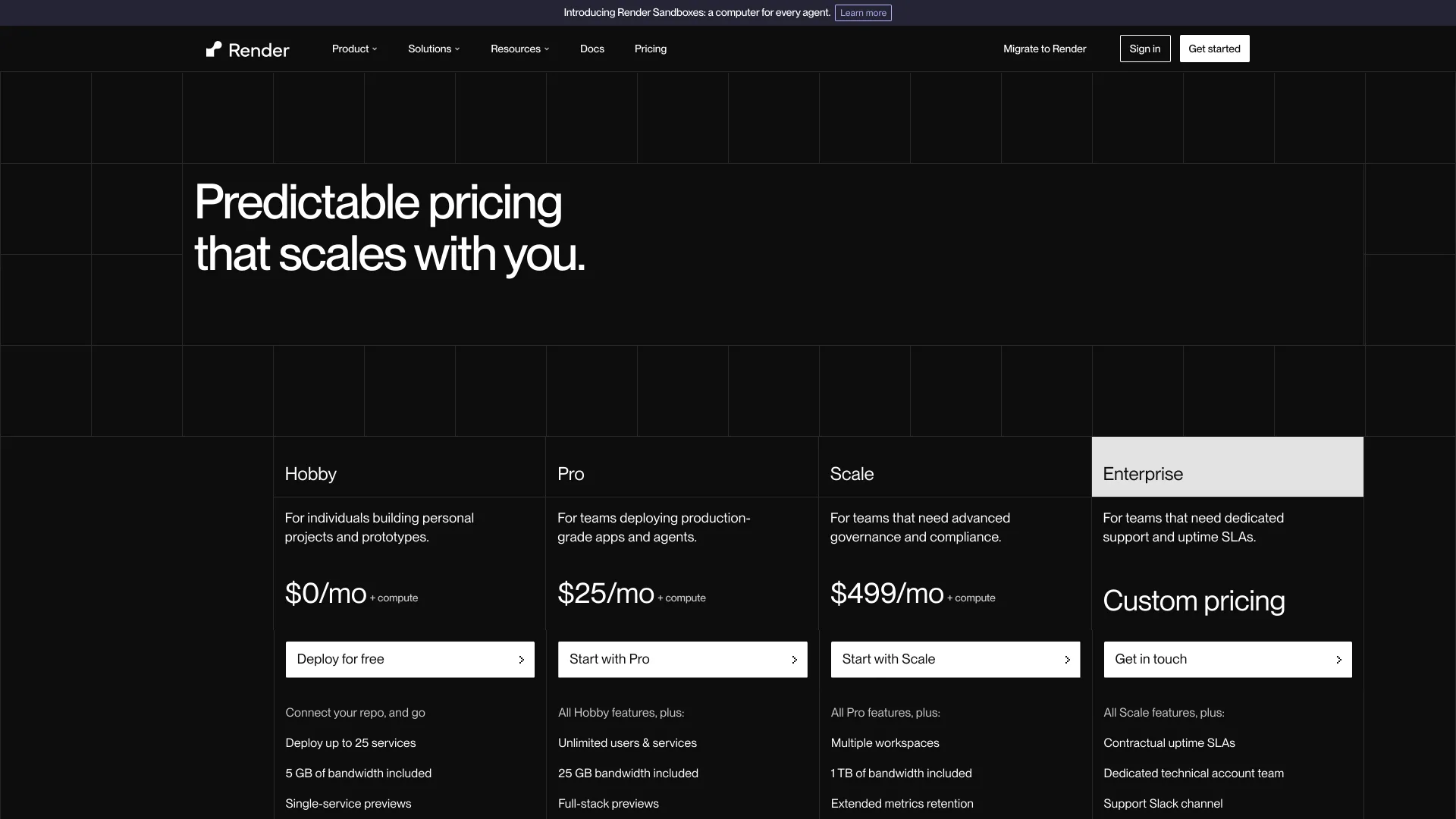
The Pro workspace is a flat $25 a month with unlimited users, the line that matters for a team of three or more. It includes 25 GB of bandwidth and 1,000 build minutes, and a 1 CPU, 2 GB web service is $25 a month.
Bandwidth past 25 GB is $0.15 a GB, so traffic is the biggest line on a busy site: $41.25 of our $91.25. Scale past one instance and you need the shared cache handler.
Pricing: Hobby $0 · Pro $25/month + compute · Scale $499/month + compute · bandwidth $0.15/GB after the allowance
Railway
Railway bills by the second for what a container actually uses, and Pro includes unlimited workspace seats. Next.js lists it as a Node.js server template.
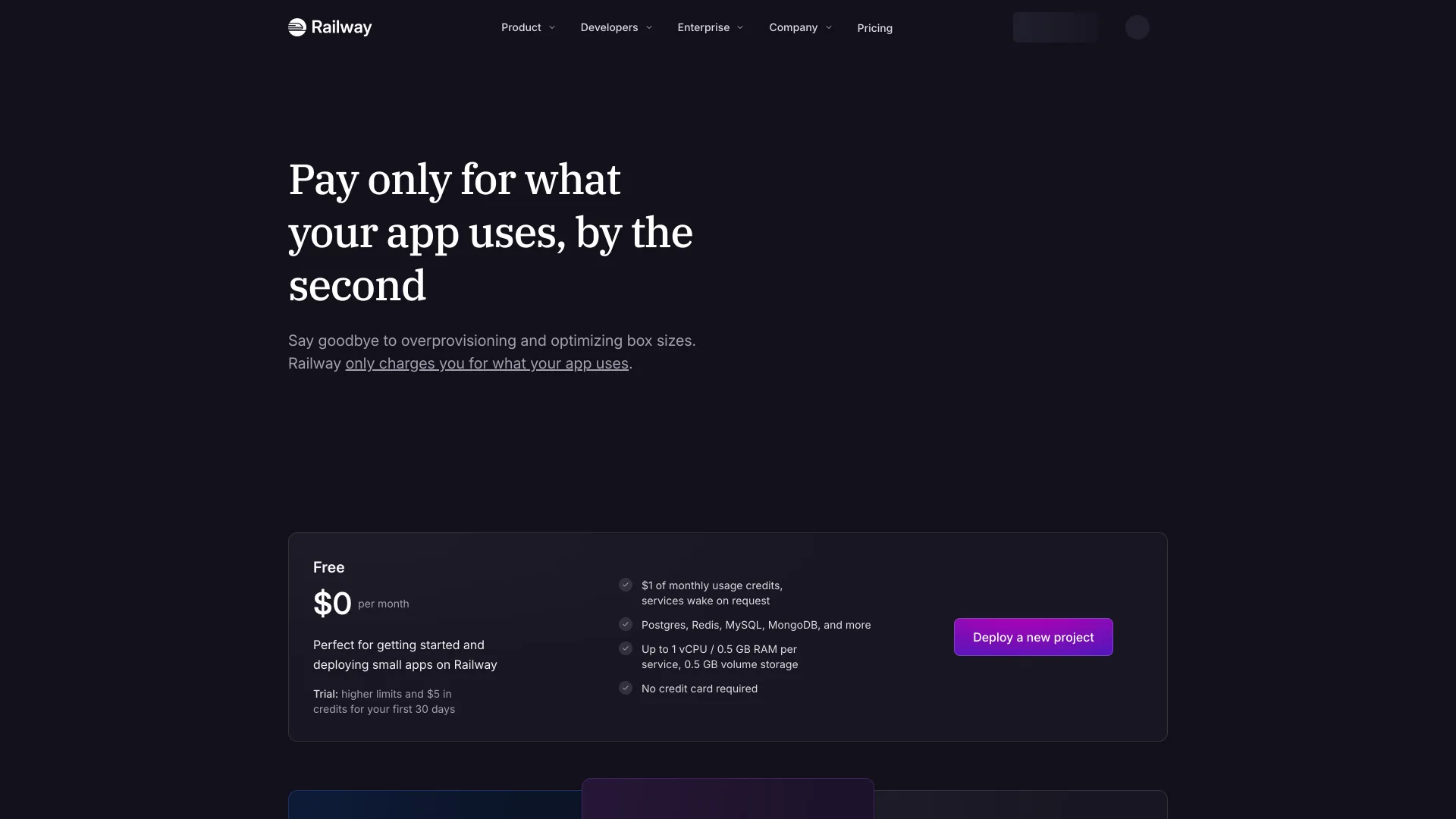
Pro is a $20 monthly minimum that includes $20 of usage. Compute is $0.00000772 per vCPU-second (about $20 a vCPU-month) and $0.00000386 per GB-second (about $10 a GB-month), egress is $0.05 a GB, and Railway's docs say service builds are free.
Usage billing cuts both ways: a store that idles at night costs well under our $55.02 ceiling, and a launch spike costs more, so set usage limits first.
Pricing: Free ($1 of credit) · Hobby $5 minimum usage · Pro $20 minimum usage, unlimited seats · egress $0.05/GB
Coolify
Coolify is the open-source option: a self-hosted platform that turns any server you own into a git-push deploy target with a dashboard on top. It is Apache 2.0 licensed, at v4.7.8 as of November 25, 2026, with about 66,000 GitHub stars.
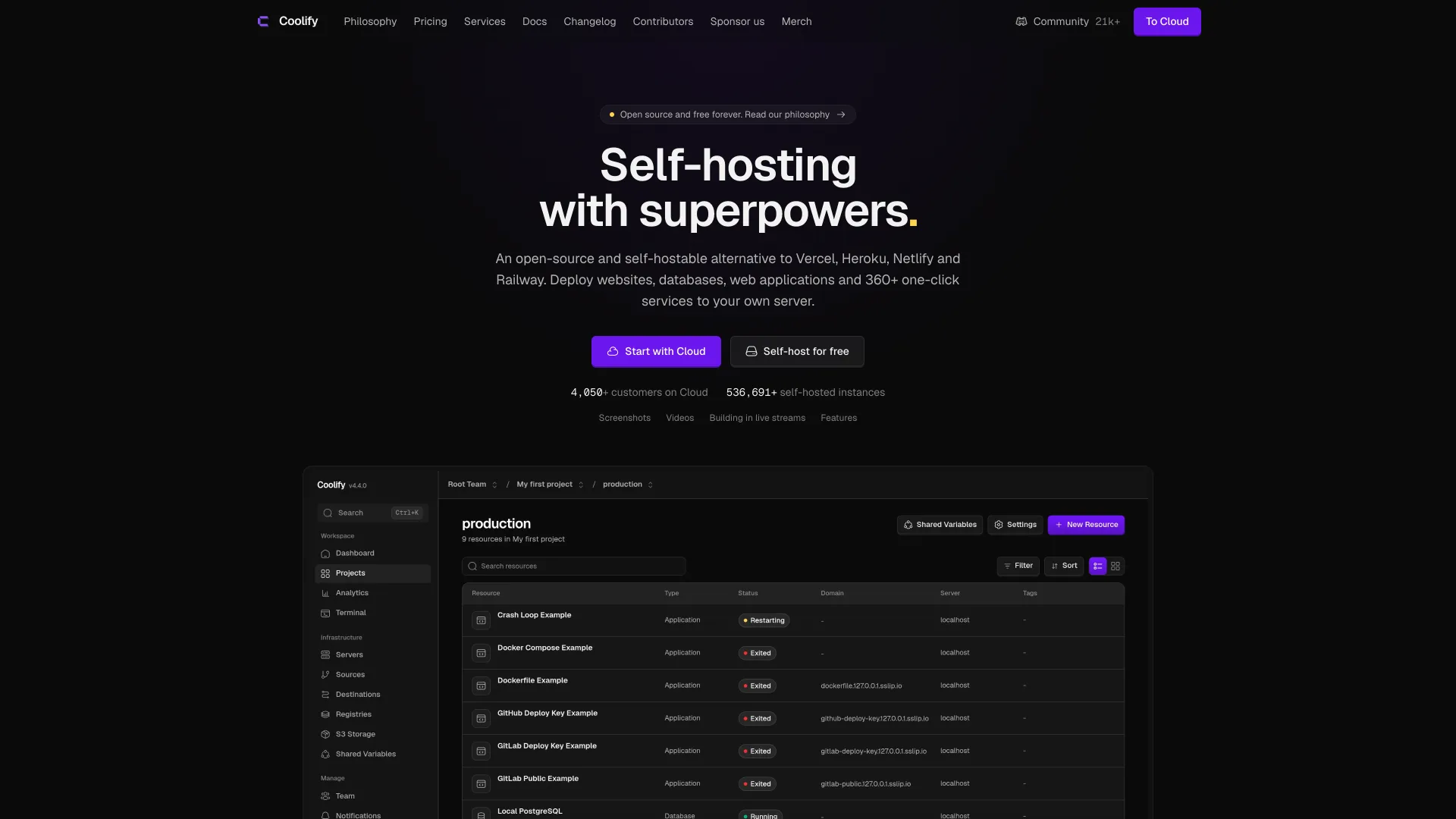
Self-hosting is free. Coolify Cloud, where Coolify runs the control plane for servers you bring, is $5 a month for two servers plus $3 per extra one. Your app runs as a container, so next start works unmodified.
You become the operations team: OS patches, backups, monitoring and uptime, and no CDN unless you put one in front. It fits teams with someone who already runs Linux boxes.
Pricing: Self-hosted free (Apache 2.0) · Cloud $5/month for 2 servers + $3/month per extra server
Northflank
Northflank is a container platform with no seat fees and per-second billing that can also deploy into your own AWS, Google Cloud or Azure account.
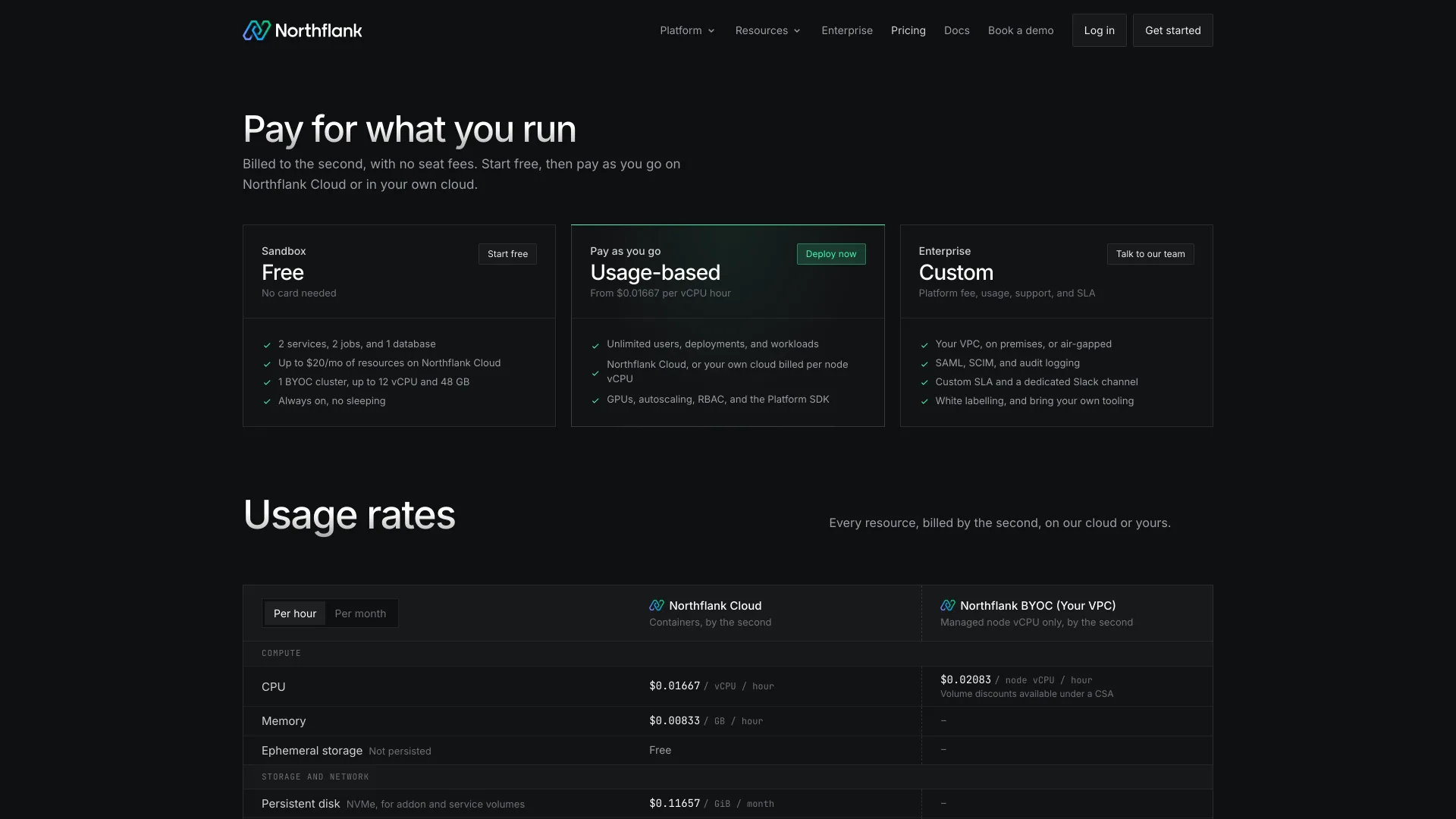
Compute is $0.01667 per vCPU-hour and $0.00833 per GB-hour, so the 1 vCPU, 2 GB nf-compute-100-2 plan is $24 a month, the cheapest always-on server in our run. Egress is $0.06 a GB.
The pricing page lists no seperate build rate, so check build costs in the dashboard before trusting our $42.
Pricing: Sandbox free · Pay as you go from $0.01667 per vCPU-hour, no seat fees · egress $0.06/GB
Sevalla
Sevalla is Kinsta's application platform: git or Docker deploys, 25 data center locations and a built-in Cloudflare integration for DDoS protection. Its pricing page advertises "No per-seat pricing."
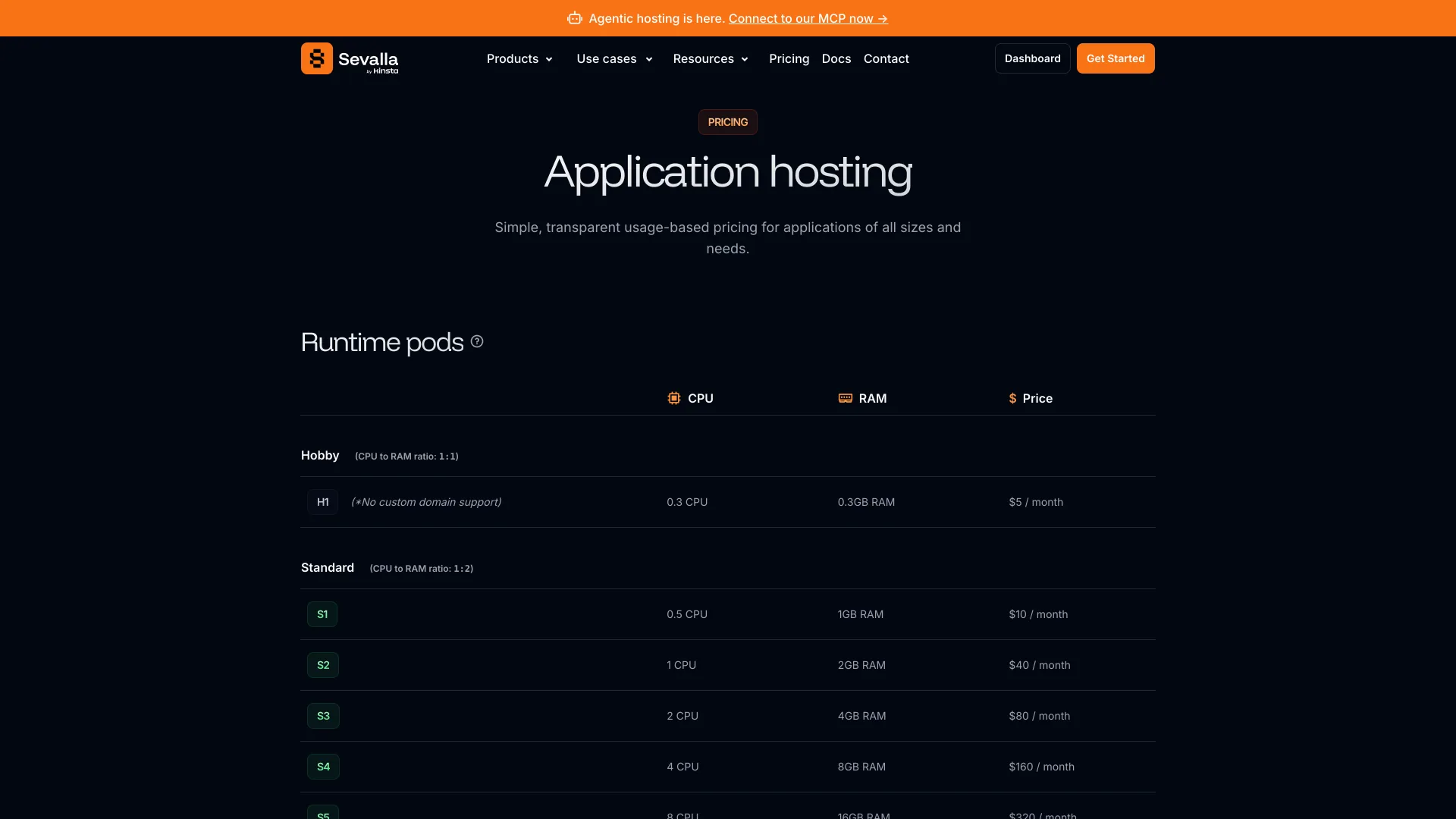
A Standard pod with 1 CPU and 2 GB is $40 a month, builds run on 4 CPU, 8 GB pods at $0.02 a minute, and external bandwidth is $0.10 a GB.
That 1 CPU pod costs $15 to $16 more than Render's or Northflank's, which is why Sevalla lands at $82. Hibernating idle pods narrows the gap on staging environments.
Pricing: Hobby pod $5/month · Standard 1 CPU / 2 GB $40/month · builds $0.02/min · bandwidth $0.10/GB
AWS Amplify Hosting
AWS Amplify Hosting runs Next.js on AWS-managed compute behind CloudFront, with no per-seat pricing. DevToolLab itself runs on it, so this entry comes with scars.
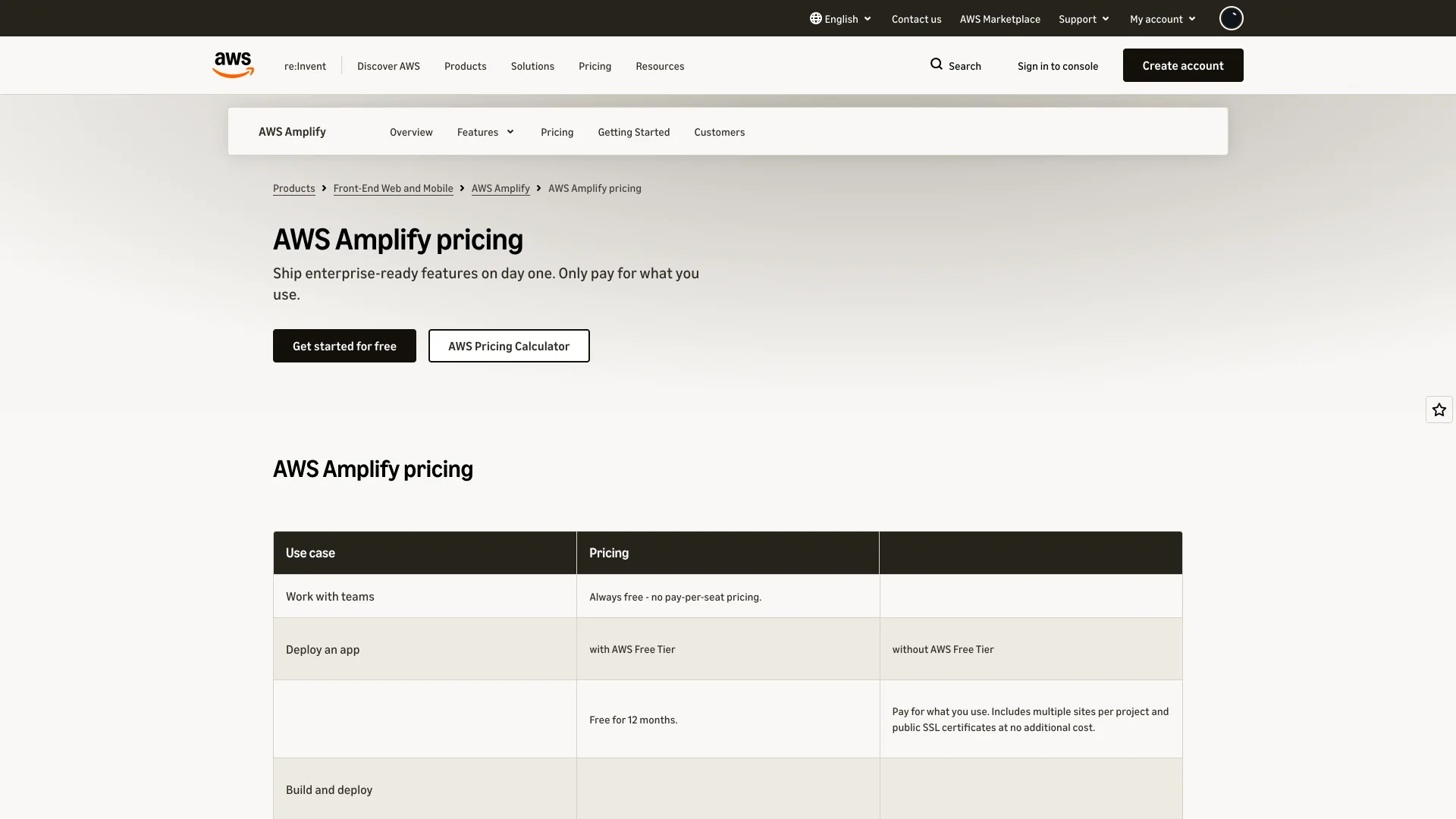
Builds are $0.01 a minute, data out is $0.15 a GB, and SSR costs $0.30 per million requests plus $0.20 per GB-hour.
Amplify's documentation supports Next.js 12 through 15 and lists on-demand ISR, streaming, after(), Edge API routes and Edge middleware as unsupported. It also caps the uncompressed server compute bundle at 220 MB: in October 2026 our deploy failed with "The size of the build output exceeds the max allowed size of 230686720 bytes" after npm run build had reported success. Moving older posts to ISR fixed it.
Pricing: No seat fees · builds $0.01/min · data out $0.15/GB · SSR $0.30 per 1M requests + $0.20 per GB-hour
Side by Side
| Platform | How Next.js runs | Team seats | Bandwidth | Builds | Our example month |
|---|---|---|---|---|---|
| Vercel | Verified adapter | $20 each | 1 TB included, 50 TB on the $20 tier | $0.014/min | $80 + compute |
| Netlify | OpenNext-based adapter | Unlimited on Pro | 20 credits/GB | 15 credits/deploy | $60 + compute |
| Cloudflare Workers | vinext (beta) or OpenNext | Not billed | Free | 6,000 min included | $5 + CPU |
| Render | next start | Unlimited on Pro | 25 GB, then $0.15/GB | 1,000 min included | $91.25 |
| Railway | next start | Unlimited on Pro | $0.05/GB | Free | Up to $55.02 |
| Coolify | next start on your server | Not billed | Your server's | Your server | $5 + server |
| Northflank | next start | No seat fees | $0.06/GB | Not published | $42 |
| Sevalla | next start | No per-seat pricing | $0.10/GB | $0.02/min | $82 |
| AWS Amplify | Amplify SSR (Next.js 12-15) | No per-seat pricing | $0.15/GB | $0.01/min | $51.60 + compute |
How to Choose Without Migrating Twice
- Price your real month. Copy last month's seats, transfer, requests and build minutes from Vercel's Usage page and price them against each vendor's rates, the way the table above does.
- Inventory your Next.js features. Grep for
revalidateTag,"use cache",after(and a Node.jsmiddleware.ts, then check each against your shortlist. On Cloudflare,npx vinext checkdoes it for you. - Decide on one instance or many. Two or more need a shared
cacheHandlerbefore you rely on on-demand revalidation. - Deploy a preview branch first. Compare TTFB and Lighthouse scores for the same pages on both hosts.
- Cut over DNS last. Every old URL should reach its page in one hop, or search engines will definately notice the chain.
Which One Should You Actually Use?
Mostly static, lots of traffic: Cloudflare Workers. Free egress makes bandwidth a non-issue, if vinext check comes back clean.
Vercel's workflow without per-seat billing: Netlify. The adapter covers the App Router feature set, and unlimited members fixes Vercel's fastest-growing line.
Plain next start and a predictable bill: Render for a flat workspace price, Railway if traffic is uneven.
Already on AWS: Amplify only if you stay on Next.js 15 without streaming. Otherwise, Northflank's BYOC option inside your own account.
No budget, and someone runs servers: Coolify on a box you already pay for.
Conclusion
In 2026 Next.js stopped needing Vercel: a stable Adapter API, docs that call a Node.js server enough, and Cloudflare reimplementing the framework on Vite. Vercel is still the smoothest place to run it, but its bill now meters builds on top of seats and CDN tiers. Price your own month the same way before you renew. If the gap is under $20 a month, migration time will cost more than you recieve back.
Related DevToolLab Tools
- Redirect Chain Checker - confirm every old URL reaches its page in one hop after the DNS cutover.
- AWS Lambda Cost Calculator - estimate the function compute the cost table leaves out when Next.js runs on Lambda.
- Lighthouse Score Calculator - see how TTFB and LCP changes move your score on a preview deploy.
- DNS Zone File Validator - check the zone exported from Vercel DNS before importing it elsewhere.
Related Guides
- Best Heroku Alternatives - container hosts for the backend services beside your Next.js app.
- 7 Best Deno Deploy Alternatives - where edge functions go now that Deno Deploy is shutting down.
- Best Serverless Postgres - a database for your new host if you used Vercel's storage integrations.
- Developer Tools Pricing Index - 160+ developer tool prices checked against vendor pages.