
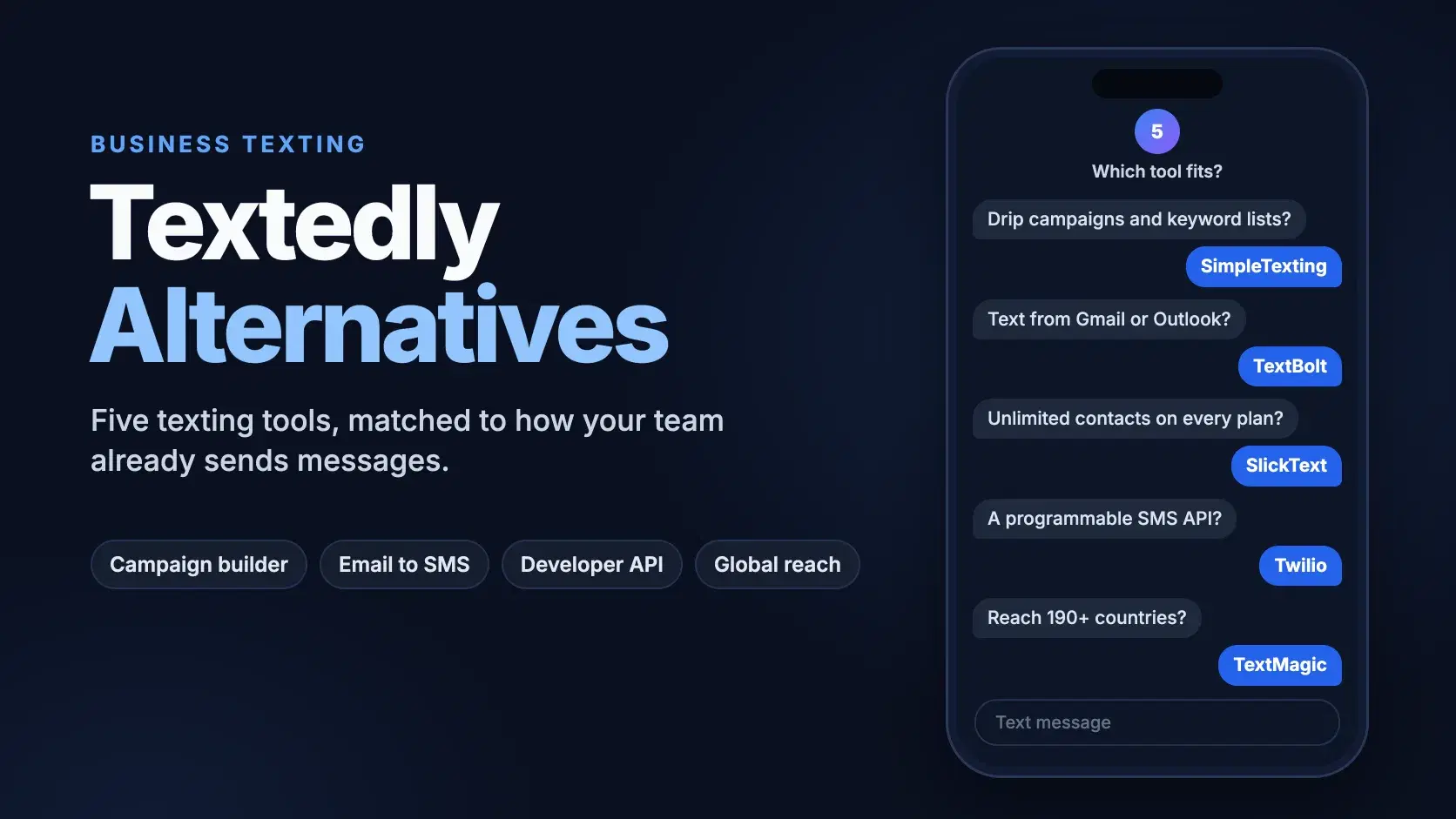
Textedly does what it promises: affordable bulk SMS for small and mid-sized businesses. But the business texting market has matured considerably, and the right tool depends on whether you need a campaign builder, a developer-grade API, or a zero-code gateway that works inside your existing email client. This article walks through five strong alternatives, covering what each does well and which teams it actually suits.
1. SimpleTexting
SimpleTexting is a dedicated SMS marketing and communication platform built for businesses that need to run campaigns, automate follow-ups, and manage subscriber lists at scale. Founded in 2010 and now serving tens of thousands of organizations across North America, it functions as a full-service messaging hub rather than a lightweight gateway.
Its core strengths sit in the campaign layer. Teams can segment contact lists by keyword responses, schedule recurring messages, and build drip sequences without writing any code. A/B testing for message content is also built in, which remains relatively uncommon among SMS-specific platforms.
On the integration side, SimpleTexting connects natively with Mailchimp, HubSpot, Zapier, and Shopify, making it a natural fit for marketing teams already working inside those ecosystems. Compliance tools, including opt-out management and TCPA guidance documentation, are thorough and easy to navigate.
Pricing starts at roughly $29 per month for a starter credit bundle, with costs scaling as volume grows. A 14-day free trial is available, though there is no permanent free tier.
SimpleTexting is the right choice for marketing and customer success teams centered on subscriber-driven campaigns and promotional messaging. If that matches your primary use case, it competes directly with Textedly at comparable price points while offering a more developed automation layer.
2. TextBolt
TextBolt is a no-code email-to-SMS gateway trusted by more than 3,000 teams across healthcare, IT, education, logistics, and government, delivering over 2.4 million texts per month. The platform lets any email client or automated system send an SMS and receive replies as a threaded inbox email, with no SDK and no code changes.
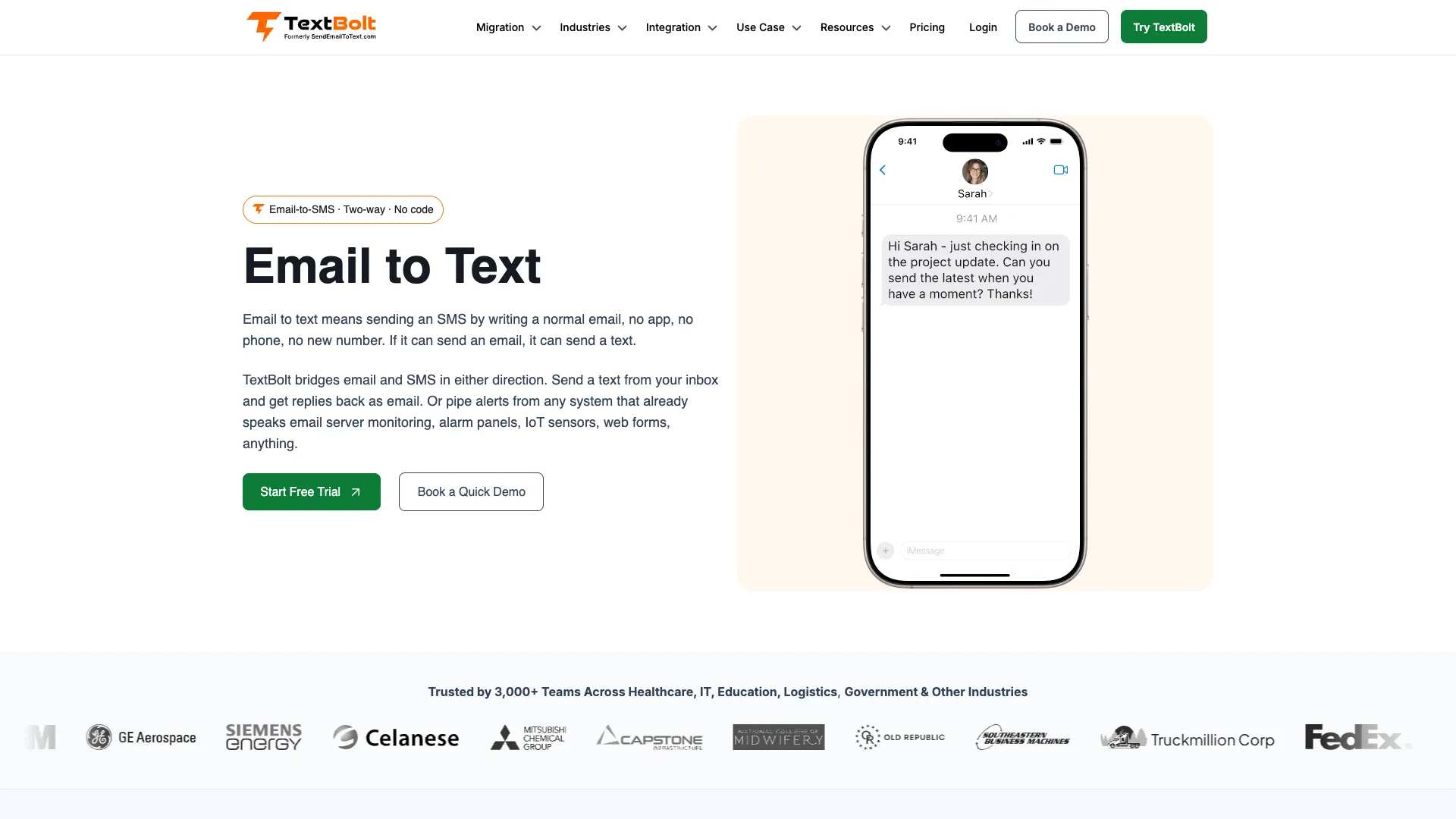
That architecture sets it apart from most alternatives in this space. Where SimpleTexting requires teams to work inside a dedicated messaging dashboard, TextBolt operates entirely within Gmail or Outlook. Outbound texts go out as emails; replies come back as threaded conversations in the same inbox, with no new interface to learn and no additional login to manage.
TextBolt has also emerged as a practical replacement for the carrier email-to-text gateways from AT&T, T-Mobile, and Verizon that are currently being phased out. Organizations that relied on those free carrier pathways need a compliant A2P 10DLC solution, and TextBolt provides verified business numbers along with the underlying infrastructure to support it.
Use cases are broad: healthcare teams send appointment reminders, IT operations teams route on-call infrastructure alerts, and broadcast facilities manage transmitter alarms, all without modifying their existing workflow tools.
Pricing includes a 7-day free trial, with subscription tiers that scale by message volume.
TextBolt is the strongest fit for teams that need dependable SMS delivery but have no appetite for adopting a new platform. If your operations already center on email, it eliminates the friction entirely.
3. SlickText
SlickText is an SMS marketing platform built around subscriber growth and customer retention. Launched in 2011, it has developed a loyal following among retailers, restaurants, and entertainment venues that rely on text messaging as a direct channel to repeat customers rather than a general-purpose communication tool.
The platform's most distinct feature is its loyalty and rewards engine. Businesses can attach point-based rewards to text interactions, encouraging customers to opt in, engage with offers, and return more frequently. This positions SlickText differently from tools like SimpleTexting or Textedly, which focus primarily on outbound broadcast messaging without the retention layer built in.
Keyword-based opt-in campaigns are another core strength. Teams assign a short keyword to a phone number, promote it in-store or on packaging, and subscribers join a list automatically by texting that word. The setup is fast and requires no technical skill, which matters for small business owners managing campaigns without a dedicated marketing team.
SlickText also supports drip automations, MMS messaging, and integrations with Shopify, Mailchimp, and Zapier. Its analytics dashboard surfaces opt-out rates, click-throughs, and subscriber growth over time, giving teams the data to refine campaigns without exporting to a separate tool.
Pricing begins at around $29 per month and scales with message volume. All plans include unlimited contacts, which is a practical advantage for businesses with large but infrequently messaged lists.
SlickText is best suited for consumer-facing businesses in retail, hospitality, and entertainment that want SMS to drive repeat visits and measurable customer loyalty.
4. Twilio
Twilio is a cloud communications platform that gives developers programmatic control over SMS, voice, WhatsApp, and email through a single API. Founded in 2008 and now serving companies across virtually every industry, it operates at the infrastructure layer of business communications. Teams build custom solutions on top of it rather than working inside a finished product.
That distinction is both its greatest strength and its primary limitation. Twilio's Programmable Messaging API is flexible enough to support almost any use case: transactional alerts, two-way conversational SMS, appointment reminders at scale, or fully custom omnichannel workflows. Companies including Airbnb and Lyft have built their core customer notification systems on Twilio's infrastructure, a signal of how far the platform can scale under real production load.
Pricing follows a pay-as-you-go model, starting at around $0.0083 per outbound SMS in the United States, with no monthly minimums. That structure makes it cost-effective for high-volume technical teams but unpredictable for smaller organizations without engineering resources to monitor and control usage.
Twilio also operates in more than 180 countries, which matters for businesses with international operations that need a consistent API across markets rather than managing separate regional tools.
Setup complexity is the main tradeoff. Configuring Twilio for production, including A2P 10DLC registration and webhook handling, typically requires a software engineer rather than a marketing manager or operations coordinator.
Twilio is best suited for engineering-led organizations that need highly customized messaging infrastructure and have the internal technical resources to build and maintain it over time.
5. TextMagic
TextMagic is a business SMS platform that has been operating since 2001, making it one of the most established services in this category. It covers the core use cases reliably: bulk notifications, appointment reminders, staff alerts, and two-way customer conversations, all accessible from a web dashboard, an API, or directly through email.
Its longevity has translated into broad global coverage. TextMagic operates across more than 190 countries, which gives it a practical edge over more US-centric platforms when organizations need to reach customers or staff in multiple regions without managing separate tools for each market.
The platform includes contact management with group segmentation, SMS surveys, and basic scheduling automation. An email-to-SMS feature also allows users to send texts from any email client, a concept similar to TextBolt's architecture, though TextMagic's primary interface remains its web dashboard rather than the inbox.
Pricing follows both a pay-as-you-go model and monthly subscription options. Pay-as-you-go rates start at around $0.049 per SMS in the United States, which suits organizations that send irregularly and want to avoid paying for unused message capacity each month. That flexibility is useful for smaller departments that need SMS occasionally rather than as a constant channel.
Integrations through Zapier, including HubSpot and Salesforce, extend the platform's reach for teams that want to connect SMS triggers to existing CRM and workflow tools without custom development.
TextMagic is best suited for small to mid-sized businesses, particularly those with international operations, that need a dependable and low-commitment SMS platform without the setup complexity of an API-first solution.
Conclusion
Business texting has moved well beyond simple broadcast messaging, and the tools that serve teams best in 2026 reflect that shift. Whether your priority is campaign automation, zero-code email integration, developer-grade flexibility, customer loyalty, or global reach, the right platform depends on matching the tool's architecture to your actual workflow. As carrier-managed gateways continue to sunset and A2P compliance requirements tighten, choosing a purpose-built solution now will save considerable friction later.
Related DevToolLab Tools
- Character Counter - check a campaign message's length before it splits into a second SMS segment and costs a second credit.
- URL Tracker - shorten the links in your texts and count who actually tapped them.
- UTM Link Builder - tag SMS campaign links so analytics can tell texting traffic apart from email.
- Webhook Receiver - inspect the inbound message webhooks Twilio sends before you write the handler.
Related Guides
- Best Email API Providers - Resend, Postmark, SendGrid, Amazon SES and Mailgun for the email side of the same notifications
- What Is a Webhook? - how inbound SMS replies reach your app when you build on an API like Twilio
- Best Opsgenie Alternatives - on-call tools and how they meter phone and SMS alerts
- Top 5 Bitly Alternatives - short links with analytics for campaign texts