
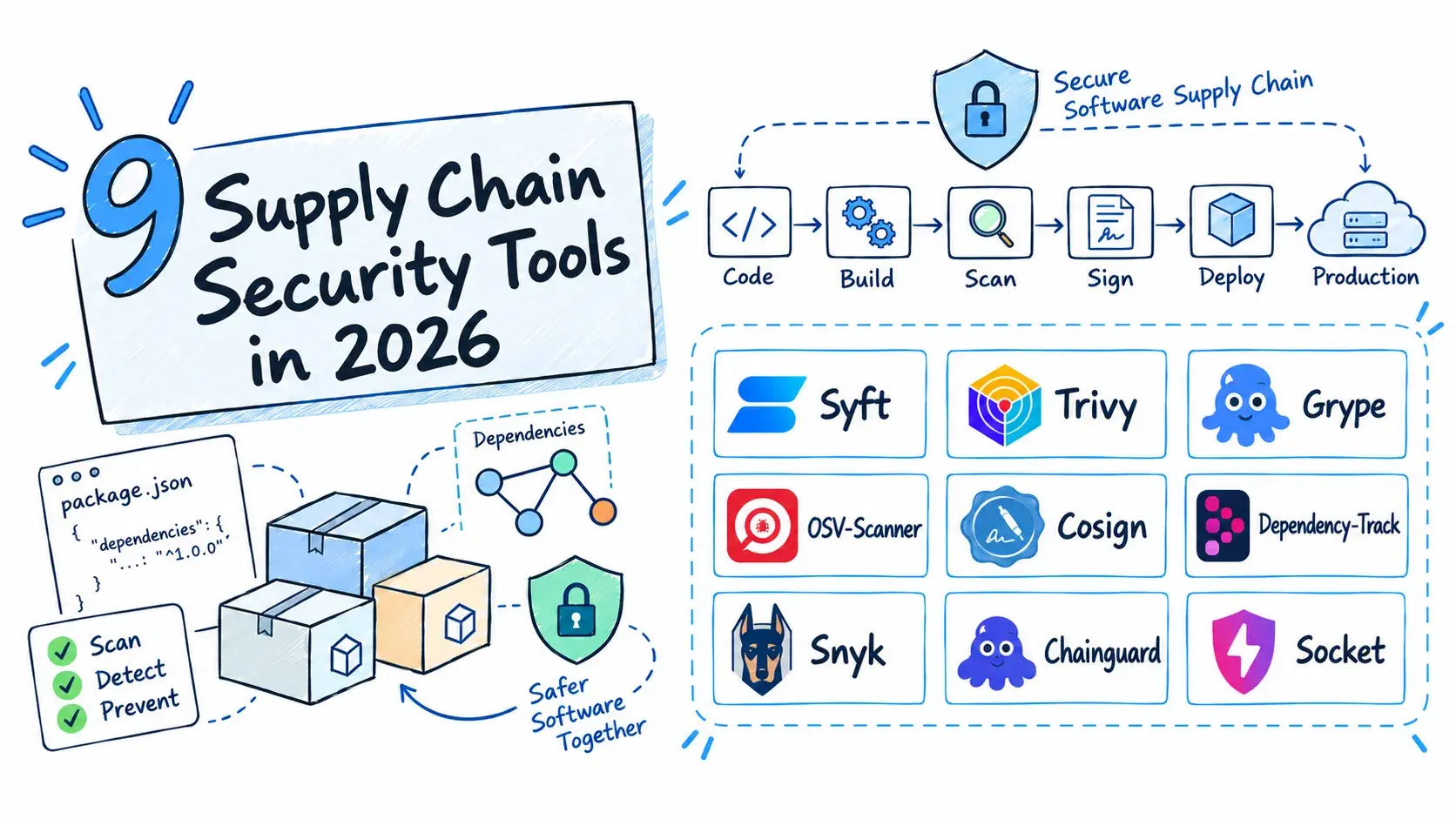
Most of the code that ships in a production application is code nobody on the team chose. Direct dependencies are a deliberate decision, but the transitive packages underneath them are resolved by a lockfile, refreshed by a bot, and reviewed by nobody. Supply chain security is the practice of knowing what is actually in that tree and proving it arrived the way you think it did.
The gap is easy to measure. I installed a single dependency, express@5.1.0, on September 19, 2026 and generated a CycloneDX software bill of materials from the lockfile. One direct dependency produced 67 components. Running the same process against a production Next.js 15 application with 112 direct production dependencies produced 762 library components, a 6.8x multiplier between what the team picked and what actually ships.
What Supply Chain Security Actually Covers
Supply chain security is three separate jobs, and most tools do one of them well. The first is inventory: producing a software bill of materials, or SBOM, that lists every component in a build. The second is provenance: signing artifacts and attesting to how they were built, so a consumer can verify that the binary came from the source it claims. The third is detection: finding known vulnerabilities in that inventory, and catching packages that are outright malicious rather than merely outdated.
Those jobs need different tools, and conflating them is the usual reason a "supply chain security" rollout stalls. A vulnerability scanner tells you nothing about whether your build pipeline was tampered with. A signing tool tells you nothing about whether the thing you signed contains a compromised package.
How Many Packages Does One Dependency Pull In?
One direct dependency pulls in far more than most developers expect, and the SBOM is how you see it. Here is the full reproduction, which takes under a minute with Trivy 0.74.0 installed:
Bashmkdir sbom-demo && cd sbom-demo npm init -y > /dev/null npm install express@5.1.0 --package-lock-only --no-audit --no-fund trivy fs --scanners vuln --format cyclonedx --output sbom.json package-lock.json
Then count what came back:
Pythonimport json bom = json.load(open("sbom.json")) print(f"CycloneDX spec : {bom['specVersion']}") print(f"components : {len(bom['components'])}") print(f"vulnerabilities: {len(bom.get('vulnerabilities', []))}")
Real output from that run on September 19, 2026:
textCycloneDX spec : 1.7 components : 67 vulnerabilities: 0
Sixty-seven components, zero known vulnerabilities. That second number is the honest part: a clean scan today says nothing about tomorrow, because the vulnerability is usually disclosed long after the package is installed. The SBOM is what lets you answer "am I affected" in minutes instead of days when it is.
Which Tools Generate an SBOM?
Syft and Trivy both generate SBOMs from source directories, lockfiles and container images, and both are Apache 2.0 licensed. Syft, maintained by Anchore, reached v1.52.0 on September 17, 2026 and carries 9,581 GitHub stars. Trivy, maintained by Aqua Security, reached v0.74.0 on August 14, 2026 and is by far the most-starred tool in this category at 37,980 stars.
The practical difference is scope. Syft does one thing, cataloging components, and emits SPDX or CycloneDX cleanly, which makes it the better building block in a pipeline. Trivy bundles SBOM generation with vulnerability scanning, misconfiguration checks and secret detection in a single binary, which makes it the better default if you want one tool in CI rather than four. Trivy 0.74.0 emits CycloneDX 1.7, as the output above shows.
Neither tool charges anything, and neither requires an account. If your only goal is an SBOM to hand to a customer or an auditor, the job is finished at this step.
How Do You Prove a Build Was Not Tampered With?
Signing and attestation prove provenance, and Sigstore is the project that made it practical. Cosign, the Sigstore signing client, reached v3.1.3 on August 6, 2026, is Apache 2.0 licensed and has 6,315 GitHub stars. Its contribution is keyless signing: instead of managing long-lived private keys, cosign uses short-lived certificates tied to an OIDC identity, such as a GitHub Actions workflow, and records the signature in a public transparency log.
The framework that gives those signatures meaning is SLSA, pronounced "salsa". As of September 19, 2026 the current specification is SLSA Version 1.2, marked Status: Approved on slsa.dev, and it defines a Build Track, a Source Track and cross-track requirements. This matters when reading older comparisons: SLSA v1.1 is now marked Retired, and the Source Track is a newer addition that most published roundups predate.
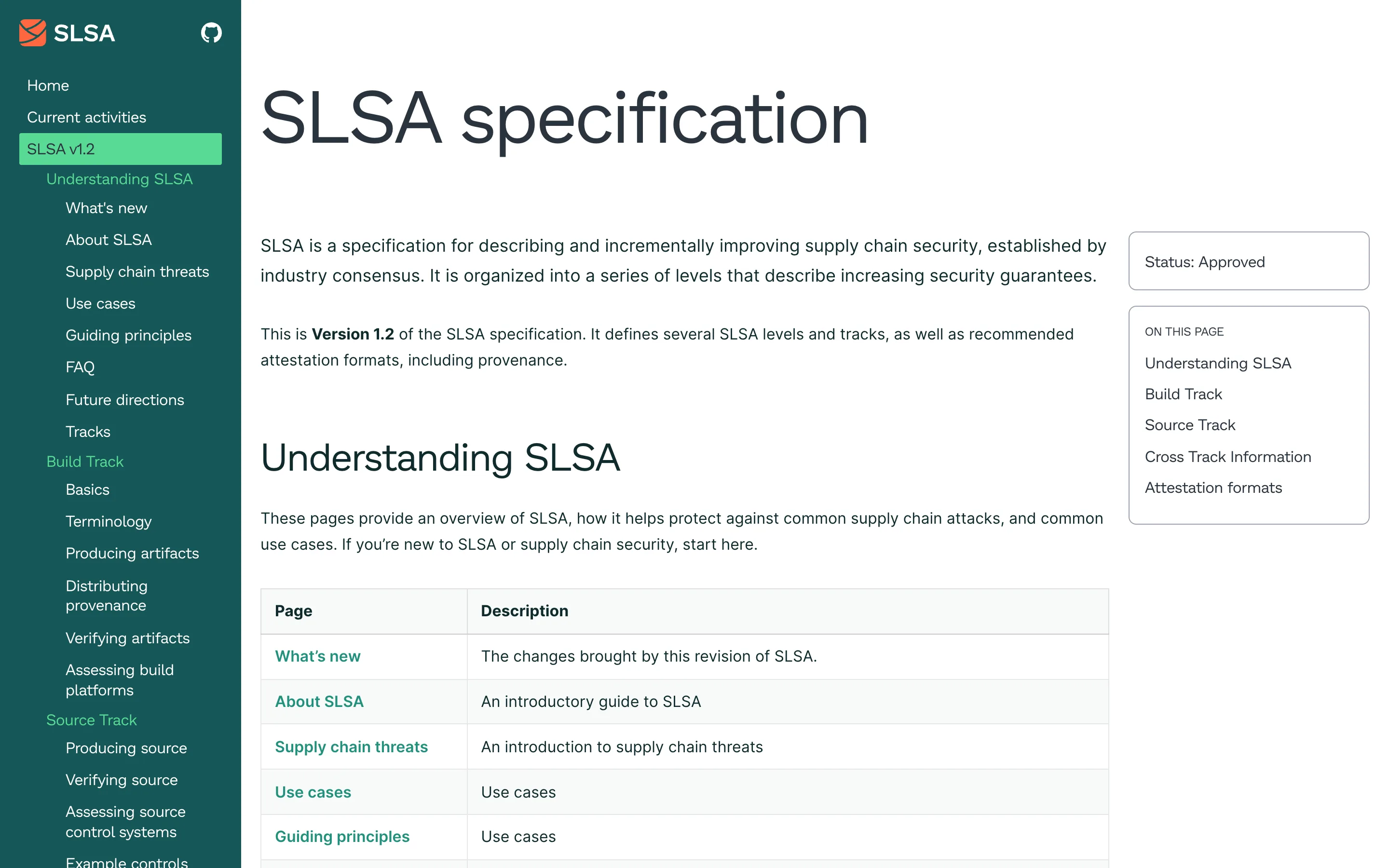
Build L1 means provenance exists. Build L2 means it comes from a hosted build platform. Build L3 means the build ran on hardened infrastructure that resists tampering by the build itself. Most teams that adopt SLSA land at L2 by using GitHub Actions or a similar hosted runner and publishing provenance, and stop there.
What Finds the Known Vulnerabilities?
Grype and OSV-Scanner both match your dependency inventory against vulnerability databases, and they disagree often enough that running both is reasonable. Grype, Anchore's scanner and Syft's companion, reached v0.119.0 on September 17, 2026 under Apache 2.0 with 12,903 GitHub stars. It consumes a Syft SBOM directly, so inventory and scanning stay separate steps.
OSV-Scanner, Google's client for the Open Source Vulnerabilities database, reached v2.6.0 on September 14, 2026 under Apache 2.0 with 11,055 GitHub stars. Its advantage is data quality: OSV records are keyed to precise affected version ranges per ecosystem rather than to a vendor's CPE string, which cuts the false positives that make CVE-based scanning exhausting.
Where Do SBOMs Go After the Build?
Generating an SBOM is easy and keeping it useful is not, which is the problem Dependency-Track solves. The OWASP project reached 5.1.0 on August 27, 2026, is Apache 2.0 licensed and has 4,220 GitHub stars. It ingests CycloneDX SBOMs from every build and continuously re-evaluates the stored inventory as new vulnerabilities are published.
That inversion is the point. A scan in CI answers "is this build vulnerable today". Dependency-Track answers "which of the 40 services we shipped last quarter contain this package", which is the question that actually gets asked during an incident, and the one a pile of SBOM files in an artifact bucket cannot answer.
What Do the Commercial Tools Add?
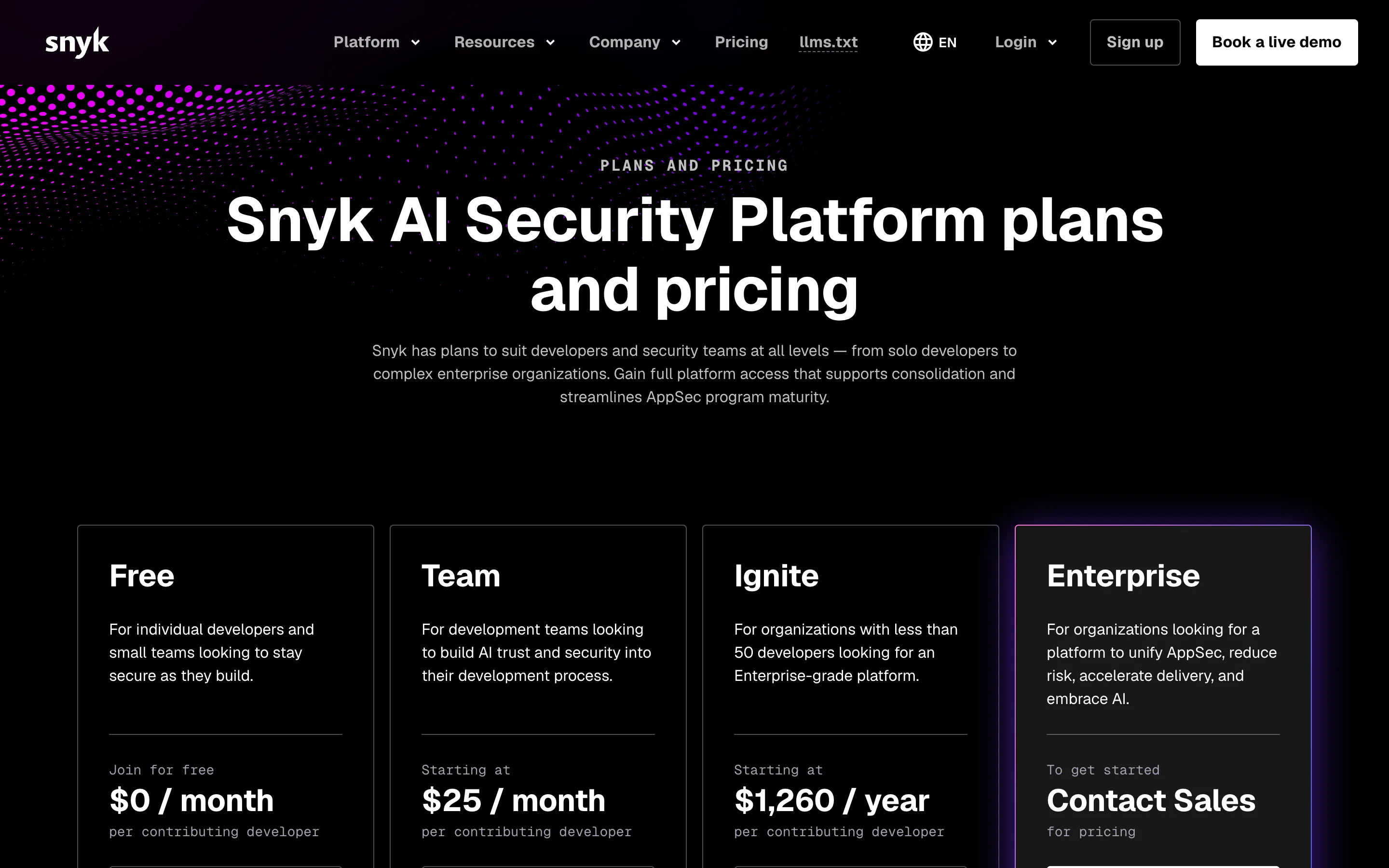
The paid tools add reachability analysis, malicious-package detection and someone to call, and their pricing models differ sharply. Snyk publishes per-seat pricing: a Free tier at $0 per month, Team starting at $25 per month, and Ignite starting at $1,260 per year, all priced per contributing developer, with Enterprise on a custom quote. Snyk lists Ignite as being for organizations with fewer than 50 developers. All figures checked on snyk.io/plans on September 19, 2026.
Chainguard attacks the problem from the other end by shipping hardened base images instead of scanning yours. Its pricing page, checked September 19, 2026, offers up to five images per organization free, and a Catalog tier with full access to its 2,000-plus images that starts at $19,000 for a team of 10. Chainguard states its images are continuously built from source in SLSA L3 hardened infrastructure and are covered by a contractual CVE remediation SLA.
Socket takes the third approach, analyzing what a package actually does rather than matching it against a CVE list, which is the only one of the three that catches a brand-new malicious package on the day it is published. One caveat worth stating plainly: socket.dev returned HTTP 403 to every non-browser client I tried on September 19, 2026, so I could not verify its current pricing from the vendor's own page and have not guessed at it.
Head-to-Head
| Tool | Job | License | Version (Sep 19, 2026) | Cost |
|---|---|---|---|---|
| Syft | SBOM generation | Apache 2.0 | v1.52.0 | Free |
| Trivy | SBOM plus scanning | Apache 2.0 | v0.74.0 | Free |
| Grype | Vulnerability scanning | Apache 2.0 | v0.119.0 | Free |
| OSV-Scanner | Vulnerability scanning | Apache 2.0 | v2.6.0 | Free |
| Cosign | Signing and attestation | Apache 2.0 | v3.1.3 | Free |
| Dependency-Track | SBOM management | Apache 2.0 | 5.1.0 | Free, self-hosted |
| Snyk | Scanning plus reachability | Commercial | n/a | $0 to $1,260/yr per developer |
| Chainguard | Hardened base images | Commercial | n/a | Free for 5 images; Catalog from $19,000 |
| Socket | Malicious package detection | Commercial | n/a | Not publicly verifiable |
How to Pick
No budget and no compliance deadline: run Trivy in CI. One binary produces the SBOM and the vulnerability report, and it costs nothing. This covers most teams honestly.
A customer is asking for an SBOM: Syft for generation, in CycloneDX format, and stop there. Do not buy a platform to satisfy a procurement checkbox.
Running more than a handful of services: add Dependency-Track. The moment you need to answer "which services contain this package" across releases, per-build scanning stops being enough.
Publishing artifacts other people consume: add Cosign and publish SLSA provenance. Keyless signing removes the key management that kills most signing projects before they ship.
Worried about malicious packages, not just outdated ones: this is the gap that CVE scanners structurally cannot close, and behavioral analysis of the kind Socket does is the category that addresses it.
Fighting a losing battle with base image CVEs: price Chainguard against the engineering hours currently spent patching. At $19,000 for a team of 10 it is a real line item, and the comparison is against salary, not against zero.
Conclusion
The free tools cover the fundamentals completely. Syft, Trivy, Grype, OSV-Scanner, Cosign and Dependency-Track are all Apache 2.0, all actively released within the last five weeks as of September 19, 2026, and together they generate an inventory, scan it, sign the build and track it over time. Nothing in that list requires a purchase order.
What money buys is reachability analysis that cuts the noise, behavioral detection of malicious packages, hardened base images with an SLA, and somebody to call at 2 AM. Those are real, and none of them are the starting point. Generate one SBOM first, look at how many packages you did not know you shipped, and let that number decide what you buy.
Related DevToolLab Tools
- SRI Hash Generator - pin a third-party script to a hash so a compromised CDN cannot silently swap the file your users execute.
- SHA256 File Checksum - verify a downloaded release artifact matches the digest the project published before you run it.
- Semver Range Tester - check whether a caret range in your manifest would have accepted a known-bad version.
- npm Package Info - inspect maintainers, versions and metadata for a package before it becomes one more node in the tree.
Related Guides
- Developer Security Toolkit: SAST, SCA and Secrets Scanning - the scanning layers that sit alongside provenance work.
- Container Security Tools Compared - image scanning and runtime defense, where these SBOMs get consumed.
- Best AI Code Security Tools - finding flaws in the code you wrote rather than the code you imported.
- GitHub Actions Best Practices - hardening the build platform that SLSA provenance attests to.