
A background job or a multi-step AI agent loop has to survive things a normal function call doesn't: a worker restarting mid-step, a third-party API timing out on retry three, a deploy landing while 40,000 runs are in flight. Handling that by hand means reinventing a state machine, a retry policy and a dead-letter queue for every pipeline.
On September 14, 2026, Temporal announced a $550 million Series E at a $12.55 billion valuation, naming demand from teams building agentic AI as the reason. That's not hype: an agent that calls three tools and waits on a human approval is the long-running, crash-prone process durable execution was built for.
What Teams Actually Run
Durable execution frameworks let you write a workflow as ordinary code and have the runtime persist every step's result, so the process resumes where it left off after a crash, a deploy or a multi-day wait, with none of that state-tracking written by hand. Three funded vendors sell this as a product, and the funding sequence shows where the market is placing its bets.
Temporal is the established name, built by the team behind Uber's internal Cadence project, and its September 2026 raise carries usage behind it: Temporal Cloud processed 1.9 trillion-plus billable actions in August 2026, up more than 350 percent year over year, against 4,300-plus paying customers and an annualized revenue run rate past $250 million, growing over 200 percent year over year. Open-source installs passed 43 million in August, up 134 percent since January 2026.
Inngest and Trigger.dev are the newer, TypeScript-first challengers, both funded after Temporal was established. Inngest raised a $21 million Series A on September 17, 2025, led by Altimeter, with Andreessen Horowitz and Vercel's Guillermo Rauch participating. Trigger.dev raised a $16 million Series A in December 2025 led by Standard Capital, with Y Combinator returning. Both bet most teams shipping AI features want a lighter, TypeScript-native version of the same guarantee, not Temporal's operational weight.
What Does the Same Workload Actually Cost?
Running one identical workload costs $99 a month on one of these platforms and more than double that on another. The gap has nothing to do with which vendor is cheaper in the abstract, it comes down to what each one actually bills.
Take a workload shaped like a lot of production AI agent pipelines: 500,000 runs a month, each with four durable steps (plan, call a tool, verify, respond), each step doing about three seconds of real work. All three publish a rate card, so the monthly bill can be computed directly from their own pricing pages rather than guessed.
js// Price one workload on all three platforms' own published rate cards. const RUNS = 500_000 const STEPS_PER_RUN = 4 const SECONDS_PER_STEP = 3 // Temporal Cloud (self-service), verified at docs.temporal.io/cloud/pricing. // Billable actions per docs.temporal.io/cloud/actions: "Start Workflow" and // "Schedule Activity" are billed; completions are not. A run with 4 // sequential activities = 1 Start Workflow + 4 Schedule Activity = 5 actions. const TEMPORAL_RATE_PER_MILLION = 50 // $50 per million actions, self-service tier const TEMPORAL_SUPPORT_SURCHARGE = 0.10 // Temporal's own worked example: +10% for support const temporalActions = RUNS * (1 + STEPS_PER_RUN) const temporalCost = (temporalActions / 1_000_000) * TEMPORAL_RATE_PER_MILLION * (1 + TEMPORAL_SUPPORT_SURCHARGE) // Inngest Pro, verified at inngest.com/pricing. Bills per whole-function // "execution" (one run = one execution), not per step. const INNGEST_BASE = 99 const INNGEST_INCLUDED_EXECUTIONS = 1_000_000 const inngestCost = RUNS <= INNGEST_INCLUDED_EXECUTIONS ? INNGEST_BASE : null // Trigger.dev Pro, verified at trigger.dev/pricing. Bills a per-run // invocation fee AND wall-clock compute time by machine size. const TRIGGER_INVOCATION_RATE = 0.000025 // $ per run const TRIGGER_SMALL_1X_RATE = 0.0000338 // $ per second, Small 1x (0.5 vCPU / 0.5GB) const triggerInvocationCost = RUNS * TRIGGER_INVOCATION_RATE const triggerComputeSeconds = RUNS * STEPS_PER_RUN * SECONDS_PER_STEP const triggerComputeCost = triggerComputeSeconds * TRIGGER_SMALL_1X_RATE const triggerTotal = triggerInvocationCost + triggerComputeCost console.log(`Temporal: ${temporalActions.toLocaleString('en-US')} actions -> $${temporalCost.toFixed(2)}/mo`) console.log(`Inngest: ${RUNS.toLocaleString('en-US')} executions -> $${inngestCost.toFixed(2)}/mo`) console.log(`Trigger.dev: $${triggerInvocationCost.toFixed(2)} invocation + $${triggerComputeCost.toFixed(2)} compute -> $${triggerTotal.toFixed(2)}/mo`)
Run on September 16, 2026:
textTemporal: 2,500,000 actions -> $137.50/mo Inngest: 500,000 executions -> $99.00/mo Trigger.dev: $12.50 invocation + $202.80 compute -> $215.30/mo
Inngest wins here because it bills per run, not per step, and 500,000 runs sits well under its $99 Pro plan's 1 million included executions. Temporal lands at $137.50 because it bills a workflow start plus one schedule per activity, at $50 per million actions plus its own published 10 percent support surcharge, regardless of step duration. Trigger.dev is most expensive because it's the only one billing wall-clock compute time by the second on top of a per-run fee, so a slower step raises its bill in a way it doesn't on the other two. Change compute time per step and Trigger.dev's number moves; change step count and Temporal's moves; Inngest's doesn't move until runs cross 1 million. That's the real difference between the billing models, not a marketing claim.
Temporal
Temporal is not, at its core, a SaaS product. It's an open-source durable execution engine, the successor to Uber's internal Cadence, that you self-host or rent as Temporal Cloud.
What it does well. A workflow is just a function in your SDK of choice (Go, Java, TypeScript, Python or .NET), with replay-based determinism giving each activity exactly-once semantics without hand-written idempotency logic. Netflix built its next-generation CI/CD system on Temporal and cut transient deployment failures from 4 percent to roughly 0.0001 percent; Coinbase runs every cryptocurrency transaction through it instead of a homegrown saga implementation.
What it does not do. It's the heaviest of the four to self-host, since the server needs a persistence store (Cassandra, MySQL or Postgres) plus a separate visibility store for production use. TypeScript support exists, but Go and Java came first and remain the ecosystem's center of gravity. And because billing is per action, a chatty workflow with many small activities costs more than a few large ones.
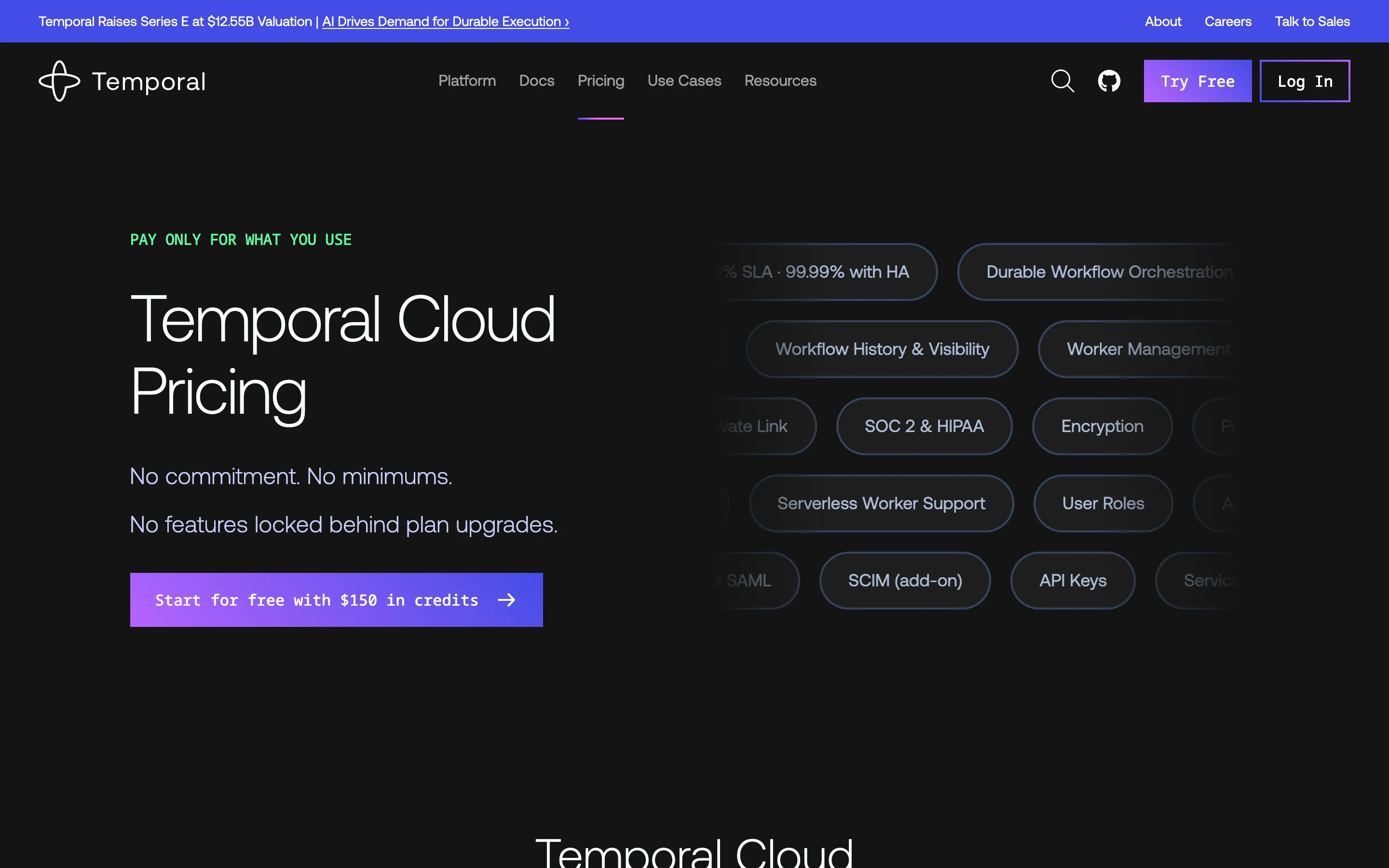
MIT licensed, 23,081 GitHub stars, server v1.32.0 as of September 11, 2026. Pricing: Self-service from $0/month, billed per action at $50/million · Business from $500/month · Enterprise custom, as of September 16, 2026.
Inngest
Inngest wraps ordinary TypeScript or Python functions in a step.run() primitive: mark the risky parts as steps, and Inngest handles retries, backoff and resuming after a crash without a separate workflow definition language.
What it does well. The local dev loop is the fastest of the three: a dev server with a UI that replays runs, no cluster to stand up first. Self-hosting stopped being second-class at its 1.0 release in January 2026, a single command with bundled Redis and SQLite, or Postgres via a --postgres-uri flag added in CLI v1.4.0. Its SDK leans hard into AI agent step functions specifically.
What it does not do. The license is the Server Side Public License with an "Apache 2.0 after three years" conversion clause, not a standard open-source license, so reselling it as a hosted service triggers SSPL's source-disclosure requirement. Trace retention is tighter than Temporal Cloud's: the free tier keeps only 24 hours, so yesterday's failure is already gone from the UI by the time someone asks about it.
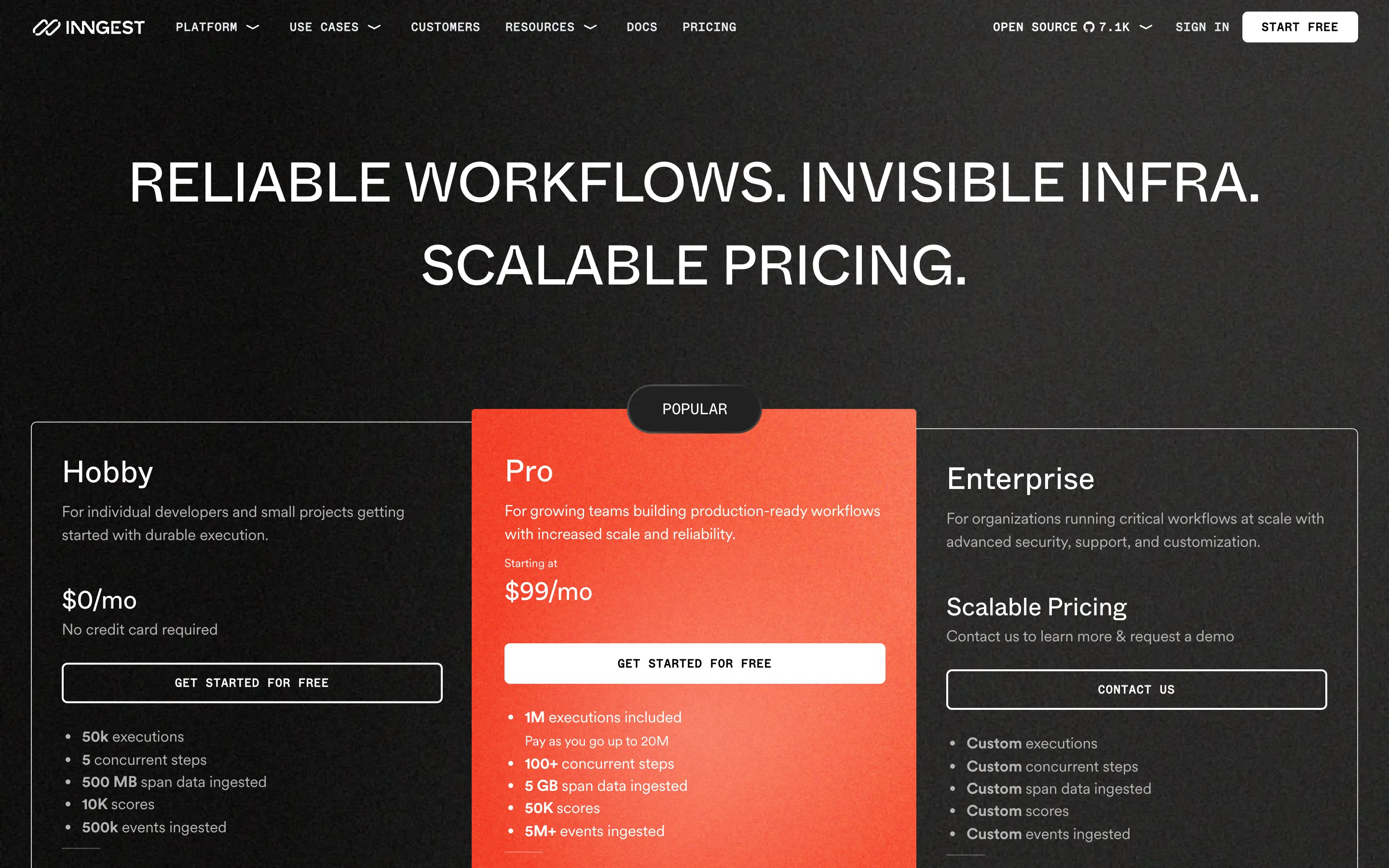
SSPL 1.0, converting to Apache 2.0 per release after three years, 5,834 GitHub stars, server/CLI v1.44.0 as of August 26, 2026. Pricing: Hobby $0/month (50k executions) · Pro from $99/month (1M executions included) · Enterprise custom.
Trigger.dev
Trigger.dev targets the same TypeScript background-job niche as Inngest, built around a task.trigger() call, and since v4 a supervisor-based architecture designed specifically to make self-hosting with Docker Compose simple rather than an afterthought.
What it does well. Version 4.6, shipped September 14, 2026, added agent-shaped primitives to the run SDK: a managed streamText helper, a chat.agent transcript store and chat.close(), aimed at agent loops rather than generic batch jobs. The self-hosted Docker Compose setup bundles its own registry and object storage, so there's no S3 bucket to wire up before a first deploy.
What it does not do. It's the only one of the three whose usage pricing bills wall-clock compute time by the second on top of a per-run fee, so a workload with slower steps costs more here than the same workload on Temporal or Inngest, exactly as the measurement above shows. Free and Hobby log retention (1 and 7 days) is short next to Temporal Cloud's defaults.
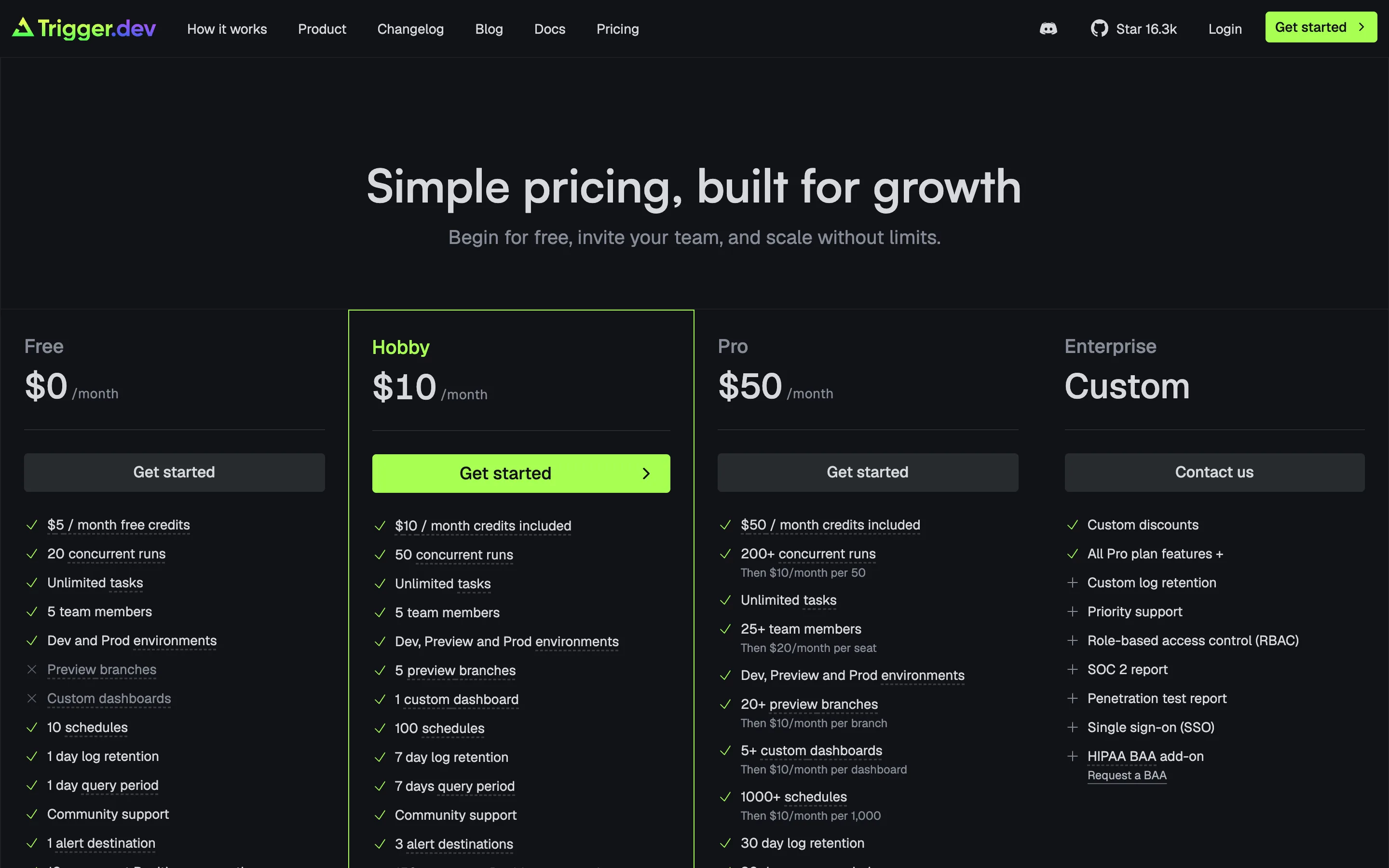
Apache 2.0, 16,289 GitHub stars, v4.6.1 as of September 15, 2026. Pricing: Free $0/month (20 concurrent runs) · Hobby $10/month · Pro from $50/month · Enterprise custom, plus metered compute from $0.0000169/second.
Hatchet
Hatchet is the fully open-source option here: a Postgres-backed orchestration engine for background tasks, AI agents and durable workflows, with no SSPL-style delayed-open-source clause anywhere in it.
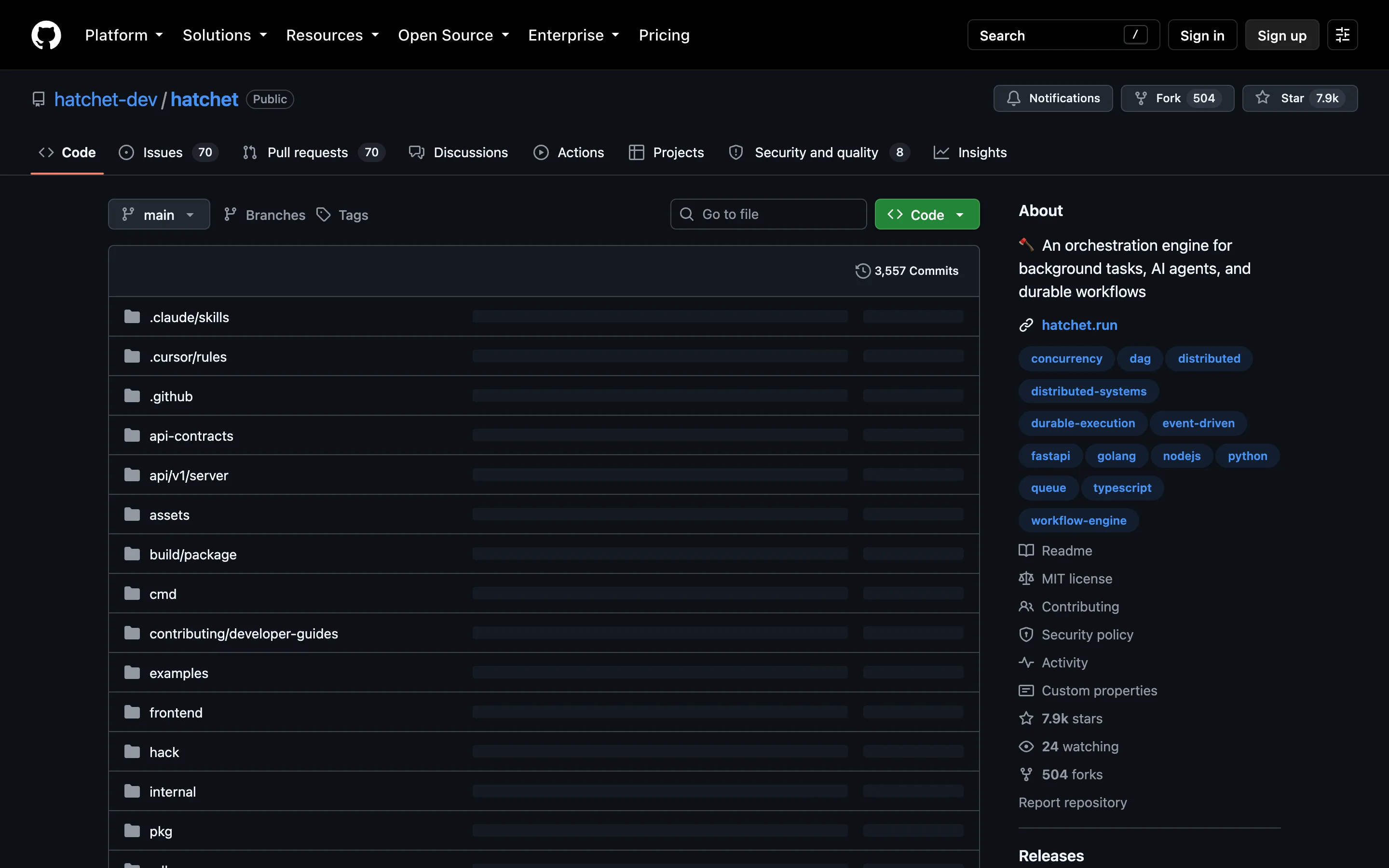
What it does well. MIT licensed end to end, so self-hosting carries no license-triggered restrictions from day one. It runs on Postgres instead of a purpose-built persistence layer, so anyone already operating Postgres can stand up the whole engine without learning a new datastore. DAG-style workflows are first class, with SDKs for Python, TypeScript, Go and Ruby.
What it does not do. At 7,949 stars and still on 0.x releases, it's much younger than Temporal, with fewer production war stories to draw on. Hatchet Cloud, its managed option, is the only one here without a public self-service price.
MIT licensed, 7,949 GitHub stars, v0.107.0 as of September 15, 2026. Pricing: Self-hosted free, cost of your own Postgres instance · Hatchet Cloud pay-as-you-go, contact for a quote.
Side by Side
| Tool | Model | Entry price | Self-host | License |
|---|---|---|---|---|
| Temporal | Workflow-as-code engine + managed cloud | $0/mo self-service, billed per action | Yes, full server | MIT |
| Inngest | Step functions over HTTP or serverless | $0/mo Hobby, $99/mo Pro | Yes, since Jan 2026 | SSPL (Apache 2.0 after 3 yrs) |
| Trigger.dev | Task-based background jobs | $0/mo Free, $50/mo Pro | Yes, Docker Compose | Apache 2.0 |
| Hatchet | Postgres-backed task queue and DAG engine | Free self-hosted, Cloud custom | Yes, MIT | MIT |
All figures verified against each project's own site on September 16, 2026.
How to Choose Without Migrating Twice
- Count your steps per run, not your runs per month. Temporal's action pricing and Trigger.dev's compute-second pricing both scale with work done inside a run; run the script above on your own numbers before comparing sticker prices.
- Decide whether TypeScript-first or polyglot matters. Inngest and Trigger.dev are TypeScript-first; Temporal and Hatchet treat Go, Python and TypeScript equally.
- Check who needs to see your workflow history, and for how long. Temporal Cloud's SOC 2 and HIPAA coverage matters for an audit trail; Inngest's free-tier 24-hour trace window does not survive that conversation.
- Price your actual compute time, not the plan price. Fast steps barely register on Trigger.dev's per-second billing; one running tens of seconds will dominate it.
- Ask whether the license lets you resell what you build. MIT (Temporal, Hatchet) and Apache 2.0 (Trigger.dev) carry no resale restriction; Inngest's SSPL triggers a source-disclosure obligation until that release's three-year Apache conversion kicks in.
Which One Should You Actually Use?
Already running Go or Java services, or need audited SOC 2 and HIPAA infrastructure: Temporal Cloud, or self-host the same MIT-licensed engine. It has the deepest production track record here, Netflix and Coinbase among them.
A TypeScript or Next.js team wanting the least new infrastructure to operate: Inngest. The local dev server and flat, run-based Pro pricing make it the cheapest, simplest fit for a workload like the one measured above.
Building an AI agent product specifically: Trigger.dev. Its chat.agent and streamText helpers, shipped September 14, 2026, are purpose-built for that loop, and Docker Compose makes self-hosting a real option.
No budget, or infrastructure that cannot leave your own Postgres instance: Hatchet. MIT licensed with no SSPL clause anywhere; running Postgres already means you have its one dependency.
Conclusion
This category moved fast this year. Temporal's September 2026 raise, on the back of 1.9 trillion actions processed in a single month, says durable execution went from an Uber-and-Netflix niche to mainstream AI infrastructure. Inngest's SSPL-to-Apache commitment and Trigger.dev's agent-specific SDK additions both bet the winning workload is an AI agent loop, not a generic cron replacement. Before picking a vendor here, ask one question: how many steps does a typical run have, and how long does each one take. That number, not a feature comparison, decides which of these four is cheapest for you.
Related DevToolLab Tools
- Cron Next Run Calculator - work out when a scheduled workflow next fires before committing a cron expression to a Temporal Schedule or Trigger.dev task.
- Webhook Signature Verifier - check the HMAC signature on an inbound event before it's allowed to start a durable run.
- UUID v7 Generator - generate time-sortable IDs for idempotency keys, so a retried step doesn't execute twice.
- JSON Schema Validator - validate an event payload's shape before it triggers a step function, instead of finding out mid-run.
Related Guides
- Best AI Agent Frameworks in 2026 - the layer above this one: picking what calls into the durable execution engine.
- AI Agent Memory Platforms - the other half of durable agent infrastructure: state that outlives a single run.
- What Is a Webhook? - the event shape that starts most of these durable runs in production.
- OpenTelemetry Node.js Setup Guide - tracing a run once it spans retries and multiple workers.