
Switching AI coding assistants is cheap for one developer and expensive for a team. Every seat license, editor plugin, MCP server config and security review has to move at once, usually against a renewal date someone else set.
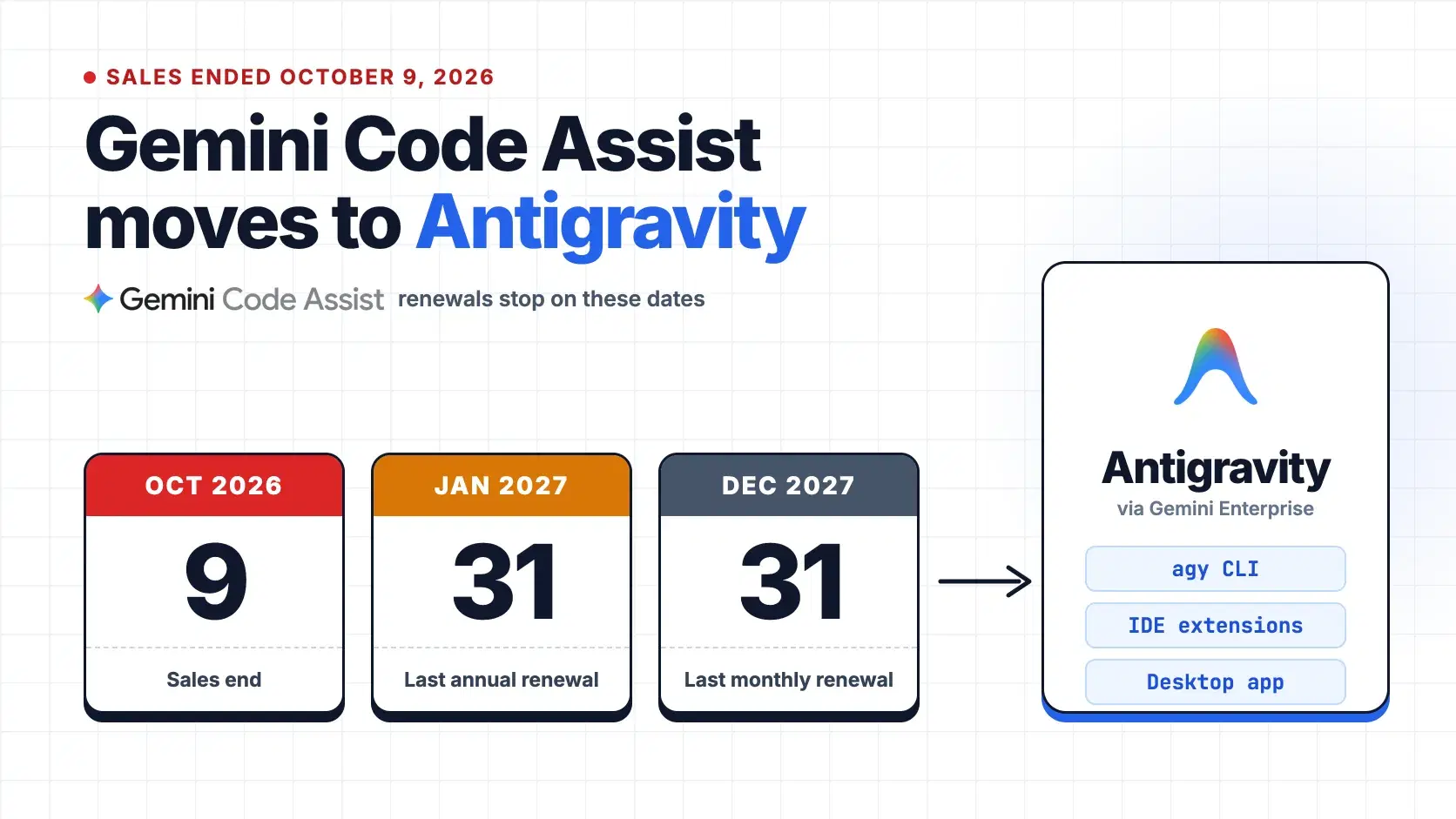
On October 9, 2026, Google stopped selling Gemini Code Assist Standard and Enterprise, and its end-of-sale page points every customer to Antigravity. Free users already moved: on June 18, 2026, the Code Assist extensions and Gemini CLI stopped serving the free tier, Google AI Pro and Google AI Ultra. For paying teams, January 31, 2027 is the last day an annual plan can renew.
The Dates That Decide Your Migration
There is no single shutdown date. Google's page says existing subscriptions "remain supported until the end of your contractual agreement", and the dates below cap how long that agreement can run.
| Date | What happens | Who it affects |
|---|---|---|
| June 18, 2026 | Code Assist extensions and Gemini CLI stop serving | Free tier, Google AI Pro and Ultra |
| September 4, 2026 | Console purchases blocked without an existing subscription | New buyers |
| October 9, 2026 | No new Standard or Enterprise subscriptions | Everyone |
| January 31, 2027 | Last day to add licenses or auto-renew an annual plan | Annual customers |
| December 31, 2027 | Last day a monthly plan can auto-renew | Monthly customers |
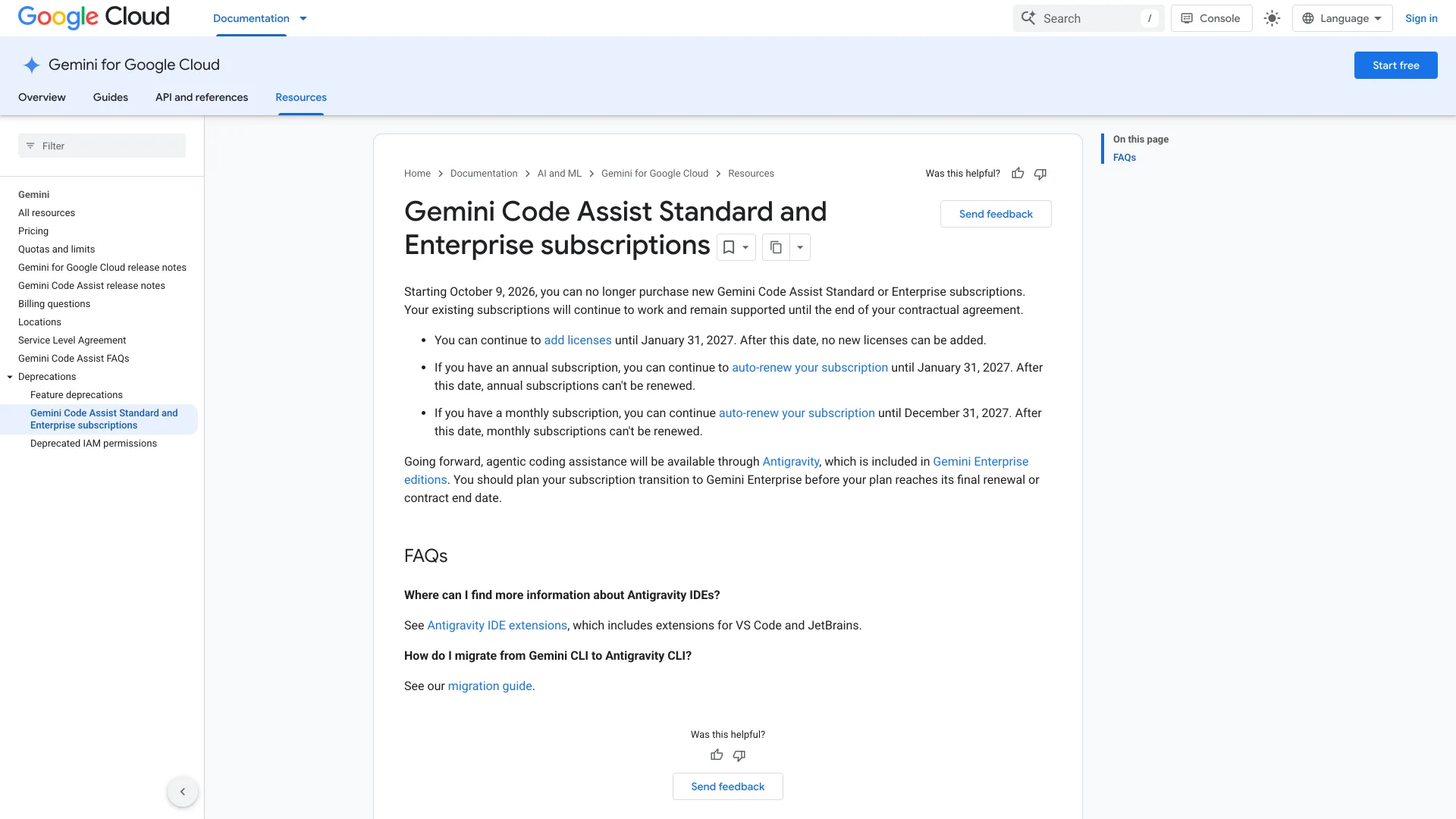
The worked example in this guide is a 40-developer platform team in Austin on Code Assist Enterprise, with an annual contract that renews on March 1, 2027. That renewal falls after January 31, so the current term is its last, and new hires can get seats only until January 31. The extensions still ship fixes in the meantime; VS Code Gemini Code Assist 2.104.0 arrived on October 8, 2026.
How Antigravity Differs From Code Assist
Gemini Code Assist is a per-seat assistant: completion, chat and agent mode inside VS Code and JetBrains, plus Code Assist inside Firebase, Colab Enterprise, BigQuery, Apigee and Application Integration. It runs Google's Gemini models only.
Google Antigravity is an agent platform with five surfaces: a desktop app, a standalone IDE, IDE extensions, a CLI called agy, and a Python SDK. Agents plan a task, run shell commands in an OS sandbox (seatbelt on macOS, bubblewrap on Linux) and ask before risky steps. Extensions exist for VS Code, Visual Studio 2026, JetBrains IDEs, Zed and Xcode.
Models are the biggest change. Under Gemini Enterprise, Antigravity runs Gemini 4 Argon, the Gemini 3.x Flash models and Gemini 3.1 Pro, and administrators can enable Anthropic's Claude Opus 5.5 and Claude Sonnet 5.5 at four thinking levels, billed by tokens. Even with Claude selected, lightweight Gemini models keep running in the background for context management and summaries, and those tokens can be billed too.
Three enterprise gaps matter for the Austin team. JetBrains, Zed and Xcode enterprise sign-in are still in preview, while VS Code and Visual Studio are not. The standalone Antigravity IDE is not supported for enterprise deployments. And third-party models run only in the global, US and EU locations, while first-party Gemini models keep regional data residency. Enterprise prompts and code are not used to train Google's foundation models, and VPC Service Controls apply, as they did under Code Assist.
What a Seat Costs Before and After
Code Assist list prices are $19 per user per month on an annual commitment or $22.80 monthly for Standard, and $45 or $54 for Enterprise.
Antigravity prices by audience. Individuals pay $0 for unlimited Tab completions and command requests with weekly rate limits, or get higher limits through Google AI Pro ($19.99 a month) or Ultra (from $99.99). Organizations buy Gemini Enterprise Standard or Plus seats, which Antigravity's pricing page lists as "starting at $30 USD per seat per month", with no separate Antigravity license. Each seat adds pooled first-party credits, $10 a month on Standard and $15 on Plus, with managed overages. A pay-as-you-go plan with no seat fee bills by consumption.
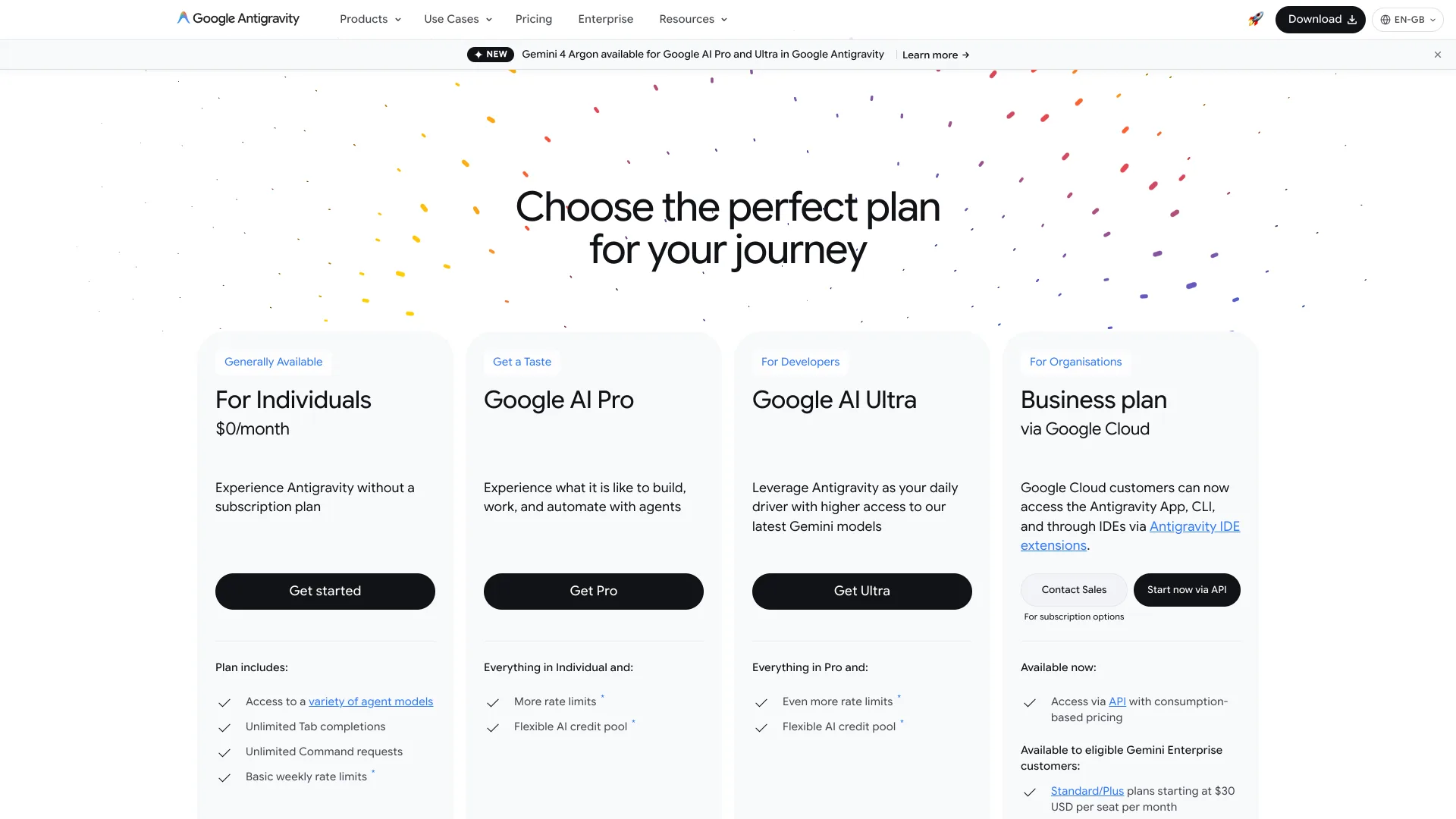
For the Austin team, Code Assist Enterprise costs 40 x $45 = $1,800 a month today. Gemini Enterprise Standard starts at 40 x $30 = $1,200 a month and includes a $400 monthly pool of Gemini credits. Claude usage and overages come on top, so the real number depends on how hard the team leans on agents.
Moving a Gemini CLI Setup to Antigravity CLI
Google's migration guide covers the personal side. On first launch, agy detects Gemini CLI settings and offers to convert them, and agy plugin import gemini turns Gemini CLI extensions into Antigravity plugins. GEMINI.md and AGENTS.md keep working unchanged, including the global ~/.gemini/GEMINI.md.
Files checked into a repository need a hand move, because the paths and one MCP key changed:
| What | Gemini CLI | Antigravity CLI |
|---|---|---|
| Workspace skills | .gemini/skills/ | .agents/skills/ |
| Global skills | ~/.gemini/skills/ | ~/.gemini/antigravity-cli/skills/ |
| Workspace MCP servers | .gemini/settings.json | .agents/mcp_config.json |
| Global MCP servers | ~/.gemini/settings.json | ~/.gemini/config/mcp_config.json |
| Remote server URL key | url or httpUrl | serverUrl |
Antigravity's MCP docs say the legacy url and httpUrl fields "aren't supported", so a straight copy breaks every remote server. This script copies the servers into the new file and renames the key, leaving settings.json untouched so teammates still on Gemini CLI keep working:
Pythonimport json, sys, pathlib # Copy Gemini CLI MCP servers into an Antigravity CLI mcp_config.json. # The source settings.json is left untouched so Gemini CLI keeps working. src, dst = pathlib.Path(sys.argv[1]), pathlib.Path(sys.argv[2]) servers = json.loads(src.read_text()).get("mcpServers", {}) for name, cfg in servers.items(): for old in ("url", "httpUrl"): if old in cfg: cfg["serverUrl"] = cfg.pop(old) print(f"{name}: {old} -> serverUrl") dst.parent.mkdir(parents=True, exist_ok=True) dst.write_text(json.dumps({"mcpServers": servers}, indent=2) + "\n") print(f"wrote {len(servers)} server(s) to {dst}")
We ran it on a sample repository with three servers (a remote GitHub server, a local Postgres server over stdio and an SSE incident feed), then moved the skills folder with Git:
Bash$ python3 gemini_mcp_to_agy.py .gemini/settings.json .agents/mcp_config.json github: httpUrl -> serverUrl incident-feed: url -> serverUrl wrote 3 server(s) to .agents/mcp_config.json $ git mv .gemini/skills .agents/skills $ git status --short R .gemini/skills/release-notes/SKILL.md -> .agents/skills/release-notes/SKILL.md ?? .agents/mcp_config.json
The stdio server's command and args carry over as-is, and headers and env are both valid keys in the new file. We did not run agy itself, which needs a Google sign-in.
What to Check Before You Renew
- Find your renewal date. An annual contract that renews after January 31, 2027 ends with its current term, and seats can be added only until then.
- Count your editors. If most of the team is on IntelliJ or PyCharm, enterprise sign-in there is still in preview; pilot it before the contract runs out.
- List your Google Cloud integrations. The end-of-sale page does not say what replaces Code Assist inside Firebase, BigQuery or Apigee, so ask your account team in writing.
- Decide whether to enable Claude. It needs administrator opt-in, bills by token, and runs only in the global, US and EU locations.
- Move repository config in one pull request per repo. Run the script, move the skills folder, and keep
.gemini/until the last Gemini CLI user switches.
Which Path Fits Your Team?
Solo developer on the free tier: you have already been moved. Install Antigravity or agy; the individual plan is $0.
Team on Code Assist Standard in VS Code: plan a move to Gemini Enterprise Standard before your renewal date. Your editor is fully supported, and the per-seat price starts $11 higher, with pooled credits included.
JetBrains-heavy enterprise: ride the Code Assist contract to its end, since the extensions still get updates, and pilot Antigravity's JetBrains extension while its enterprise support is in preview.
Regulated workloads that need in-country processing: stay on first-party Gemini models, which keep regional data residency, and leave third-party models off.
Teams leaving Google entirely: compare the terminal agents in our guide to CLI AI coding agents before your renewal date, not after.
Conclusion
Google did not switch Code Assist off. It stopped selling it and capped renewals, which leaves each team a fixed amount of runway. Put your renewal date, editor mix and Cloud integrations in one document this quarter, and move repository config before the last term ends rather than during it.
Related DevToolLab Tools
- AGENTS.md Generator - write the
AGENTS.mdfile that both Gemini CLI and Antigravity read, so project rules survive the switch. - MCP Server Config Generator - build server entries for the new
mcp_config.jsoninstead of editing JSON by hand. - JSON Validator - check
mcp_config.jsonafter the move, since one stray comma disables every server in the file. - JSON Diff - compare the old
settings.jsonservers with the new file to confirm nothing was dropped.
Related Guides
- Best CLI AI Coding Agents compares Claude Code, Codex, OpenCode and other terminal agents you might run alongside
agy. - Best AI Coding Assistants ranks GitHub Copilot, Cursor and Windsurf for teams pricing a non-Google option.
- Best MCP Servers lists the servers worth moving into your new
mcp_config.json. - 9 Open Source Claude Code Alternatives covers self-hosted agents for teams that want no vendor seat at all.