
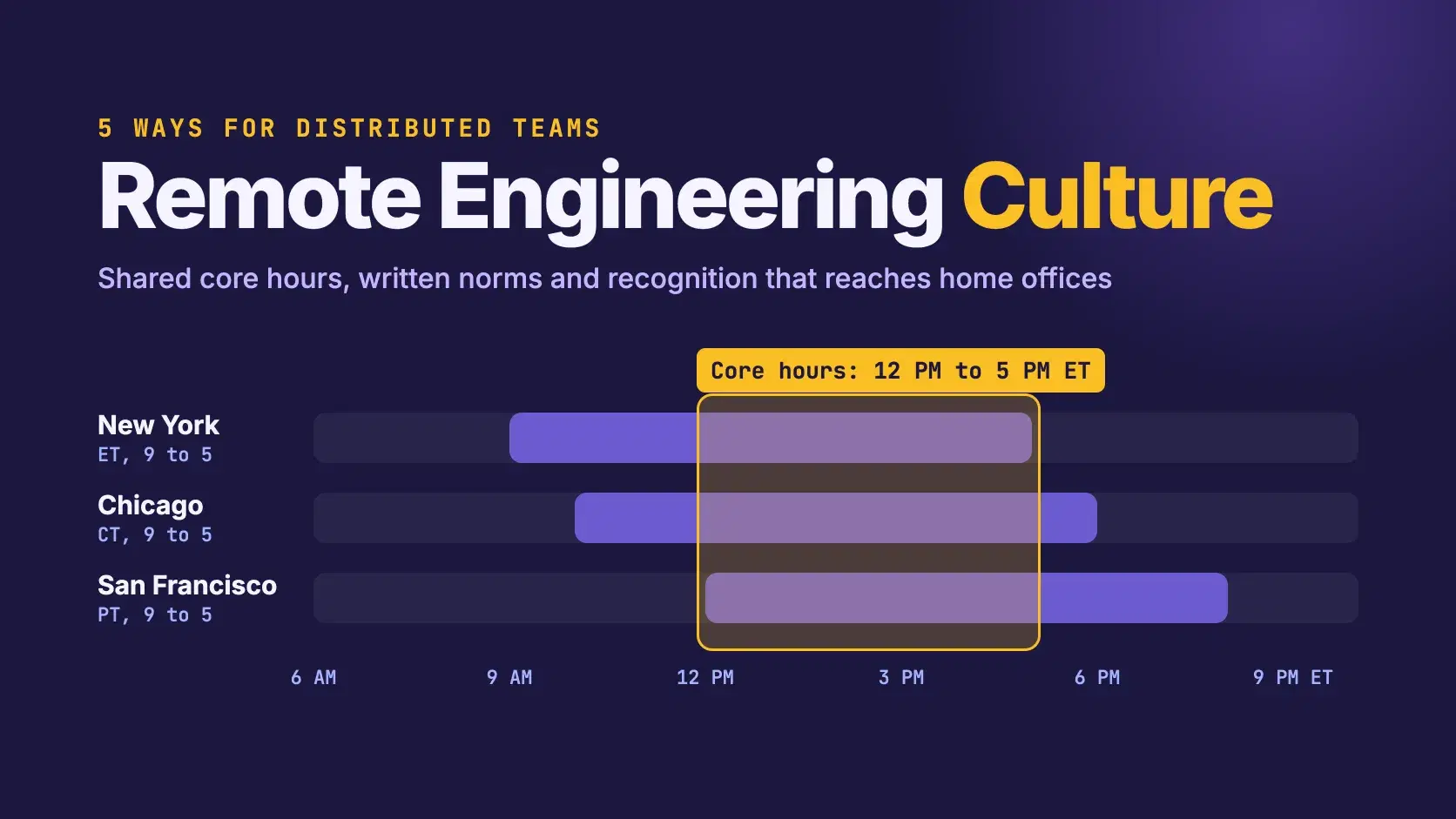
Building a strong engineering culture when your team is scattered across multiple time zones requires intentional design rather than accidental proximity. In November 2023, 64.9 percent of workers in computer and mathematical occupations teleworked at least part of the time, according to the U.S. Bureau of Labor Statistics, forcing modern engineering managers to rethink how camaraderie and trust are built without physical bullpens.
When developers sit behind screens hundreds or thousands of miles apart, traditional perks like shared office snacks or hallway chats vanish. The physical distance often breeds professional isolation unless the organization's leadership implements structured connection frameworks.
The Harsh Reality
Remote engineering teams struggle because asynchronous workflows and deep focus requirements naturally reduce casual chatter. Without a deliberate strategy, engineers turn into isolated code-shipping units rather than cohesive team members.
Culture in a distributed architecture must be engineered through explicit rituals and not physical office osmosis.
1. Establish Asynchronous Communication Guardrails
Muddy communication protocols often tank engineering velocity, leading to constant context switching and alert fatigue. Distributed teams need documented boundaries for when to use Slack, when to use GitHub issues, and when to jump on a quick Zoom huddle.
Setting clear expectations around response times prevents developers from feeling pressured to be online 24 hours a day.
- Document explicit SLAs for code reviews and architectural feedback loops
- Enforce core collaboration hours that overlap across disparate time zones
- Replace status update meetings with asynchronous Loom videos or written summaries
When communication is streamlined, engineers preserve their mental energy for complex debugging and system design. When management respects deep work blocks and asynchronous workflows, trust grows naturally.
2. Design Meaningful Virtual Rituals That Go Beyond Happy Hours
Virtual happy hours often fail. Why? Because forced Zoom socializing feels awkward for introverted technical talent.
Instead of generic gatherings, remote teams bond much better over shared technical challenges and structured collaboration spaces. Organizing initiatives like virtual hackathons, architecture review club sessions, or gaming tournaments gives developers a shared purpose.
Collaboration insights for remote teams highlight that psychological safety is the primary driver of high-performing distributed engineering units. Engineers need safe spaces to voice code failures during post-mortems without fear of blame. Team rituals should celebrate successful deployments and transparently analyze production bugs as shared learning opportunities.
3. Implement Intentional Recognition Programs for Invisible Work
Writing clean microservices, refactoring legacy code, and maintaining CI/CD pipelines often happens quietly behind the scenes. And because managers cannot walk over to a desk to witness a breakthrough, invisible technical contributions frequently go unrewarded. Remote workers crave tangible proof that their long-term dedication and architectural ownership matter to the broader organization.
This is where integrating thoughtful remote-friendly recognition initiatives makes a profound operational difference. When an engineer hits a major tenure milestone, sending a physical package straight to their home office bridges the digital divide.
Distributed developers feel deeply valued when companies honor their loyalty with years of service awards delivered directly to their doorsteps. Physical tokens of appreciation remind remote engineers that they belong to a tangible community with a shared history.
4. Map Out Career Growth Paths With Transparent Documentation
Remote isolation intensifies when engineers cannot see a clear trajectory for their professional advancement within the company. In co-located offices, promotions and leadership tracks are often discussed over lunch or casual hallway catch-ups. Distributed organizations must democratize career progression by writing down explicit competency matrices and promotion criteria.
Engineering managers should conduct bi-weekly career alignment check-ins focused purely on skill acquisition and mentorship. According to remote work productivity metrics in 2026, remote workers average 3 hours 36 minutes of deep focus work a day, which leaves little room for unstructured career gossip.
Providing access to cloud certifications, architectural conferences, and internal tech-talk platforms demonstrates a genuine investment in developer talent. Clear documentation removes ambiguity and ensures remote engineers feel equally positioned for leadership tracks.
5. Foster Psychological Safety Through Blameless Post-Mortems
Complex distributed systems inevitably fail, and how an engineering culture responds to those outages dictates team morale. Finger-pointing destroys psychological safety and drives talented developers to look for remote roles elsewhere.
Blameless post-mortems shift the focus from human error to systemic vulnerabilities and process improvement.
Encouraging engineers to openly share architectural vulnerabilities or production mistakes helps you build deep peer trust. Treating a system failure as an educational milestone rather than a punishable offense helps teams innovate faster. Developers know their managers have their backs when things break in production, and thus culture thrives.
Actionable Frameworks to Make Remote Recognition Stick
Moving from a theoretical appreciation model to a daily operational habit requires consistent administrative follow-through. Distributed engineering managers must establish predictable routines that prevent recognition from falling off the radar during hectic sprint cycles. Bridging the gap between digital code commits and human appreciation takes deliberate structural scaffolding.
Establish a Global Recognition Calendar
Distributed squads operate across multiple time zones, which means milestones like work anniversaries can easily slip past unnoticed if tracked manually. Engineering leads should maintain a centralized calendar that tracks tenure dates, major release completions, and project completions globally.
Automating alerts for these critical dates ensures leadership never misses an opportunity to acknowledge an engineer's hard work.
Combine Public Peer Shoutouts With Private Material Rewards
Public recognition on Slack channels gives engineers peer validation, but physical gifts provide a lasting tangible token of gratitude. Pair a public shoutout during your weekly sprint retrospective with a physical package shipped directly to their home address. This dual approach covers both immediate emotional validation and long-lasting physical appreciation.
Train Engineering Leads on Micro-Culture Habits
Middle managers hold the keys to team retention, yet they often get bogged down exclusively in velocity metrics and sprint planning. Coach engineering managers to spend five minutes in one-on-one meetings discussing personal milestones and career sentiment rather than which Jira tickets need attention. Equipping leads with the tools to spot early signs of isolation stops burnout before it impacts code quality.
Conclusion
Building resilient remote engineering culture requires treating culture as an iterative codebase that receives continuous feedback and updates. By combining strict asynchronous communication standards with tangible recognition milestones, distributed teams can achieve elite performance levels.
If you found this guide helpful, explore more of our articles and insights that companies working with remote developer teams love.
Related DevToolLab Tools
- World Clock - see the current time in every city your team works from, so a Slack message lands inside someone's working hours.
- Time Zone Converter - find the core collaboration hours that overlap for engineers in San Francisco, New York and Europe.
- Meeting Cost Calculator - put a dollar figure on a recurring status meeting before you replace it with a written summary.
- Pomodoro Timer - protect the deep work blocks that asynchronous workflows are meant to create.
Related Guides
- Best Countries for Remote Developers in 2026 - salaries, taxes and time zone overlap for building a distributed team
- Vietnam vs India for Software Engineers - where to hire remote engineers, and what each market costs
- Best AI Code Review Tools - keep code review response times inside the SLAs your team agrees on
- Essential Developer Tools - the shared toolkit a distributed engineering team standardizes on