

51% of all GitHub commits in early 2026 are AI-generated or AI-assisted. That number creates a problem no one talked about when AI coding tools launched: who reviews the AI's code?
The answer, increasingly, is another AI. The AI code review market has exploded alongside vibe coding and AI-first development workflows. But the category is fragmented -- there are PR-level reviewers, IDE inline analyzers, security scanners, and general-purpose AI assistants all claiming to do "code review." They work very differently, and picking the wrong one for your workflow is a real productivity cost.
This guide cuts through the noise. We explain what each category does, test the best tools in each, and give you a decision framework so you pick the one that fits your actual situation.
"🏆 Editor's Pick: SonarQube - If you're looking for one tool that enforces code quality AND security at scale, SonarQube is our top recommendation. Quality Gates, 40+ language support, and deep SAST scanning make it the most complete platform in this category. Jump to full review ↓
Why AI Code Review Is Now Essential
Three converging trends make AI code review the category to watch in 2026:
AI-generated code has real quality problems. 45% of AI-generated code fails at least one OWASP Top 10 security check. 53% of developers have found security vulnerabilities in AI-written code. When you use Cursor, Claude Code, or GitHub Copilot to write 80% of a feature, you're shipping code you may not have read line by line -- and traditional human review catches less of it because reviewers also skim AI-generated code faster.
Code review is a bottleneck. Stack Overflow's 2026 developer survey found code review wait time is the top-ranked productivity killer, ahead of slow builds and unclear requirements. For solo developers and small teams, reviews pile up and slow shipping. AI reviewers don't have calendars.
The security stakes are rising. As more non-developers ship production code via vibe coding, the need for automated security checks compounds. Someone building their first SaaS app with Lovable or Replit doesn't know to look for SQL injection, CORS misconfigurations, or hardcoded secrets. AI review tools catch these before they ship.
Two Categories of AI Code Review
Before picking a tool, understand that "AI code review" means two distinct things.
1. PR-Level AI Reviewers
These run at the pull request level -- when you open a PR on GitHub, GitLab, or Bitbucket, they automatically review the diff, post comments, summarize changes, and flag issues. They see every changed line, have access to broader codebase context, and their feedback arrives alongside human reviewer comments.
Best for: Teams with a PR workflow, catching issues before merge, automating the first-pass review.
Examples: CodeRabbit, Gitar, Qodo, Greptile, PR-Agent.
2. IDE-Level AI Code Analysis
These run inside your editor (VS Code, Cursor, JetBrains) and provide real-time or on-demand feedback on the code you're writing. Some analyze as you type; others run on demand. The feedback loop is immediate but the scope is narrower -- typically the current file or recently edited code.
Best for: Individual developers, catching issues as you write, learning from AI feedback in real time.
Examples: Cursor Bugbot, GitHub Copilot code review, Sourcery, Snyk AI, Checkmarx.
Top AI Code Review Tools
1. CodeRabbit
Best overall for teams on GitHub or GitLab

CodeRabbit is the most widely adopted AI PR reviewer in 2026. It installs via GitHub/GitLab app in under two minutes, requires no configuration to get started, and begins reviewing every PR immediately. Its reviews are contextual -- it understands the full diff, can trace how a change affects other parts of the codebase, and posts specific, actionable comments (not vague warnings).
What CodeRabbit does well:
- Summarizes PRs in plain English (great for async teams and non-technical stakeholders)
- Identifies logic errors, not just style issues
- Learns from your codebase conventions over time
- Supports
@coderabbitaicommands in comments for interactive follow-up - Integrates with Jira, Linear, and GitHub Projects for issue tracking
What it doesn't do:
- Deep security analysis (it catches obvious issues, not CVE-level vulnerabilities)
- Works with on-premises Git (GitHub and GitLab cloud only for the managed version)
Pricing: Free · Pro $24/user/month · Pro Plus $48/user/month · Enterprise custom Supported: GitHub, GitLab, Azure DevOps, Bitbucket (beta) · Languages: All major languages
Setup:
- Go to coderabbit.ai and install the GitHub App
- Grant access to the repos you want reviewed
- Open any PR -- CodeRabbit reviews automatically
No YAML, no config files, no CI pipeline changes required to start.
2. SonarQube
Best for enterprise-grade code quality, security scanning, and enforced standards at scale

SonarQube is the industry standard for static analysis in enterprise development teams, trusted by 7 million+ developers across 500,000+ organizations. Where most tools in this list focus on the PR review moment, SonarQube takes a broader approach: it enforces code quality gates across your entire codebase, tracks technical debt over time, and provides deep security scanning that covers OWASP, CWE, STIG, and NIST SSDF standards across 40+ languages.
The key differentiator is the Quality Gate -- a configurable pass/fail threshold that blocks merges if code doesn't meet your standards. This turns code quality from a suggestion into a hard requirement, which matters at scale when dozens of developers are shipping AI-generated code daily.
What SonarQube does well:
- Quality Gates that block PRs from merging when code quality drops below your defined threshold
- Deep SAST scanning across 40+ languages including Java, JS/TS, Python, C#, Go, Rust, Kotlin, and IaC (Terraform, Kubernetes)
- Security scanning mapped to OWASP, CWE, STIG, and NIST SSDF -- plus taint analysis for SQL injection and XSS across files
- Technical debt tracking over time so you can see if the codebase is improving or degrading
- Branch analysis that shows quality metrics per feature branch before merge
- Integrates natively with GitHub, GitLab, Bitbucket, Azure DevOps, and all major CI/CD pipelines
- AI-assisted fix suggestions for detected issues via SonarQube AI CodeFix
What it doesn't do:
- Conversational PR comments in the style of CodeRabbit (it posts findings, not dialogue)
- Lightweight enough for solo developers or very small projects -- best value for teams of 5+
Pricing: Cloud Team from $32/month · Enterprise custom · SonarQube Server (self-hosted) with annual per-instance pricing Supported: GitHub, GitLab, Bitbucket, Azure DevOps · Languages: 40+ including Java, JS/TS, Python, C#, Go, Rust, Kotlin, PHP
Setup with GitHub Actions (SonarQube Cloud):
yaml- uses: actions/checkout@v4 with: fetch-depth: 0 - name: SonarQube Scan uses: SonarSource/sonarqube-scan-action@v8.1.0 env: SONAR_TOKEN: ${{ secrets.SONAR_TOKEN }}
Self-hosted SonarQube Server: add SONAR_HOST_URL: ${{ vars.SONAR_HOST_URL }} to the env block above. Also requires a sonar-project.properties file in your repo root.
SonarQube is the right choice when code quality and security need to be enforced -- not just suggested. For teams building at scale, especially those shipping AI-generated code into regulated or high-stakes environments, Quality Gates combined with its security scanning coverage make it the most comprehensive static analysis tool available.
3. Ito
Best for runtime analysis for PR reviews with evidence
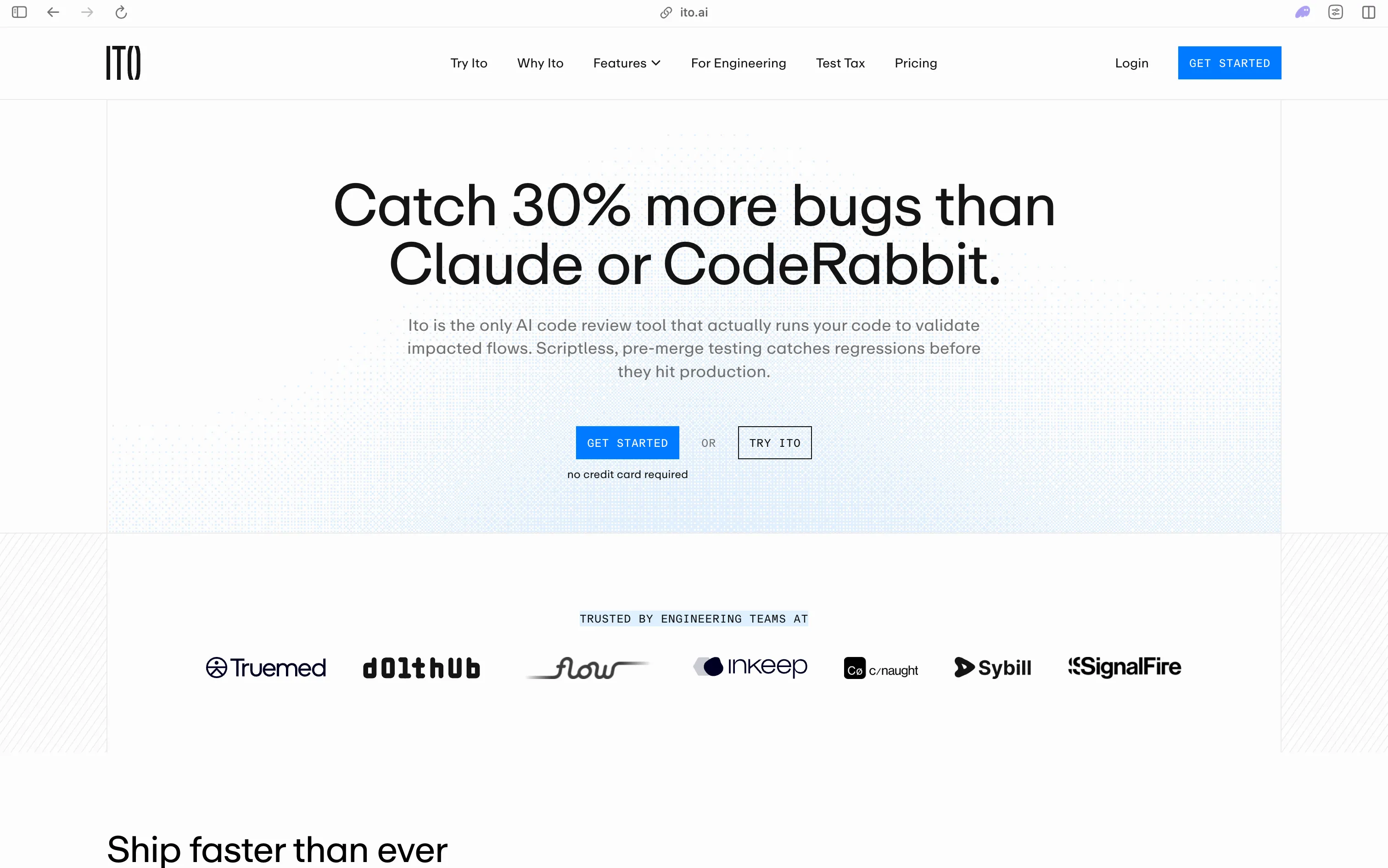
Ito is the only tool in this list that actually runs your code before reviewing it. It connects to any repository via OAuth, and on every pull request provisions a sandboxed environment, builds a code-aware test plan, and exercises the app with a swarm of agents. Every issue it flags comes with evidence -- exact lines, reproduction steps, and a fix -- plus video and logs of each feature working.
What Ito does well:
- Runtime analysis instead of diff inference -- catches flow and regression bugs static reviewers miss entirely
- Comments back on exact lines with evidence, reproduction steps, and how to fix
- Test plans build themselves and improve with use -- no Playwright/Cypress suite to write or maintain
- Validates API/backend behavior alongside the frontend
- Video proof of every feature working
What it doesn't do:
- Runs slower than static review -- a full pass typically takes 45-60 minutes since it builds and exercises the app
- $40/developer/month can add up at scale, though the first 10 PRs and qualifying open-source projects are free
Pricing: Free for first 10 PRs and qualifying open-source projects · $40/user/month · free trial available Supported: GitHub (via OAuth)
Setup:
- Connect your repository via OAuth at ito.ai
- Open a PR -- Ito provisions a sandbox, builds a test plan, and runs it automatically
- Review the evidence-based report (logs, screenshots, video) alongside your usual PR review
4. Gitar
Best for AI-powered code reviews, automated CI fixes, and streamlining pull request workflows
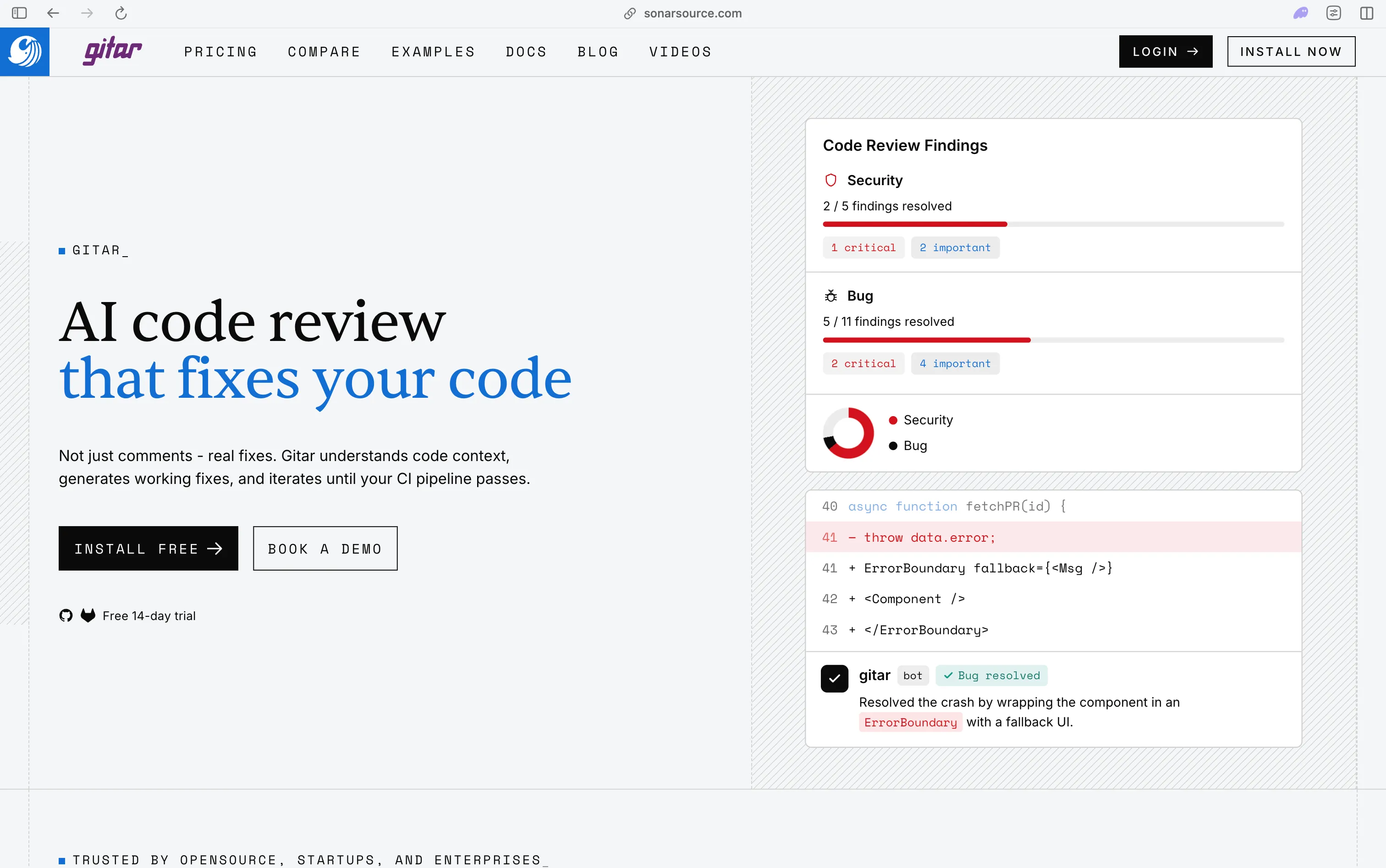
Gitar is an AI-powered code reviewer with a different endpoint than everything else in this list: instead of leaving you a list of comments, it writes the fix. On every pull request it reviews the diff with full codebase context, flags bugs, security vulnerabilities, performance issues, and code quality problems as inline comments -- and then generates working fixes and applies them directly to the PR branch, iterating until your CI pipeline passes. Sonar acquired Gitar in May 2026, and it continues as a standalone product with deeper SonarQube integration on the roadmap.
What Gitar does well:
- Reviews PRs for security vulnerabilities, logic errors, performance bottlenecks, edge cases, and code quality issues, with findings posted as inline comments and summarized in a centralized dashboard comment
- Generates fixes and commits them directly to the PR branch instead of stopping at suggestions
- CI failure analysis: investigates a failed pipeline, identifies the root cause, and can generate or apply the fix directly to the PR branch
- Custom review rules via repository-specific markdown files, so coding standards, architectural guidelines, and project-specific best practices get enforced on every review
- Merge protection and auto-approval: block merges above a severity threshold, or approve PRs that meet predefined quality criteria
- Language-agnostic -- works with virtually any language or framework, so polyglot teams need no per-language configuration
What it doesn't do:
- Deep SAST and compliance scanning (Sonar positions SonarQube for that; the two are complementary rather than overlapping)
- A bot that commits to your branches requires trust -- teams with strict change-control processes will want to review Gitar's applied fixes like any other commit
Pricing: Core $20/user/month · Pro $40/user/month · Enterprise custom (outcome-based, per PR) · 14-day Pro trial, no credit card Supported: GitHub, GitLab, Bitbucket, Azure DevOps (incl. self-hosted) · CI: GitHub Actions, GitLab Pipelines, CircleCI, Buildkite, Bitrise
Setup:
- Start the free 14-day Pro trial at sonarsource.com/products/gitar
- Install the Gitar app for GitHub or GitLab and grant access to your repos
- Open a PR -- Gitar reviews it, comments on exact lines, and starts proposing fixes
Where CodeRabbit hands you a well-organized list of things to fix, Gitar's pitch is closing the loop entirely: review, fix, green pipeline. For teams already shipping large volumes of AI-generated code, a reviewer that clears its own findings is a real reduction in review-cycle time -- and pairing it with SonarQube's Quality Gates covers both the PR moment and the codebase-wide standard.
5. Qodo (formerly CodiumAI)
Best for test-focused teams and behavior analysis

Qodo takes a different angle from CodeRabbit: instead of primarily reviewing code style and logic, it focuses on behavior -- does this code actually do what the PR description says? It generates test cases for the changed code, identifies edge cases the PR doesn't handle, and flags behavioral regressions.
What Qodo does well:
- Auto-generates unit tests for changed code (not just suggestions -- actual runnable tests)
- "Integrity" analysis: compares what the code does to what the PR description claims
- Edge case identification that most reviewers miss
- CLI tool for local testing before pushing
What it doesn't do:
- General code style feedback (not its focus)
- Security scanning at depth
Pricing: Free (250 credits/mo) · Teams $30/user/month (annual) or $38/month · Enterprise custom Supported: GitHub, GitLab, Bitbucket · IDE Plugin: VS Code, JetBrains, Neovim
6. Greptile
Best for codebases where reviewers lack deep context

Greptile indexes your entire repository and builds a semantic understanding of how everything connects. When reviewing a PR, it can tell you how a change ripples through the rest of the codebase -- not just what changed in the diff, but what that change breaks elsewhere.
What Greptile does well:
- Cross-codebase impact analysis ("this change affects 3 other modules not in this PR")
- Useful for large repos where reviewers can't hold the full context in their head
- Natural language queries about the codebase in review comments
- Can answer questions like "is this the only place we do this kind of data transformation?"
What it doesn't do:
- Auto-posting review comments on PRs (review is query-based, not automated)
- Works best on large, complex codebases -- overkill for small projects
Pricing: Free (open source) · Pro $30/seat/month · Enterprise custom
7. PR-Agent (Codium/Open Source)
Best free option for self-hosted teams

PR-Agent is an open-source PR review tool from the Qodo team. It's self-hostable, runs via CLI or GitHub Actions, and supports multiple model backends (OpenAI, Claude, Gemini, local models via Ollama). For teams that need privacy, on-premises Git, or want to bring their own model, PR-Agent is the primary serious option.
Bash# Install via pip pip install pr-agent # Configure export OPENAI_API_KEY=your-key # or ANTHROPIC_API_KEY for Claude export GITHUB_TOKEN=your-github-token # Review a PR python -m pr_agent.cli --pr_url=https://github.com/org/repo/pull/123 review
Via GitHub Actions (runs on every PR automatically):
yamlon: pull_request: types: [opened, reopened] jobs: review: runs-on: ubuntu-latest steps: - uses: Codium-ai/pr-agent@main env: OPENAI_API_KEY: ${{ secrets.OPENAI_API_KEY }} GITHUB_TOKEN: ${{ secrets.GITHUB_TOKEN }}
Pricing: Free (open source) - model API costs apply separately Supported: GitHub, GitLab, Bitbucket, Azure DevOps, Gerrit · Models: GPT-5, Claude, Gemini, Ollama (local)
Top IDE-Level AI Code Reviewers
8. Cursor Bugbot
Best for Cursor users -- zero setup

Cursor's built-in Bugbot scans files as you edit them and flags potential bugs inline. It's not a separate tool -- it's always running in the background when you're using Cursor. No config, no extra cost (included in Pro). For vibe coding workflows where the AI writes code and you review it, Bugbot catches obvious mistakes before you even run the code.
Strengths: Zero friction, contextually aware of your project, instant feedback. Limitations: Cursor-only, surface-level analysis (logic errors more than security vulnerabilities).
9. GitHub Copilot Code Review
Best for GitHub ecosystem users already paying for Copilot

GitHub Copilot added native PR review in late 2025. Copilot Pro is $10/month (individual) and Copilot Business is $19/user/month (teams). A free tier also exists with 2,000 completions/month. If your team is already paying for Copilot, enabling code review costs nothing extra. Quality is solid for logic and style; less thorough than CodeRabbit for large PRs with many changed files.
Enable it: In GitHub Copilot settings, turn on "Copilot code review" for the repository. It can also be assigned as a reviewer on any PR.
10. Sourcery
Best for Python-heavy teams

Sourcery specializes in Python refactoring and code quality. It runs in VS Code, PyCharm, and CI, and provides specific refactoring suggestions with one-click application. Less comprehensive for other languages.
Pricing: Free (open source, up to 3 repos) · Pro $12/seat/month · Team $24/seat/month
Security-Focused AI Code Analysis
Standard code reviewers catch logic errors and style issues. These tools specialize in security vulnerabilities -- a different and critical category, especially as AI-generated code enters production.
11. Snyk AI
Best overall for developer-friendly security scanning

Snyk integrates directly into VS Code, the CLI, and CI pipelines. It scans your code for known vulnerabilities (OWASP Top 10, CVEs in your dependencies), and its AI layer explains each vulnerability in plain English with fix suggestions. Unlike traditional SAST tools that generate walls of unactionable warnings, Snyk prioritizes findings by actual risk and pairs every issue with a remediation path.
Key capabilities:
- Dependency vulnerability scanning (the single highest-ROI security check -- most serious breaches come from known vulnerable dependencies)
- SAST (Static Application Security Testing) for code patterns
- Container image scanning
- IaC security (Terraform, Kubernetes)
Bash# Install CLI npm install -g snyk # Authenticate snyk auth # Scan a project snyk test # dependency vulnerabilities snyk code test # SAST scan of your code
Pricing: Free (open source, limited scans) · Team $25/user/month · Enterprise custom
12. Checkmarx One
Best for enterprise compliance requirements

Checkmarx One is the standard in regulated industries (finance, healthcare, government) that have mandatory SAST requirements. It integrates with every major CI/CD platform, generates the compliance reports required for audits, and has the broadest language support of any tool in this list.
When to use Checkmarx: When you have a compliance requirement (SOC 2, PCI-DSS, HIPAA) that mandates documented static analysis, not just when you want better code.
Pricing: Enterprise, custom pricing - not suitable for individual developers
13. Socket
Best for supply chain security

Socket specifically targets the npm/PyPI/Maven supply chain -- malicious packages, dependency confusion attacks, typosquatting, and unexpected network behavior in packages. In 2026, supply chain attacks through malicious npm packages are the most common initial access vector for JS/TS codebases. Socket catches them before they're installed.
npm install -g @socketsecurity/cli
socket scan .
Pricing: Free (public repos) · Pro $10/user/month (private repos)
Head-to-Head Comparison
| Tool | Type | Free Tier | GitHub | GitLab | Security Focus | Best For |
|---|---|---|---|---|---|---|
| CodeRabbit | PR reviewer | Open source only | Yes | Yes | Moderate | Teams, PR workflow |
| SonarQube | SAST + Quality Gates | No free tier | Yes | Yes | Very High | Enterprise scale, quality enforcement |
| Ito | Runtime-verified PR review | Free (first 10 PRs, qualifying OSS) | Yes | No | Moderate | Evidence-based, pre-merge behavioral testing |
| Gitar | PR reviewer + auto-fix | 14-day trial | Yes | Yes | Moderate | Teams that want fixes applied, not just flagged |
| Qodo | PR reviewer + tests | Yes (250 credits/mo) | Yes | Yes | Low | Test-driven teams |
| Greptile | Codebase Q&A + review | No | Yes | No | Low | Large codebases |
| PR-Agent | PR reviewer | Yes (self-hosted) | Yes | Yes | Moderate | Privacy-first teams |
| Cursor Bugbot | IDE inline | Included in Pro | N/A | N/A | Low | Cursor users |
| Copilot Review | PR reviewer | No (Copilot sub) | Yes | No | Low | Copilot subscribers |
| Snyk AI | Security SAST | Yes (limited) | Yes | Yes | High | All teams |
| Checkmarx | Enterprise SAST | No | Yes | Yes | Very High | Enterprise/compliance |
| Socket | Dependency security | Open source | Yes | Yes | Supply chain | JS/Python teams |
How to Pick the Right Tool
Solo developer, open source project: Start with CodeRabbit's free tier (open source) and Snyk's free tier for dependency scanning. Together they cover 80% of what you need at zero cost.
Small startup team (2-10 devs): CodeRabbit Pro ($24/user/month) + Snyk Team ($25/user/month). PR review automation pays for itself in saved reviewer time within weeks.
Need pre-merge behavioral certainty: Ito, when static diff review isn't enough to trust that a feature actually works. It runs the app in a sandbox and reports back with evidence, at the cost of a slower per-PR turnaround (45-60 min) and a per-developer fee.
Review backlog is the bottleneck: Gitar ($20-40/user/month). It reviews the PR, writes the fix, applies it to the branch, and iterates until CI passes -- the output is a mergeable PR rather than a longer comment thread.
Test-obsessed team: Qodo alongside CodeRabbit. Especially valuable if you're shipping AI-generated code and need actual runnable test coverage, not just suggestions.
Privacy-first or self-hosted Git: PR-Agent (open source) with your own model backend (Claude API, OpenAI, or local via Ollama). Full control, no data leaves your environment.
Scaling team that needs quality enforcement: SonarQube Cloud Team ($32/month) when "please fix this" in a PR comment isn't enough. Quality Gates block merges hard when standards aren't met. Pairs with CodeRabbit for full PR + SAST coverage.
Compliance or regulated industry (NIST, STIG, OWASP): SonarQube Enterprise or Checkmarx One. SonarQube covers NIST SSDF, OWASP, CWE, and STIG out of the box. Checkmarx if your security team requires certified SAST tooling specifically.
Primarily worried about supply chain: Add Socket to whatever else you're running. It covers dependency and package-level threats that PR-level reviewers miss entirely.
Using Cursor already: Bugbot is on by default in Cursor Pro. Add CodeRabbit at the PR level so the same code gets reviewed at both write-time and before merge.
Building an AI Code Review Workflow
The most effective setups layer multiple tools rather than relying on one:
- IDE level (write time) - Cursor Bugbot or GitHub Copilot catches obvious errors as you type
- Pre-commit (local) - Snyk CLI for dependency + SAST scan · Socket for supply chain check on new packages
- PR level (review time) - CodeRabbit or Qodo for full diff review and comments · PR-Agent if self-hosted
- Security (scheduled) - Snyk weekly full project scan · Dependabot for automated dependency updates with CVE tracking
You don't need all four layers on day one. Start with the PR level (CodeRabbit free for open source, or a one-week Pro trial). Add Snyk when you're ready to take security seriously. Layer in IDE tooling as your workflow matures.
A Note on AI Reviewing AI
One concern worth addressing: does it make sense to use AI to review AI-generated code? Isn't it circular?
Not really, for two reasons. First, the AI doing the review is different from the AI that wrote the code -- it has different training, different context, and different specialization. CodeRabbit reviewing Cursor-generated code catches things Cursor wouldn't catch about its own output, the same way a second human reviewer catches things the first author missed.
Second, the most common errors in AI-generated code are predictable categories: missing input validation, insecure defaults, incorrect error handling, performance anti-patterns. AI reviewers are specifically trained to spot these patterns. They're not catching subtle architectural problems -- that still requires human judgment. But they're highly effective at the class of errors that AI code generators are most likely to introduce.
The workflow that works: AI generates code, AI reviews it for common errors, human reviews the AI reviewer's output and the overall logic. The human review step is shorter and higher-level, which is the right use of human attention.
Conclusion
The AI code review category exists because of a gap that AI coding tools created and cannot close themselves. When 51% of committed code is AI-generated, and 45% of that code has a security flaw, the review layer is not optional. It is the difference between shipping faster and shipping problems faster.
The tool choice is simpler than the category makes it look. For most developers and teams, the decision tree has two branches: if you work on open-source or want to start without spending money, CodeRabbit free tier is the obvious first move -- it requires no configuration and starts reviewing your PRs immediately. If you care about security beyond logic errors, Snyk runs alongside it at no cost for open-source projects and covers the vulnerability class that PR reviewers typically miss.
Everything else in this guide is optimization for specific situations: Gitar if you want the reviewer to write and apply the fix instead of just flagging it, Qodo if test coverage is your weak point, Greptile if cross-codebase impact analysis matters, PR-Agent if you need self-hosted or want to bring your own model, Checkmarx if compliance mandates it.
The "AI reviewing AI" concern is valid but ultimately misses the point. The goal is not a perfect reviewer. The goal is catching the predictable, systematic errors that AI code generators reliably produce -- the missing input validation, the insecure default, the open CORS policy -- before they reach production. AI reviewers are very good at exactly that class of problem. Human reviewers can then focus on what they are actually better at: architecture, intent, and the subtle logic that no automated tool catches.
Start with one tool. Add a second when the first has become a habit. Review the AI reviewer's output before you merge. That loop, done consistently, produces better code than any individual tool.
Related Tools and Reading
- JWT Decoder -- Inspect and verify JWT tokens in AI-generated auth code
- JSON Formatter -- Format API response payloads for debugging
- Base64 Encoder/Decoder -- Decode encoded values in security audits
- What Is Vibe Coding? -- How AI-first development workflows create the need for AI code review
- Best CLI AI Coding Agents -- The tools that generate the code you need to review
- Best MCP Servers -- Sentry MCP lets your AI reviewer see real production errors
Pricing and features change frequently in this space. Verify current pricing directly with each vendor before purchasing.