
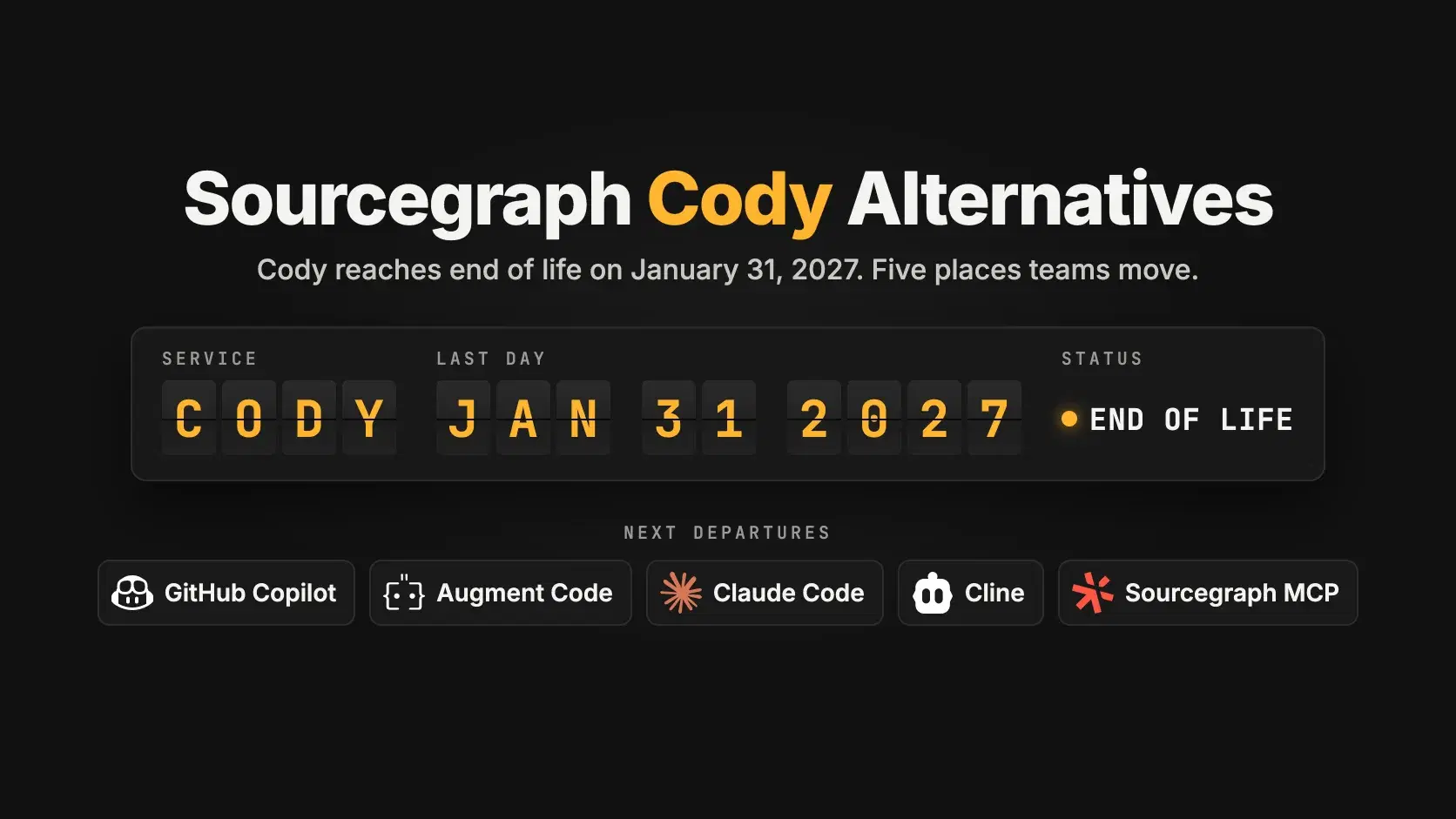
Large engineering teams bought Sourcegraph Cody for something most AI coding assistants could not do: answer questions with context pulled from every repository the company owned, not just the files open in the editor. That context came from a Sourcegraph instance the company ran itself, often next to GitLab or Bitbucket servers that no cloud assistant could reach.
On November 9, 2026, Sourcegraph's Dan Adler announced that Cody reaches end of life on January 31, 2027. Sourcegraph keeps Code Search, Deep Search, its MCP server and Batch Changes, and says plainly that Deep Search and MCP "aren't one-for-one replacements for every Cody capability." Below are the five realistic places a Cody team can go, tested against one worked example.
What Cody Did That You Now Have to Replace
Cody did three seperate jobs, and a replacement has to cover all of them or you assemble them from two products. Cody's own feature reference lists clients for VS Code, JetBrains IDEs, Visual Studio (experimental), the Sourcegraph web app and a CLI.
The first job was inline help: single and multi-line autocomplete and auto-edit suggestions as you type. The second was chat grounded in single-repo or multi-repo context from the Sourcegraph instance, with repo-based filters that keep sensitive repositories out of prompts. The third was admin control of models: an administrator could use Sourcegraph's hosted models or bring their own keys to any OpenAI-compatible endpoint, and pick a default model for chat and for autocomplete separately.
Why Not Just Move to Another Autocomplete Assistant?
Because the standalone chat-and-autocomplete assistant shrank from every side in 2026, and Augment's sale below is one more example. Google stopped selling new Gemini Code Assist Standard and Enterprise subscriptions on October 9, 2026 and points those customers to Antigravity inside Gemini Enterprise. Tricentis announced on July 30, 2026 that it acquired Tabnine to put Tabnine's Enterprise Context Engine into its testing platform. The open-source Continue repository is now read-only after a final 2.0.0 release, and the Roo Code repository is archived, its last release dated May 15, 2026.
The products still growing are coding agents. The cross-repo knowledge Cody had built in now comes from a context layer the agent queries, usually over the Model Context Protocol (MCP). So the decision splits in two: which agent your developers use in the editor, and where that agent gets context about the code it cannot see.
The Worked Example and How We Compared
Picture a 150-engineer insurance software company in Chicago. It has 1,200 repositories on GitLab Self-Managed, developers split between IntelliJ IDEA and VS Code, and a security rule that every model call goes through the company's own Amazon Bedrock account in us-east-1. Today it runs Cody Enterprise against a self-hosted Sourcegraph instance.
We checked each option on five points: supported editors, where cross-repo context comes from, whether calls can go to your own model endpoint, self-managed Git support, and what 150 engineers pay. Every fact comes from the vendor's own pricing page or documentation, checked November 18, 2026.
Side by Side
| Option | Editors | Cross-repo context | Your own model endpoint | Self-managed Git | Price for 150 engineers |
|---|---|---|---|---|---|
| GitHub Copilot Business | VS Code, Visual Studio, JetBrains, Eclipse, Xcode, Neovim | Semantic indexing, Copilot Spaces | Enterprise BYOK in public preview | Not on GitHub Enterprise Server; GitLab indexing only in VS Code | $2,850/month |
| Augment Code (Harness) | VS Code, JetBrains, Vim and Neovim, CLI | Context Engine, also served over MCP | Not documented | Cloud agents connect to GitHub Enterprise Server and GitLab Self-Hosted | Enterprise quote |
| Claude Code Team | Terminal, VS Code, JetBrains | Via MCP servers | Amazon Bedrock, Google Cloud, Microsoft Foundry | Works on local clones from any host | $3,000/month (standard seats) |
| Cline | VS Code, JetBrains, CLI | Via MCP servers | Bedrock, Vertex and other keys | Works on local clones from any host | $0 plus model usage |
| Sourcegraph Deep Search and MCP | Any MCP client | Code graph across every repository | Includes AI credits | Self-hosted or single-tenant cloud | From $16,000/year |
GitHub Copilot: The Closest Like-for-Like in the Editor
GitHub Copilot runs in more editors than any option here: VS Code, Visual Studio, JetBrains IDEs, Eclipse, Xcode and Neovim. Copilot keeps a semantic code search index for each repository, and Copilot Spaces let a team group repositories, issues, pull requests and notes into a shared context for grounded answers.
For the Chicago team, the problem is where the code lives. GitHub's documentation says Copilot is not currently available for GitHub Enterprise Server. Indexing for repositories hosted outside GitHub, such as GitLab, works only in VS Code, uploads the indexed data to GitHub, and stays off until an owner enables the "Semantic indexing for non-GitHub repositories" policy. Enterprise-level bring your own key is in public preview.
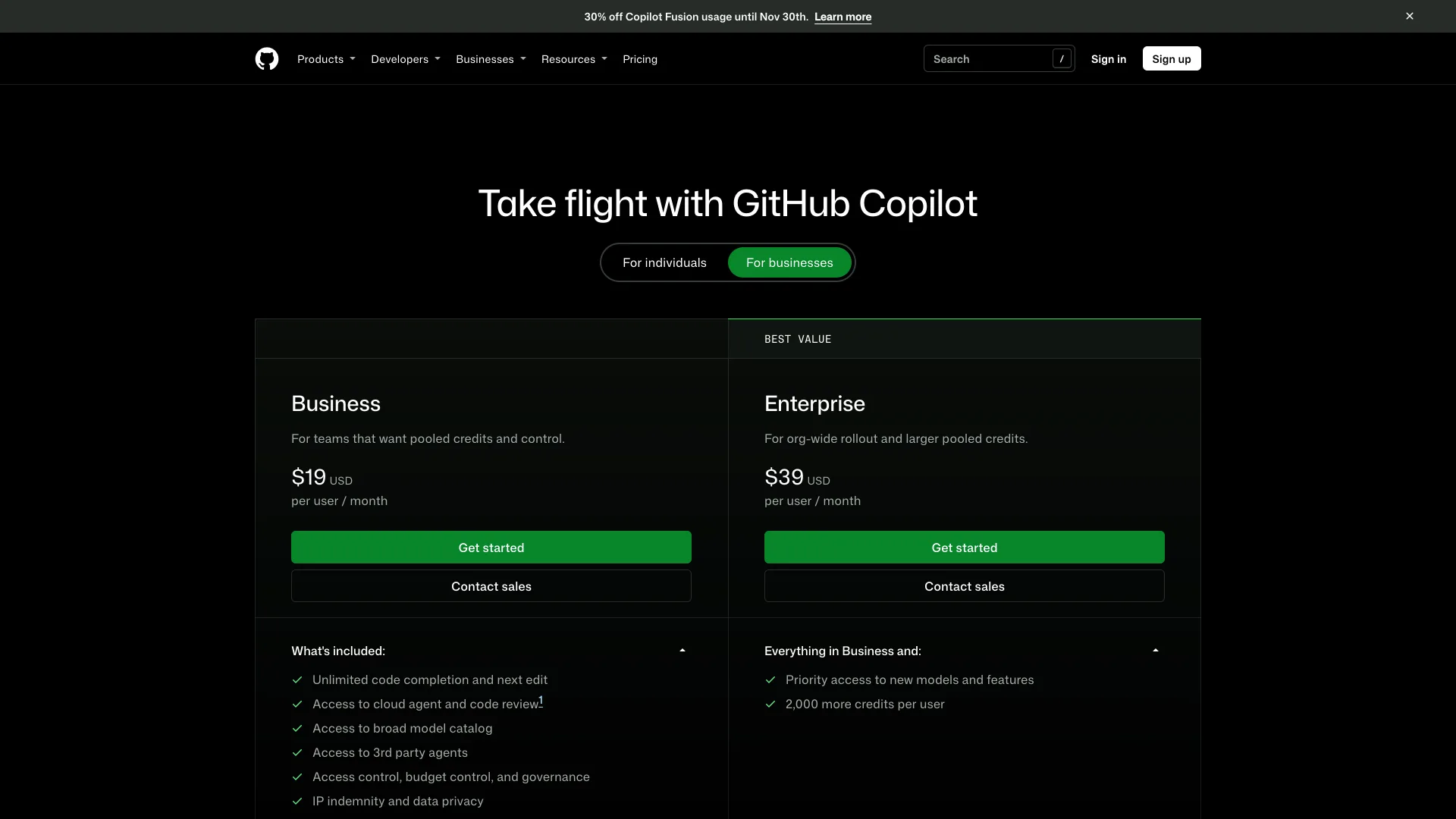
Copilot Business costs $19 per granted seat per month and includes 1,900 GitHub AI Credits per user, pooled across the organization, with usage past the pool billed at $0.01 per credit. For 150 engineers that is $2,850 a month. Copilot Enterprise, built for GitHub Enterprise Cloud customers, is $39 per seat with 3,900 credits.
Augment Code: A Context Engine, Now Owned by Harness
Augment Code is the closest match to Cody's original pitch. Its Context Engine indexes your codebase so completions, chat and the coding agent work from more than the open files, and the same engine runs as an MCP server that Claude Code and other agents can query. Augment supports VS Code, JetBrains IDEs, Vim and Neovim, plus the Auggie CLI, and its Cosmos cloud agents connect to GitHub Enterprise Server and GitLab Self-Hosted.
It also changed hands this fall. On October 8, 2026, Harness acquired Cosmos, the Auggie CLI, the Code Context Engine and the team behind them, and augmentcode.com now carries a "by harness" mark. Ask how the IDE extensions fit that roadmap before signing a multi-year contract.
The gaps for the Chicago team are the editor list and model routing. Augment lists no Visual Studio extension, its models page lists the models Augment hosts, and its documentation does not describe sending calls to a customer's own Bedrock account.
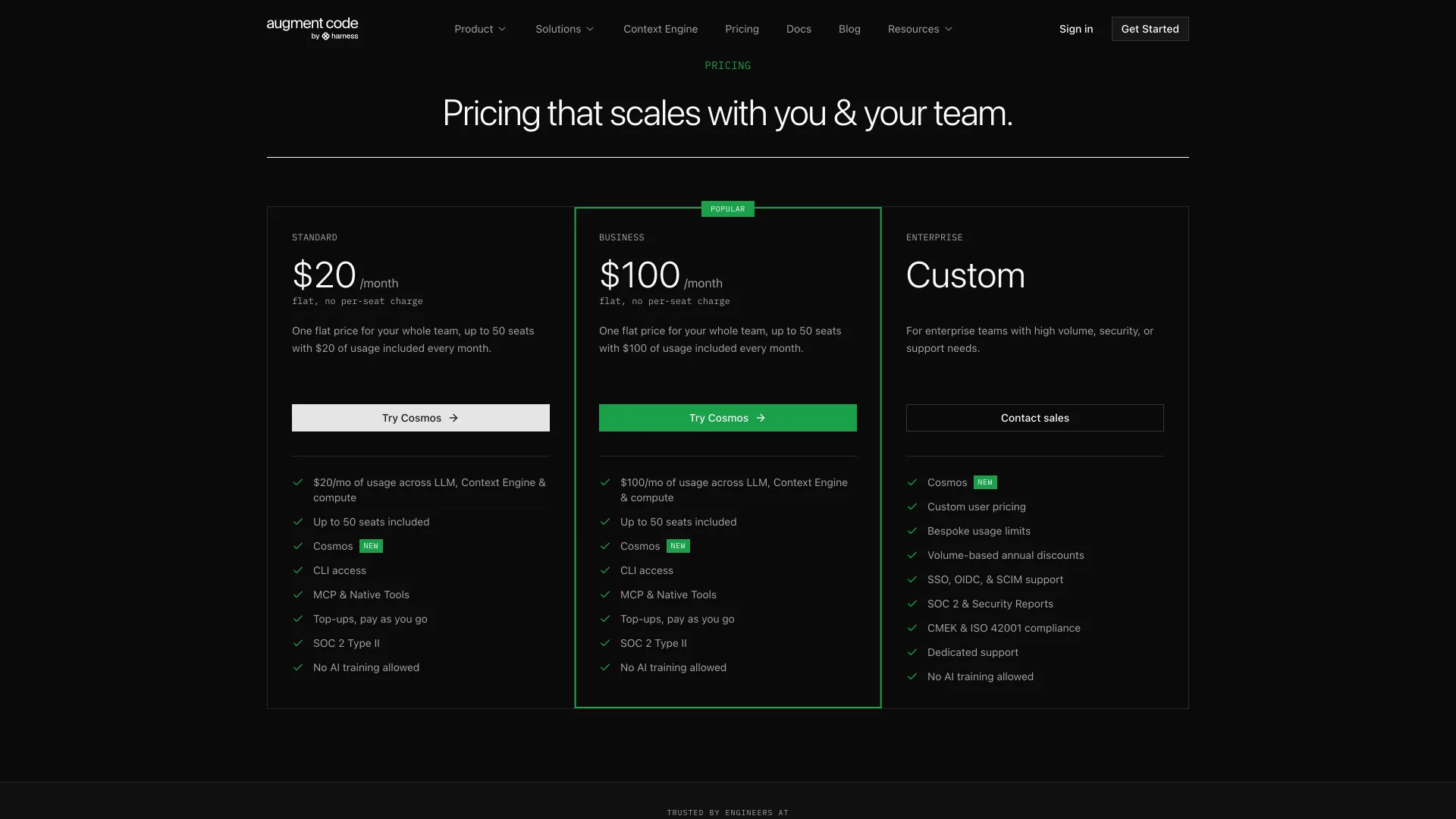
Augment's self-serve plans are flat team prices: Standard is $20 a month and Business $100 a month, each for up to 50 seats with that dollar amount of usage included and pay-as-you-go top-ups. A 150-engineer team lands on Enterprise, priced through sales, which adds SSO, OIDC, SCIM, customer-managed encryption keys and ISO 42001 compliance. SOC 2 Type II covers every plan.
Claude Code: An Agent That Can Run on Your Own Bedrock Account
Claude Code is Anthropic's coding agent. It runs in the terminal and connects to VS Code and JetBrains IDEs, where its plugin opens proposed changes in the IDE's diff viewer and shares the current selection. It is the only commercial option here that meets the Chicago team's model rule out of the box: setting CLAUDE_CODE_USE_BEDROCK=1 sends every request to the company's own AWS account, per the Claude Code Bedrock guide, and Anthropic documents Google Cloud and Microsoft Foundry routes as well.
Claude Code works on the local clone, so the other 1,199 repositories need a context layer. Sourcegraph's MCP server or Augment's Context Engine MCP lets it search them the way Cody did. What it does not replace is tab completion: the JetBrains plugin's documented features are quick launch, diff viewing, selection sharing and file references. Anthropic documents no Visual Studio plugin.
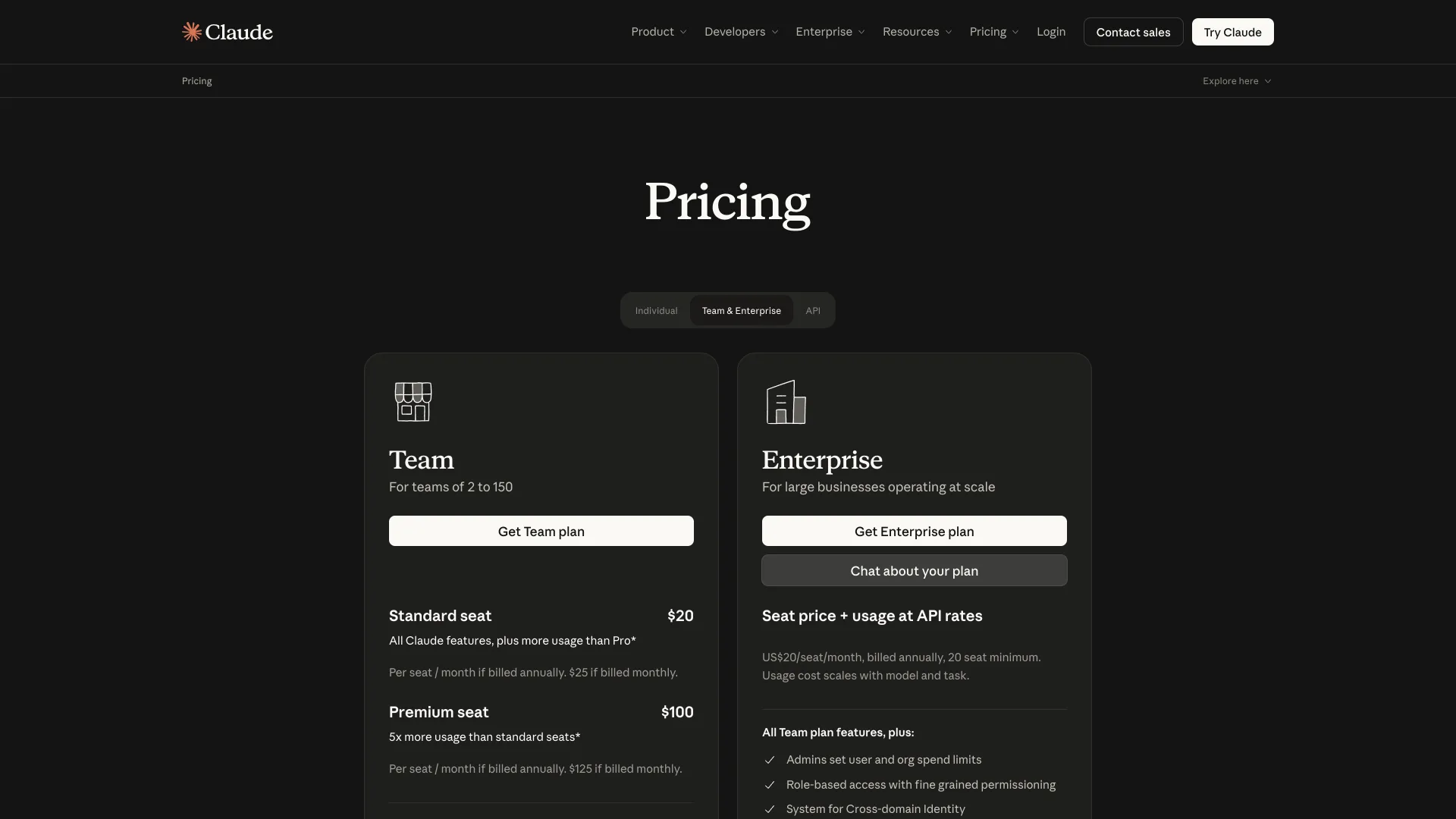
Claude Code is included in all paid Claude plans. The Team plan covers 2 to 150 people at $20 per standard seat per month billed annually ($25 monthly), or $100 for a premium seat with five times the usage. That puts 150 standard seats at $3,000 a month. Claude Enterprise is $20 per seat plus usage at API rates, with a 20-seat minimum, and on Bedrock there is no Anthropic seat at all: AWS bills the tokens.
Cline: Apache 2.0, With Your Own Model Endpoint
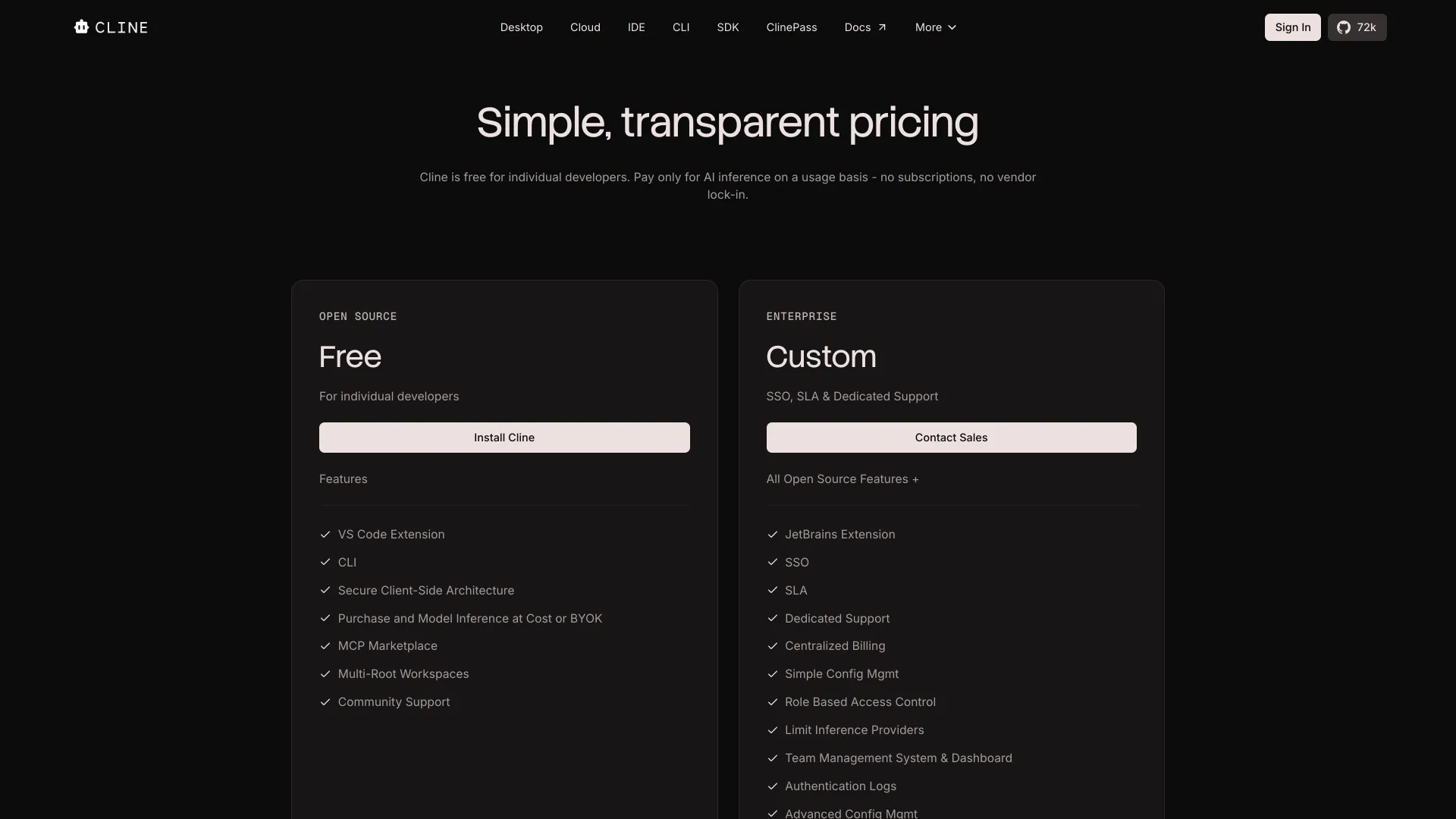
Cline is an open-source coding agent for VS Code and JetBrains IDEs, with a CLI and an SDK. It is licensed Apache 2.0, and as of November 18, 2026 its GitHub repository has 71,750 stars, with version 4.1.26 released October 26, 2026. Cline raised $32 million in seed and Series A funding led by Emergence Capital and Pace Capital, announced July 31, 2025.
The extension is free, and you pay only for model usage with your own keys from providers including AWS Bedrock, GCP Vertex, OpenAI and Anthropic. That meets the Chicago team's Bedrock rule at no license cost. Cline supports MCP servers, so Sourcegraph's MCP server gives it the same cross-repo reach as Claude Code.
The tradeoffs are shape and licensing. Cline is built around an agent you hand tasks to, so a team that mostly used Cody's completions should test that workflow first. Its JetBrains plugin is listed as free on the JetBrains Marketplace, but Cline's pricing page puts the JetBrains extension under Enterprise, alongside SSO, SCIM, audit logs and VPC deployments, so IntelliJ shops should confirm terms with Cline's sales team.
Sourcegraph Deep Search and MCP: Keep the Context, Swap the Assistant
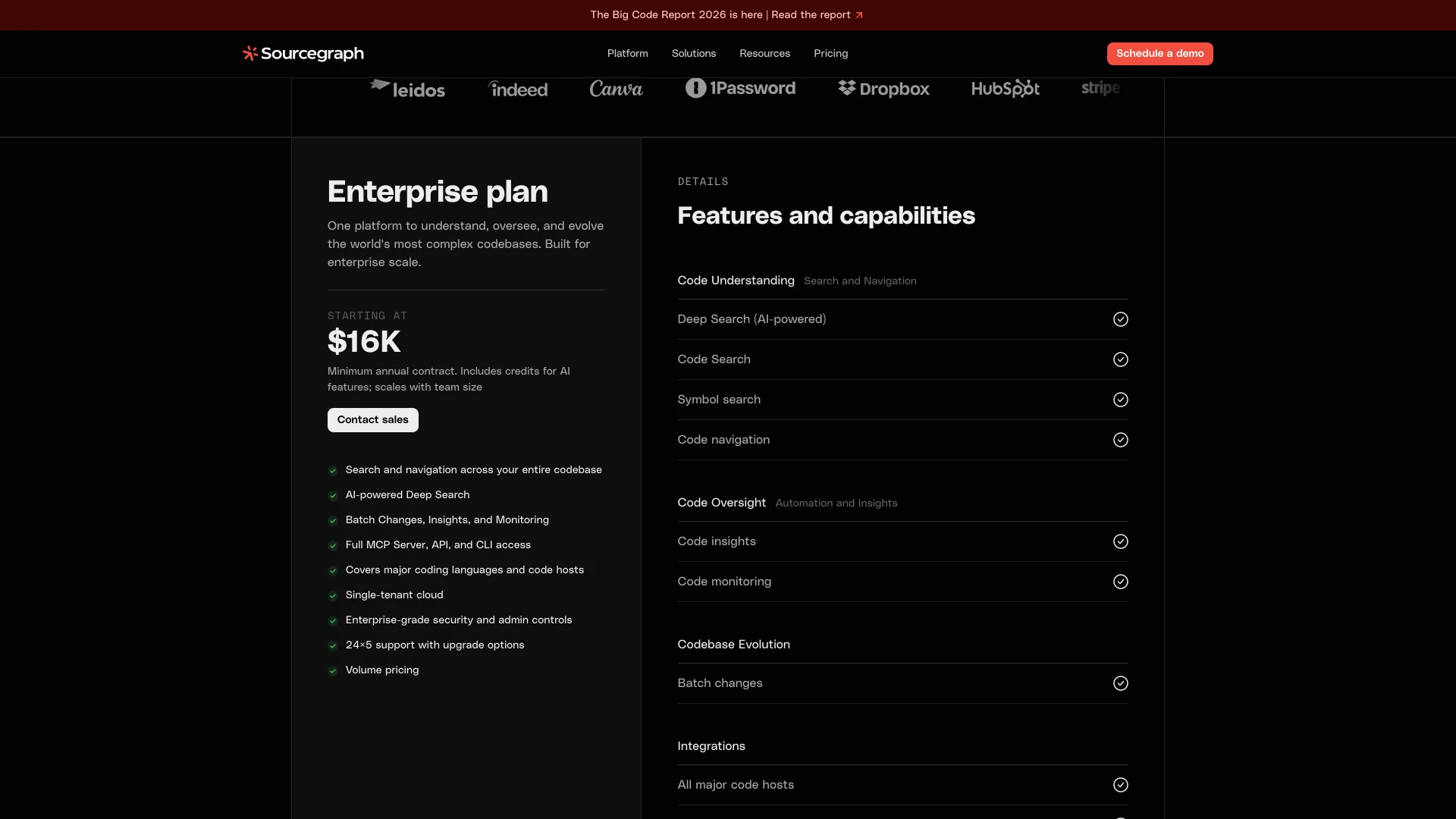
For many Cody teams the cheapest migration keeps the part of Cody that was hardest to copy. Sourcegraph's MCP server exposes code search, repository history and Deep Search to Claude Code, Codex, Cursor, Copilot, OpenCode and Amp. It serves three endpoints, /.api/mcp, /.api/mcp/all and /.api/mcp/deepsearch, and clients sign in with OAuth. Sourcegraph runs self-hosted or as single-tenant cloud and covers the major code hosts, so the Chicago team's 1,200 GitLab repositories stay searchable.
This is not an assistant on its own. It has no completions or editor chat, so it pairs with Claude Code or Cline. Amp, which Sourcegraph spun out as Amp Frontier Corporation on December 2, 2025, is one of the supported clients, but its site lists desktop and mobile apps, a CLI and cloud environments, and no IDE extension.
Sourcegraph's Enterprise plan starts at $16,000 a year as a minimum annual contract, with credits for AI features such as Deep Search included and pooled across the organization.
How to Choose Without Migrating Twice
Work through these in order:
- Check where your code is hosted. GitHub Enterprise Server rules out Copilot today. On GitLab or Bitbucket Self-Managed, Copilot's repository indexing works only in VS Code and uploads code to GitHub.
- Check your model routing rule. If calls must go to your own Bedrock or Vertex account, Claude Code and Cline qualify without negotiation.
- Pick the context layer. Keep Sourcegraph if you already run it and want every agent to share one code graph; choose Augment if you want the agent and the context engine from one vendor.
- Count who used completions versus chat. Teams that lived in tab completion need Copilot or Augment in the editor, even if agents handle larger tasks.
- Pilot two options with ten engineers each well before January 31, 2027.
Which One Should You Actually Use?
Already on GitHub Enterprise Cloud: Copilot Business, with Visual Studio and Eclipse users covered too.
GitLab or Bitbucket Self-Managed, own Bedrock account: Claude Code or Cline, with Sourcegraph's MCP server for cross-repo context.
One vendor for agent and context, vendor-hosted models acceptable: Augment Code Enterprise.
No license budget: Cline with pay-per-token keys.
Conclusion
Cody's end of life is less a product swap than a change of architecture. The Chicago team would keep its Sourcegraph instance for context across 1,200 repositories, move editor work to Claude Code or Cline running on its own Bedrock account, and recieve the same multi-repo answers through MCP instead of a built-in assistant. Teams already on GitHub have a simpler path: Copilot Business covers every editor Cody supported, at $19 a seat.
Related DevToolLab Tools
- MCP Server Config Generator - write the config that connects Claude Code or Cline to Sourcegraph's MCP endpoint, instead of hand-editing JSON for each developer.
- AGENTS.md Generator - move the conventions your team kept in Cody's prompt library into a file every coding agent reads.
- Secret Scanner - check a repository for API keys before you give an agent read access to it.
- GitLab CI Generator - set up the pipeline that runs agent-written changes through your tests on GitLab Self-Managed.