
Every new engineer and every coding agent hits the same wall: the answer to "where do we do this in our code" lives in repositories no single editor window has open. IDE assistants index the repository you are in, which is the wrong scope when one payment bug spans four services, a Terraform module, and a runbook nobody has read since the last incident.
That gap is what code search tools sell, and the lineup changed hard this year. The product most 2025-era comparisons listed third here is gone: bloop, the Rust code search engine with 9,500 GitHub stars, was archived on January 2, 2025, and the company behind it announced its shutdown on April 10, 2026. Its domain now resolves to a parking page. Meanwhile the free option got quietly excellent. While writing this guide I installed Zoekt, the Apache-2.0 engine Sourcegraph maintains, and it indexed a shallow clone of kubernetes/kubernetes (31,300 files) on a laptop in 6.03 seconds, then answered a filtered regex query across the whole index in 193 ms.
What Changed in This Category
The top of the market went enterprise-only. Sourcegraph's pricing page now lists exactly one plan, Enterprise, starting at $16,000, with AI credits bundled and a "contact sales" button where a signup form used to be. The individual Cody plans developers bought for $9 or $19 a month are gone.
Code review absorbed the mid-market. Greptile built its reputation on natural language questions over a whole codebase. Today its homepage says "The AI Code Reviewer" and its docs cover reviews, rules, and pull request workflows. The index is still there, feeding review agents rather than a search box.
Agents became the main consumer of search. Sourcegraph, Sourcebot, and Greptile all ship MCP servers, because the thing asking "where is this pattern used" is increasingly Claude Code or Cursor rather than a person. You are no longer shopping for a search UI, you are shopping for a grounding layer both can query.
Comparison Table
| Tool | Type | Best for | Hosting | Pricing |
|---|---|---|---|---|
| Sourcegraph | Index + Deep Search agent | Multi-repo enterprises | Cloud or self-hosted | From $16,000/year |
| Greptile | Code graph + review agents | Pull request review | Cloud or self-hosted | Free tier, $30/seat/mo |
| Sourcebot | Self-hosted search + AI answers | Sourcegraph's shape, less money | Self-hosted Docker | Free, $20/user/mo |
| Zoekt | Trigram search engine | Your own search layer | Self-hosted binary | Free, Apache 2.0 |
| OpenGrok | Cross-reference search | Java shops, on-prem | Self-hosted (Tomcat) | Free, CDDL 1.0 |
| bloop | Archived AI code search | Nothing new | Read-only repo | Discontinued |
Sourcegraph: The Enterprise Standard
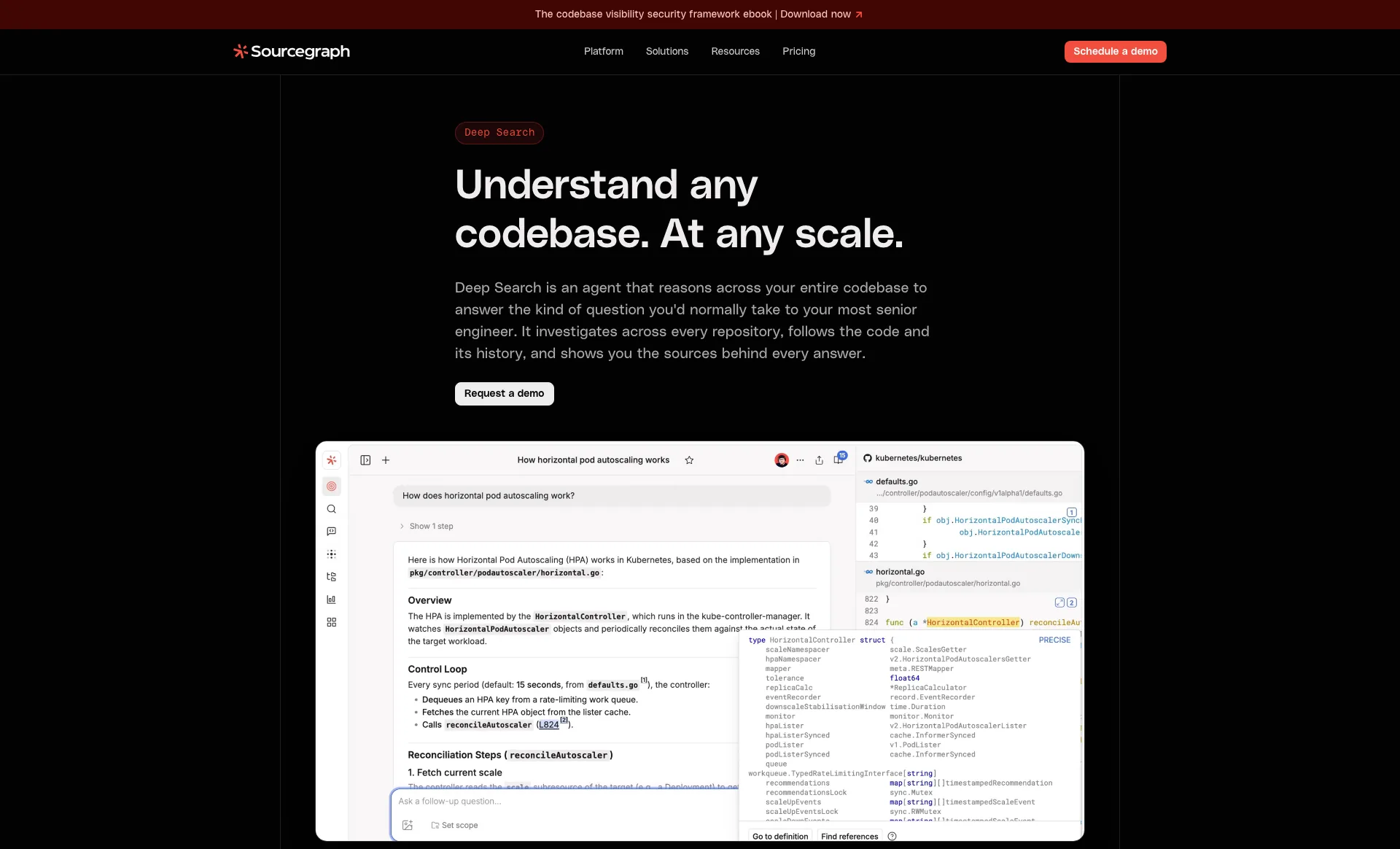
Sourcegraph is still the reference implementation of code search at scale, and its 2026 pitch is Deep Search: an agent that investigates across every repository, follows code and its history, and shows the searches, files, commits, and diffs behind each answer. Its own framing is the honest version of the AI search argument, that the advantage comes from the index rather than the model.
Underneath sits the platform that made Sourcegraph a category: code search with symbol lookup and navigation, Batch Changes for fleet-wide edits, Code Insights, and an MCP server plus GraphQL and REST APIs, on single-tenant cloud or self-hosted. It answers the question nothing else can: aggregate across a portfolio, such as every repository still pinned to a vulnerable log4j version, as a cited answer instead of a page of hits.
What it does not do is fit a small team's budget, since there is no free tier and no self-serve checkout. There is still a free way in: sourcegraph.com/search does public code search with regular expressions and commit diff search across open-source repositories.
Greptile: Excellent, and No Longer a Search Tool
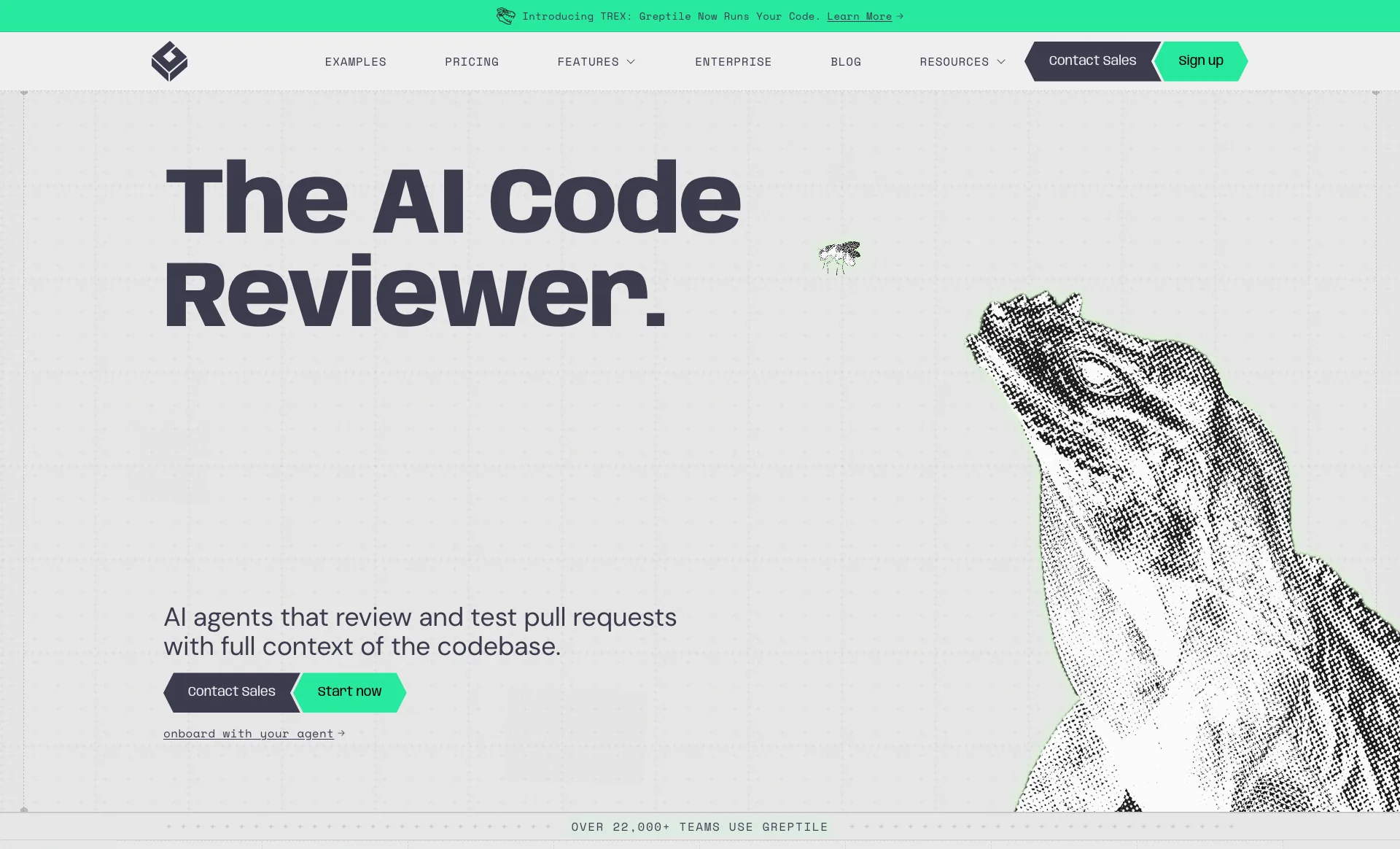
If a listicle sent you here expecting a code search product, adjust your expectations. Greptile is now an AI code reviewer used by more than 22,000 teams. It builds a graph index of files, functions, and dependencies, runs a swarm of agents over each pull request, assesses impact beyond the diff, and learns your standards from how engineers respond to earlier comments. Its newest feature, TREX, runs your code during review rather than reasoning about it statically.
That index is the same asset that once powered its Q&A product, and it is what makes the reviews good. Cross-repo context comes from repository clusters, an MCP server exposes review tools to Claude, Cursor, VS Code, and Codex, and self-hosting runs on Docker Compose or a Helm chart, air-gapped included.
The caveat is what the docs make plain: the current documentation is entirely review workflows, and the general purpose "ask my codebase" API older articles cite is not part of it. Treat Greptile as the review layer on top of your code, not the search box your engineers explore it with.
Pricing: Starter is free for one active developer, unlimited repositories, 50 credits a month. Pro is $30 per seat per month with 50 credits per seat, extra reviews at $1 per credit, and a configurable spend cap. A standard review costs one credit, a TREX review three. Non-commercial MIT or Apache projects can apply for free access.
bloop: The Cautionary Tale
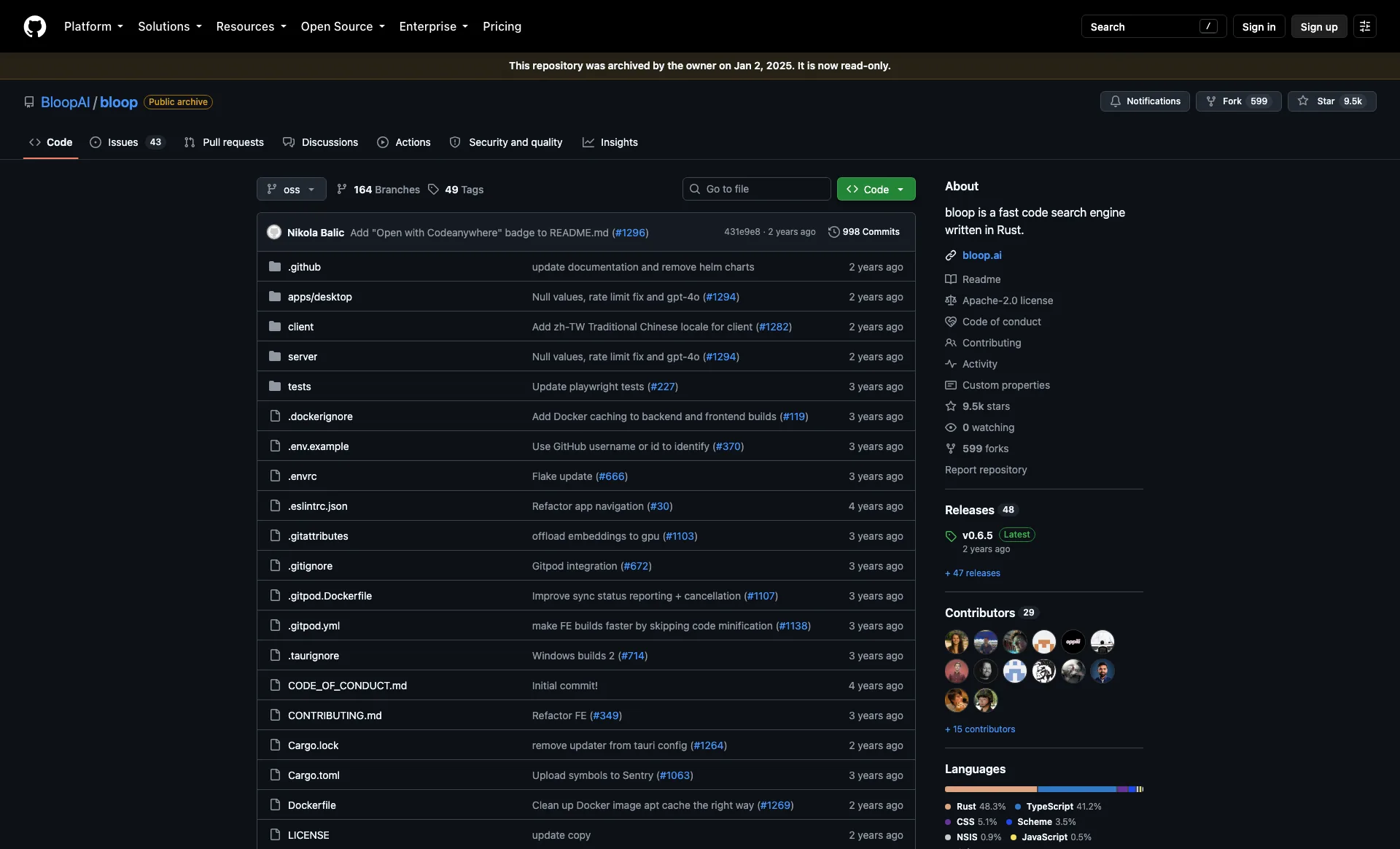
bloop earns a section because it keeps appearing in comparison posts nobody rechecked. It was a good idea: a fast code search engine in Rust, Apache 2.0, with on-device embeddings for semantic search alongside regex and symbol search, and it collected 9,500 stars.
The timeline is unambiguous. The last release, v0.6.5, shipped in April 2024, and GitHub archived the repository on January 2, 2025. The company pivoted to COBOL modernization, then to Vibe Kanban, an agent orchestration tool that reached nearly 28,000 stars, and on April 10, 2026 founder Louis Knight-Webb posted "Goodbye bloop," announcing the company was shutting down and the project would continue as community maintained open source.
Nothing breaks tomorrow if you run bloop today, but nobody is patching a two-year-old stack that calls model APIs. Migrate to Sourcebot, or Zoekt if you only used the search half. The lesson: check the last commit date before adopting any tool whose value is an index it maintains for you.
Open Source and Self-Hosted Options
Most teams should start here, because self-hosted search is better than enterprise pricing implies.
Sourcebot
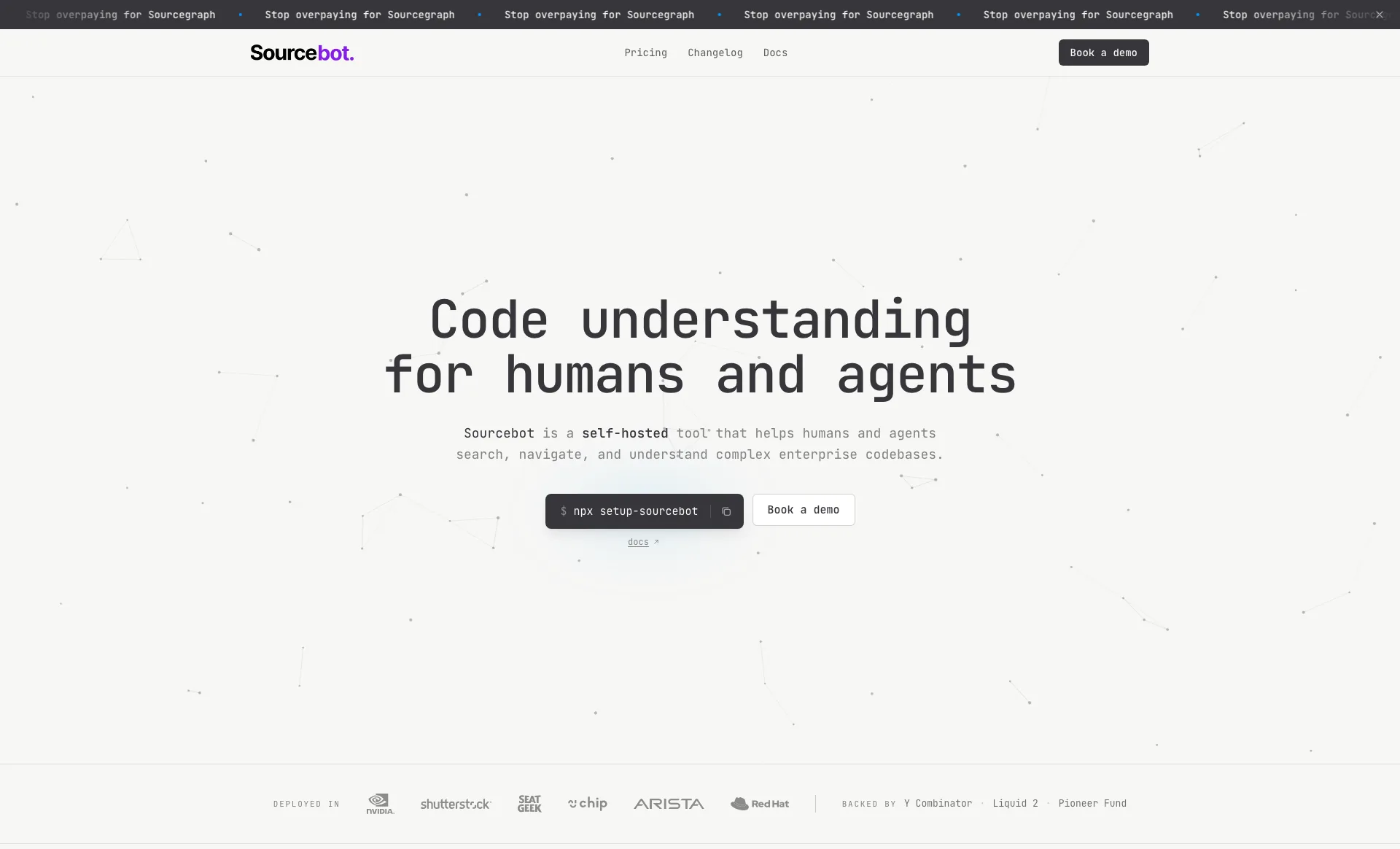
Sourcebot is the most direct answer to Sourcegraph's price, and says so with a scrolling "stop overpaying for Sourcegraph" banner. You launch it with npx setup-sourcebot or a single Docker image, and it indexes every repository and branch across GitHub, GitLab, and other hosts. Search covers regex, symbol and language filters, and boolean logic on a trigram index, while Ask Sourcebot answers with inline citations. Version 5.1.9 shipped on August 22, 2026, and commits land daily.
Read the license first. Code outside the ee directory is under the Functional Source License 1.1, which converts to Apache 2.0 after two years, and the enterprise directory has its own terms, so this is source available rather than OSI open source. The repository also pulls in its own fork of Zoekt as a submodule, which is why the search feels familiar.
Pricing: Basic is free and self-hosted: search UI, regex, symbol and filtered search, git history and blame, file explorer. Pro is $20 per user per month for Ask Sourcebot, the agent context layer, code navigation, SSO, audit logs, and permission syncing, with a 14-day trial.
Zoekt
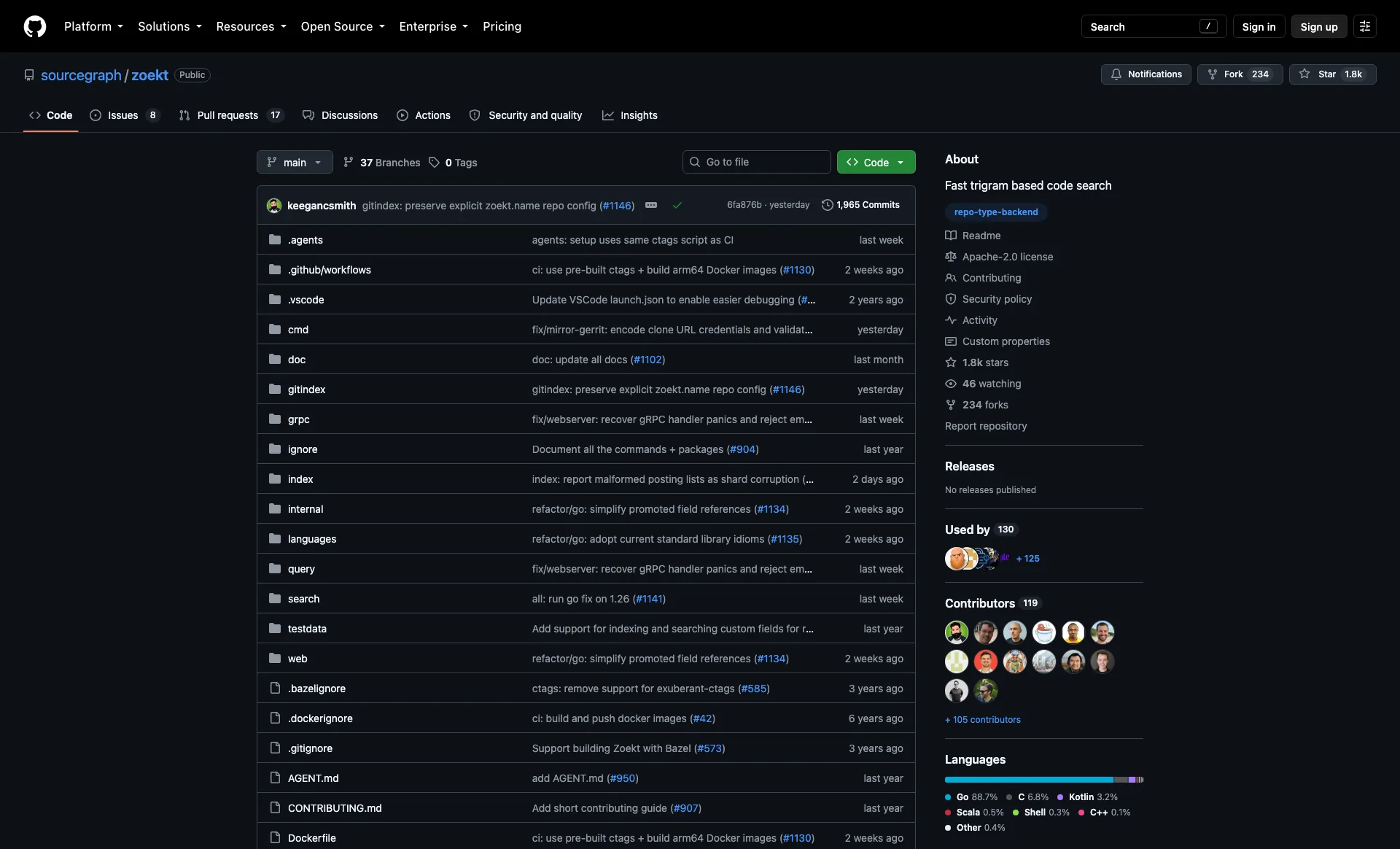
Zoekt is the trigram engine behind Sourcegraph's own search, forked from a Google project in 2017 and maintained by Sourcegraph ever since. Apache 2.0, written in Go, 119 contributors, with commits landing the day before this post went out. There is no web polish, which is the point: this is the engine you embed.
OpenGrok
OpenGrok is the veteran, an Oracle-maintained Java cross-reference engine under CDDL 1.0 still shipping regularly, with release 1.14.17 on August 24, 2026. No AI layer, and it wants a servlet container, but for a large on-premises Java or C codebase needing precise cross-references, two decades of operational history counts.
How to Evaluate One on Your Own Repository
Do this before you sit through a demo. Ten minutes tells you what your codebase needs.
- Index your largest repository with Zoekt first to set the free baseline. Everything below ran on macOS with Go 1.23.4 while writing this post.
Bashgo install github.com/sourcegraph/zoekt/cmd/zoekt-git-index@latest go install github.com/sourcegraph/zoekt/cmd/zoekt@latest git clone --depth 1 https://github.com/kubernetes/kubernetes.git kube zoekt-git-index -index ./index -branches HEAD kube
The clone was 396 MB. Indexing reported 31,300 files, wrote three shards, and finished in 6.03 seconds of wall clock time, producing a 651 MB index.
- Run the query you care about, something a plain grep sweep gets wrong.
Bashzoekt -index_dir ./index -l 'file:\.go$ hmac\.(Equal|New)'
That returned 7 files in 193 ms, and 46 ms warm. Two gotchas: write the regex bare, because the slash-delimited /pattern/ form used on sourcegraph.com returns nothing in this CLI, and expect sym: queries to come back empty unless universal-ctags is on your PATH at index time, which macOS does not ship.
-
Decide whether a natural language layer is worth paying for. Ask three questions your team argued about last month. If regex plus file filters answered them, you need an index, not an agent. If they needed behavior traced across four services, that is what Deep Search and Ask Sourcebot are for.
-
Test the agent path, not just the browser tab. Wire the candidate's MCP server into Claude Code or Cursor and re-ask those questions from inside the agent.
-
Check maintenance before migrating onto it. Last commit, last release, open issue trend. This check would have flagged bloop a year before its domain lapsed.
How to Choose
Fewer than 50 engineers: Self-host Sourcebot Basic for free, or Zoekt if you want no app at all. Add Sourcebot Pro at $20 per user for cited answers and the agent context layer.
Hundreds of repositories: Sourcegraph Deep Search is the only product here built for portfolio-wide aggregation with an audit trail behind each answer. Budget from $16,000.
Your real problem is pull request quality: Greptile at $30 per seat. A strong review tool, but do not buy it expecting search.
Cross-references on a legacy on-prem codebase: OpenGrok, still shipping releases in August 2026.
You were relying on bloop: Migrate now, to Sourcebot.
Conclusion
The split in 2026 is not AI versus regex, it is who owns the index. Sourcegraph priced its index like infrastructure, Greptile pointed its index at code review, and bloop's index stopped being maintained. What survived at the free end is better than that repositioning suggests: an Apache-2.0 engine that indexed 31,300 files in six seconds, and a self-hosted app built on a fork of it with a real free tier.
Run the Zoekt commands above on your largest repository this week. If a regex and a file filter answer your questions in under a second, you are done and it cost nothing. If they do not, you know which questions justify a paid natural language layer, which is a far better place to start a sales call than a feature list.
Related Tools and Reading
- GitHub Repo Stats - Check stars, forks, and issue activity before betting on an open-source search engine
- Regex Explainer - Break down a dense search pattern before running it across every repo
- Docker Compose Generator - Draft the compose file for a self-hosted Sourcebot or Greptile deployment
- Git Command Generator - Local code archaeology with
git log -Swhen a full index is overkill - Best AI Code Review Tools - Where Greptile competes today, next to CodeRabbit and Qodo
- Best MCP Servers - How these search indexes reach your coding agent
- Best AI Code Migration Tools - The modernization work cross-repo search precedes
Pricing and positioning in this category changed several times during 2026. Verify current pricing with each vendor, and check the last commit date on anything self-hosted.