

Every agent or RAG pipeline that reads the live web needs the same plumbing: render the page, strip the navigation and the cookie banner, and hand the model Markdown it can afford to read. Firecrawl turned that into one API call and became the default.
On September 22, 2026, Firecrawl announced a $75M Series B led by Smash Capital and launched Alexandria, a knowledge library for agents. We priced one ordinary job, re-indexing a 5,000-page docs site every week, on Firecrawl and eight alternatives: the same 20,000 pages a month cost $94 on Firecrawl month to month, $30 on Tavily, $20 on Exa and $1.51 to $15.77 on Jina Reader, depending on page length.
What Firecrawl Charges, and Where It Gets Expensive
Firecrawl's pricing, effective September 4, 2026 and checked October 14, 2026, runs on one credit balance. A basic scrape, crawl or map costs 1 credit per page, search costs 2 credits per 10 results, and the JSON, Question and Highlight formats add 4 credits per page, so structured extraction costs five times as much as Markdown. A page that answers 403 or 404 still costs a credit.
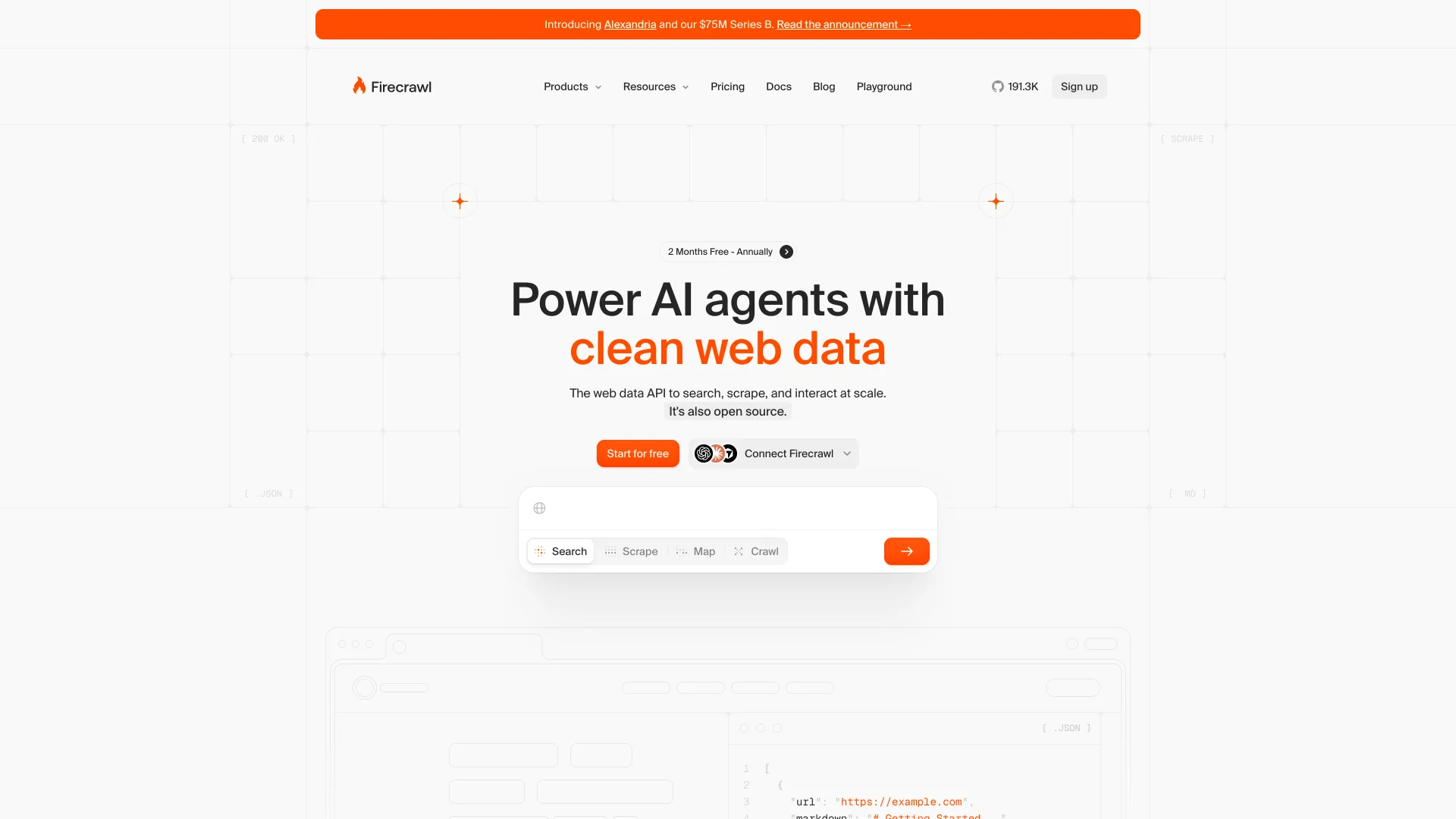
Hobby is $19 a month for 5,000 credits, Standard $99 for 100,000, Growth $399 for 500,000 and Scale $749 for 1,000,000, about 16 to 20 percent less billed yearly, and extra Hobby credits cost $5 per 1,000. That gives three reasons to look elsewhere: structured JSON makes the bill five times larger, you only need search results, or the AGPL-3.0 license does not fit how you ship a self-hosted copy.
What 20,000 Docs Pages a Month Costs
The worked example is a support assistant that re-indexes a docs site the size of Stripe's every week. Stripe's docs sitemap listed 4,946 URLs on October 14, 2026, so four passes is about 20,000 known URLs a month. Two services bill by output size, so we measured 10 pages sampled evenly from that sitemap: Jina Reader returned a median of 1,511 tokens per page, one React SDK reference page alone produced 143,348 tokens and pulled the mean to 15,770, and the raw HTML averaged 922,459 bytes.
js// Price one month of turning ~20,000 known URLs into Markdown on each service. // Rates are from each vendor's pricing page, checked October 14, 2026. const PAGES = 20_000 // Measured on 10 pages sampled from docs.stripe.com's sitemap const JINA_TOKENS_MEDIAN = 1_511 // tokens per page returned by r.jina.ai const JINA_TOKENS_MEAN = 15_770 // one 143,348-token API reference page pulls the mean up const HTML_BYTES_MEAN = 922_459 // uncompressed HTML per page const cheapest = (options) => options.reduce((a, b) => (b.cost < a.cost ? b : a)) // Firecrawl: 1 credit per scraped page; extra credits are sold in $5 packs const firecrawl = cheapest( [ { plan: "Hobby", fee: 19, credits: 5_000, perFive: 1_000 }, { plan: "Standard", fee: 99, credits: 100_000, perFive: 2_000 }, ].map((p) => ({ plan: p.plan, cost: p.fee + Math.ceil(Math.max(0, PAGES - p.credits) / p.perFive) * 5, })), ) // Tavily: basic Extract costs 1 credit per 5 successful URLs const tavilyCredits = Math.ceil(PAGES / 5) const tavily = cheapest( [ { plan: "Project", fee: 30, credits: 4_000 }, { plan: "Bootstrap", fee: 100, credits: 15_000 }, ].map((p) => ({ plan: p.plan, cost: p.fee + Math.max(0, tavilyCredits - p.credits) * 0.008 })), ) // ScrapeGraphAI: 1 credit per Markdown scrape; packs of 10,000 credits cost $40 const scrapegraph = cheapest([ { plan: "Starter + 1 Medium pack", cost: 20 + Math.ceil(Math.max(0, PAGES - 10_000) / 10_000) * 40 }, { plan: "Growth", cost: 100 }, ]) // Browserbase: Markdown output is billed as Fetch Extract, $4 per 1,000 calls past the plan's included calls const browserbase = cheapest([ { plan: "Developer", cost: 20 + (Math.max(0, PAGES - 1_000) / 1_000) * 4 }, { plan: "Startup", cost: 99 + (Math.max(0, PAGES - 10_000) / 1_000) * 4 }, ]) const rows = [ ["Firecrawl", `$${firecrawl.cost}`, `${firecrawl.plan} plan + pay-as-you-go, month to month`], ["Tavily Extract", `$${tavily.cost}`, `${tavily.plan} plan, ${tavilyCredits.toLocaleString("en-US")} credits`], ["Exa Contents", `$${(PAGES / 1_000) * 1}`, "$1 per 1,000 pages, before the $10 monthly free credit"], [ "Jina Reader", `$${((PAGES * JINA_TOKENS_MEDIAN) / 1e6 * 0.05).toFixed(2)} to $${((PAGES * JINA_TOKENS_MEAN) / 1e6 * 0.05).toFixed(2)}`, "$0.05 per 1M output tokens, median to mean page", ], ["Spider", `$${((PAGES * HTML_BYTES_MEAN) / 1e9).toFixed(2)} + CPU`, "$1 per GB of fetched content, pay as you go"], ["ScrapeGraphAI", `$${scrapegraph.cost}`, scrapegraph.plan], ["Browserbase Fetch", `$${browserbase.cost}`, `${browserbase.plan} plan, Markdown via Fetch Extract`], ["Crawl4AI or self-hosted Firecrawl", "$0 + servers", "open source; you run the browsers and proxies"], ] const w = [36, 18] console.log(`${PAGES.toLocaleString("en-US")} pages to Markdown, one month\n`) for (const [name, cost, note] of rows) console.log(name.padEnd(w[0]) + cost.padEnd(w[1]) + note)
text20,000 pages to Markdown, one month Firecrawl $94 Hobby plan + pay-as-you-go, month to month Tavily Extract $30 Project plan, 4,000 credits Exa Contents $20 $1 per 1,000 pages, before the $10 monthly free credit Jina Reader $1.51 to $15.77 $0.05 per 1M output tokens, median to mean page Spider $18.45 + CPU $1 per GB of fetched content, pay as you go ScrapeGraphAI $60 Starter + 1 Medium pack Browserbase Fetch $96 Developer plan, Markdown via Fetch Extract Crawl4AI or self-hosted Firecrawl $0 + servers open source; you run the browsers and proxies
Each line uses the cheapest tier that returns Markdown for a public page. Anti-bot modes, heavy JavaScript and JSON cost more everywhere, and the token and byte meters swing tenfold on one site. Firecrawl drops to $83 if you prepay Standard for a year.
Crawl4AI: The Open Source Default
Crawl4AI is an Apache 2.0 Python library that drives a headless browser and returns Markdown, with no API key and no meter.
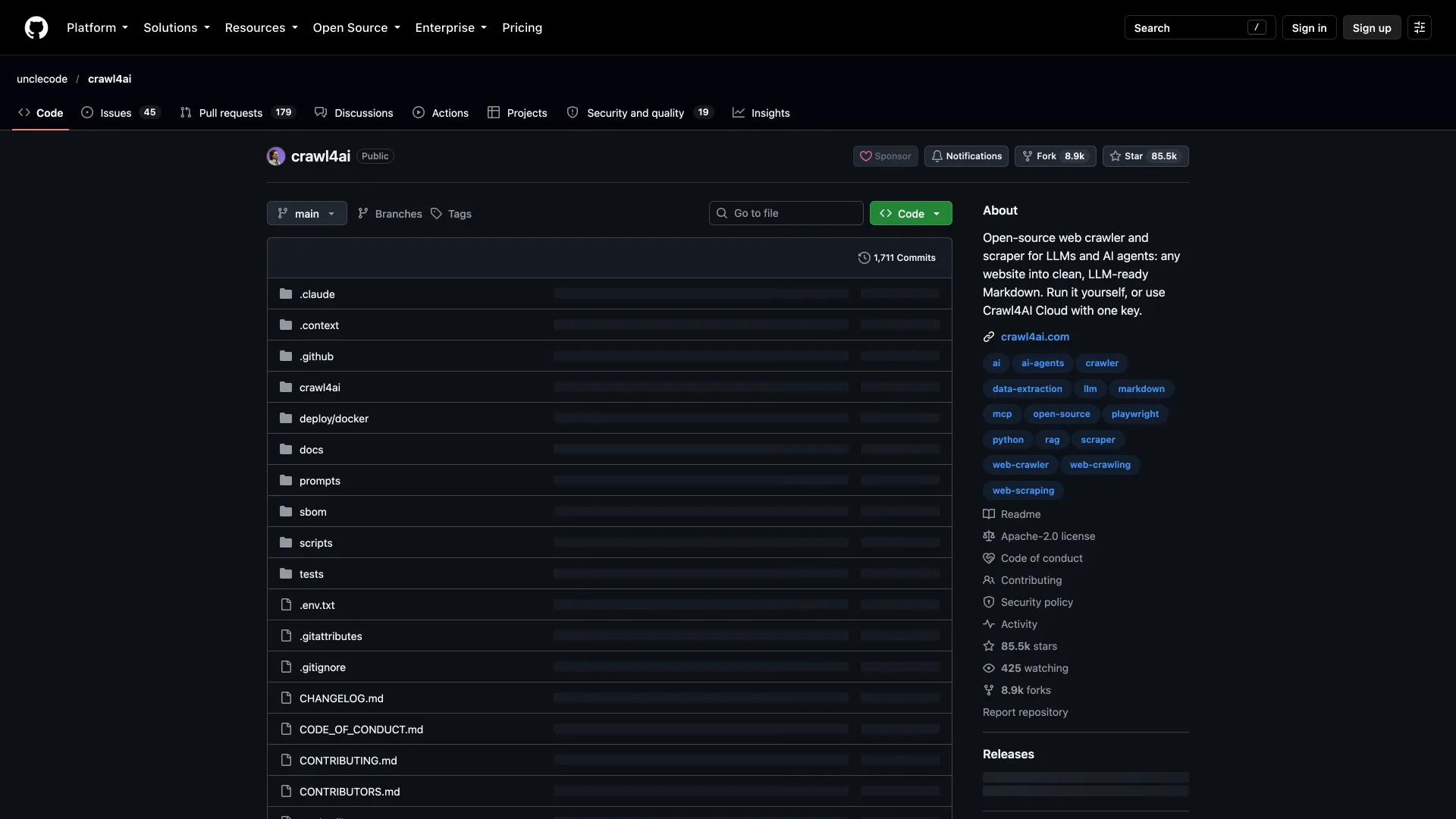
What it does well: pip install -U crawl4ai plus crawl4ai-setup gives you a crawler that runs as a library or a Docker server inside your own VPC, the cleanest answer for SOC 2 or HIPAA scoping because no page leaves your network.
What it does not do: proxies, CAPTCHAs, blocked IPs and scaling the browser fleet are your problem.
License and version: Apache-2.0, 85,485 GitHub stars, v0.9.4 released September 23, 2026 · Hosted: 2,000 free credits, paid from $10.
Self-Hosted Firecrawl: Same API, Your Servers
Firecrawl's self-hosting guide starts the API you already call from a Docker Compose file, so client code only needs a new base URL.
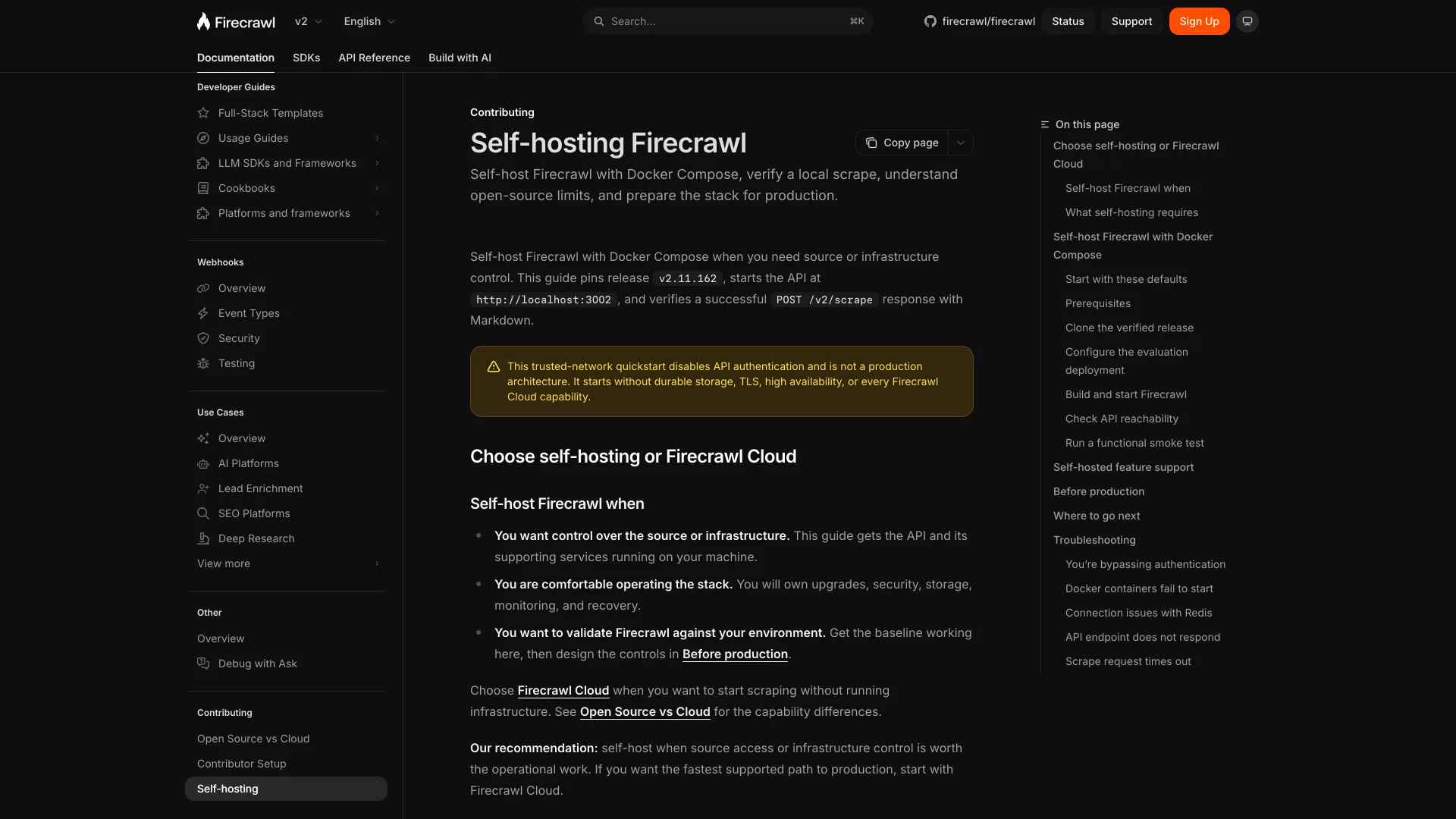
What it does well: no credits. Compose runs the API and workers, Playwright, Redis, RabbitMQ, a PostgreSQL queue and FoundationDB, and exposes only the API, on port 3002.
What it does not do: production defaults. The repository's SELF_HOST.md says the API is unauthenticated, the Compose file defines no persistent volumes, scraping uses bundled Playwright, and the Fire-engine scraping engine and AI features need separate setup. Under AGPL-3.0, a modified copy offered over a network must share its source with users.
License and version: AGPL-3.0, 191,299 stars, v2.11 release line, which the guide pins at v2.11.162 · Cost: your servers.
Jina Reader: A URL Prefix, Billed by Tokens
Jina Reader converts a page when you put https://r.jina.ai/ in front of its URL, and s.jina.ai does the same for a search. Jina AI has been part of Elastic since October 2025.
What it does well: it is the cheapest metered option here, and its open source branch was re-synced with the hosted code in April 2026, so a self-hosted copy runs the same code.
What it does not do: you cannot predict the bill from a page count, since our sample spanned 181 to 143,348 tokens per page. The 10 million free tokens on a new key are for non-commercial use only, and each search costs at least 10,000 tokens.
Pricing: $50 for 1 billion tokens ($0.05 per million) · 20 requests per minute without a key, 500 with one · License: Apache-2.0, 12,147 stars.
Spider: Billed by the Gigabyte
Spider is a crawling API built on an MIT-licensed Rust crawler that prices requests by bandwidth and CPU time instead of pages.
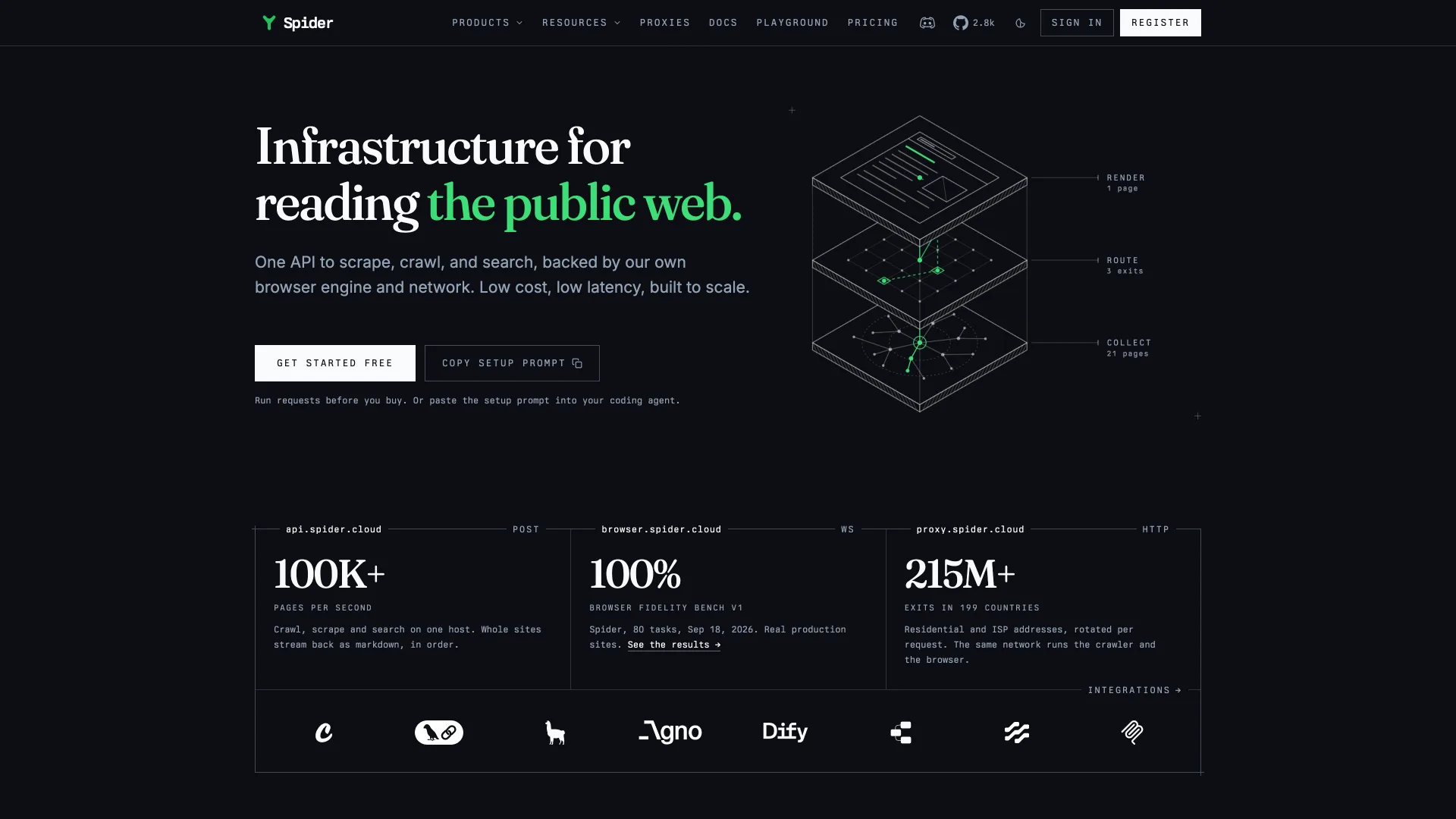
What it does well: failed requests cost $0, JavaScript rendering bills as compute rather than a multiplier, and an Unlimited plan sells concurrency instead of requests, from 2 concurrent for $40 a month.
What it does not do: Stripe's docs averaged 922 KB of HTML, so this job lands at $18.45 plus CPU time, and zero data retention multiplies the price by 2.5.
Pricing: $1 per GB plus $0.0001 per CPU minute · Unlimited from $40 a month · License: MIT core, spider crate v2.53.9 published September 5, 2026.
Exa: A Search Index With Page Contents
Exa runs its own web index for agents, and its Contents endpoint returns the full text of any list of URLs, from cache with a live crawl as fallback.
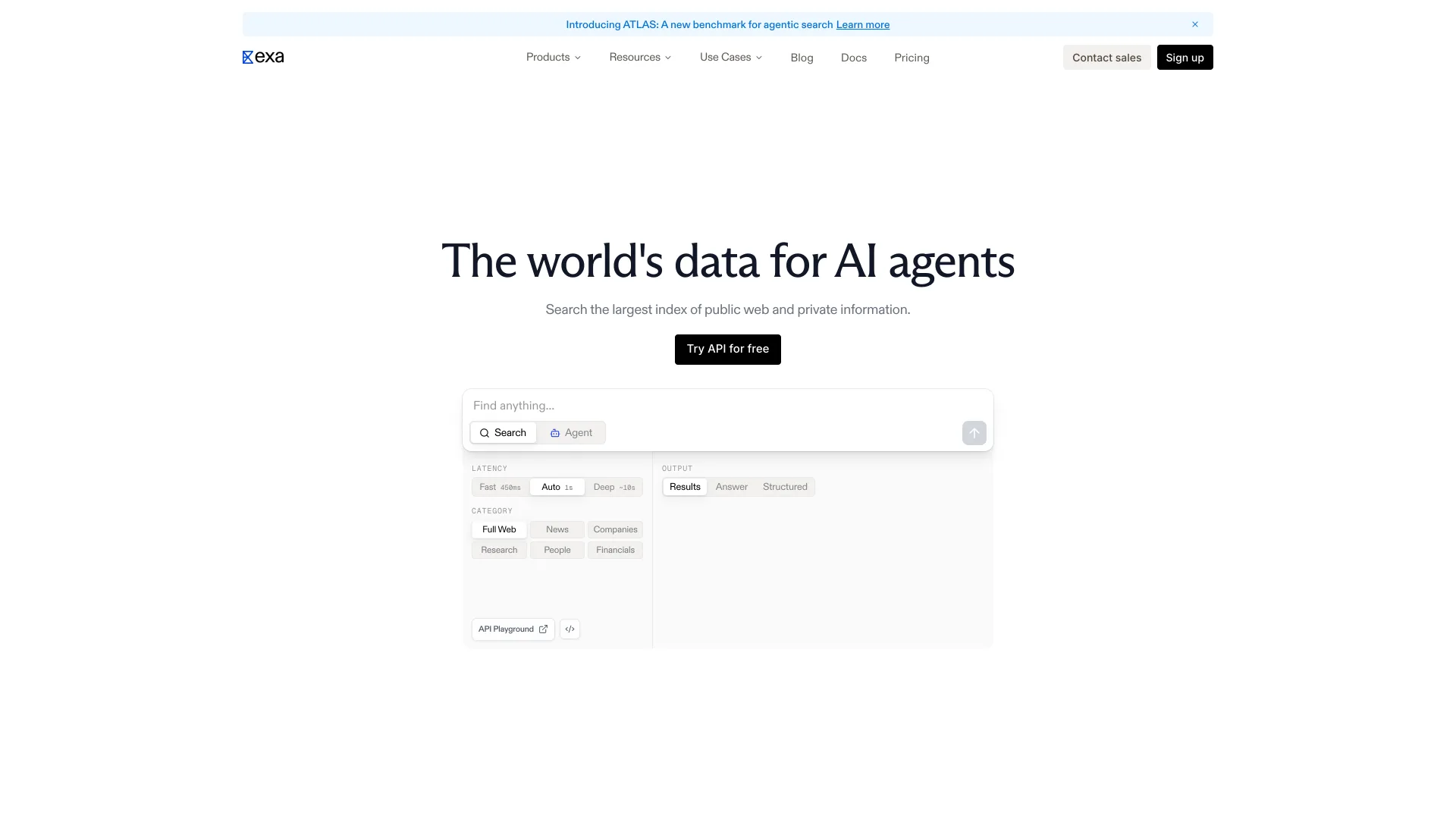
What it does well: $1 per 1,000 pages with no plan fee, search from $4 per 1,000 requests and $10 of free credit monthly.
What it does not do: it is an index, not a crawler you steer, with no self-hosted option, and a cached page can be older than the live one unless you set a livecrawl policy.
Pricing: Contents $1 per 1,000 pages · Search $4 to $15 per 1,000 requests · License: proprietary.
Tavily: Search and Extract on One Credit Meter
Tavily sells search, extract, map and crawl endpoints for agents on one credit balance. Nebius announced an agreement to acquire Tavily on February 10, 2026, and the site now carries a "by Nebius" logo.
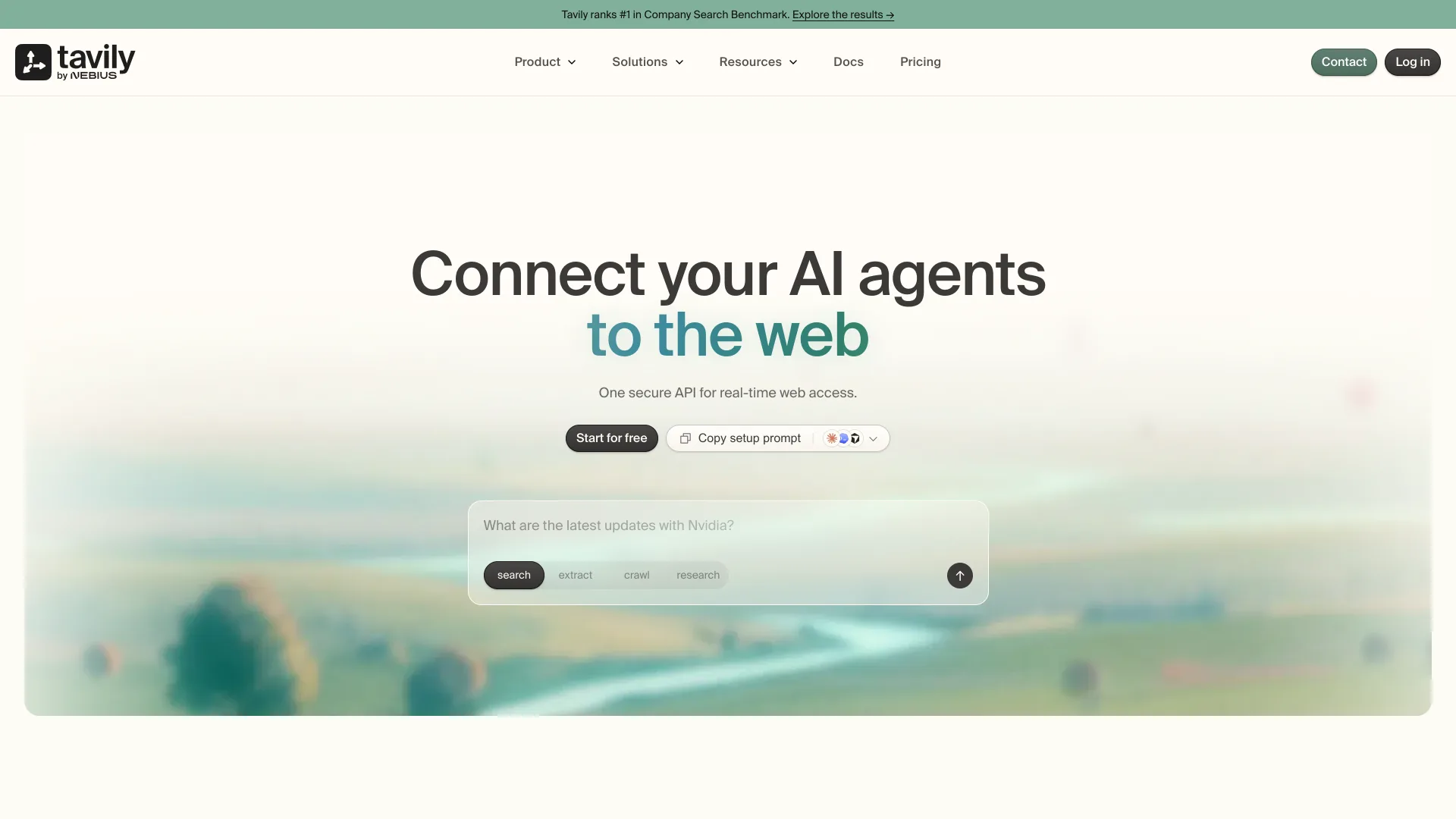
What it does well: basic Extract charges 1 credit per 5 successful URLs, so our 20,000 pages fit the $30 Project plan exactly, failed extractions are free, and a basic search is 1 credit.
What it does not do: crawling adds a mapping charge of 1 credit per 10 pages, advanced extraction doubles the price, and nothing self-hosts.
Pricing: Free 1,000 credits a month · Project $30 for 4,000 · Bootstrap $100 for 15,000 · $0.008 per extra credit · License: proprietary.
ScrapeGraphAI: Prompt-Driven Extraction
ScrapeGraphAI started as an MIT Python library that sends a page and a natural-language prompt to an LLM and returns JSON, and now sells a hosted API.
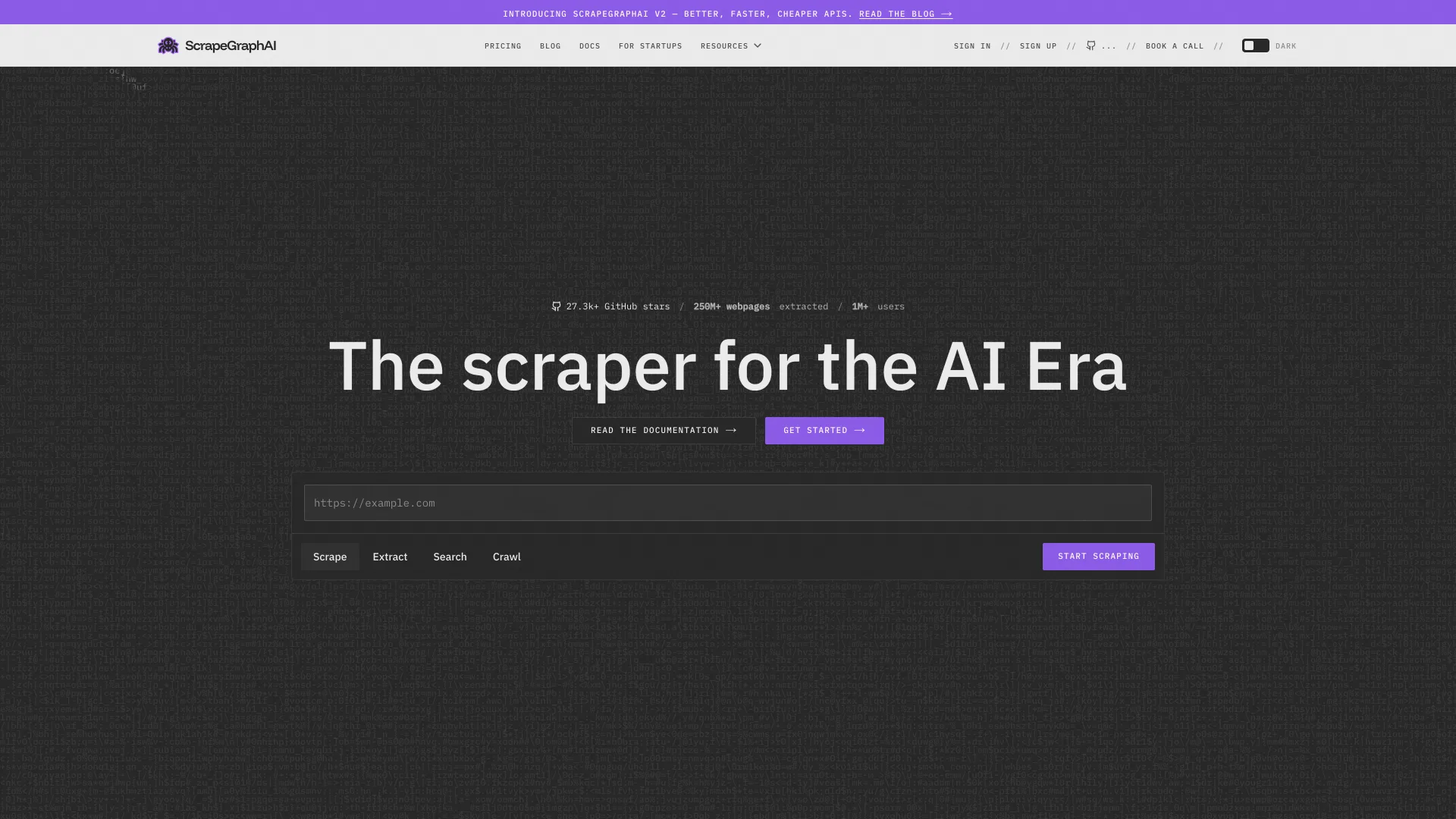
What it does well: structured extraction is the point. An Extract call costs 5 credits, the same count Firecrawl charges for a JSON page, and the library runs against a local Ollama model, so extraction can stay on your hardware.
What it does not do: search costs 2 credits per result, 20 for a 10-result search, anti-bot "stealth" adds 5 credits to any call, and the library needs playwright install plus a model first.
Pricing: Starter $20 for 10,000 credits · Growth $100 for 100,000 · License: MIT library, v2.3.1 released October 6, 2026.
Browserbase: Real Browsers When Fetch Is Not Enough
Browserbase runs cloud browsers for agents and now sells Fetch and Search APIs next to them. Its MIT-licensed Stagehand framework drives those browsers with natural-language actions.
What it does well: logins, forms and multi-step flows, which no page-to-Markdown API handles. Raw HTML from Fetch costs $1 per 1,000 calls on the Developer plan.
What it does not do: cheap Markdown. Asking Fetch for Markdown or JSON bills as Fetch Extract at $4 per 1,000, which puts this job at $96. Fetch also skips JavaScript and caps responses at 5 MB.
Pricing: Developer $20 a month with 100 browser hours, then $0.12 an hour · Startup $99 · License: proprietary, Stagehand MIT (25,660 stars, v3.7.3).
Side by Side
| Tool | Billing unit | 20,000 pages/month | Search API | Self-host | License |
|---|---|---|---|---|---|
| Firecrawl | Credits per page | $94 | Yes | Yes | AGPL-3.0 |
| Crawl4AI | Your servers | $0 + servers | Hosted only | Yes | Apache-2.0 |
| Jina Reader | Output tokens | $1.51 to $15.77 | Yes | Yes | Apache-2.0 |
| Spider | GB + CPU time | $18.45 + CPU | Yes | Crawler core | MIT core |
| Exa | Per 1,000 pages | $20 | Yes | No | Proprietary |
| Tavily | Credits | $30 | Yes | No | Proprietary |
| Browserbase | Calls + browser hours | $96 | Yes | No | Proprietary |
| ScrapeGraphAI | Credits | $60 | Yes | Library | MIT library |
How to Choose Without Migrating Twice
- Diff the sitemap before you price anything. Most docs pages do not change in a given week. Re-scrape only new URLs and changed
lastmoddates and every number above shrinks. - Run the 10-page sample on your own site. Token and byte meters moved tenfold on one site; ten real pages per candidate settles it.
- Decide whether you need JavaScript rendered. Server-rendered docs do not; a React dashboard does, which rules out Browserbase Fetch.
- Price structured output as its own line. JSON costs 5 credits a page on Firecrawl and 5 per Extract call on ScrapeGraphAI. An LLM pass over cheap Markdown may cost less.
- Read the license before you embed. AGPL-3.0 reaches your service if you modify Firecrawl and offer it over a network; Apache-2.0 and MIT do not.
Which One Should You Actually Use?
Cheapest per page for public docs: Exa Contents at a flat $1 per 1,000 pages, or Jina Reader if you measure your pages first and they are short.
An agent that searches, then reads: Tavily. One credit meter covers both, and the $30 plan covered this whole workload.
Data that cannot leave your VPC: Crawl4AI, unless your code already speaks Firecrawl's API; then self-host Firecrawl and budget time for authentication and persistence.
Logins, forms and single-page apps: Browserbase with Stagehand.
Happy with Firecrawl's output: stay, and watch the crossover. Hobby plus pay-as-you-go beats Standard at $99 month to month up to 21,000 pages, but prepaying Standard at $83 a month wins from about 18,000.
Conclusion
The money in this category is moving up the stack: Firecrawl is building a knowledge library, Tavily ships under Nebius and Browserbase sells search next to its browsers, while page-to-Markdown becomes a commodity priced per page, per token or per gigabyte. Before renewing, check which one your bill follows.
Related DevToolLab Tools
- Sitemap Diff Checker - send only new and changed URLs to the scraping API each week.
- Sitemap Validator - check that the sitemap parses before you pay to fetch it.
- HTML to Markdown Converter - a baseline Markdown conversion to compare each API's output against.
- Robots.txt Tester - check which paths a site allows crawlers to fetch.
Related Guides
- Best Web Scraping APIs for AI - Firecrawl, Apify, Bright Data and Zyte at 100,000 pages a month.
- Best AI Search APIs - search APIs compared for agents that need results rather than full pages.
- Best RAG Platforms and Tools - where the Markdown goes next: chunking, embedding and retrieval.
- How to Find AI Crawlers in Your Logs - spotting these crawlers on your site.