
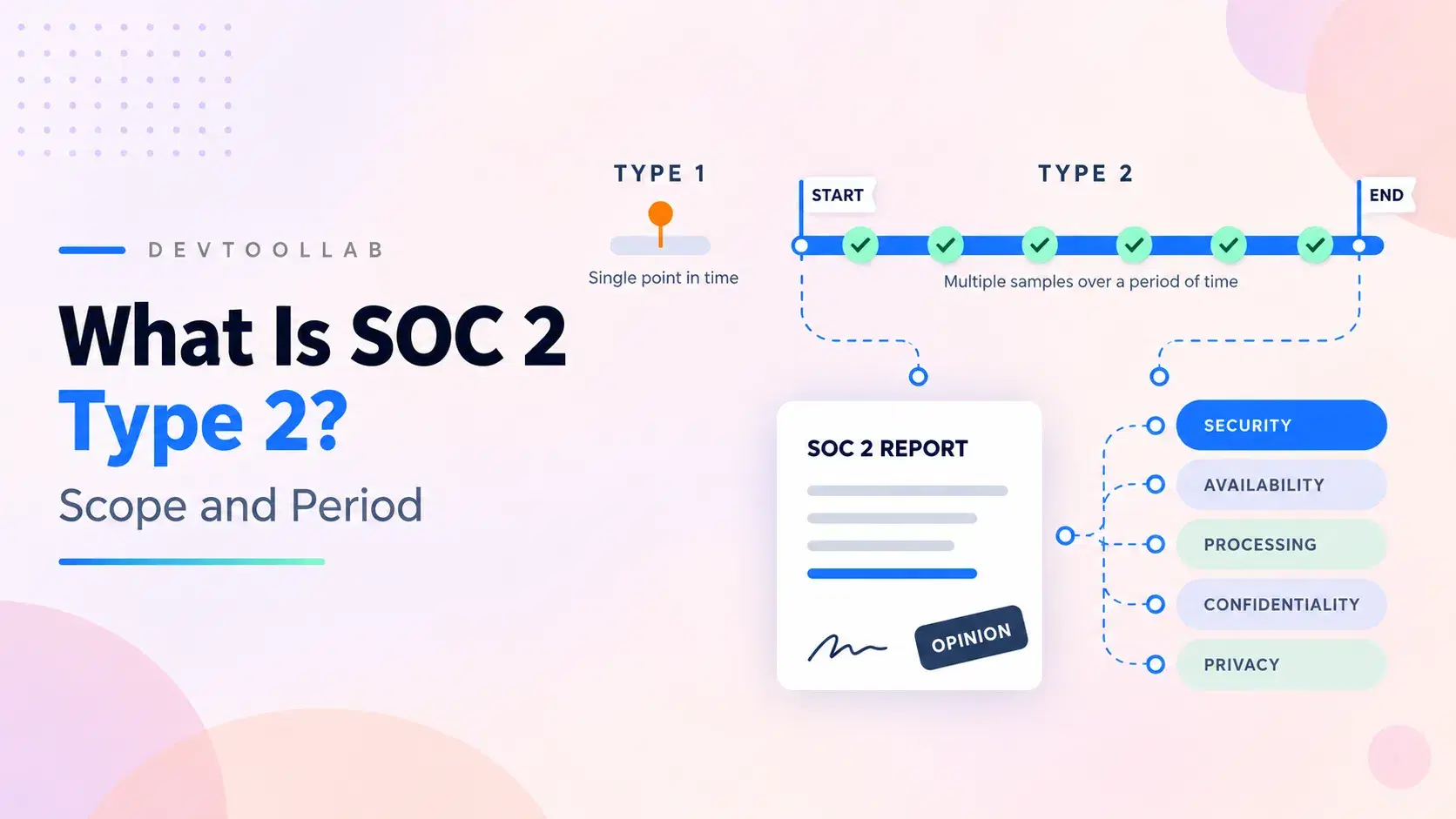
If a customer's security questionnaire asks for your SOC 2 Type 2 report, they are asking for evidence that your controls worked over a stretch of time, not that they existed on the day an auditor looked. That single distinction is the whole difference between the two report types, and it is why a Type 2 takes months to produce and a Type 1 can be finished in weeks.
The definition is simple. What has changed is the value of the answer. In 2026 the AICPA, which writes the standard the report is issued under, published a run of unusually blunt material about SOC 2 report quality: a public notice on its SOC landing page that it is looking into allegations about a compliance vendor's business practices, a set of FAQs on software tools in SOC 2 examinations dated March 31, 2026, ethics guidance on business arrangements with SOC tool providers dated April 13, 2026, and peer reviewer guidance addressing SOC 2 risks dated May 14, 2026. A report that everyone treats as a pass or fail badge is being publicly questioned by the body that defines it. That is worth understanding before you buy one or accept one.
What Is SOC 2 Type 2?
A SOC 2 Type 2 report is an examination, performed by a licensed CPA firm, of whether a service organization's controls were suitably designed and operated effectively throughout a defined period of time. The report names that period on its face, and every conclusion in it is scoped to those dates.
SOC reports were established in 2011 and are performed under the AICPA's Statements on Standards for Attestation Engagements, according to the Journal of Accountancy, the AICPA's own publication, on February 1, 2026. The current reporting requirements for service auditor reports come from SSAE-21. The report gives a service organization's customers, called user entities in the standard, independent assurance about the controls that organization runs over their data.
Two things follow from that definition and surprise people constantly.
It is an opinion, not a certificate. Nobody is "SOC 2 certified." A CPA firm expresses an opinion, and that opinion can be unqualified, qualified, adverse, or disclaimed. The Journal of Accountancy notes that vendors often promise "compliance," and adds in the same sentence that this is "a term never used in SOC 2 examinations."
It is a restricted-use report. A SOC 2 is distributed to specified parties who understand the service organization's system and the nature of its services. It is not a public marketing asset, which is why vendors publish a SOC 3 or a trust page instead and put the SOC 2 behind an NDA.
What Is the Difference Between SOC 2 Type 1 and Type 2?
Type 1 tests design at a point in time; Type 2 tests design and operating effectiveness across a period. The AICPA maintains separate illustrative management representation letters for each, so the split is formal, not a market convention.
| SOC 2 Type 1 | SOC 2 Type 2 | |
|---|---|---|
| What is tested | Design and implementation of controls | Design plus whether controls operated effectively |
| Time covered | A single specified date | A stated period, start and end |
| Evidence used | Controls as they exist on that date | Samples pulled from across the whole period |
| Typical purpose | A first report, or an urgent contract requirement | What enterprise buyers and renewals actually ask for |
| Can it show exceptions | Design deficiencies only | Design deficiencies plus operating failures during the period |
The practical consequence is that a Type 2 catches things a Type 1 structurally cannot. If offboarding worked in January, broke in April, and was fixed in July, a Type 1 dated August sees a working control. A Type 2 covering January to August samples the year and finds the April failures. That is the entire reason enterprise buyers ask for Type 2 and treat a Type 1 as a placeholder.
What Do the Five Trust Services Criteria Cover?
The Trust Services Criteria are the AICPA's control criteria for SOC 2, published as the 2017 Trust Services Criteria with Revised Points of Focus, 2022. They define five categories: security, availability, processing integrity, confidentiality, and privacy. That list is the subtitle of the AICPA's own SOC 2 guide, and the Journal of Accountancy describes the same scope.
Security is the common criteria and is included in every SOC 2 examination. The other four are elected based on what the organization actually promises its customers. Adding categories you do not need adds controls, evidence, and audit cost for no commercial benefit, which is why most first reports are security only. For companies managing audit evidence across finance and operations, understanding accounting for fixed assets can also support stronger asset records, depreciation tracking, and control documentation.
- Security. Protection against unauthorized access, the baseline in every report.
- Availability. Relevant when you sell an uptime commitment.
- Processing integrity. Relevant when you process transactions or transform data on a customer's behalf.
- Confidentiality. Relevant when customers designate information as confidential under contract.
- Privacy. Relevant when you handle personal information, and the category most often confused with confidentiality.
How Long Is the SOC 2 Type 2 Observation Period?
There is no length fixed by the standard. The report states the period it covers, and the length is a decision made by management with the service auditor, not a rule you can look up in the Trust Services Criteria.
This matters because a great deal of published advice asserts a mandatory three, six, or twelve month window as though it were in the standard. It is not. What is true is commercial: a longer period gives a buyer more confidence because more samples were pulled across more time, and most enterprise procurement teams want continuous coverage year over year. Organizations issuing their first report often choose a shorter window to get something in front of a customer, then move to a rolling twelve month cycle.
Two related items you will meet in procurement. A gap between the end of one report period and today is normal, and it is bridged by a bridge letter, which is a management representation and not an auditor opinion. And a report period that ended eighteen months ago tells you about a system that may no longer exist.
What the AICPA Said About Fast SOC 2 Reports in 2026
The AICPA's SOC 2 Working Group went public in 2026 with concerns that vendor-driven speed is degrading report quality. This is the part almost no explainer covers, and it changes how you should read any report handed to you.
Reporting in the Journal of Accountancy on February 1, 2026, Sean Linton, CPA/CITP, audit partner at EisnerAmper LLP and chair of the AICPA Assurance Services Executive Committee's SOC 2 Working Group, said that SOC "professionals are seeing indications that 'fast and easy' may come at the expense of quality and objectivity." The same article notes that tool vendors, now numbering in the dozens, market compliance in weeks or hours, and that through heavy investment in search engine optimization these companies dominate online search results for SOC 2 services.
The mechanism is a referral network. Because most tool providers are not CPA firms, they cannot attest to anything themselves, so some have built networks of accounting firms to perform the examinations, with marketing that alludes to producing thousands of SOC 2 reports per year. The risk is templated output. Terry O'Brien, CPA/CITP, a director at Schellman and a SOC 2 Working Group member, put it directly: "You just know it's a template. You can compare any five of their reports, and they're all exactly the same, with a different client logo on it."
The cost of a weak report lands on both sides. Jeff Cook, CPA, principal at Fortreum Associates LLC and a Working Group member, noted that if a SOC 2 report is rejected by a business partner, "it's not worth the paper it's on." Jeff Krull, CPA/CITP, of Baker Tilly US, framed the reputational risk: "Even if there are 100 good SOC 2 reports, the one bad one that people get their hands on, they're posting it on LinkedIn, they're posting on social media."
None of this makes compliance automation platforms a bad idea. The same CPAs credit the tools for replacing screenshot-and-spreadsheet evidence collection with direct system connections, which is a genuine improvement. The warning is narrower: speed promises and audit quality pull in opposite directions, and the report is only worth what the examination behind it was worth.
How to Read a SOC 2 Type 2 Report Before You Trust It
Work through seven checks in order. Most take under a minute and together they separate a real examination from a logo swap.
- Confirm the auditor is a licensed CPA firm. Only a CPA firm can issue the opinion. Look the firm up. Cook's point about state boards of accountancy is the enforcement path when a firm does not follow the standards.
- Read the opinion paragraph, not the cover. Find whether it is unqualified, qualified, adverse, or disclaimed. A qualified opinion is not a failure, but it is a conversation.
- Check the period and the gap. Note the start and end dates, then measure the distance from the end date to today. Ask for a bridge letter if it is more than about three months.
- Read the exceptions and management responses. A report with zero exceptions across twelve months is not automatically reassuring. Findings are evidence the testing was real.
- Read the system description and scope. Confirm the product you are buying is actually in scope. Scope that names a different system or a subset of environments is the most common way a report looks fine and covers nothing.
- Check the Trust Services Criteria included. Security only is normal. If you were promised availability or privacy coverage, verify the category is actually in the report.
- Check subservice organizations and CUECs. See whether major subprocessors are carved out or included, and read the complementary user entity controls, which are the things the report assumes you are doing.
Which Report Do You Actually Need?
Selling to enterprise and stuck in procurement: you need a Type 2. A Type 1 will usually be accepted once, as evidence you are underway, and asked to be replaced at renewal.
Pre-revenue or facing one urgent contract: a Type 1 gets you unblocked, and is only worth doing if you commit to the Type 2 period starting immediately after.
Evaluating someone else's report: run the seven checks above. The scope section and the exceptions section carry more information than the opinion.
Choosing between audit firms or platforms: treat a fixed, unusually short timeline as a question to ask rather than a feature to buy, which is precisely the concern the AICPA's SOC 2 Working Group raised in 2026.
Related DevToolLab Tools
- AWS IAM Policy Generator - build least-privilege policies, which is the control most often sampled under the logical access criteria in a Type 2 period.
- Security Headers Checker - verify the transport and browser protections an auditor will ask you to evidence repeatedly across the observation window.
- Certificate Decoder - inspect a certificate's issuer, validity dates and SANs, since expiry management is a recurring control that fails quietly between audits.
- Privacy Policy Generator - draft the public commitments that the privacy category holds you to if you elect it.
Related Guides
- Best SOC 2 Compliance Automation Platforms: Vanta vs Drata vs Secureframe vs Sprinto
- Developer Security Toolkit
- Best Secrets Management Tools
- Container Security Tools
Conclusion
SOC 2 Type 2 means one thing: an independent CPA firm examined your controls across a stated period and formed an opinion about whether they were designed properly and actually worked. Not a certificate, not a pass mark, and not a fixed twelve month window mandated by anyone.
The definition has not changed. What changed in 2026 is that the AICPA started saying out loud that not every report carrying the name is worth the same. That makes the seven checks above more useful than the acronym, whether you are buying a report, selling one, or being handed one by a vendor.