
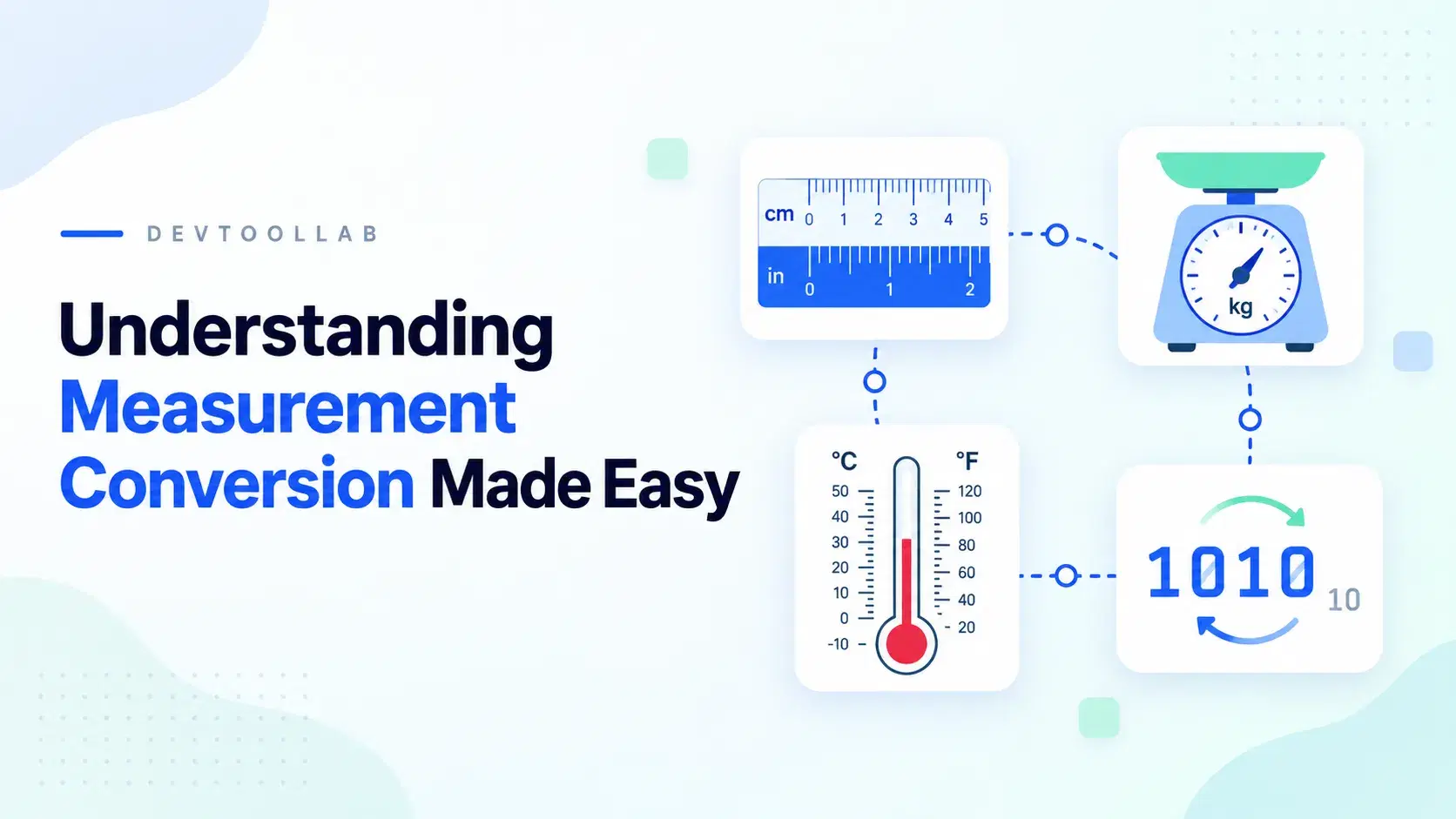
Measurements are something we deal with almost every day, even when we do not think about them. We measure the length of a table, check the weight of a package, look at the temperature outside, or calculate the distance between two places. In school, work, cooking, construction, technology, and many other areas, being able to understand and convert measurements can save time and prevent mistakes.
The good thing is that measurement conversion is not as complicated as it may seem. Once you understand how different units relate to one another, converting between them becomes a straightforward process.
What Is Measurement Conversion?
Measurement conversion means changing a measurement from one unit into another without changing its actual value.
For example, a distance can be measured in meters, centimeters, feet, or inches. If you have a length of 2 meters and need to know how many centimeters it is, you can convert the measurement because one meter is equal to 100 centimeters. Therefore, 2 meters is equal to 200 centimeters.
The measurement itself has not changed. Only the way it is expressed has changed.
This is useful because different countries, industries, and situations often use different units. A person working with an international company may see measurements in meters and kilograms, while someone else may be more familiar with feet and pounds.
Why Do We Need to Convert Measurements?
Different measurement systems can make everyday information difficult to compare. Imagine buying a piece of furniture that is listed in inches when you normally use centimeters. Without conversion, it may be difficult to know whether the furniture will fit in your room.
The same situation can happen with cooking recipes. A recipe may use cups and tablespoons, while you may prefer to measure ingredients in grams and milliliters. Converting the measurements makes the instructions easier to follow.
Measurement conversion is also important in professional fields. Engineers, architects, scientists, technicians, and construction workers regularly work with different units. A small mistake in a conversion can sometimes lead to an incorrect calculation, so understanding the basic rules is important.
Common Types of Measurement Conversion
There are several common types of measurements that people convert regularly.
Length
Length conversion is used to compare distances or the size of objects. Common units include millimeters, centimeters, meters, kilometers, inches, feet, yards, and miles.
For example:
- 1 meter = 100 centimeters
- 1 kilometer = 1,000 meters
- 1 foot = 12 inches
- 1 yard = 3 feet
Knowing these basic relationships makes many everyday conversions easier.
Weight and Mass
Weight and mass are also frequently converted. Depending on the measurement system, you may come across kilograms, grams, milligrams, pounds, and ounces.
For example, kilograms and grams are commonly used in the metric system, while pounds and ounces are widely used in the United States.
If you are buying products, preparing food, shipping a package, or following instructions from another country, converting these units can make the information easier to understand.
Temperature
Temperature conversion is another common task. The most familiar temperature scales are Celsius, Fahrenheit, and Kelvin.
Celsius is widely used around the world, while Fahrenheit is commonly used in the United States. Kelvin is mainly used in scientific applications.
Unlike simple length conversions, temperature conversion requires a formula because the scales have different starting points. For example, converting Celsius to Fahrenheit involves multiplying the Celsius value by 9/5 and then adding 32.
Understanding Digital and Number Conversions
Not every type of conversion involves physical measurements. Computers and digital devices also use different number systems.
The decimal system is the one people normally use in everyday life. It uses ten digits, from 0 to 9. Computers, however, work primarily with binary numbers, which use only 0 and 1.
This is where a binary Converter can come in handy when you want to check how a number is represented in binary or convert it between decimal and binary formats.
For someone learning programming or computer science, binary conversion can initially feel unfamiliar. For example, the decimal number 10 is represented as 1010 in binary. Checking a few examples can make the relationship between the two number systems much easier to understand.
Understanding the basic concept is still valuable, even when using a conversion tool. Once you know that binary is based on powers of two, the numbers begin to make more sense.
Manual Conversion vs. Online Tools
Many conversions can be completed manually if you know the correct formula or conversion factor. This is often the best way to learn because it helps you understand what is happening behind the calculation.
However, manual calculations can become inconvenient when you need to perform several conversions or work with more complicated numbers.
Online conversion tools can make this process quicker. Instead of searching for a formula and calculating the result yourself, you can enter the value, select the units, and check the converted result.
These tools can be particularly helpful when dealing with less familiar units. They can also reduce the chance of simple calculation mistakes.
Still, it is a good idea to have a basic understanding of the conversion you are performing. A tool can provide an answer, but understanding the process helps you recognize whether the result makes sense.
Tips for Making Conversion Easier
A few simple habits can make measurement conversion much easier.
First, identify the units you are starting with and the units you need. This prevents confusion before you begin the calculation.
Second, check whether the conversion requires a formula or a simple conversion factor. Converting meters to centimeters, for example, is straightforward, while temperature conversions require a formula.
Third, pay attention to decimals. A misplaced decimal point can completely change the result.
It is also helpful to estimate the answer before completing the conversion. If you convert 5 kilometers into meters, you should expect a much larger number because a kilometer contains 1,000 meters. If your result is smaller than 5, something is probably wrong.
Finally, when using an online tool, double-check that you selected the correct units. Entering a value in inches while selecting centimeters as the starting unit will produce the wrong result.
Measurement Conversion in Everyday Life
You do not need to be a mathematician or scientist to benefit from understanding conversions. Simple conversion skills can be useful in many ordinary situations.
You might need to convert a recipe while cooking, check the dimensions of furniture before ordering it, understand a product's weight, compare travel distances, or read instructions that use unfamiliar units.
Students also encounter conversions in mathematics, physics, chemistry, and computer science. Having a clear understanding of units can make these subjects easier because many problems depend on using the correct measurements.
Conclusion
Measurement conversion is mainly about understanding the relationship between different units. Once that relationship is clear, changing a measurement from one unit to another becomes much less intimidating.
From centimeters and meters to kilograms and pounds, conversions appear in many parts of everyday life. Digital number systems add another layer, but the basic idea remains the same: understand how one system relates to another and use the appropriate method to make the conversion.
The best approach is to understand the basic principles, use the correct formulas or conversion factors, and check your results when necessary. With a little practice, measurement conversion becomes a simple and useful skill rather than something that feels complicated.