
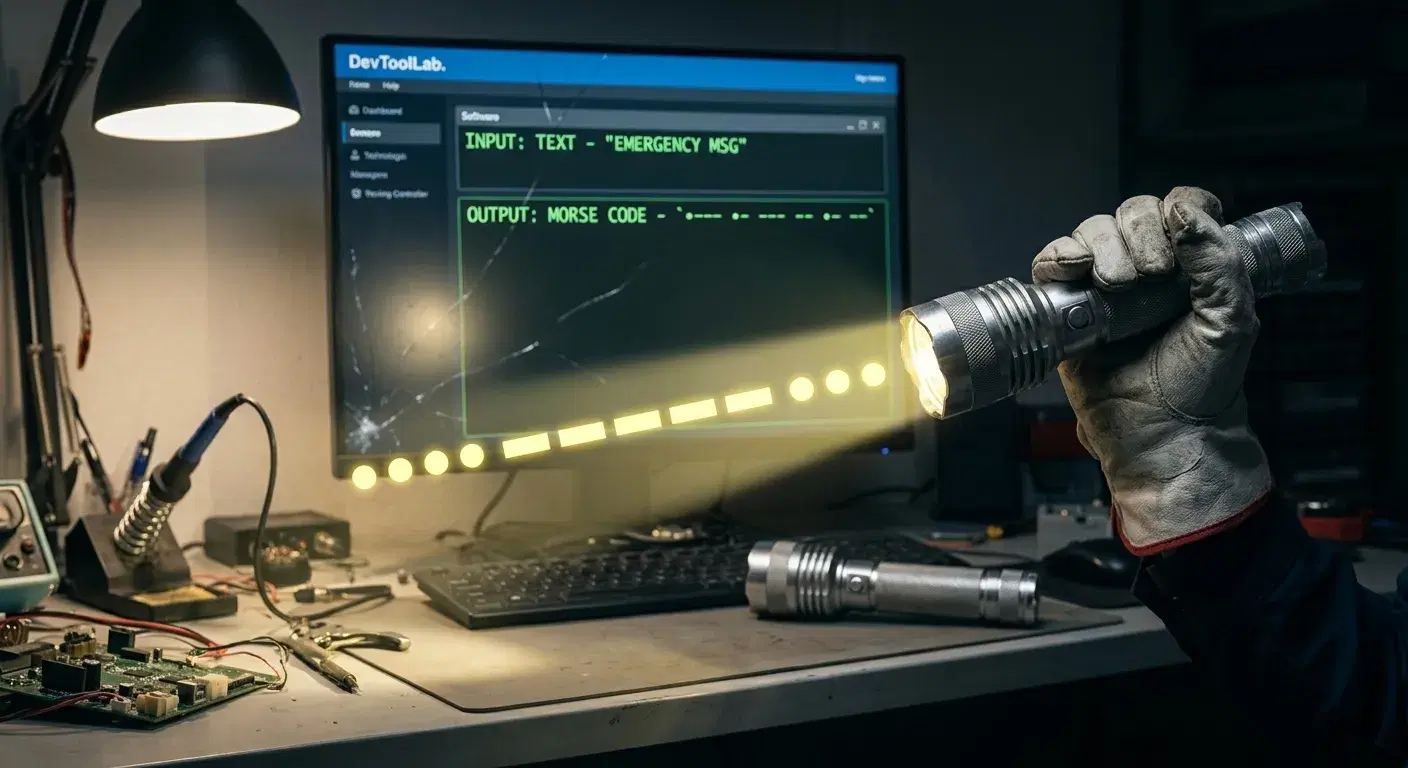
Morse code is one of the earliest digital communication systems. Long before computers or modern networks existed, it established a framework for turning human language into binary states. It converts characters into standardized patterns of dots and dashes, translating raw text into basic electrical impulses, sounds, or flashes of light.
Despite its age, it remains useful for learning, communication, and signaling. Modern engineers and tech enthusiasts often look at it as a foundational study in serialization and encoding. This article breaks down how the system works, looking at encoding text, decoding patterns, and translating those signals into visual mediums.
What Is Morse Code Encoding?
The Basic Principle
At its foundation, encoding is the process of translating data from one form into another using a fixed rule set. In this system, letters become dots and dashes. These two states represent short and long signals. A dash is exactly three times longer than a dot.
text[Text: A] --> [Encoding Rule] --> [Dot-Dash: • —]
This structural rule is governed by the standardized international Morse code. It ensures that a signal sent from a ship in the Atlantic can be read by an operator in Europe without any platform compatibility issues.
Why Encoding Matters
The primary value of standardized encoding is consistent communication. Without a rigid standard, variations in timing or character mapping would corrupt the data stream. Because the rules are simple, it allows for easy transmission across different mediums. You don't need complex hardware layers or protocols. As long as you can toggle a current, interrupt a radio wave, or flash a light, you can move information.
Converting Text Into Morse Code
Character Mapping
The conversion process relies on a lookup table where each character corresponds to a unique sequence. The system was designed around frequency of use. Common letters get shorter codes, while rare ones get longer chains.
- Letters: The letter "E" is a single dot (•), because it appears constantly in English prose. The letter "Q" is much heavier, mapping to ——•—.
- Numbers: Numeric values are uniform, always using a sequence of five elements. For example, the number 1 is •————, while 5 is •••••.
- Common punctuation: Punctuation marks require longer sequences to avoid confusion with alphanumeric text. A period (.) maps to •—•—•—, and a comma (,) converts to ——••——.
Modern Translation Tools
Manual conversion works for short phrases, but it slows down heavily over long paragraphs. How software automates the process comes down to simple key-value mapping arrays. A basic script ingests a string, sanitizes the input to uppercase, strips unsupported characters, and replaces each remaining character with its corresponding dots and dashes.
JavaScript// A simple look into how data is serialized const morseMap = { 'A': '•—', 'B': '—•••', 'C': '—•—•' }; function encode(text) { return text.toUpperCase().split('').map(char => morseMap[char] || '').join(' '); }
When analyzing text outputs or setting up simple text arrays during development, passing strings through an online Morse code translator lets you quickly verify your character mappings. It maps characters instantly, rendering clean outputs for scripts or manual validation. While standard tools focus only on text and sound outputs, utilizing a site that handles optical Morse code translation. For example, this tool lets you see exactly how the dots and dashes look when turned into flashes of light.

The light signal feature on the translator allows users to see text strings converted into flashing visual patterns. Credit: Morsetranslator.net
Understanding Morse Code Decoding
Reading Morse Code Patterns
Decoding is the inverse operation, but it introduces a critical variable that encoding lacks: time. While a machine can generate perfect spacing, human operators must carefully evaluate timing and spacing to decipher the incoming data stream. The architecture relies on relative units of time:
- The duration of a dot is the basic unit of time measurement.
- A dash is three units.
- The space between elements inside a single letter is one unit.
- The space between separate letters is three units.
- The space separating letters and words is seven units.
Without these precise gaps, the signal collapses into an unreadable string of pulses.
Common Decoding Challenges
The main hurdle in decoding is handling human error or noise in the transmission medium. Similar-looking characters frequently cause issues. For instance, if the space between a dot and a dash is slightly too long, the letter "A" (•—) can easily be misread as "E" (•) and "T" (—).
Signal interpretation errors also crop up when dealing with atmospheric interference in radio transmissions or atmospheric haze in visual signaling. A weak, flickering signal can turn dashes into dots, corrupting the payload entirely.
Different Ways Morse Code Messages Can Be Transmitted
The beauty of this encoding method lies in its physical flexibility. It doesn't care about the transport layer.
Sound Signals
Audio transmission utilizes distinct beeps and tones. Operators listen to audio frequencies - typically around 700 Hz - and translate the auditory duration directly into characters. It requires minimal cognitive processing once an operator develops muscle memory for the sound patterns rather than counting individual dots and dashes.
Radio Communication
This is where Continuous Wave (CW) transmission dominates. Amateur radio usage keeps this alive across the globe. By turning a radio carrier wave on and off, operators can send messages across massive distances using incredibly low power. Where voice transmission fails due to heavy static or low signal strength, a crisp CW tone can often slice right through the noise.
Visual Signals
When radio silence is mandatory or hardware is unavailable, optical transmission takes over.
- Lamps: High-powered signal lanterns on naval vessels use mechanical shutters to open and close over a light source.
- LEDs: Small microcontrollers can blink onboard indicator lights to output system status or error codes via code.
- Flashlights: A simple handheld tool can become a long-range beacon in an outdoor environment.
Using Light Signals to Send Morse Code
Why Light Signals Work
Optical telegraphy works well because it bypasses the need for an underlying electrical or radio infrastructure. It provides excellent visibility over distance, assuming a clear line of sight. Furthermore, the simple equipment requirements mean you can communicate using tools found in almost any basic toolkit or emergency kit.
Flashlight Signaling Basics
When using a manual light source, you swap time-duration tones for light duration. A short flash represents a dot. A long flash represents a dash. The core challenge is maintaining physical consistency. If your short flash lasts a quarter of a second, your long flash must hold steady for three-quarters of a second. Relaxing your thumb on the button too early creates immediate translation errors for the person watching on the other side.
Practicing Visual Communication
To get good at this, you need to step away from the keyboard and practice timing with actual hardware. If you want to study the operational standards for handheld signaling in low-visibility environments, checking out these technical instructions on how to send Morse code with a flashlight provides a reliable overview of the intervals required to keep messages legible over long distances.
Modern Applications of Morse Code
Emergency Communication
When automated systems fail, basic protocols save lives. The most famous SOS example (••• ——— •••) remains the universal distress signal. Because it is instantly recognizable, anybody with a light or a whistle can flag down help without needing to share a native language with the rescuer.
Education and Learning
For students of computer science and electrical engineering, studying this legacy framework provides a clear path for understanding communication systems. It introduces basic concepts of data serialization, compression, and error correction without the distraction of complex software stacks.
Amateur Radio Communities
There is a vibrant, global network of operators who prioritize this format over modern digital modes. Continued practical use ensures that the skill isn't lost to history, maintaining a decentralized backup communication grid that functions entirely independently of the global internet infrastructure.
Benefits of Learning Morse Code Today
Improves Pattern Recognition
Learning the system trains your brain to process auditory or visual data streams in real time. It forces you to look at chunks of symbols and decode them into coherent concepts on the fly, which sharpens general pattern recognition skills.
Builds Communication Awareness
When every character requires deliberate physical effort to transmit, you learn to appreciate brevity. It teaches you to strip out useless filler words and focus on high-density information delivery.
Connects Historical and Modern Technologies
Studying this system bridges the gap between old-school hardware and modern binary logic. It shows that the core principles of networking - latency, bandwidth, encoding, and decoding - haven't changed all that much in over a century.
Conclusion
Morse code remains a practical encoding system, far outliving its original telegraph infrastructure. While it is no longer the primary method for global commerce, modern tools make conversion and decoding simple for anyone curious about the tech. Messages can still be transmitted through sound, radio, and light signals when modern networks drop out. Ultimately, learning the basics provides insight into both historical and modern communication methods, proving that simple, robust logic never truly goes out of style.