
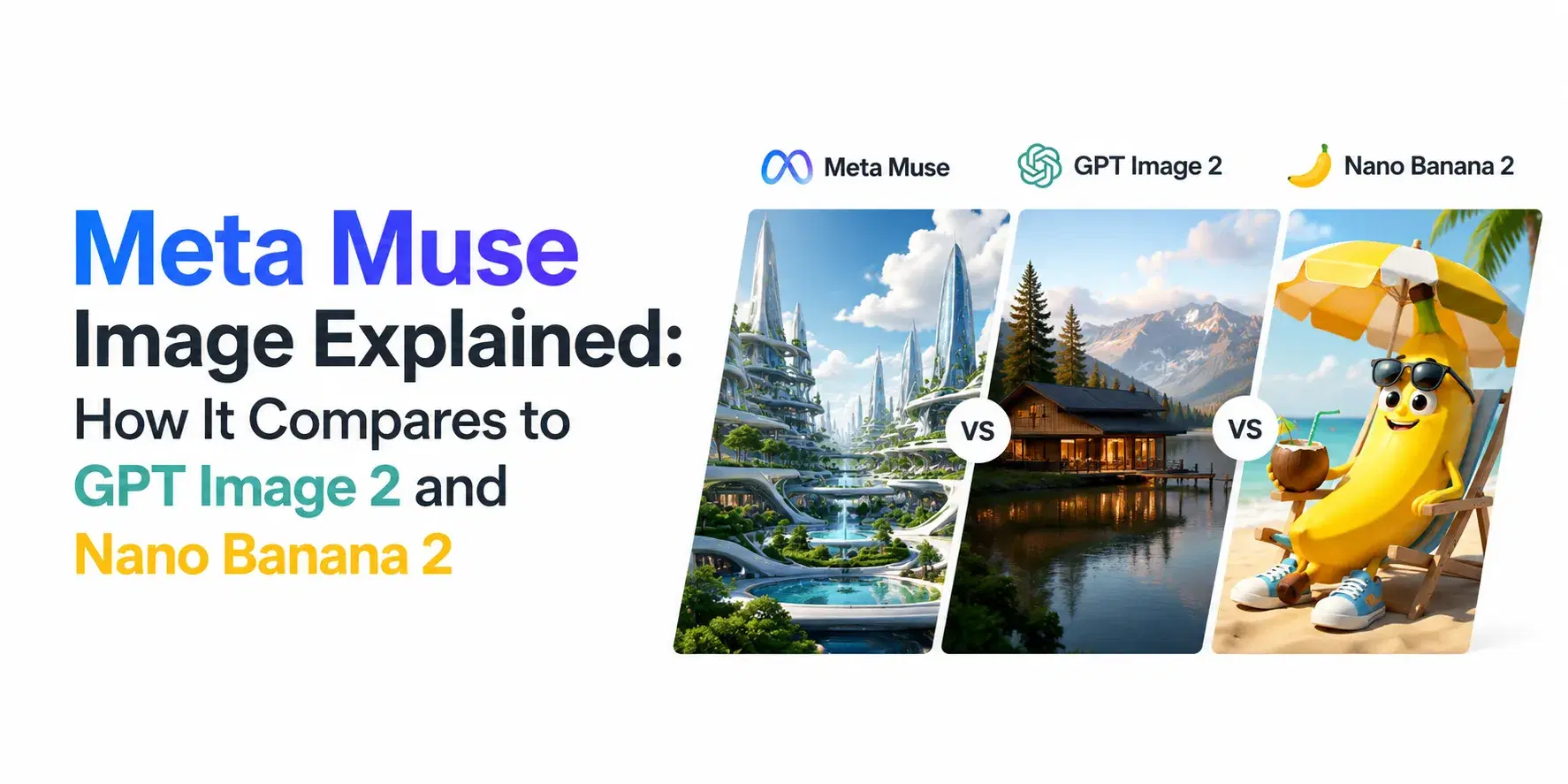
Meta Muse Image is Meta's first in-house AI image generation model, shipped on July 7, 2026, and it landed at #2 on Arena's community-voted leaderboard - ahead of Google's Nano Banana 2, xAI's Grok Imagine, and Microsoft's MAI Image, trailing only OpenAI's GPT Image 2. That's a sharp debut for a company that spent the last few years shipping image features built on licensed and partner models rather than something built in-house.
Muse Image is the first public result out of Meta Superintelligence Labs (MSL), the AI division Mark Zuckerberg formed in June 2025 with Alexandr Wang as chief AI officer, backed by a hiring push that reportedly included signing bonuses up to $1 billion for top researchers. If you've been evaluating AI image tools for a project - we covered the current API-accessible field in Best AI Image Generators in 2026 last week - here's what actually shipped, how it compares, and whether it changes anything you're building today.
What Is Meta Muse Image?

According to Meta's official announcement, Muse Image launched alongside a video sibling, Muse Video, both built by MSL rather than licensed from a partner lab. What separates it architecturally from a typical diffusion model is that Meta built it to behave like an agent that reaches for tools mid-generation instead of mapping a prompt straight to pixels:
- Code execution - for a prompt that needs an accurate chart, a QR code, or a visualization built from numbers you gave it, Muse Image writes and runs a script rather than trying to hallucinate pixels that merely look like a bar chart.
- Web search grounding - for prompts referencing current events, real products, or specific facts, the model searches before generating instead of relying purely on training-data recall.
- Self-refinement - an emergent behavior from reinforcement learning training, where the model reviews its own output and makes local edits or regenerates sections it judges to be wrong, rather than stopping at a single pass.
- Test-time compute scaling - output quality improves with more inference-time reasoning, in what Meta describes as roughly log-linear scaling across text and visual tokens. It's the same class of technique OpenAI and Google use to push reasoning-model quality, applied here to image generation.
Meta calls this "deliberate reasoning," positioning it against the more common best-of-N approach most image models use (generate a large batch, pick the best result), and says it's more compute-efficient at inference time.
Muse Image vs GPT Image 2 vs Nano Banana 2: The Benchmark Numbers
Arena's community-voted rankings put Muse Image at an Elo of 1280 against GPT Image 2's 1385 - a 105-point gap, which works out to roughly a 64% expected win rate for GPT Image 2 in a head-to-head vote. That's a real gap, not a rounding error. But Muse Image holds the #2 spot across text-to-image, single-image editing, and multi-image editing, ahead of Nano Banana 2, Grok Imagine, and Microsoft's MAI Image. CNBC reported that Meta's own internal benchmarks similarly show Muse Image trailing GPT Image 2 but beating Nano Banana 2 on single- and multi-image editing tasks specifically.
For a first release, landing ahead of every competitor except one is a genuinely strong showing - most labs need at least one full model generation to get this close to the leader.
| Model | Maker | Developer API | Where to use it now |
|---|---|---|---|
| GPT Image 2 | OpenAI | Yes | ChatGPT, OpenAI API |
| Muse Image | Meta (MSL) | No - consumer only | Meta AI app, Instagram Stories (US), WhatsApp (limited regions) |
| Nano Banana 2 | Yes | Gemini app, AI Studio, Gemini API | |
| Grok Imagine | xAI | Yes | Grok app, xAI API |
| MAI Image 2.5 | Microsoft | Yes | Copilot, Bing Image Creator, Microsoft Foundry (Azure) |
Muse Spark: The Model Behind the Model
Muse Image doesn't work alone. Muse Spark is a separate reasoning LLM inside MSL that Muse Image hands off to when a request goes beyond a single static image - turning a generated image into an animated GIF, a simple website, or a small interactive game. It's a similar division of labor to how OpenAI pairs GPT Image 2 with a general reasoning model for multi-step tasks, but Meta is more explicit about the two-model handoff in its own documentation.
Where Muse Image Is Available (and What It Costs)
Muse Image is live inside the Meta AI app, on meta.ai, in Instagram Stories (US only for now), and in WhatsApp direct messages in a limited set of countries. Facebook integration is "coming soon." As of launch, it isn't a standalone product - it's a feature inside apps you probably already have installed.
Basic use is free. Heavier use requires one of the Meta One subscription plans that launched in May 2026: Meta One Plus ($7.99/mo) or Meta One Premium ($19.99/mo) for consumers, or Meta One Essential ($14.99/mo) and Meta One Advanced ($49.99/mo) for creators and businesses needing higher generation volume. The Premium tier unlocks deeper reasoning and higher image/video generation limits. These plans are still in limited regional testing (Singapore, Guatemala, and Bolivia at initial rollout) rather than globally available.
Every image ships with Content Seal, an invisible watermark Meta can detect with a lookup tool at meta.ai/identification - useful if you need to check whether an image circulating online came out of Muse Image.
Does Meta Muse Image Have a Developer API?
This is the detail that matters if you're building anything: Muse Image has no public developer API. SiliconANGLE reported that Meta hasn't announced immediate API availability, though the company may eventually provide developer access through its broader AI infrastructure plans. At launch, this is a consumer feature locked inside Meta's own apps - not something you can call from a backend the way you'd hit the OpenAI, Gemini, or Black Forest Labs APIs.
That puts Muse Image in a different category from everything in our AI image generator comparison. If your project needs programmatic image generation today, nothing here changes: GPT Image 2, Nano Banana 2, Ideogram 4, and Flux.2 remain the actual options, because they're the ones you can call from code right now.
What's worth watching is what happens if Meta does open an API. A model sitting at #2 on Arena has an obvious incentive to monetize the way OpenAI and Google already do, and Meta's Llama API is currently free while the company builds developer adoption - the same playbook that got Llama models embedded everywhere before pricing showed up. If Muse Image follows that path, it becomes a serious option for anyone already building inside Meta's developer ecosystem.
What This Means for the Field
Two things are worth taking away even though you can't build on Muse Image yet.
First, the list of labs seriously competing on image generation just grew. In the span of a few months, Microsoft's MAI Image and xAI's Grok Imagine joined the field alongside OpenAI, Google, and Black Forest Labs - and now Meta. That's five well-resourced labs actively shipping frontier image models, which is real competitive pressure keeping prices down and quality moving.
Second, the tool-use architecture is a more interesting story than the leaderboard position. Search-grounded generation and code-executed charts or QR codes solve real, boring accuracy problems that pure diffusion models still get wrong - ask a typical model for "a bar chart showing Q3 revenue up 12%" and it confidently draws something that looks like a chart, with numbers that don't actually add up, because it's drawing a picture of a chart rather than computing one. If Muse Image's agentic approach holds up as well in practice as the benchmarks suggest, expect other labs to start bolting similar tool use onto their own image models within the next model cycle or two.
Conclusion
Muse Image is a strong first release and a legitimate #2 on the leaderboard, but it's a consumer feature today, not a developer tool - there's no API, and Meta hasn't committed to shipping one. If you need to generate images programmatically right now, use GPT Image 2, Nano Banana 2, Ideogram 4, or Flux.2 instead. Keep an eye on Muse Image if you're already building inside Meta's ecosystem - the agentic, tool-using architecture is worth understanding even before it's something you can call from code.
Related reading: Best AI Image Generators in 2026 covers every model you can actually call from an API today, with pricing and code examples. Best AI Video Generation Models covers Muse Video's competition in the video-generation space.