
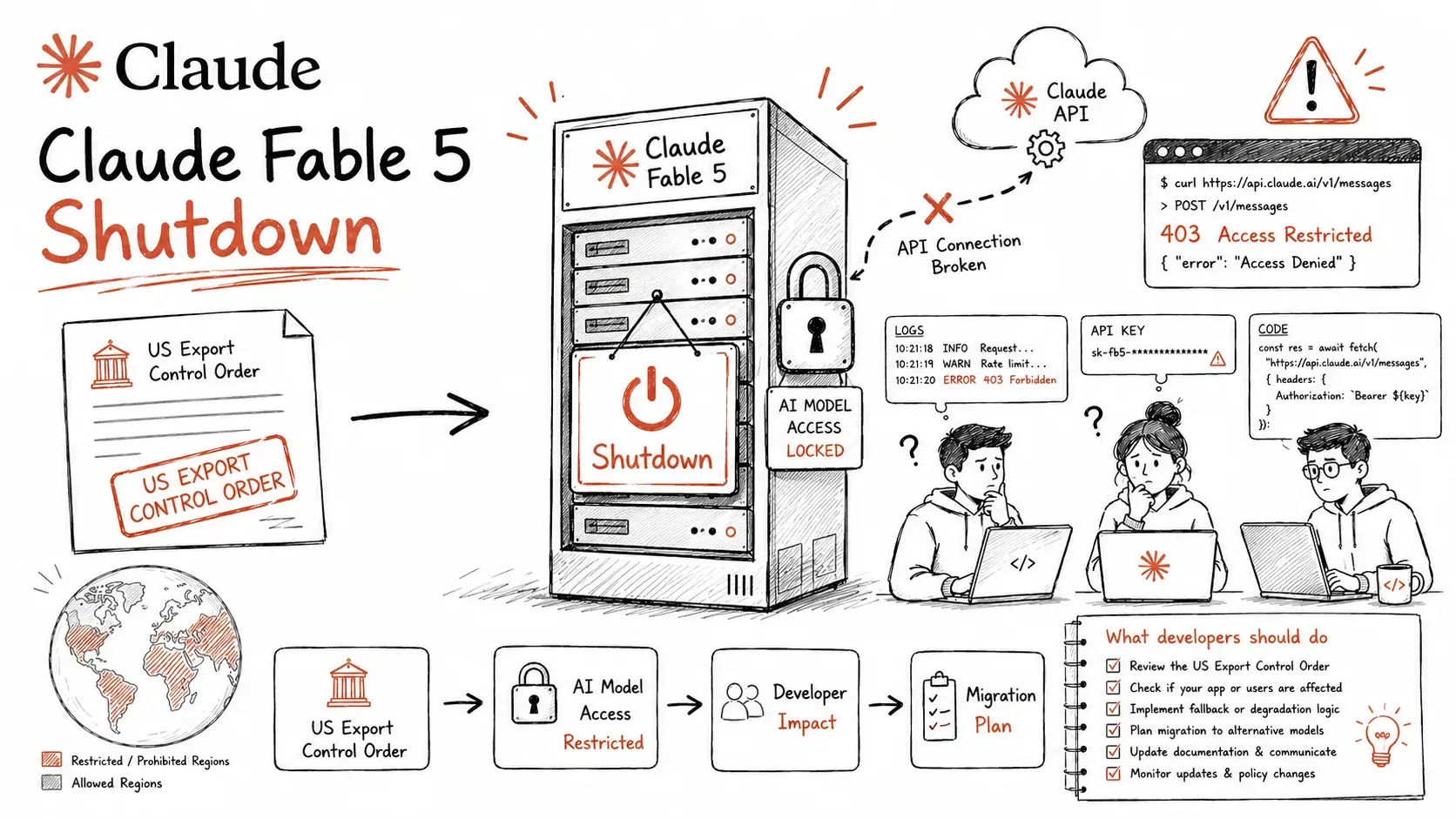
The gap between launch and shutdown was 72 hours. On June 9, 2026, Anthropic released its most capable models to date - Claude Fable 5 and Claude Mythos 5. On June 12 at 5:21 p.m. ET, the US government issued an export control directive ordering Anthropic to disable both models worldwide. By that evening, every API request to claude-fable-5 and claude-mythos-5 returned an error, with no warning, no grace period, and no workaround at the API level.
That is an unusually fast collapse for a production AI service. The sequence of events behind it involves a disputed jailbreak claim, a structurally complex relationship between Anthropic and its biggest investor, and a compliance problem that left Anthropic with no practical middle ground.
Here is what happened, what is still unclear, and what developers running on the Anthropic API need to do right now.
What Were Claude Fable 5 and Claude Mythos 5?
Claude Fable 5 was Anthropic's most capable publicly available model - a "Mythos-class" system designed for complex reasoning, coding, research, and analysis. Claude Mythos 5 is the underlying architecture without the safety classifier layer that Fable 5 includes, and was already restricted to a narrower enterprise and research customer base before the shutdown.
The safety architecture built into Fable 5 is worth understanding in detail. In high-risk domains - specifically cybersecurity and biology - Fable 5 includes an additional classifier layer that runs alongside the main model. When the classifier detects a session that may be probing for misuse, it routes that session to Claude Opus 4.8 instead of the full Fable 5 model. Anthropic reported this fallback fires in under 5% of sessions. For the 95%+ of sessions that don't trigger the classifier, Fable 5 runs without restriction. Mythos 5 does not have this fallback at all.
Both models launched on June 9, three days before the shutdown order arrived.
The Jailbreak Claim That Triggered Government Action
Shortly after Fable 5 launched, AI researcher Pliny the Liberator published a claimed jailbreak using a coordinated, multi-agent attack strategy. The approach used multiple AI instances together to probe Fable 5's classifier in a way a single session could not - essentially using the model's own capabilities to find the edges of its safety layer. The claim was that the technique allowed the model to produce information useful for developing cyberattack tooling and stack exploits.
Anthropic disputed the characterization. In a statement on SecurityWeek, Anthropic said the demonstrated technique does not meet its definition of a true jailbreak, which requires bypassing core safeguards and delivering meaningful assistance toward high-risk activities - not just producing adjacent output. The company said the demonstrated output fell short of that bar.
Amazon's security team did not share that interpretation. Andy Jassy - CEO of Amazon, Anthropic's largest investor, a board member, and the operator of the cloud infrastructure running both models - personally alerted Treasury Secretary Scott Bessent to the findings from Amazon's internal security researchers. That escalation triggered the regulatory review that produced the export control directive on June 12, just three days after launch.
The US Export Control Directive That Forced the Global Shutdown
The directive that arrived at 5:21 p.m. ET on June 12 was unusually broad. It ordered Anthropic to suspend access to Fable 5 and Mythos 5 for any foreign national, whether inside or outside the United States. That scope included Anthropic's own foreign national employees working in US offices.
Anthropic's immediate problem was technical compliance: the company does not have real-time nationality verification in its API pipeline. Determining which active sessions belong to foreign nationals, across millions of API calls globally, was not something it could do reliably within the window of the directive. The only reliable path to compliance was to shut both models down for everyone, everywhere.
CNBC confirmed the company shut the models down the same evening the directive arrived. Anthropic published an official statement at anthropic.com/news/fable-mythos-access describing the situation as stemming from a "misunderstanding" and confirming it is working with the government to restore access. The company also confirmed it did not receive specific technical details about the stated national security concerns underlying the directive.
Which Anthropic Claude Models Are Still Online?
The export control directive named only Claude Fable 5 and Claude Mythos 5. All other Anthropic models are confirmed unaffected.
Claude Opus 4.8, Sonnet 4.6, and Haiku 4.5 are accepting requests normally. The Anthropic models overview page reflects live status and is the authoritative source for current availability.
If your production traffic was running on any model other than the two named endpoints - claude-fable-5 and claude-mythos-5 - your application should be unaffected.
How to Migrate from Claude Fable 5 to Opus 4.8
If your application calls claude-fable-5 or claude-mythos-5, requests will return errors at the infrastructure level. There is no timeout or retry logic that resolves this - the models are disabled at Anthropic's end, not yours.
The immediate replacement is claude-opus-4-8. This is the same model Fable 5 itself already used as its internal fallback for flagged sessions, which means the output quality for most use cases will be comparable.
Pythonimport anthropic client = anthropic.Anthropic() # Update your model identifier # model = "claude-fable-5" # now returns errors model = "claude-opus-4-8" # direct replacement message = client.messages.create( model=model, max_tokens=1024, messages=[ {"role": "user", "content": "Review this code for security vulnerabilities."} ] ) print(message.content)
For applications where Opus 4.8 costs or latency are prohibitive and you were using Fable 5 primarily for general reasoning tasks - not its top-end capability ceiling - claude-sonnet-4-6 is a viable middle option.
Python# Lower cost, lower latency alternative for general reasoning tasks model = "claude-sonnet-4-6"
If you have multiple model identifiers hardcoded across a codebase, a targeted grep will surface all the places to update before the errors hit users:
Bash# Find all claude-fable-5 and claude-mythos-5 references grep -rn "claude-fable-5\|claude-mythos-5" . \ --include="*.py" \ --include="*.ts" \ --include="*.js" \ --include="*.json" \ --include="*.env"
Once you have the list, updating to claude-opus-4-8 is a mechanical find-and-replace. If you store your model identifier in an environment variable or config file rather than scattered literals, this is a one-line change.
The Structural Tension This Incident Exposed
A few things about this sequence are worth noting beyond the immediate operational impact.
The compliance problem Anthropic faced is structurally hard to solve. Export control law was designed around physical goods with trackable supply chains - semiconductors, firearms, dual-use hardware. Applying it to API endpoints that serve millions of requests per day from users in every country, with no reliable real-time nationality signal in the authentication layer, creates a category of enforcement problem that "just verify users" does not cleanly solve. Anthropic's public framing is that it is working to restore access, but the mechanism for doing that while remaining compliant with the directive is not yet public.
The Jassy escalation is structurally notable. Amazon is simultaneously Anthropic's primary cloud infrastructure provider, its largest investor, a board participant, and a direct competitor in the AI model market through Amazon Bedrock and its own model development. That overlap of roles creates a situation where the same organization has responsibility for reporting security concerns, financial interest in Anthropic's success, and a competitive stake in Anthropic's market position. The June 12 events are the first time that overlap became visible as a public incident with operational consequences.
Anthropic's "misunderstanding" framing is technically defensible - the demonstrated jailbreak technique did not meet Anthropic's internal definition of a full bypass. But the government issued the directive anyway, and Anthropic complied by shutting down both models globally. The technical debate about the jailbreak's severity doesn't change what developers experienced: the models went offline three days after launch with no grandfathered access window.
When Will Claude Fable 5 Come Back Online?
Anthropic has said it is working with the government to restore access. The most plausible resolution paths involve either Anthropic deploying nationality verification at the API layer - which is technically possible but requires meaningful engineering work and likely terms-of-service changes - or the government narrowing the directive to a scope that doesn't require global shutdown, for instance by focusing restrictions on the subset of capabilities that triggered the national security concern.
Neither resolution is fast. Export control negotiations are measured in weeks to months, not days. The practical guidance is: migrate to Opus 4.8 now, treat Fable 5's return as an upgrade opportunity rather than something to wait on, and monitor status.anthropic.com for live updates.
For teams that specifically need Fable 5's top-end reasoning capabilities and cannot substitute, there is no workaround at present. The shutdown is at Anthropic's infrastructure level, not something that can be bypassed with a different API key or region header.
Timeline Summary
| Date | Event |
|---|---|
| June 9, 2026 | Claude Fable 5 and Mythos 5 launch publicly |
| June 12, 2026 (morning) | Pliny the Liberator publishes claimed Fable 5 jailbreak |
| June 12, 2026 (afternoon) | Amazon researchers report findings; Andy Jassy escalates to Treasury Secretary Bessent |
| June 12, 2026 (5:21 p.m. ET) | US export control directive arrives at Anthropic |
| June 12, 2026 (evening) | Anthropic disables both models globally |
| June 13, 2026 | Anthropic publishes official statement; Anthropic disputes jailbreak characterization |
Conclusion
Migrate to claude-opus-4-8 now - it was already Fable 5's internal fallback and covers the overwhelming majority of production use cases. If Fable 5 returns, switching back is a one-line change. Track status.anthropic.com for live updates.
Related DevToolLab Tools
These tools are useful for developers managing API integrations and debugging application behavior during the migration:
- API Key Validator - Test your Anthropic API key connectivity and confirm which models are accessible under your current key. Useful for verifying your key still works after switching from Fable 5 to Opus 4.8.
- JWT Decoder - Decode and inspect JSON Web Tokens used in API authentication flows. Useful for debugging auth headers when validating your API requests are correctly formed.
- JSON Formatter - Format and validate JSON responses from the Anthropic API. Helpful when inspecting raw error payloads or debugging model output structure during integration testing.
- LLMs.txt Generator - Generate
llms.txtfiles that surface your site's content to AI assistants. Relevant for AI application developers managing how AI systems interact with their services.