
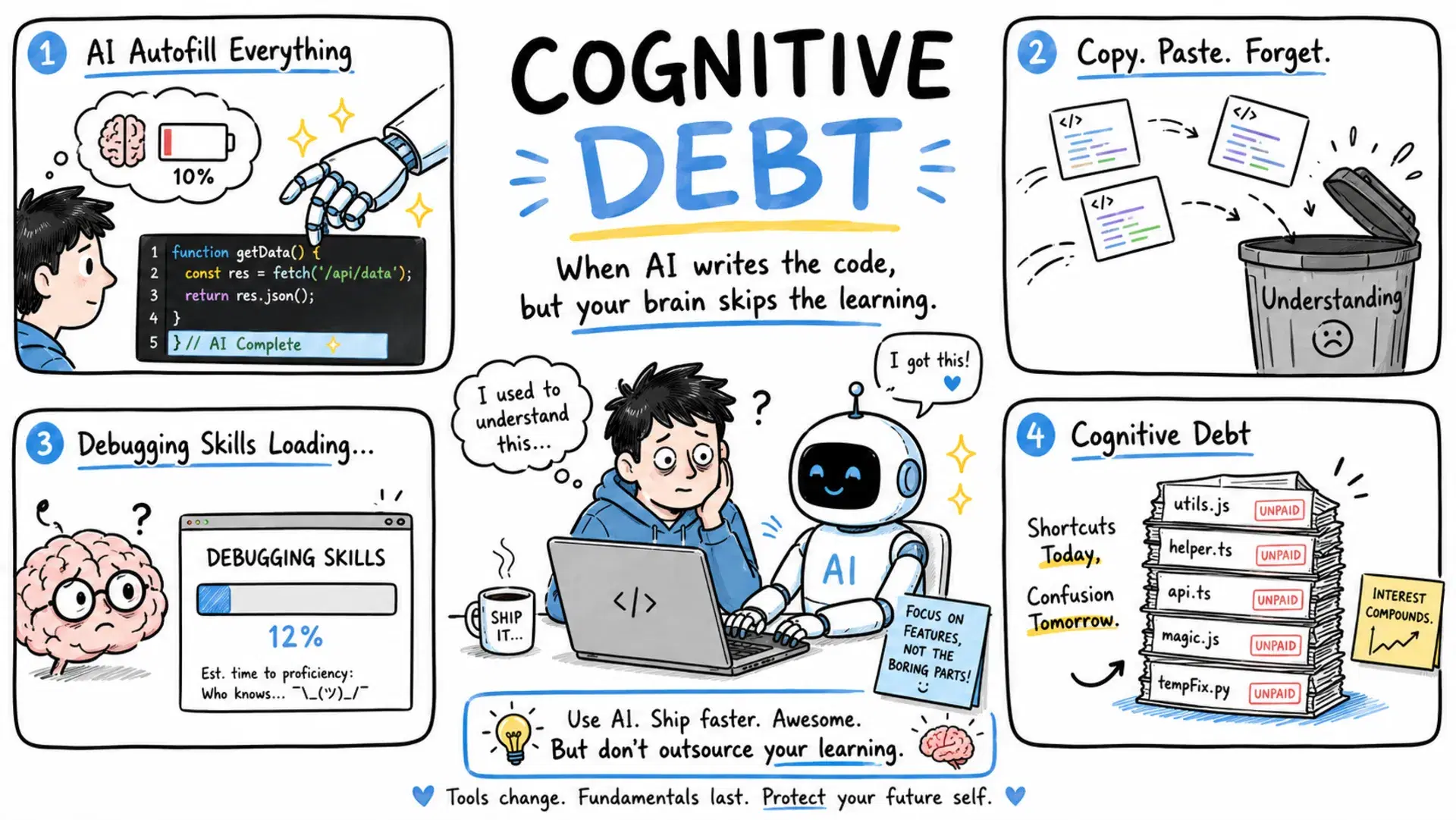
On January 28, 2026, Anthropic published a study that quietly upended a comfortable assumption in the developer community. Researchers gave two groups of programmers the same task: learn an unfamiliar Python library and write working code with it. One group had access to an AI assistant. The other did not. Both groups finished. But when researchers tested how well each group actually understood the code they had just written, the AI group scored 50% on the comprehension quiz. The manual group scored 67%.
A 17-percentage-point gap - nearly two letter grades - between developers who used AI and those who didn't, on code they had written themselves minutes earlier.
This gap has a name. Multiple researchers converged on it at roughly the same time in early 2026: cognitive debt. It may be the most important concept in software engineering that most developers haven't thought carefully about yet.
This isn't a case against AI coding tools. 84% of developers now use them, and the productivity gains for straightforward tasks are real. This is a case for understanding the hidden cost - and a practical guide to capturing the benefits without accumulating the debt.
What Is Cognitive Debt?
Cognitive debt is the growing gap between how much code exists in a system and how much of it any human being genuinely understands.
The term emerged from two independent directions in early 2026. Addy Osmani, an engineering leader at Google Chrome, coined the closely related term comprehension debt in a March 2026 post that later ran as an O'Reilly Radar piece in April. His definition: "The growing gap between the volume of code in a system and how much of it any human being genuinely understands. Making code cheap to generate doesn't make understanding cheap to skip. The comprehension work is the job."
Simultaneously, Margaret-Anne Storey (Canada Research Chair at the University of Victoria) was formalizing cognitive debt in an arXiv paper published March 23, 2026. Her framework identifies it as a team-level property: the erosion of shared understanding when a team ships code faster than they can build mental models of it. She extended this into a Triple Debt Model: technical debt (in the code), cognitive debt (in the people), and intent debt - the absence of documented rationale that humans and AI agents need to safely work with code.
Simon Willison, creator of Datasette and a longtime open-source developer, documented his own experience in a February 2026 post: "I've experimented with prompting entire new features into existence without reviewing their implementations, and found myself getting lost in my own projects with no firm mental model of what they can do and how they work, making each additional feature harder to reason about."
Cognitive Debt vs. Technical Debt
These two concepts are easy to confuse, but they represent fundamentally different problems.
| Technical Debt | Cognitive Debt | |
|---|---|---|
| Where it lives | In the code | In the people |
| How it surfaces | Slow builds, tangled dependencies, failing tests | Inability to explain, debug, or extend code |
| Measurable via | Code coverage, DORA metrics, build times | Comprehension scores, review quality, debugging time |
| Announces itself? | Yes - through friction | No - breeds false confidence |
| Visible in dashboards? | Often | Never |
The dangerous part of cognitive debt is that it is invisible. Your codebase looks clean. Tests are green. Velocity metrics are fine. Meanwhile, nobody on the team can actually explain why the system does what it does. Technical debt slows you down. Cognitive debt leaves you unable to safely accelerate - and you don't realize it until something breaks in production and nobody can reason through why.
What Research Actually Shows
The 2026 research on this topic is unusually rigorous for a software engineering conversation. Multiple independent teams reached convergent findings.
The Anthropic Study: A 17% Comprehension Drop
Shen and Tamkin's study at Anthropic is the most cited. They ran a randomized controlled trial with 52 junior professional programmers. All participants learned Trio, a Python async library none of them had used before. Half had AI assistant access. Half did not.
The AI group finished coding tasks about 2 minutes faster - not statistically significant. But on the 14-question comprehension quiz that followed, the AI group scored 50% versus the control group's 67% (Cohen's d = 0.738, p = 0.01).
More revealing than the gap itself were the interaction patterns they identified. Developers who delegated to AI - asking "write this code" - scored below 40%. Developers who used AI as a conceptual tutor - asking "why does this approach work?" - scored above 65%, matching or exceeding the non-AI group. The problem is not the tool. How you use it determines whether you learn or drift.
The study also found that the control group encountered a median of three errors per coding session. The AI group encountered one. This sounds like a win - but those errors were correlated with significantly better comprehension scores. Productive struggle, it turns out, is how learning happens.
The METR Productivity Paradox
The METR study found something even more unsettling. When experienced open-source developers were randomly assigned to work with AI (Cursor Pro with Claude models) versus without it, the AI group took 19% longer to complete tasks on their own large, complex codebases.
Before the study, those same developers expected AI to speed them up by 24%. After experiencing the slowdown, they still believed AI had sped them up by 20%. That is a 39–43 percentage point gap between perceived and actual performance. The confidence AI provides appears to be partially illusory - and it is hard to calibrate against because it is felt, not measured.
A 2026 METR follow-up found that developers with more sustained AI exposure did show real productivity gains of around 19%. The learning curve for AI-tool proficiency is real. The point is not that AI never helps - it is that early trust should be earned rather than assumed, and that the perception gap is significant.
Your Brain on AI: The MIT Media Lab Research
A June 2025 MIT Media Lab study used EEG brain scans on three groups: people writing with LLM assistance, with search engine assistance, or with no tools. Brain connectivity - the measure of how hard and how broadly neural networks were working - scaled systematically downward as tool support increased. LLM users showed weaker brain connectivity, lower memory retention, and a reduced sense of ownership over their output.
This was not just cognitive load reduction. It was genuine cognitive disengagement. Writing without assistance engaged stronger executive control and deeper creative processing. Writing with LLM assistance produced the finished artifact but not the neural work behind it. The paper explicitly uses the phrase "accumulation of cognitive debt" - grounding the concept in neuroscience, not just intuition.
The Epistemic Debt Experiment: 77% vs. 39%
Sreecharan Sankaranarayanan's February 2026 study (arXiv:2602.20206) ran 78 participants through three conditions: manual coding, unrestricted AI, and AI with an "Explanation Gate" - a scaffolding intervention requiring participants to explain AI-generated code before integrating it.
Initial performance was comparable across all conditions. Both AI groups finished faster and with stronger initial results (p < .001). Then researchers imposed a 30-minute AI-blackout maintenance task.
The unrestricted AI group had a 77% failure rate on the maintenance task. The Explanation Gate group had a 39% failure rate. The manual group performed steadily throughout.
Sankaranarayanan named this pattern epistemic debt: the accumulation that occurs when developers outsource the cognitive work required for schema formation - the mental models that make code maintainable by humans. The result is "fragile experts": developers who can build features quickly with AI but cannot maintain or debug what they have built without it.
How Cognitive Debt Accumulates
Understanding the mechanisms makes the mitigations easier to apply.
Desirable Difficulties Eliminated
Learning science has long identified a counterintuitive principle: harder learning conditions produce better long-term retention. The difficulties need to be the right kind - retrieval practice, spaced repetition, working through confusion - but the discomfort itself is the signal that real learning is happening.
AI eliminates that discomfort. When you paste an error message into a chat interface and receive a fix, you have fixed the bug. You have not learned what caused it. That moment of confusion - "why is this happening?" - is when memory consolidation occurs. AI fast-paths past it.
The Generation-Comprehension Gap
AI generates working code faster than humans can absorb it. A coding agent might produce 200 lines of well-structured code in 30 seconds. Reading those 200 lines and building a mental model of how they interact with the rest of your codebase takes considerably longer. Most developers do not spend that time. They run the tests, see green, and move on.
GitClear's analysis of 211 million changed lines of code found that code duplication increased eightfold in 2024, and refactoring - the activity that most concentrates comprehension - collapsed from 25% of changed lines in 2021 to less than 10% in 2024. Code churn (new code revised within two weeks of initial commit) nearly doubled, from 3.1% to 5.7%. The pattern is consistent with developers generating first and never quite getting to the understanding.
Automation Complacency
This mechanism is well-documented in aviation and nuclear power: sustained automation use causes skill atrophy in the tasks automation handles, and simultaneously erodes the capacity to catch the automation's failures. The Air France 447 crash (2009) is the canonical case - the crew had atrophied manual flying skills from years of autopilot dependence, and when the autopilot disconnected at 38,000 feet in degraded conditions, they could not recover.
A 2026 study found developers accept faulty AI reasoning 73.2% of the time while overruling it only 19.7% of the time. That acceptance rate is what automation complacency looks like in code review.
Cognitive Offloading vs. Cognitive Outsourcing
These two modes of AI interaction produce opposite outcomes, and they look identical from the outside.
Cognitive offloading is healthy: using AI to handle syntax, boilerplate, and well-understood patterns, freeing attention for higher-order decisions. A senior engineer offloading repetitive code generation while focused on architecture is building efficiency on top of existing understanding.
Cognitive outsourcing is the risk: using AI to handle the thinking itself - problem decomposition, debugging logic, design decisions. Outsourcing that work does not just fail to build skills; it gradually degrades existing skills through disuse. Both feel like the same action (typing a prompt), but one builds on a foundation and one quietly hollows it out.
Warning Signs You Are Accumulating Cognitive Debt
Most cognitive debt accumulates invisibly. These are the signals worth watching for:
- You cannot explain code you just wrote in a review. When asked about a design decision, your honest answer is "the AI suggested it."
- Your productivity drops to near zero when AI tools are unavailable. Rate limits, outages, or offline work expose dependency that was invisible during normal operation.
- You avoid sections of your own codebase. There are files you mentally categorize as "AI wrote this, I don't fully follow it" - and you route around them.
- Your pull request reviews are getting shallower. You can confirm that tests pass, but you engage less with the logic.
- You can build new features but struggle to maintain old code. New functionality comes easily; debugging a six-month-old function is inexplicably hard.
- You paste error messages directly into chat without forming a hypothesis first. The diagnostic step - "what could cause this?" - gets skipped entirely.
- Your mental model of your own system is fuzzy. If someone asked you to whiteboard the architecture, the lines get uncertain quickly.
- You accept AI-generated solutions without being able to articulate why they work. The answer compiles and passes tests, and that is the entirety of your validation.
None of these are disqualifying individually. Together, they describe a pattern worth interrupting.
The Counter-Argument: Is This Actually a Problem?
The concern about AI-induced skill erosion is not universally accepted, and the counter-arguments deserve honest engagement.
The historical precedent argument: Every layer of abstraction - assembly to C, C to Python, Python to frameworks - was accused of de-skilling developers. Each layer instead expanded the developer population and enabled new categories of software. AI may simply be the next layer.
The usage-pattern defense: The Anthropic study contains its own counter-argument. Developers who used AI for conceptual inquiry scored as well as or better than the no-AI group. The problem is passive delegation, not AI tools. Used as a Socratic tutor, AI may accelerate learning.
The skill-evolution argument: Developers are shifting from implementation to evaluation, from synthesis to review. Evaluation arguably requires stronger domain expertise - you need to know what is wrong with a solution, not just what the solution is. AI may be forcing a discipline upgrade, not a downgrade.
The scaffolding argument: Junior developers gain 21–44% productivity improvements from AI tools. For engineers without access to strong mentors, AI democratizes exposure to good patterns and high-quality code they would not otherwise encounter. Stack Overflow's 2026 data shows 64% of developers now use AI to learn (up from 37% in 2024).
These arguments are real. The honest picture: passive delegation - not AI tools themselves - is the high-debt default. It requires less effort, provides more immediate satisfaction, and has no feedback mechanism that signals when you are drifting into it.
How to Fight Cognitive Debt: A Practical Protocol
These strategies come from the research literature and from practitioners who have navigated this balance deliberately.
Step 1 - Apply the Explanation Gate
Before integrating any AI-generated code into your codebase, explain it back - out loud, in writing, or to a colleague. Not "what does it do" (the function name handles that), but: why does it work this way, and what would break if this part changed?
In Sankaranarayanan's study, this single intervention cut the maintenance failure rate from 77% to 39% with no measurable impact on initial productivity. It does not slow your build. It closes the comprehension gap before it becomes load-bearing debt.
Python# Before accepting this AI-generated function, answer two questions: # 1. Why does this avoid O(n²) complexity? # 2. What breaks if k > len(arr)? def max_sum_subarray(arr: list[int], k: int) -> int: window_sum = sum(arr[:k]) max_sum = window_sum for i in range(k, len(arr)): window_sum += arr[i] - arr[i - k] max_sum = max(max_sum, window_sum) return max_sum
If you cannot answer those questions, you have not finished the task. Generating the code was the first half. Understanding it is the second.
Step 2 - Attempt First, Then Consult
Spend 15–30 minutes working through a problem independently before opening the AI interface. This is the most friction-inducing recommendation, but also the highest-leverage one.
The productive struggle during that initial attempt - the wrong hypotheses, the half-correct approaches - is where schema formation happens. When you then consult the AI, you arrive with a framework for evaluating its answer rather than receiving it into an empty vessel. For boilerplate you genuinely understand, use AI freely. For patterns you are learning, the attempt compounds in retained understanding.
Step 3 - Ask "Why?" More Than "Write This"
The Anthropic study's most actionable finding: developers who used AI for conceptual inquiry scored 65%+, matching developers who used no AI at all. The prompts that build skills look like:
- "Explain the time complexity of this approach and why this data structure was the right choice."
- "What are the tradeoffs between this implementation and using a queue instead?"
- "What would break if a concurrent write happened here?"
The AI's explanation of its own output is often more valuable than the output itself. The code is what the AI produces. The understanding is what you build by interrogating it.
Step 4 - Schedule No-AI Days
Reserve one day per week - or a half-day - for unassisted work. The goal is not asceticism. It is calibration.
AI tools create a form of productivity inflation where your baseline competence becomes difficult to measure. Regular unassisted sessions reveal your actual skill level and surface the specific gaps that have opened since the last one. Most engineers who try this report that the first session is uncomfortable, the second is frustrating, and by the third something useful has shifted.
Step 5 - Design Before You Generate
Before asking for code, engage the AI in architecture. Describe the problem, ask for the tradeoffs between approaches, work through the design collaboratively before generating any implementation.
Code generation then fills in an architecture you understand, rather than delivering an architecture embedded in code you do not. The reasoning work stays in your head. Only the implementation work moves to the AI.
Step 6 - Change the Review Question
When your team reviews AI-generated code, shift the question from "does this work?" to "can you explain what this does?" Require reviewers to reconstruct the logic, not just verify the output against tests. Rotate reviewers so architectural understanding does not concentrate in one or two people.
This makes reviews slower on AI-heavy pull requests. That is the point. The review friction is where your team's shared mental model gets rebuilt.
How to Audit Your Team's Cognitive Debt
Run this exercise quarterly. No special tools are required.
Architecture whiteboard: Ask three engineers independently to draw the architecture of a shared system. Compare the diagrams. Where the diagrams diverge is where cognitive debt has accumulated.
Code explanation walk: Pick a 50-line function that was AI-generated and committed more than two weeks ago. Ask the author to explain it without looking at the code. Track how long it takes to recover the reasoning - and whether they can.
Debugging dry run: Give an engineer a bug report for AI-generated code they have not touched before, with AI access removed, for 20 minutes. Observe whether they can form and test hypotheses independently or whether they stall immediately.
Review quality sample: Pull the last 10 pull requests. Count how many review comments engage with logic versus "LGTM" or test-result confirmation. A declining ratio of logic engagement is an early signal.
These are diagnostic instruments, not pass/fail tests. The goal is a picture of where understanding is strong versus where the team is navigating on confidence rather than comprehension.
The Industry Picture
The individual-level concern is real, but the structural-level concern may be larger.
GitClear's data shows a measurable shift in how codebases evolve: less refactoring, more duplication, higher early churn. A codebase that humans understand deeply is fundamentally different from one where working code was generated and accepted without deep review. The first can be extended and maintained. The second accumulates brittleness invisibly - and the brittleness only becomes visible during incidents, migrations, and onboarding.
Stack Overflow's 2025 survey (49,009 respondents across 166 countries) found that developer trust in AI accuracy fell from 40% to 29% year-over-year, and favorability fell from 72% to 60%, even as adoption continued rising. Developers are noticing something. They just do not always have language for it. Cognitive debt is part of what they are noticing - and 64% now use AI specifically to learn (up from 37% in 2024), which suggests the community is finding better usage patterns, just not uniformly.
Conclusion
The research is consistent: AI coding tools offer real productivity gains while carrying a measurable comprehension cost that does not appear in standard metrics until it becomes a crisis. The gap between those outcomes is not which tools you use - it is whether you maintain the explanation work as your responsibility. Code you can generate but not explain is a liability shaped like an asset.
The practical response is not to use AI less. Attempt problems before delegating them. Explain code before integrating it. Ask "why?" more than "write this." Build reviews around comprehension, not correctness. Margaret-Anne Storey's framing is the most durable: a program is not its source code - it is the theory in your head about how it works. AI can generate the source code. Only you can build the theory.
Related Tools
These DevToolLab tools are useful when reviewing and debugging AI-generated code:
- Diff Checker - Compare AI-generated code against your original implementation line by line
- JWT Decoder - Verify and inspect tokens from AI-generated authentication code
- Regex Tester - AI writes regex; verify it actually works before shipping
- SQL Formatter - Format and review AI-generated database queries before running them
- YAML Formatter - Validate AI-generated config files and infrastructure-as-code
Related reading: What Is Vibe Coding? · Best CLI AI Coding Agents in 2026 · AI Code Review Tools