
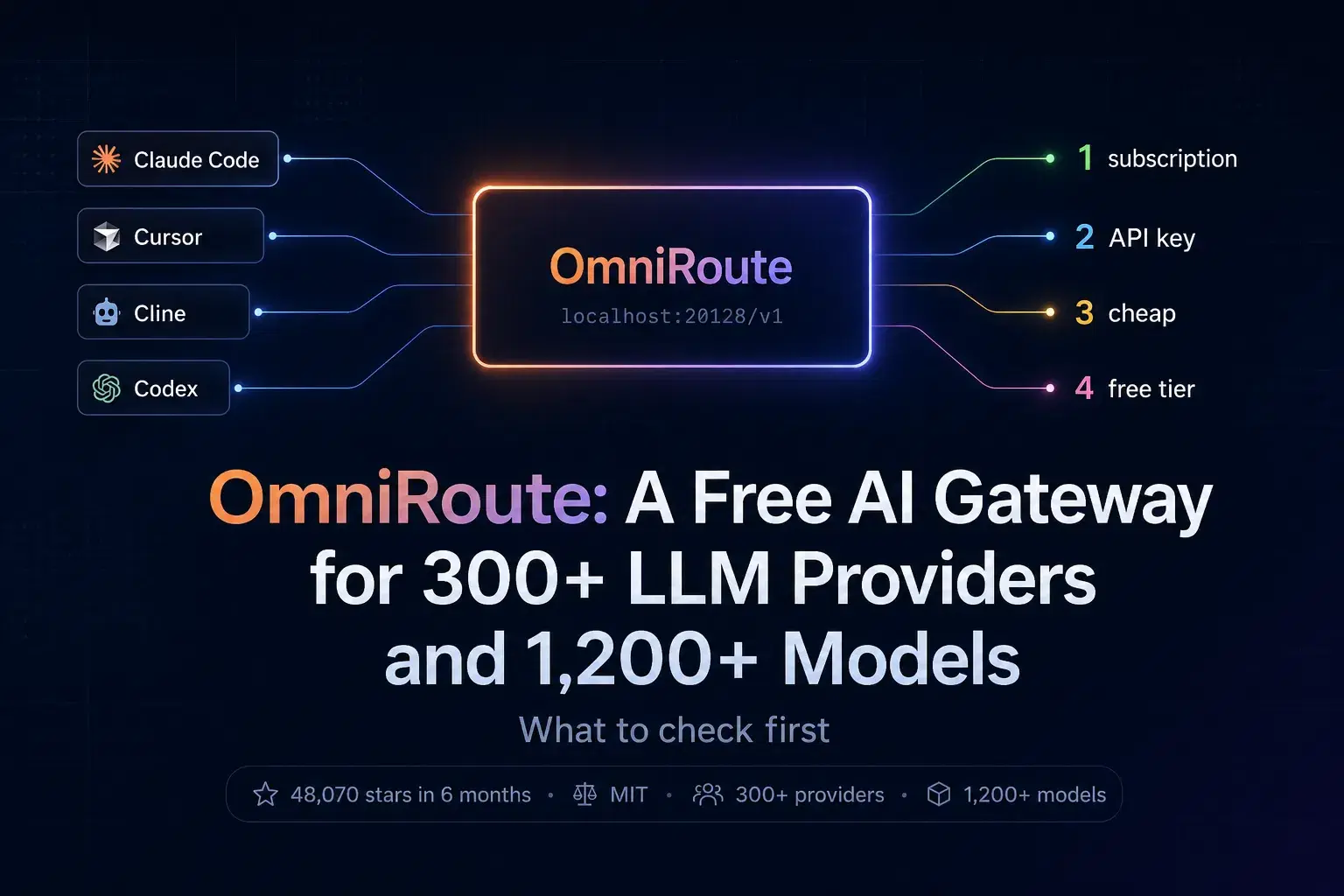
Running coding agents against several model providers means juggling a separate API key, rate limit and billing dashboard for each one, and rewriting your config every time a quota runs dry mid-session. Anyone using Claude Code, Cursor and Cline side by side has hit the point where the model stops responding and the work stops with it.
OmniRoute is one answer: a local, MIT-licensed proxy putting 300 or so providers behind a single OpenAI-compatible endpoint, failing over automatically when one runs out. It reached 48,070 GitHub stars in six months, worth putting in context: LiteLLM, the established name here, has 56,363 stars and dates to July 2023.
That growth is real and so is the engineering. The headline number on the front page, roughly 1.53 billion free tokens a month, needs more care, and the project's own documentation is where you find out why.
What It Actually Is
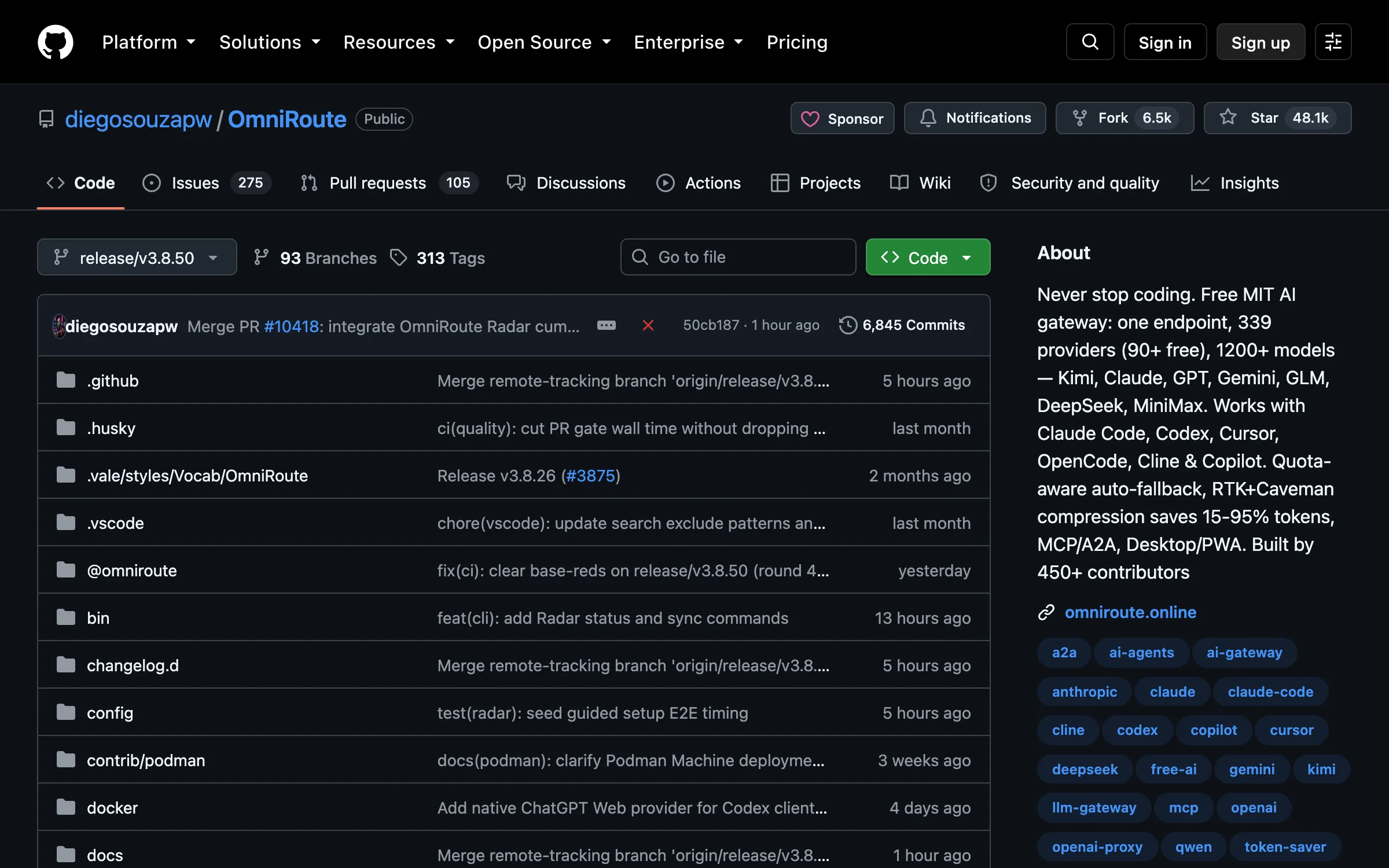
OmniRoute runs on your machine, not someone else's. It listens on localhost:20128, speaks the OpenAI API format at /v1, and forwards each request to whichever provider its router picks. Point Claude Code, Codex, Cursor, Cline or Copilot at that local URL and they keep working unchanged, because to them it looks like an ordinary OpenAI-compatible endpoint.
The local-first design is what matters for privacy. Keys are stored encrypted with AES-256-GCM on your own disk and prompts do not transit a vendor's cloud, which is a genuine architectural difference from a hosted gateway.
The Routing Engine Is the Real Product
Strip away the free-token marketing and what remains is a competent failover system, the part worth your attention.
Requests cascade through four tiers. Tier 1 is subscriptions you already pay for, such as Claude Code or Copilot. When that quota is exhausted it drops to Tier 2, your own API keys. Then Tier 3, deliberately cheap models. Then Tier 4, free tiers. The effect is that a session does not stop when one bucket empties.
Underneath sit three independent recovery layers, and the thresholds are specific enough to be worth quoting. A provider-level circuit breaker trips only on 408 and 5xx responses, at three consecutive failures for OAuth connections, five for API keys and two for local models, then resets after 60, 30 or 15 seconds into a half-open probe. A per-connection cooldown backs off exponentially from 5 seconds for OAuth and 3 for API keys, and honors Retry-After on a 429 rather than guessing. A per-model lockout isolates a single failing model instead of benching the whole provider.
Those are sensible defaults, and anyone who has written retry logic against flaky LLM APIs will recognize them as built by someone who had the problem. There are 19 routing strategies on top, from cheapest-first to most-quota-remaining to pinning a prompt prefix to one account so prompt caching actually hits.
Token Compression
OmniRoute bundles a compression stack it calls RTK and Caveman, claiming 15 to 95 percent reduction and around 89 percent on tool-heavy sessions. Code blocks, URLs and structured data are documented as preserved byte-perfect.
Treat the 89 percent as a vendor benchmark until you measure it on your own traffic, because "tool-heavy sessions" is doing a lot of work in that sentence. Agent transcripts full of repetitive tool output compress far better than prose. Even at the low end it is still the most direct lever on an API bill, since compression reduces tokens before they are billed.
The Free-Tier Math
The 1.53 billion figure is an aggregation, not a pool anyone hands you. OmniRoute sums the documented free tiers of 43 provider pools across 516 models and shows the running total on a dashboard at /dashboard/free-tiers.
To the project's credit, the methodology is published rather than hand-waved. Shared pools are counted once, one-time signup credits are listed separately from recurring budgets, and the docs note that counting every rate limit around the clock would read near 10 billion, which they decline to publish. The largest documented contributors are Mistral at roughly 1 billion tokens a month, llm7 at 150 million, Groq at 117 million and Gemini at 60 million.
The figures are re-audited every two weeks, and the changelog is a reminder that free tiers are weather rather than climate. In 2026 alone Chutes ended its free tier in March, Phind shut down in January, Kluster sunset in June, and several others were revoked or paused. A number built on 43 such tiers moves, and the docs say plainly that it moves both ways.
Read the ToS Table First
This is the part most coverage of OmniRoute skips, and it sits in the project's own repository at docs/reference/FREE_TIERS.md. A table titled "ToS attention" lists 15 providers whose terms sit awkwardly with proxy use, quoting those terms directly rather than paraphrasing them.
Google Antigravity's terms "explicitly prohibit using third-party software, tools, or services (including proxies) to access the service via OAuth." Fireworks "explicitly prohibits proxy/intermediary use, API key transfers, and sublicensing." NLP Cloud "explicitly prohibits setting up a proxy or other device that allows others to access the Service through it." Several entries cover consumer chat products reached with session tokens, where the terms ban automated access or credential sharing outright.
The maintainers label each row ok, caution or ambiguous, call it informational rather than legal advice, and leave the decision to you. That is more transparency than this category usually offers, and also a clear signal: a meaningful share of that 1.53 billion sits behind terms prohibiting exactly this pattern of access.
The practical consequence is account risk. Providers enforce these terms by suspending accounts, and a suspension can take the paid subscription you actually rely on with it. The feature list also advertises TLS fingerprint stealth and multi-level proxying for cases where access is blocked, which tells you the friction is real and that the project's answer is to route around it.
My read: the routing, fallback and compression are worth having on their own merits, and they work perfectly well with providers you are entitled to use. Enable the connectors whose terms permit a personal proxy, skip the flagged ones, and do not wire a work subscription into it without asking whoever owns that contract. Treating the free-token headline as the reason to install it is how people lose accounts.
How It Compares
| Stars | License | Created | Model | |
|---|---|---|---|---|
| OmniRoute | 48.1k | MIT | Feb 2026 | Local proxy, 300+ providers |
| LiteLLM | 56.4k | Non-standard | Jul 2023 | Library and proxy, hosted option |
| one-api | 36.4k | MIT | Apr 2023 | Self-hosted gateway and billing |
| Portkey Gateway | 12.7k | MIT | Aug 2023 | Edge gateway, hosted control plane |
LiteLLM is the safer institutional choice: three years of production use and a large integration surface. OmniRoute is younger, ships releases regularly and has drawn more than 400 contributors, which is a lot of eyes for a six-month-old project but not the same as a three-year track record.
Should You Use It
Solo developer juggling several coding agents: yes, with the flagged connectors off. The failover alone justifies it.
Cost-sensitive side project: yes, and use free tiers you are actually entitled to rather than chasing the headline number.
Team or company setting: proceed carefully. Subscription pooling in particular is the kind of thing that violates seat-based licensing, and "our gateway did it automatically" is not a defense anyone wants to make.
Regulated or contract-bound environment: LiteLLM or Portkey, not because OmniRoute is bad but because a documented ToS-attention table is a compliance conversation you do not want to open.
Trying It Without Surprises
- Check the port is free first. It binds
localhost:20128, and a silent bind failure looks like the gateway ignoring you. Our Port Checker confirms nothing else holds it. - Hit the endpoint directly before wiring an agent to it. One request against
/v1/chat/completionstells you whether the problem is the gateway or your editor config. Our cURL Command Generator builds the request with the right headers and JSON body. - Read the ToS table and disable what you are not entitled to.
docs/reference/FREE_TIERS.mdlists the 15 flagged providers. This is a five-minute read that protects the account you actually depend on. - Know what the status codes mean before you tune retries. The circuit breaker only trips on 408 and 5xx, and 429 is handled separately through
Retry-After. Our HTTP Status Codes Reference is the quick lookup for which class you are actually seeing. - Price the paid path before relying on the free one. Free tiers vanish with no notice, so know what the same workload costs on a normal API. Our LLM Token Cost Calculator does that math per call, day and month.
- Measure compression on your own traffic. Log token counts for a day with it off, then on. The published 89 percent comes from tool-heavy agent sessions and may not describe yours.
Conclusion
OmniRoute is a genuinely good piece of routing infrastructure wrapped in a headline that oversells the safe part of it. The four-tier fallback, the three-layer recovery with sane thresholds, and the local-first key storage are all things you would want in a gateway, and the MIT license means you can read every line of it.
The 1.53 billion free tokens are real in the sense that the arithmetic is documented and audited. They are not free in the sense that all of them are yours to use: the project's own terms-of-service table lists 15 providers whose terms prohibit proxy access, and it publishes that table because the maintainers know it matters. Use it for the routing, enable the connectors you are entitled to, and treat the free-token number as a ceiling that includes doors you should not open.
Related DevToolLab Tools
- Port Checker - Confirm nothing else is holding localhost:20128 before you start the gateway.
- cURL Command Generator - Test the local endpoint directly before blaming your editor config.
- HTTP Status Codes Reference - Know whether you are looking at a 429, a 408 or a 5xx before tuning retries.
- LLM Token Cost Calculator - Price the same workload on paid APIs, since free tiers disappear without notice.
Related Guides
- Best LLM Gateways - the established options this competes with
- Best LLM Guardrails Tools - what belongs in front of a model once routing is solved
- Best AI Code Execution Sandboxes - isolating the code these agents write
- Top CLI AI Coding Agents - the clients you would point at a gateway like this
Star counts, free tiers and provider terms change quickly. Check the repository and each provider's terms before relying on any of it.