
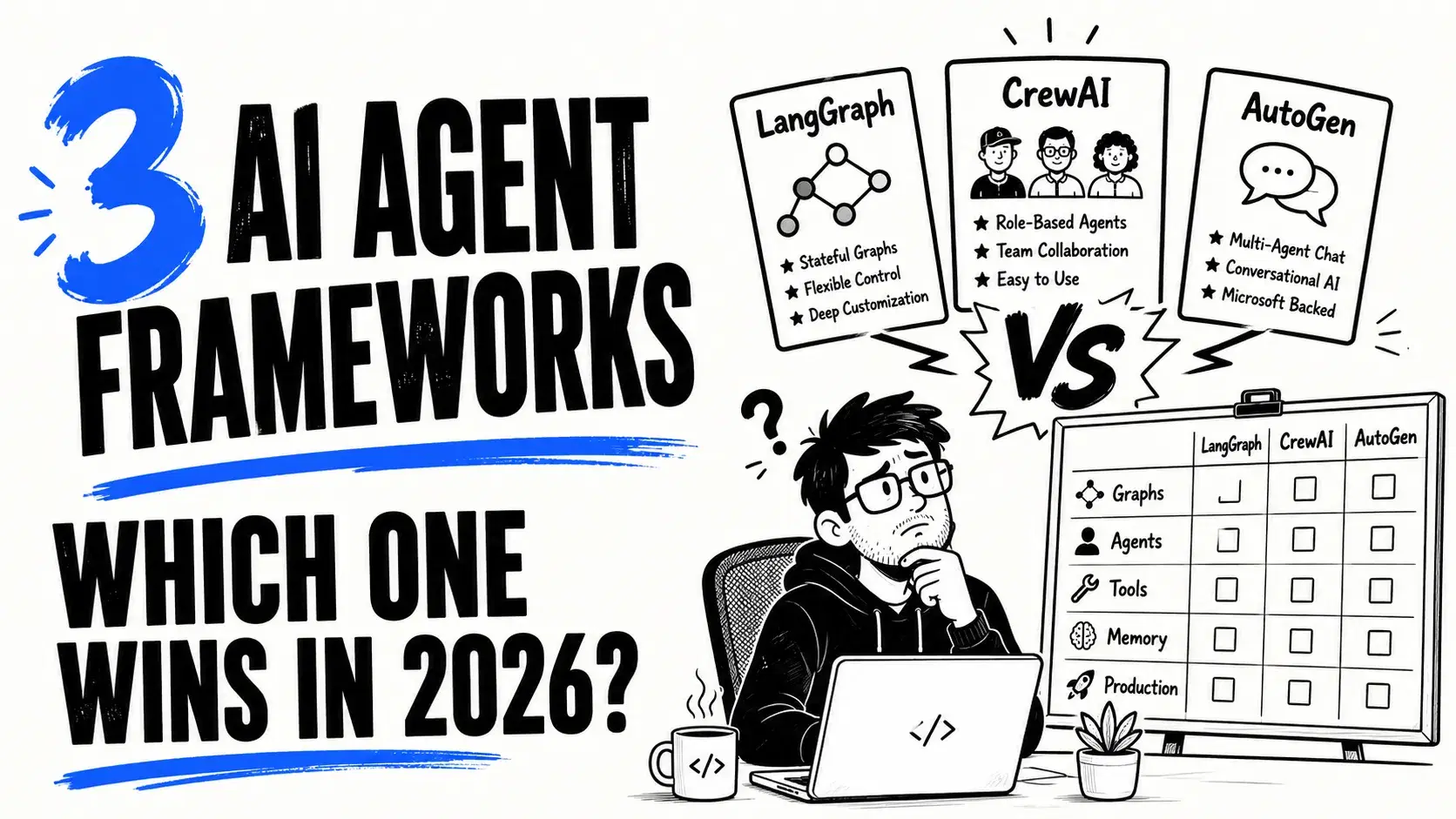
Gartner reported a 1,445% surge in multi-agent system inquiries from Q1 2024 to Q2 2025. As of mid-2026, three Python frameworks account for the majority of production AI agent deployments: LangGraph, CrewAI, and AutoGen - now split into AG2 and the Microsoft Agent Framework. They share almost no design philosophy, and picking the wrong one costs you weeks of refactoring.
This is a direct comparison with working code for each. By the end you will know which framework fits your use case and what each one is genuinely bad at.
The Three Frameworks at a Glance
- LangGraph - agent workflows as directed graphs. Nodes do work; edges route on shared state. Everything is explicit, everything is persisted.
- CrewAI - agents as a human team. Give each agent a role, goal, and tools, then assemble them into a Crew. Declarative and fast to prototype.
- AutoGen / AG2 - conversational agent teams that interact through multi-turn message exchanges. Microsoft split the project in 2026 - this matters for new work.
LangGraph: Graph-Based State Machines

LangGraph (v1.2, May 2026) models every agent run as a StateGraph - a directed graph where nodes are Python functions and edges are transitions driven by shared state. After every node execution, state is persisted to SQLite (dev) or Postgres (prod), which means agents can pause for human approval, survive container restarts, and be replayed from any checkpoint for debugging.
LangGraph Basic Agent
Pythonfrom typing import TypedDict, Annotated, Sequence from langgraph.graph import StateGraph, END from langgraph.checkpoint.memory import MemorySaver from langchain_anthropic import ChatAnthropic from langchain_core.messages import HumanMessage, BaseMessage import operator class AgentState(TypedDict): messages: Annotated[Sequence[BaseMessage], operator.add] llm = ChatAnthropic(model="claude-sonnet-4-6") def call_llm(state: AgentState) -> dict: response = llm.invoke(list(state["messages"])) return {"messages": [response]} builder = StateGraph(AgentState) builder.add_node("llm", call_llm) builder.set_entry_point("llm") builder.add_edge("llm", END) # MemorySaver is for development only - use PostgresSaver in production app = builder.compile(checkpointer=MemorySaver()) config = {"configurable": {"thread_id": "demo-1"}} result = app.invoke( {"messages": [HumanMessage(content="What is 2 + 2?")]}, config=config ) print(result["messages"][-1].content)
The thread_id enables multi-turn memory. Run the graph again with the same thread_id and it loads the full conversation history from the checkpointer. The Annotated[Sequence[BaseMessage], operator.add] reducer tells LangGraph to append messages rather than replace state on each update.
What it does well: Human-in-the-loop workflows via the interrupt() primitive (stable since v1.0), token efficiency (30-40% fewer tokens than equivalent CrewAI crews on medium tasks), and observability via LangSmith with full state transitions per node. LangGraph surpassed CrewAI in GitHub stars in early 2026, driven by enterprise teams that need audit trails.
What it does not do well: The learning curve is steep. Defining a graph explicitly - every node, every edge, every routing function - requires more boilerplate than CrewAI for simple workflows. There are no built-in abstractions for common patterns like "a researcher and a writer"; you build those from primitives.
Install: pip install langgraph langchain-anthropic | Current version: 1.2.x
CrewAI: Role-Based Agent Teams

CrewAI (v0.105+) models agents as a team. Each agent gets a role, goal, backstory, and tools. Tasks describe what to do and who does it. The Crew handles execution order. A working two-agent pipeline takes 25 lines without reading much documentation.
CrewAI Basic Crew
Pythonfrom crewai import Agent, Task, Crew researcher = Agent( role="Python Expert", goal="Write clean, well-documented Python code solutions", backstory="You are a senior Python developer with 10 years of production experience.", verbose=True, llm="anthropic/claude-sonnet-4-6" ) reviewer = Agent( role="Code Reviewer", goal="Review Python code for bugs, edge cases, and style issues", backstory="You are a meticulous code reviewer who always catches corner cases.", verbose=True, llm="anthropic/claude-sonnet-4-6" ) code_task = Task( description="Write a Python function that calculates the nth Fibonacci number using memoization.", expected_output="A complete function with type hints, docstring, and example usage.", agent=researcher ) review_task = Task( description="Review the Fibonacci function for correctness, edge cases (n=0, n=1, negative n), and best practices.", expected_output="A short code review listing issues and suggested improvements.", agent=reviewer ) crew = Crew(agents=[researcher, reviewer], tasks=[code_task, review_task]) result = crew.kickoff() print(result.raw)
CrewAI handles the sequential handoff from researcher to reviewer automatically. The output of code_task is injected as context for review_task. It also supports YAML-based config (agents.yaml, tasks.yaml) for iterating on agent behavior without touching Python.
What it does well: Fastest time to a working prototype. If the workflow maps to "a team of humans doing a task," CrewAI models it cleanly. v1.10.1 (early 2026) added MCP and A2A protocol support.
What it does not do well: Precise control flow. Sequential and hierarchical process modes cover most workflows, but conditional routing ("if step 3 fails, retry step 1 with different params") requires workarounds. Token cost is also higher - benchmarks show 4.5K tokens per run on tasks where LangGraph uses under 2K.
Install: pip install crewai crewai-tools | Current version: 0.105+
AutoGen in 2026: A Project That Split

As of March 2026, the original AutoGen has diverged into three paths:
- AutoGen v0.7.x - Microsoft's maintenance-mode line. Gets security patches; core team has moved on.
- AG2 - community-led fork preserving backward-compatible v0.2
GroupChatAPI. Use this if you have existing AutoGen code to maintain. - Microsoft Agent Framework - production-grade successor merging AutoGen with Semantic Kernel. Still early.
For new greenfield projects, this split is genuinely awkward. You are betting on which path gets maintained long-term.
AG2 Conversational Agent Example
Pythonimport os from autogen import AssistantAgent, UserProxyAgent config_list = [{"model": "gpt-4o", "api_key": os.environ.get("OPENAI_API_KEY")}] assistant = AssistantAgent( name="assistant", llm_config={"config_list": config_list} ) user_proxy = UserProxyAgent( name="user_proxy", human_input_mode="NEVER", max_consecutive_auto_reply=5, code_execution_config={"work_dir": "coding", "use_docker": False} ) user_proxy.initiate_chat( assistant, message="Write a Python function that checks if a number is prime, then test it with 17 and 100." )
What it does well: Multi-party conversation workflows and code execution sandboxes. GroupChat - where multiple agents debate a problem - works well for adversarial review: one agent writes code, a second reviews, a third runs the tests.
What it does not do well: Token cost is the highest of the three - one benchmark showed 5-6x the token cost of LangGraph on equivalent reasoning tasks. The project split also creates long-term maintenance uncertainty for new work.
Install: pip install ag2 (community fork) or pip install autogen (Microsoft maintenance line)
Comparison Table
| Criterion | LangGraph 1.2 | CrewAI 0.105 | AutoGen / AG2 0.7 |
|---|---|---|---|
| Learning curve | Steep - explicit graph | Gentle - role/task | Medium |
| Control over flow | Full - conditional edges | Limited - process modes | Conversation-based |
| Token efficiency | Best | ~2x overhead | ~5-6x overhead |
| Stateful persistence | First-class (PostgresSaver) | Basic | Not built-in |
| Human-in-the-loop | interrupt() primitive | Workaround required | human_input_mode |
| Production readiness | Mature | Solid | Uncertain (split) |
| Best for | Stateful, long-running workflows | Quick team-based prototypes | Code execution, debate loops |
How to Pick
Use LangGraph when your workflow has conditional paths, retry logic, human approval gates, or needs to survive restarts. Production teams running agents that touch customer data land here because the audit trail is built-in.
Use CrewAI when you need a working prototype today. If the use case maps to a team of humans - researcher, analyst, writer - CrewAI models it in 30 lines. Also the right call when non-engineers need to iterate on agent behavior via YAML config.
Use AutoGen / AG2 when you have existing v0.2 GroupChat code to maintain, or when the task specifically needs a code-execution loop where an agent writes code, runs it, reads the error, and fixes it. For everything else in 2026, the project split makes it the riskiest choice.
Observability
LangGraph integrates directly with LangSmith - set LANGCHAIN_TRACING_V2=true and every graph execution shows full state transitions, token counts, and timing per node. CrewAI added enterprise observability in March 2026 as a paid CrewAI+ feature; the open-source version logs to stdout. AutoGen / AG2 requires an external tool like Langfuse for structured tracing.
Install Reference
Bashpip install langgraph langchain-anthropic # LangGraph pip install crewai crewai-tools # CrewAI pip install ag2 # AG2 community fork pip install autogen # Microsoft maintenance line
All three work with Claude, OpenAI, and local models via Ollama. Set ANTHROPIC_API_KEY for Claude models. For Ollama use ollama/llama3.2 as the model string in CrewAI, or configure the LLM client directly in LangGraph.
Conclusion
LangGraph is the most battle-tested choice for complex, stateful workflows in mid-2026. CrewAI is the fastest route to a working prototype for team-based pipelines. AutoGen's code-execution sandbox is genuinely useful for the right problem, but the project split makes it a harder long-term bet for new work.
A practical approach many teams use: prototype in CrewAI to validate the workflow logic quickly, then migrate the production version to LangGraph for checkpointing and observability. Match the framework to the shape of the problem.
Related DevToolLab Tools
These tools are useful when building and debugging AI agent pipelines.
- AI Token Counter - Count exact tokens for Claude 4, GPT-4o, and Gemini before sending a request. Multi-agent workflows carry large assembled contexts; this catches oversized payloads before they inflate costs.
- JSON Formatter - Inspect and format raw tool output payloads agents return between steps. Makes it clear which fields are bloated and can be trimmed from the context injection.
- YAML Validator - Validate the
agents.yamlandtasks.yamlfiles CrewAI projects use. Catches YAML syntax errors before they surface as confusing Python runtime failures. - JSON Schema Validator - Validate structured output schemas for constrained generation. Catches definition errors before they cause parsing failures in downstream pipeline steps.
- Dockerfile Generator - Generate a production-ready Dockerfile for your agent app. Consistent dependency environments prevent the "works on my machine" class of deployment failures.