
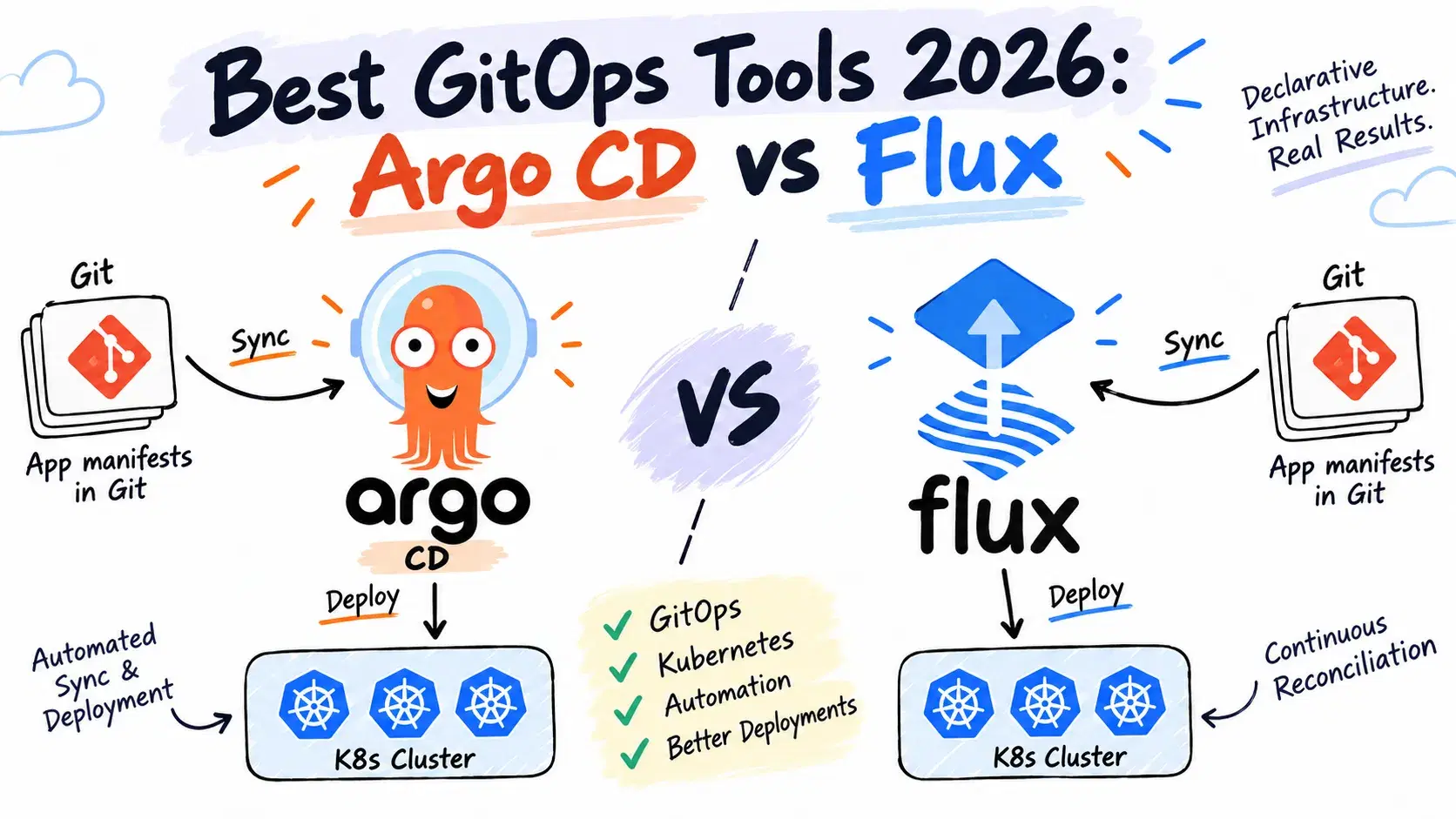
Once a cluster has more than one person with kubectl access, its real configuration and the configuration in your repository start to disagree. Someone patches a replica count at 2 AM to stop a page, the fix never lands in Git, and a routine deploy quietly reverts it weeks later. GitOps tools close that gap by making the repository the only thing allowed to change the cluster.
Two projects own this category, and their install manifests tell you most of what separates them. Argo CD v3.5.3 ships 59 Kubernetes objects in a 1.9 MB file. Flux v2.9.5 ships 43 objects in 334 KB. Both are CNCF graduated, both are Apache 2.0, and both do the same job.
What GitOps Actually Means Here
GitOps is a pull model: a controller running inside the cluster watches a Git repository and continuously reconciles the live state to match it. Nothing pushes from CI. Your pipeline's last step is a commit, not a kubectl apply, which is why a GitOps controller replaces the deploy stage of a pipeline rather than the build stage.
The controller is not a CI system and will not build your images. If you are still choosing the build half, that is a separate decision covered in our CI/CD tools comparison.
Argo CD
Argo CD is a centralized application platform: an API server, a repository server, an application controller, a Redis cache, and a web UI that renders the resource tree of every application it manages. The unit of work is an Application custom resource pointing at a repository path and a destination cluster.
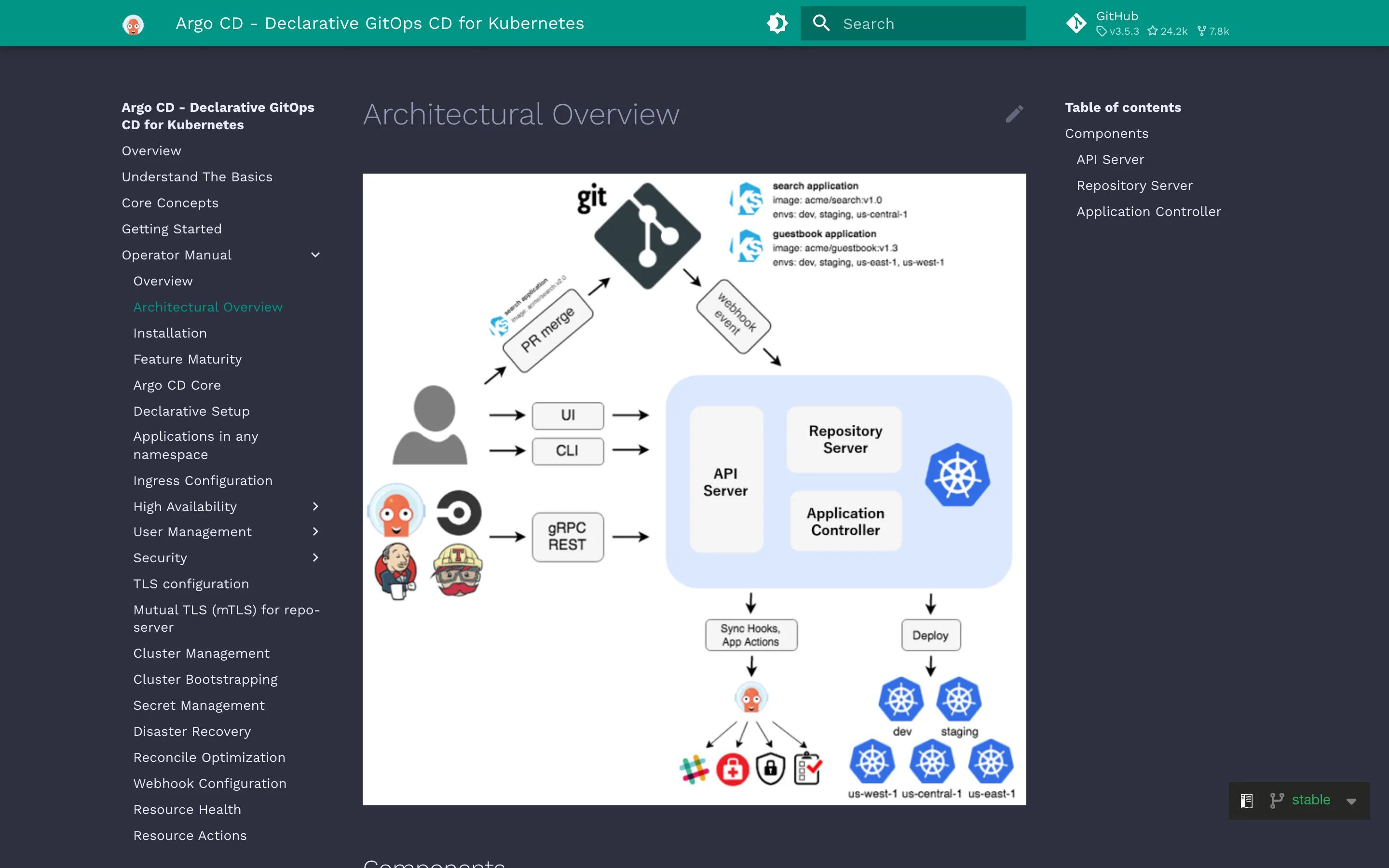
Argo CD is the more widely deployed of the two. The CNCF announced on July 24, 2025 that its 2025 Argo CD End User Survey found the project running in nearly 60 percent of Kubernetes clusters used for application delivery, with 97 percent of respondents running it in production, up from 93 percent in 2023, and a Net Promoter Score of 79. Read that with the caveat it deserves: CNCF and the Argo maintainers ran the survey and its respondents are Argo CD users, so it measures enthusiasm among adopters, not neutral market share.
What it does well. The UI is the reason most teams pick it: an application tree showing every managed object, its sync status, its health and a diff against Git, which you can hand to a developer without a training session. Argo CD also has the more mature permission model, with its own RBAC layer, projects and built-in SSO.
What it does not do. Image update automation is not built in. Argo CD watches Git, so something else must write a new image tag into Git when a build finishes, assembled from Argo CD Image Updater or a CI step. Version 3.0.0, released May 6, 2025, also tightened two defaults in ways that break upgrades: logs RBAC is enforced by default and fine-grained RBAC inheritance is disabled by default. Both are correct security decisions, and both lock people out of the UI on upgrade day if nobody read the notes.
License and version. Apache 2.0, v3.5.3 released September 14, 2026, 24,160 GitHub stars as of September 15, 2026. Accepted to the CNCF on March 26, 2020 and graduated December 6, 2022.
Flux
Flux is the opposite shape: no server, no UI, no database. It is a set of small controllers that live in the cluster and are driven by custom resources and the flux CLI. Source, Kustomize, Helm, Notification, and the two optional image controllers each do one job.
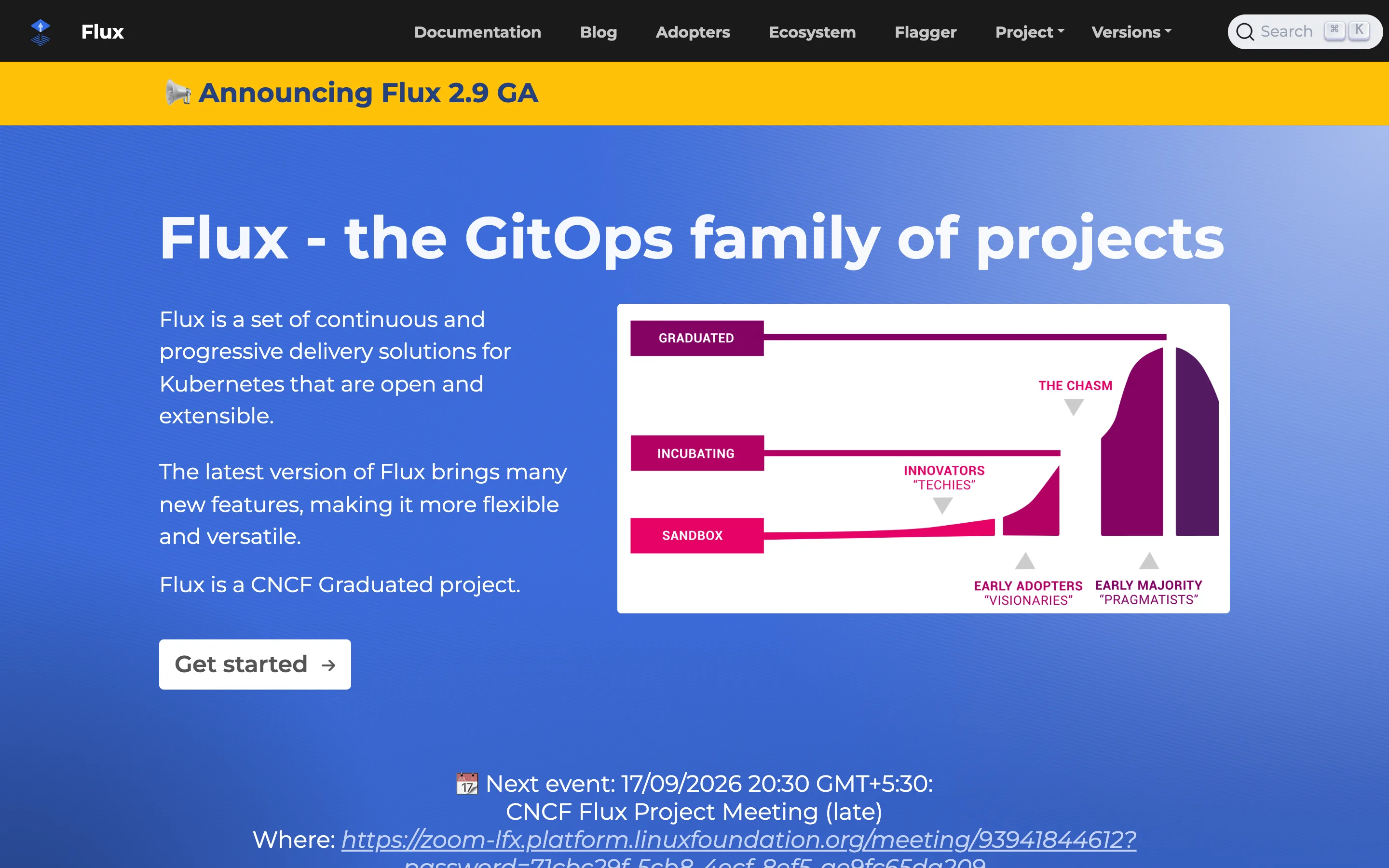
What it does well. Image automation is first class: the image reflector and image automation controllers watch a registry, pick a new tag by policy, and commit it back to Git with no extra tooling. Flux also treats Helm as a real citizen, since HelmRelease runs actual Helm releases with drift correction, and v2.8.0 of February 24, 2026 added Helm v4 support with server-side apply. The v2.9.0 release of June 30, 2026 added a CLI plugin system, server-side apply field ignore rules, and Git commit signing with SSH keys.
What it does not do. There is no dashboard. Status lives in kubectl output and flux get, which suits a platform team and frustrates developers who wanted a link to click. Per-team RBAC is plain Kubernetes RBAC, so multi-tenancy is something you design with namespaces rather than something the tool hands you.
The sponsor question you should ask. Weaveworks, the company that coined the term GitOps and built Flux, ceased commercial operations in early February 2024. The project did not die with it: on February 15, 2024, ControlPlane announced it had hired core maintainers Stefan Prodan and Soule Ba as full-time employees, and Flux has shipped two feature releases in 2026 alone.
License and version. Apache 2.0, v2.9.5 released August 31, 2026, 8,407 GitHub stars as of September 15, 2026. Accepted to the CNCF on July 15, 2019, incubating from March 12, 2021, graduated November 30, 2022.
What Does Each One Actually Install?
Argo CD installs roughly four times as much YAML as Flux, but almost all of the difference is custom resource definition schema rather than running software. This script downloads both projects' published install manifests and counts what is in them:
Python# What each GitOps controller actually installs. pip install pyyaml import collections, urllib.request, yaml MANIFESTS = { "Argo CD v3.5.3": "https://raw.githubusercontent.com/argoproj/argo-cd/v3.5.3/manifests/install.yaml", "Argo CD v3.5.3 HA": "https://raw.githubusercontent.com/argoproj/argo-cd/v3.5.3/manifests/ha/install.yaml", "Flux v2.9.5": "https://github.com/fluxcd/flux2/releases/download/v2.9.5/install.yaml", } WORKLOADS = ("Deployment", "StatefulSet", "DaemonSet") for name, url in MANIFESTS.items(): raw = urllib.request.urlopen(url).read().decode() docs = [d for d in yaml.safe_load_all(raw) if d] kinds = collections.Counter(d["kind"] for d in docs) workloads = [d for d in docs if d["kind"] in WORKLOADS] containers = sum(len(w["spec"]["template"]["spec"].get("containers", [])) for w in workloads) crd_kb = sum(len(yaml.safe_dump(d)) for d in docs if d["kind"] == "CustomResourceDefinition") / 1024 print(f"{name:<19} {len(docs):>3} objects {kinds['CustomResourceDefinition']:>2} CRDs " f"{len(workloads):>2} workloads {containers:>2} containers " f"{len(raw)/1024:>6.0f} KB total {crd_kb:>6.0f} KB of it CRD schema")
Run on September 15, 2026, it prints:
textArgo CD v3.5.3 59 objects 3 CRDs 7 workloads 7 containers 1873 KB total 1784 KB of it CRD schema Argo CD v3.5.3 HA 70 objects 3 CRDs 8 workloads 10 containers 1923 KB total 1784 KB of it CRD schema Flux v2.9.5 43 objects 15 CRDs 7 workloads 7 containers 334 KB total 315 KB of it CRD schema
Both projects run seven containers in their default install, so the "Flux is lighter" folklore is mostly wrong at the process level. Argo CD's three CRDs account for 1,784 KB of its 1,873 KB manifest because the Application and ApplicationSet schemas are enormous, a real cost on clusters with tight etcd limits; Flux spreads 15 CRDs across 315 KB. The honest structural difference is high availability: Argo CD's HA install adds a StatefulSet and three containers because it depends on Redis, while Flux ships no StatefulSet and keeps no cache to lose.
The Fleet Tools Nobody Writes About
Two smaller projects solve a problem neither Argo CD nor Flux was designed for: pushing configuration to many clusters selected by label rather than named one at a time.
Rancher Fleet is SUSE's GitOps engine and the one built into Rancher, designed for scale in cluster count rather than application complexity, with a GitRepo resource targeting cluster groups. Apache 2.0, v0.16.1 released August 21, 2026, 1,728 GitHub stars. If you already run Rancher, do not add a second controller to do the same job.
Sveltos is the long shot. It distributes add-ons to clusters matched by label selector, turning "every production cluster in us-east-1 gets this Helm chart" into one resource. Apache 2.0, addon-controller v1.15.0 released September 12, 2026, 575 GitHub stars. That star count is the warning label.
Argo Rollouts is not a GitOps controller at all but the progressive delivery piece teams want next, handling the canary and blue-green strategies a plain sync does not. Apache 2.0, v1.10.0 released August 27, 2026, 3,576 GitHub stars.
What Do the Commercial Control Planes Cost?
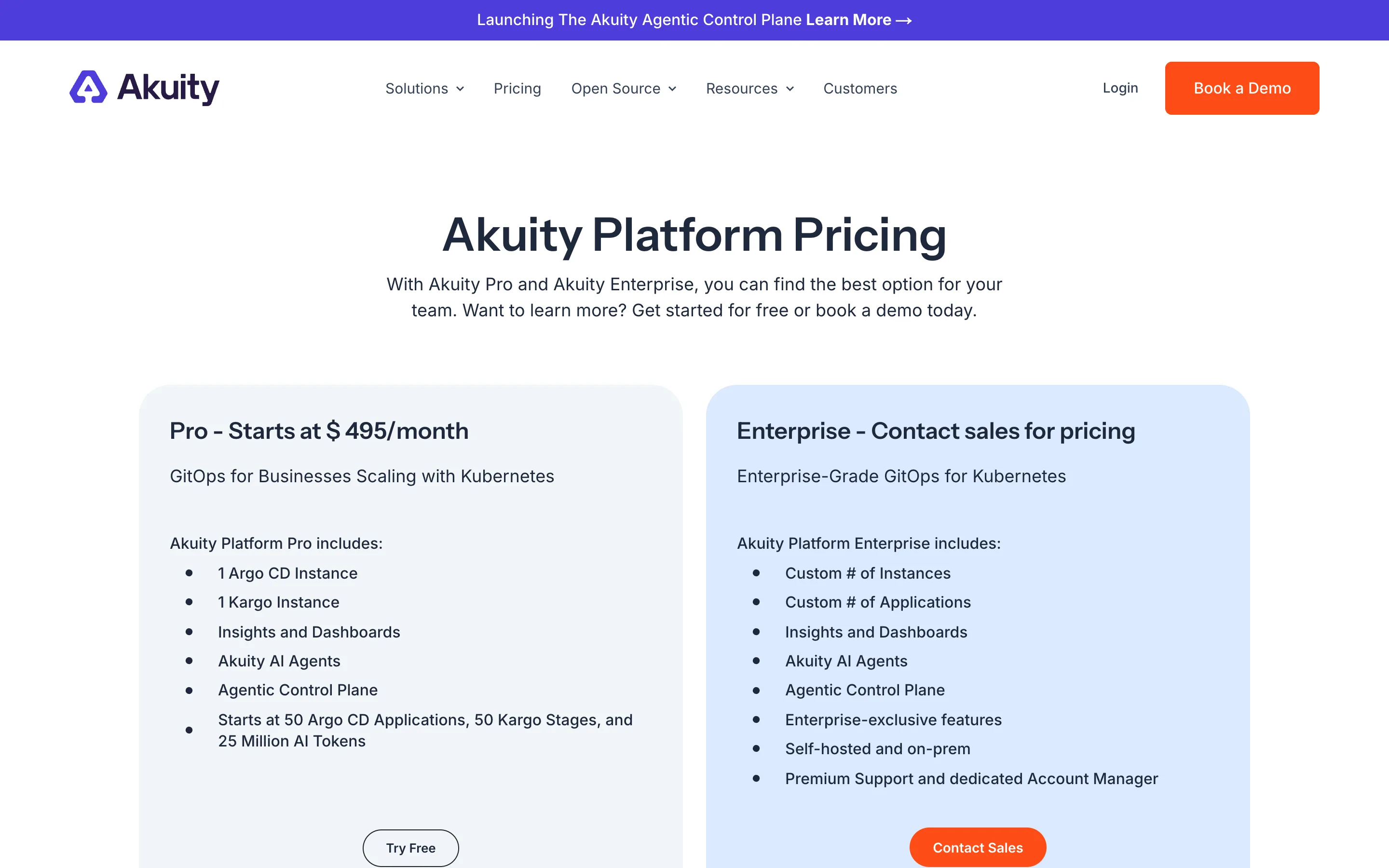
Both open-source projects are free, and the money is in managed control planes and support. Akuity, founded by Argo co-creators, publishes Akuity Platform Pro at $495 per month, which includes one Argo CD instance, one Kargo instance, dashboards, and a starting allocation of 50 Argo CD applications, 50 Kargo stages and 25 million AI tokens. Enterprise is contact-sales.
The Codefresh side has consolidated: as of September 15, 2026, codefresh.io/pricing returns a 301 to octopus.com/pricing/overview after the Octopus Deploy acquisition. Octopus Deploy publishes Octopus Cloud at $0 per year for a tier capped at 10 projects, 10 machines and 10 users, $4,330 per year for Professional and $24,600 for Enterprise, with self-hosted Octopus Server at $2,080 and $15,600.
On the Flux side, ControlPlane employs the maintainers and sells support and hardened builds rather than a hosted control plane. You are buying assurance around software you already run, not a service you log into.
Side by Side
| Tool | Model | Latest version | License | GitHub stars | Who pays the maintainers |
|---|---|---|---|---|---|
| Argo CD | Central server plus UI | v3.5.3, Sep 14, 2026 | Apache 2.0 | 24,160 | Multi-vendor, CNCF graduated 2022 |
| Flux | In-cluster controllers, CLI | v2.9.5, Aug 31, 2026 | Apache 2.0 | 8,407 | ControlPlane since Feb 2024 |
| Rancher Fleet | Fleet-scale, Rancher-native | v0.16.1, Aug 21, 2026 | Apache 2.0 | 1,728 | SUSE |
| Sveltos | Label-selected add-on delivery | v1.15.0, Sep 12, 2026 | Apache 2.0 | 575 | Community |
| Argo Rollouts | Progressive delivery add-on | v1.10.0, Aug 27, 2026 | Apache 2.0 | 3,576 | Argo project |
All star counts and release dates verified against the GitHub API on September 15, 2026.
How to Choose Without Migrating Twice
- Count your audiences, not your clusters. If application developers need to see deploy status themselves, you need a UI, and that is Argo CD. If the only people touching delivery are three platform engineers who live in a terminal, Flux removes a server you would otherwise operate.
- Decide who moves the image tag. If you want the registry to drive deploys without a CI step writing to Git, Flux's image automation controllers do that natively and Argo CD needs a companion.
- Check what your distribution already ships. Rancher includes Fleet. Running a second controller alongside a bundled one is a common and avoidable mistake.
- Price the control plane, not the license. Both engines cost nothing. Ask whether $495 per month for a managed Argo CD beats the engineer-days of running it yourself, which at small scale it usually does not.
- Only then look at Helm depth. If you mostly deploy upstream Helm charts with values overlays, Flux's
HelmReleaseis the stronger implementation.
The Verdict, by Team
Application developers need to self-serve: Argo CD. The resource tree UI is the feature, and no amount of CLI polish substitutes for it.
A small platform team that lives in a terminal: Flux. Seven containers, no Redis, no server to run, and image automation you would otherwise build yourself.
Already running Rancher: Rancher Fleet, because it is already installed and already supported.
Dozens of clusters needing the same add-ons: Sveltos alongside whichever engine you picked, with eyes open about a 575-star project.
You need canary deploys: Argo Rollouts on top, since neither base engine does progressive delivery alone.
Your compliance team wants a name on a support contract: Akuity at $495 per month for Argo CD, or ControlPlane for Flux.
Conclusion
The sponsor drama in this category resolved in favor of the software. Weaveworks went under in February 2024, and Flux shipped v2.8.0 in February 2026 and v2.9.0 in June 2026 anyway. Argo CD spent v3.0 tightening RBAC defaults rather than adding features.
So pick on shape, not survival odds. Argo CD is a product you give developers; Flux is an engine you give a platform team. The install manifests say it more bluntly than any feature matrix: one ships a UI, an API server and a Redis dependency, the other ships seven controllers and a CLI.
Related DevToolLab Tools
- Kubernetes YAML Generator - scaffold the Deployment and Service manifests that go into the Git repository your GitOps controller watches, without copying a stale blog snippet.
- YAML Validator - catch the indentation mistake before you commit it, because a GitOps controller reports a broken manifest as a failed reconciliation several minutes later.
- GitHub Actions Generator - build the CI half that tests and pushes the image, leaving the deploy to the controller.
- Semver Calculator - work out the next version tag before an image automation policy picks it up from your registry.
Related Guides
- Best CI/CD Tools in 2026 - the build half of the pipeline, compared on what the vendors actually charge.
- Best Infrastructure as Code Tools in 2026 - Terraform, OpenTofu, Pulumi and Crossplane for the clusters these controllers run on.
- Container Security Tools Compared - image scanning and runtime defense for the workloads you are reconciling.
- Best eBPF Observability Tools in 2026 - zero-code instrumentation for watching what happens after the deploy lands.