
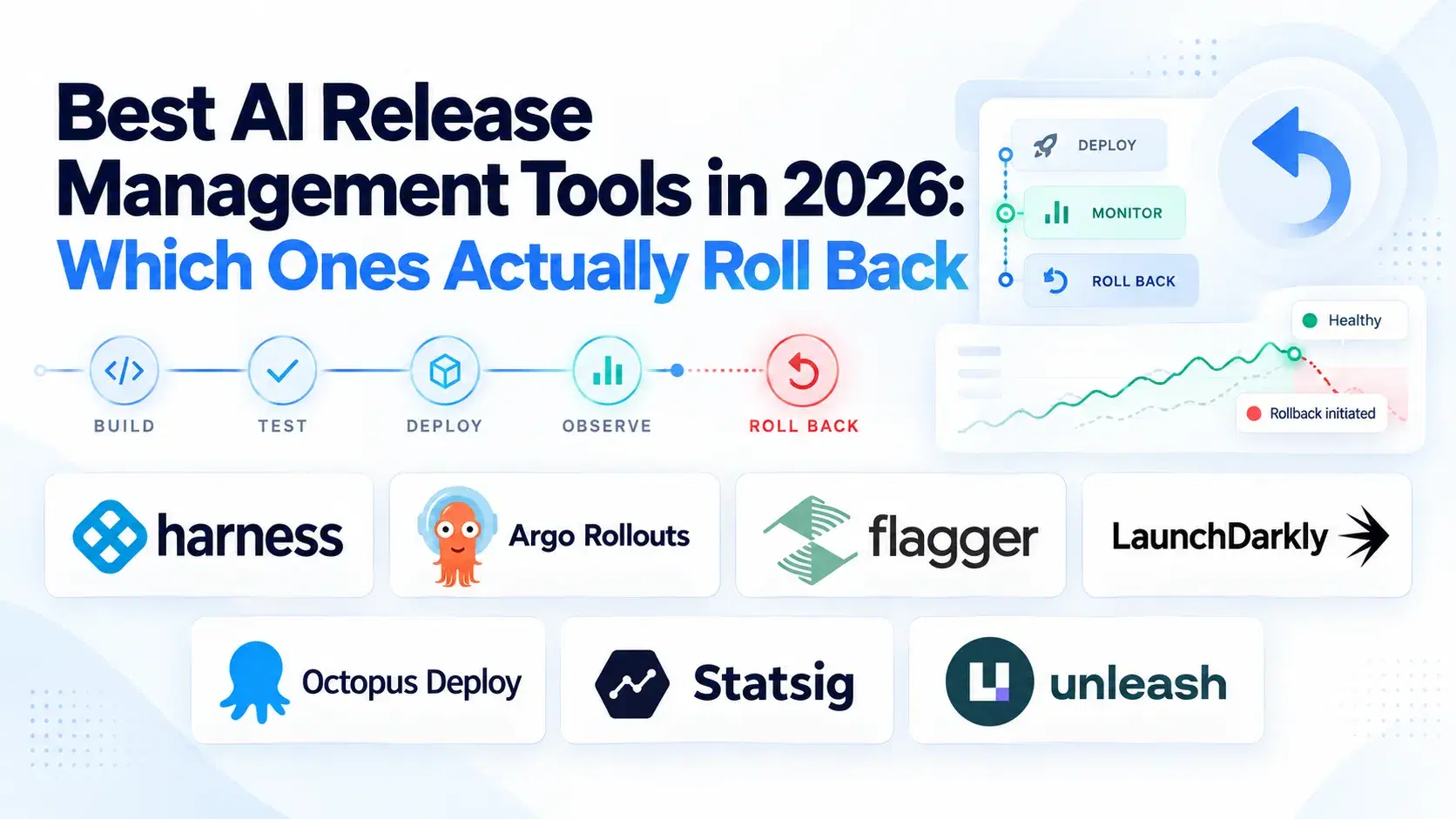
Getting a build into production is rarely the hard part anymore. The hard part is the ten minutes after the deploy, when the error rate is up a fraction of a percent, p99 latency has drifted, and someone has to decide whether that is a traffic spike or a regression that needs reverting.
Google's DORA team measured what happens at that speed. Its 2025 State of AI-assisted Software Development report, drawn from nearly 5,000 technology professionals, found that 90 percent of respondents now use AI at work and more than 80 percent believe it made them more productive, but AI adoption still shows a negative relationship with software delivery stability even as its relationship with throughput turned positive. More changes are reaching production faster, and more of them break things. That gap is the market for release management tooling in 2026.
What Does "AI Release Management" Actually Mean?
It means two different things, and the difference decides whether a tool can save you at 2 AM.
The first is statistical deployment verification, which predates the current AI wave. The tool baselines your metrics and logs before a release, shifts a slice of traffic to the new version, tests against that baseline, then promotes or reverts without waiting for a human. This is what stops an incident. Harness, Argo Rollouts, Flagger and Spinnaker's Kayenta all work this way.
The second is an LLM assistant bolted onto a deployment tool: chat that explains why a pipeline failed, writes release notes, or suggests a fix. Useful for the postmortem, but it is a diagnosis aid, not a control loop, and nothing in that category reverts a release while you are asleep. Read every claim through that filter: not whether a model is involved, but whether the tool takes an action.
Which Tools Can Revert a Release on Their Own?
| Tool | What its AI does during a release | Reverts automatically | License and price, as of September 2026 |
|---|---|---|---|
| Harness | Baselines logs and metrics pre-deploy, correlates deviations across endpoints | Yes, or a review gate | Proprietary, price not published |
| Argo Rollouts | Runs metric queries as rollout steps, scores each one | Yes | Apache 2.0, free, v1.10.0 |
| Flagger | Canary analysis plus conformance webhooks per traffic step | Yes | Apache 2.0, free, v1.45.0 |
| LaunchDarkly | Sequential testing on guardrail metrics during a flag rollout | Yes, opt-in | Proprietary, free tier, then usage-metered |
| Octopus Deploy | Diagnoses a failed deployment and suggests recovery steps | No, diagnosis only | Proprietary, free tier, $2,080/yr self-hosted |
| Statsig | Experiment analysis with CUPED and sequential testing | Via flag, not deploy | Proprietary, free tier to about $150/mo |
| Unleash | No verification model, kill switches and gradual rollout | Manual kill switch | AGPL-3.0, free self-hosted |
| Dromeas | Council-reviewed readiness checks on the diff between release tags, before deploy | No, blocks the release before it ships | Proprietary, free tier, Pro from $25/mo |
Harness
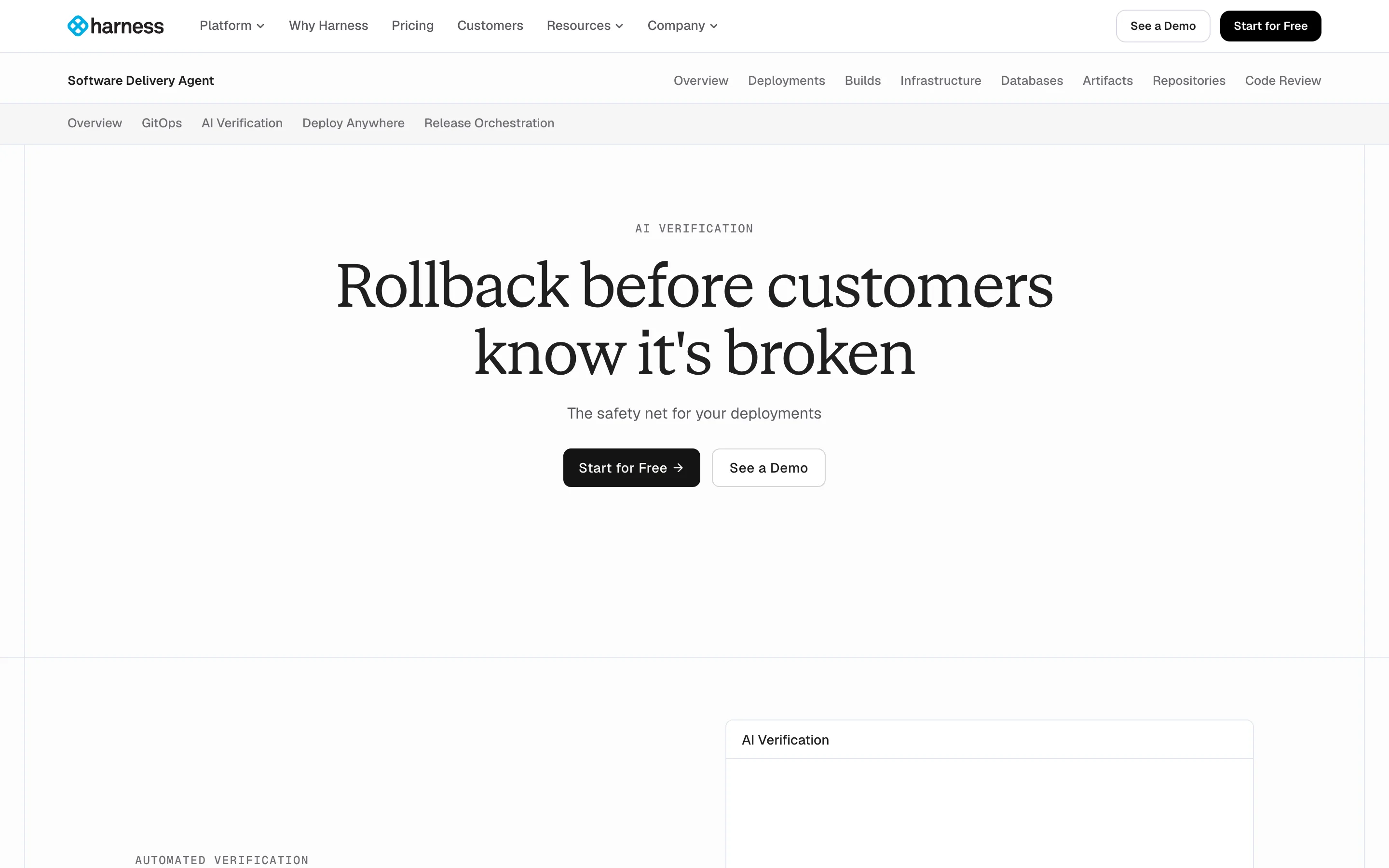
Harness is the most direct commercial answer, and it no longer hides behind generic language: the product page is titled AI Verification and headlined "Rollback before customers know it's broken."
Harness takes pre-deployment baselines of application logs and metrics, compares them against data streamed from your observability stack during the release, and correlates metric and log findings across endpoints before deciding. The outcome is configurable: automatic rollback, a manual review gate, or a notification routed to one engineer. It reads metrics from AppDynamics, Datadog, Prometheus and CloudWatch plus fifteen others, and logs from Splunk, Elasticsearch, Grafana Loki and Google Cloud Ops. If you already pay for one, most of the wiring is done.
The catch is commercial. Harness publishes plan names and limits, 60 concurrent pipeline executions on Essentials against 500 on Enterprise, but no prices. Every paid tier routes to sales, so budget procurement time as well as license cost.
Argo Rollouts
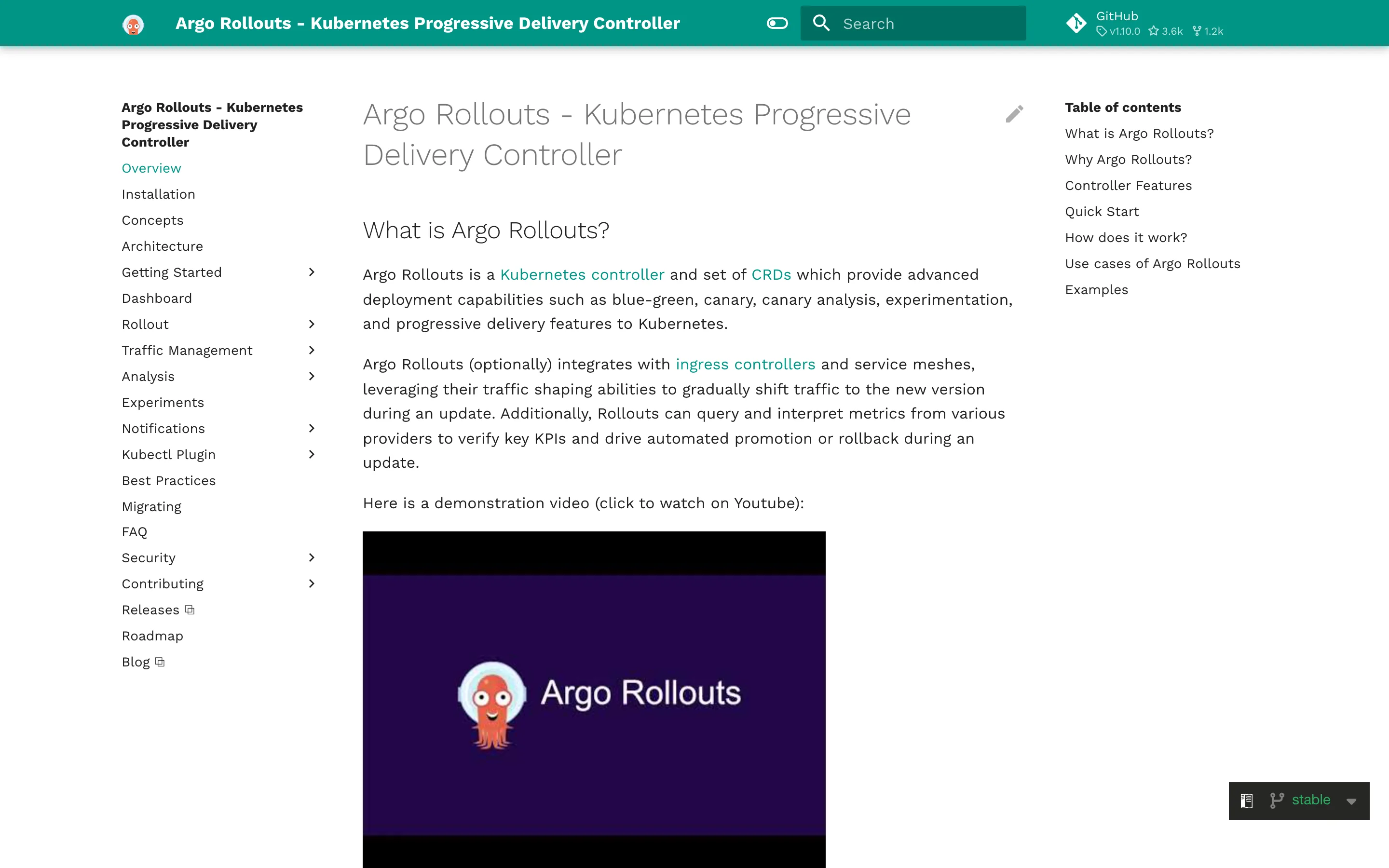
Argo Rollouts is the open-source option most teams should try first, because if you already run Argo CD the operational cost is close to zero. It is a Kubernetes controller and set of CRDs adding blue-green, canary and canary analysis to workloads that would otherwise get a rolling update. Version 1.10.0 shipped on August 27, 2026 under Apache 2.0, and the repository carries about 3,600 GitHub stars.
What makes it a verification tool rather than a traffic splitter is the AnalysisTemplate: a metric query, a success condition and a failure limit, referenced as a rollout step. Argo Rollouts queries the provider at each step and drives promotion or rollback from the result. Its 2026 work has centered on the Kubernetes Gateway API plugin, replacing mesh-specific integrations with one standard interface.
Flagger
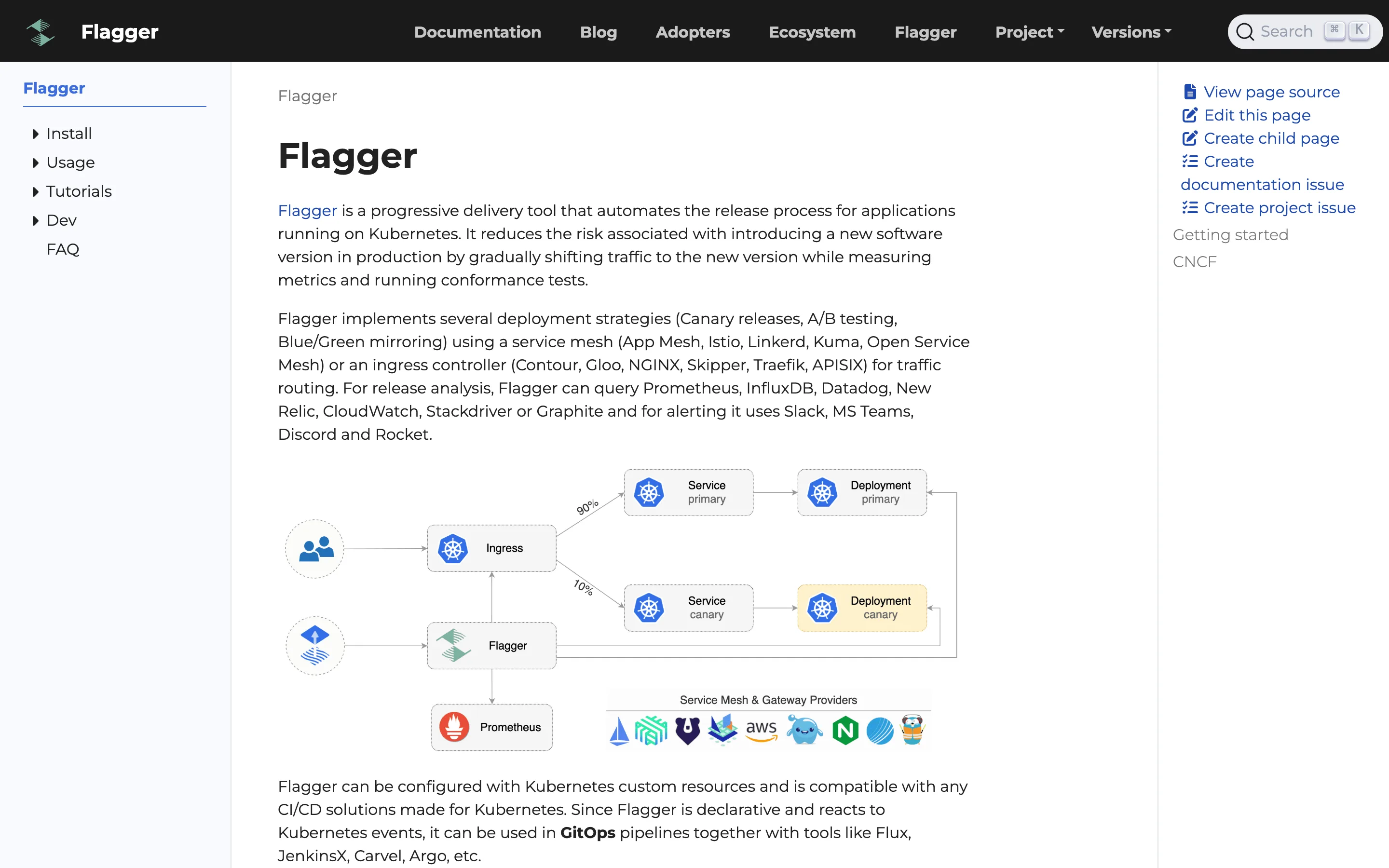
Flagger is the Flux project's progressive delivery operator and the natural pick if your GitOps flow is Flux rather than Argo. Version 1.45.0 was released on September 1, 2026 under Apache 2.0, and the repository has roughly 5,400 stars.
Flagger shifts traffic gradually while measuring metrics and running conformance tests, then halts and reverts when analysis thresholds are breached. It covers canary releases, A/B testing and blue/green mirroring across App Mesh, Istio, Linkerd and Kuma, or ingress controllers including Contour, NGINX, Traefik and APISIX, and queries Prometheus, InfluxDB, Datadog, New Relic, CloudWatch or Graphite.
The practical difference from Argo Rollouts is the conformance webhook: Flagger can call any HTTP endpoint at each step, folding a smoke test into the promotion gate instead of a separate CI stage.
LaunchDarkly
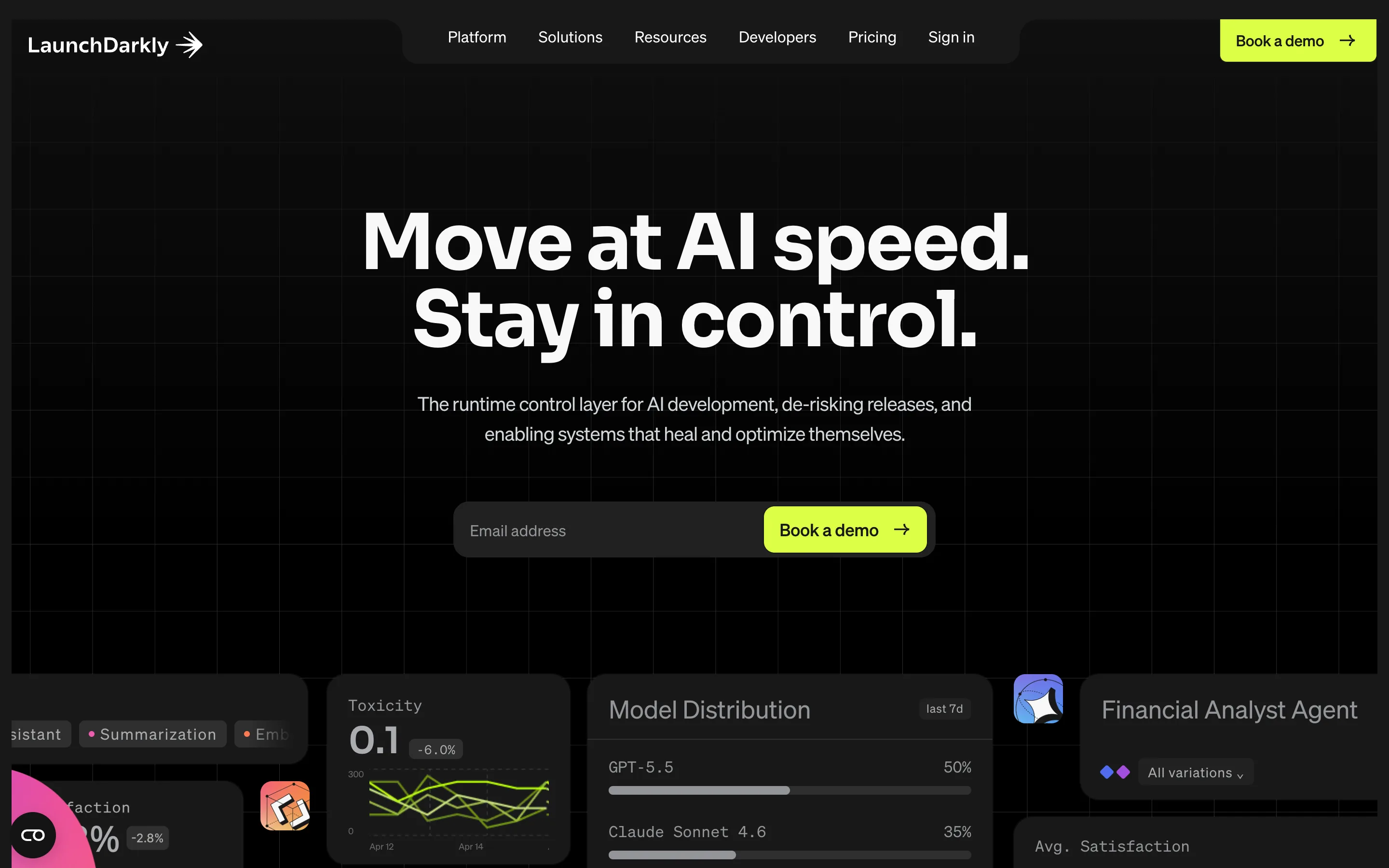
LaunchDarkly attacks the same problem from the flag layer instead of the deployment layer, and its guarded rollout is a real control loop. It raises traffic to a new flag variation in stages while watching metrics you nominate, using sequential testing to decide whether the difference between variations is a statistically significant regression. When the confidence interval sits entirely on the worse side of your success criteria, LaunchDarkly flags the regression, notifies the flag maintainer, and rolls back automatically if you enable that option. Guardrail metrics can be errors, latencies, clicks or conversions, from integrations, custom SDK events, the metric import API or OpenTelemetry traces.
Pricing is public and metered rather than per-seat. Developer is $0 per month with unlimited seats, 5 service connections, 1,000 client-side monthly active users and 5,000 AI runs. Foundation is pay as you go at $10 per service connection per month plus $8.33 per 1,000 client-side MAU, with 5,000 AI runs included and $5 per additional 1,000. Enterprise is custom. Guarded rollouts appear on all three tiers, but the deeper Release Monitoring package is a Guardian add-on sold only with Enterprise, which is what turns a free evaluation into a real quote. For the flag platform itself, our LaunchDarkly alternatives comparison covers Unleash, GrowthBook, Flagsmith and OpenFeature.
Octopus Deploy
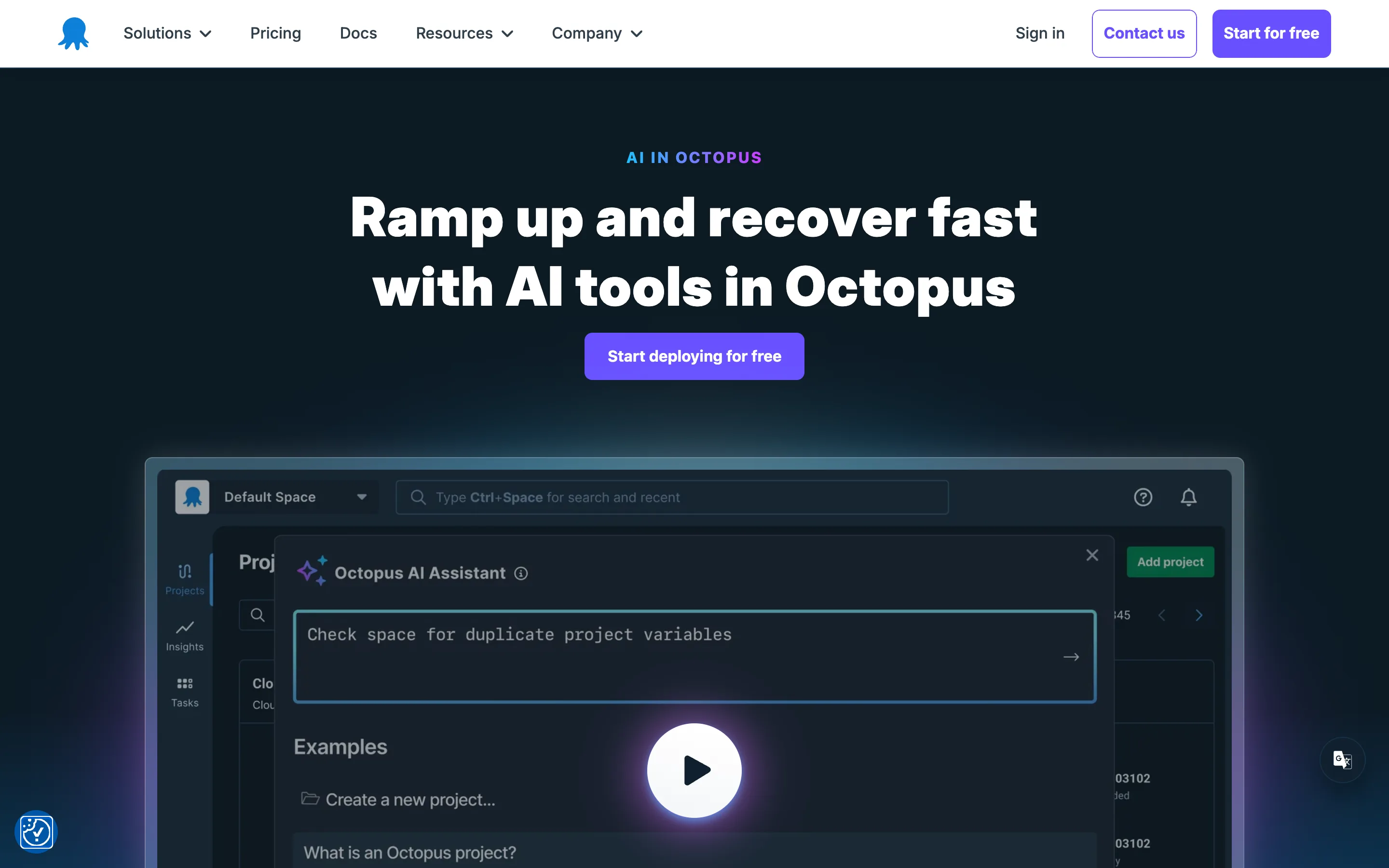
Octopus Deploy is the clearest example of the second category, and it is honest about it. Its AI features are Recovery Agent, which diagnoses the root cause of a deployment failure in one click, the Octopus AI Assistant, a Chrome extension that creates projects from prompts and analyzes deployment logs, and an Octopus MCP Server that lets external AI agents drive change management, auditing and compliance. All of it shortens the time between a failure and understanding it. None of it gates a promotion.
Octopus earns its place on governed orchestration across many environments and tenants, a different problem from canary analysis, and its pricing is public. Octopus Cloud runs $0 per year on Free, $4,330 on Professional and $24,600 on Enterprise; self-hosted Octopus Server is $0, $2,080 and $15,600. Projects are the scaling unit, Free capped at 10 projects, 10 tenants, 10 machines and 10 users, with extra tenant or machine capacity at $770 per year.
Statsig
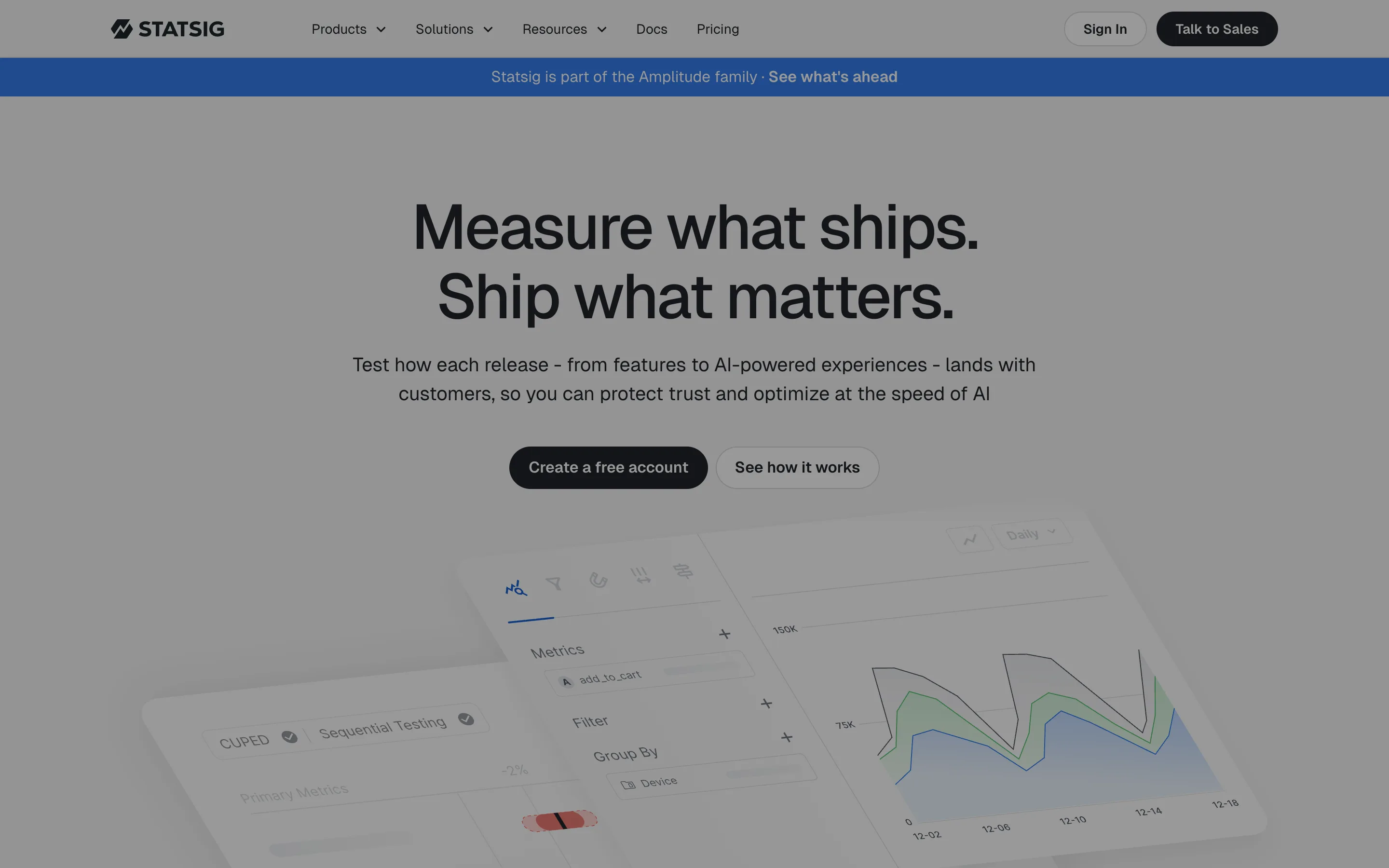
Statsig is technically strong, and worth a paragraph as a warning about a criterion teams forget. It is warehouse-native, running experiments against Snowflake, BigQuery or Databricks, with analysis built on CUPED and sequential testing, priced from free to roughly $150 per month before overages.
The complication is ownership. OpenAI acquired Statsig for $1.1 billion in an all-stock deal announced in September 2025, and founder Vijaye Raji became OpenAI's CTO of Applications. Then in May 2026 Amplitude took over the Statsig brand and customer base while OpenAI kept the team that built the product, which the company's own site now acknowledges with a "Statsig is part of the Amplitude family" banner. Optimizely CEO Alex Atzberger called the result "a race car without a driver." Judge the roadmap risk yourself, but a system that gates production releases is the wrong place to be relaxed about vendor continuity.
Unleash
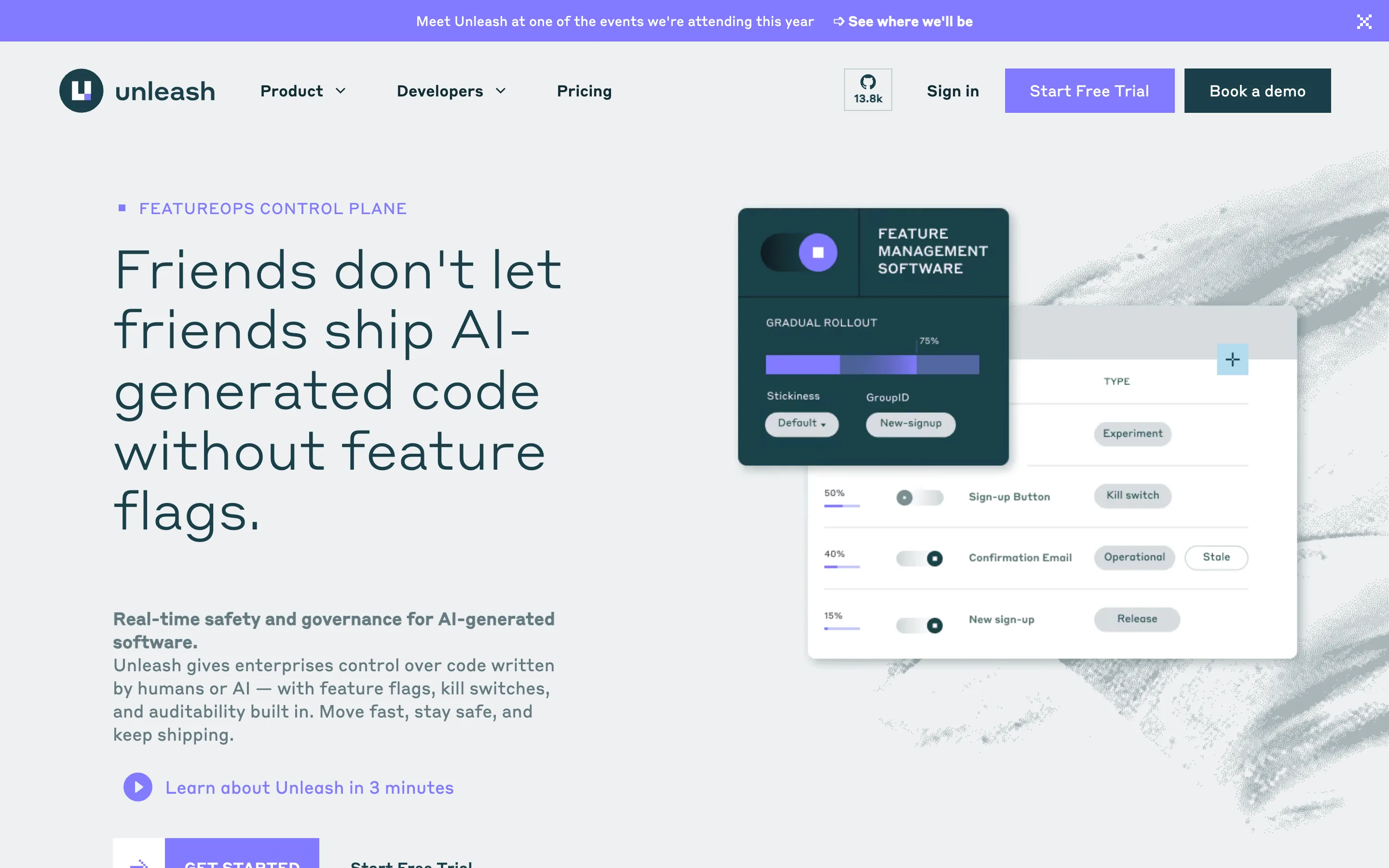
Unleash has no verification model and does not pretend to, but it names the problem best: its homepage reads "Friends don't let friends ship AI-generated code without feature flags," positioned as governance for AI-generated software. That is the DORA finding turned into a product pitch.
Unleash gives you the crudest and most reliable rollback there is, a kill switch that needs no redeploy, plus gradual rollout through activation strategies. It is AGPL-3.0-or-later with about 13,800 stars and self-hosts on-premises or on any cloud against PostgreSQL. Two limits matter: the open-source edition allows 1 project, 2 environments and 5,000 flags per instance, and open-source Unleash Edge reaches end of life on December 31, 2026, after which edge evaluation requires Enterprise Edge.
Dromeas
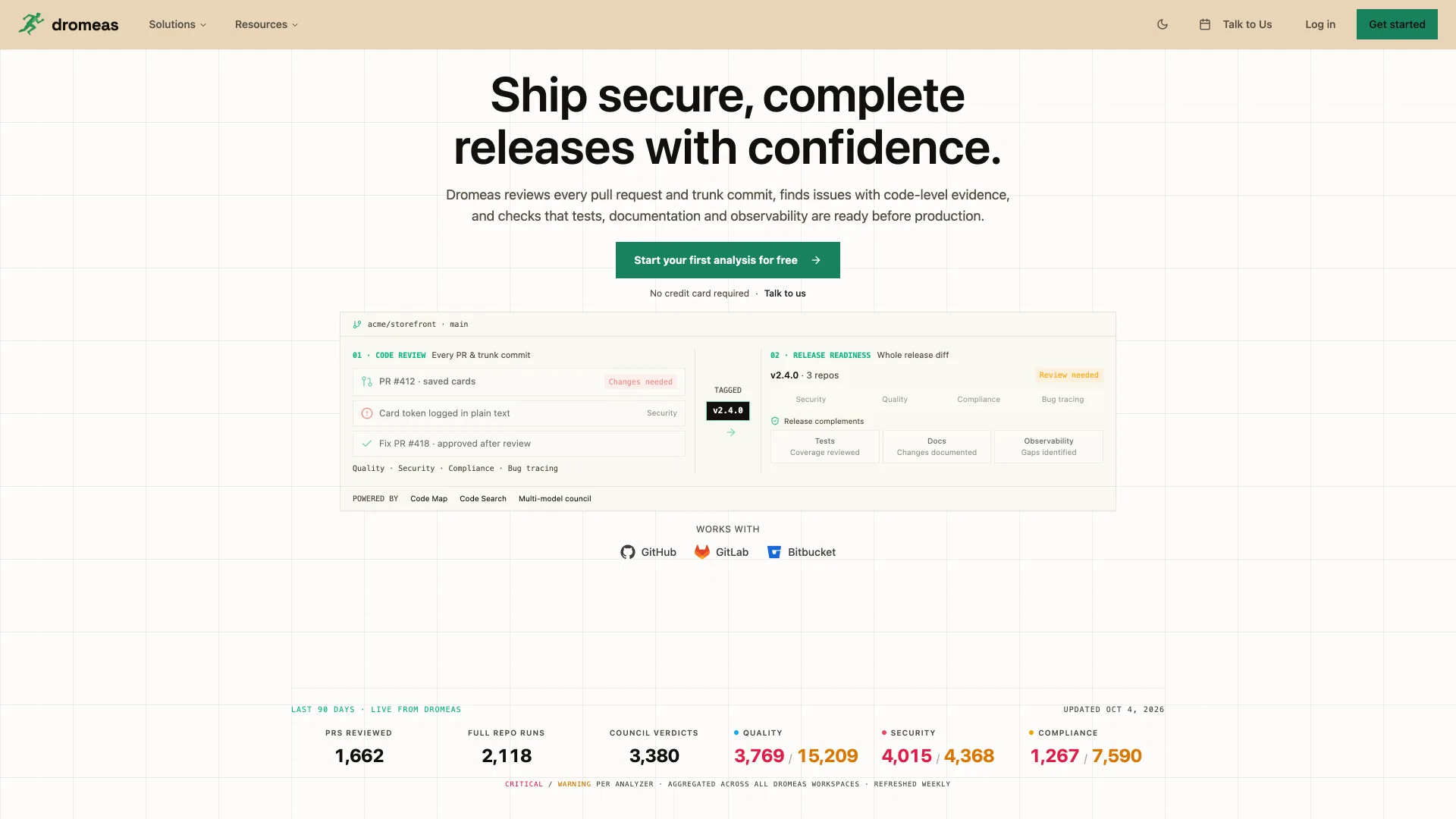
Dromeas works one step earlier than every other tool here. The controllers above react once a release takes traffic; Dromeas gates it on the code when you cut the tag, before any canary starts. Link Git tags from one or more repositories into a versioned release, and specialized agents run six readiness checks (security, quality, compliance, tests, documentation and instrumentation) scoped to the exact diff since the previous tag. Critical findings block the release until a human accepts the risk or requests a fix; warnings stay advisory. The instrumentation check matters most next to the tools above: it flags observability gaps in the changed code, and an AnalysisTemplate can only revert on a metric the new version emits.
What puts it on the "takes an action" side of the split is that the output is a verdict, not a chat. A council of models from several providers, including Anthropic, OpenAI, Google and DeepSeek, grades each finding, and only what the council agrees on survives, which is Dromeas's answer to false positives in an automated gate. Verdicts are grounded in the Code Map, an indexed graph of files, functions and callers, so a finding names the code paths a change reaches, not just a threshold it crossed. The same agents review every pull request and every commit on main, recommend merge, request changes or a fix, and deliver fixes as pull requests from a bot account, never as direct pushes to main. You can bring your own model through any OpenAI-compatible endpoint such as Ollama or vLLM, and the hosted MCP server lets Claude Code, Cursor or VS Code run review_local_diff on uncommitted changes.
There are no infrastructure prerequisites: Dromeas connects to GitHub, GitLab or Bitbucket Cloud and runs on tags, whatever deploys the build. It does not watch production after a release ships, so it complements Argo Rollouts, Flagger or LaunchDarkly rather than replacing them. Pricing is per credit, not per seat. Free is $0 with 50 credits a month for one public repository and 5 collaborators, no card required, and Pro starts at $25 per month for 100 credits across all public and private repositories, with packs up to 5,000 credits. How far the credits go depends on run volume and the models you choose.
How to Add a Guarded Rollout to a Kubernetes Service
You do not need a platform migration to get automated rollback. On Argo Rollouts it is two manifests. First the analysis, which defines "healthy" as a Prometheus query, a success condition and a failure limit.
yamlapiVersion: argoproj.io/v1alpha1 kind: AnalysisTemplate metadata: name: error-rate spec: args: - name: service-name metrics: - name: error-rate interval: 1m count: 5 successCondition: result[0] < 0.01 failureLimit: 1 provider: prometheus: address: http://prometheus.monitoring.svc.cluster.local:9090 query: | sum(rate(http_requests_total{service="{{args.service-name}}",status=~"5.."}[2m])) / sum(rate(http_requests_total{service="{{args.service-name}}"}[2m]))
Then reference it as a step between the traffic weights. Traffic goes to 10 percent, holds five minutes, runs the analysis, and advances to 50 percent only if the error rate stayed under 1 percent across five checks.
yamlapiVersion: argoproj.io/v1alpha1 kind: Rollout metadata: name: checkout-api spec: replicas: 6 strategy: canary: steps: - setWeight: 10 - pause: { duration: 5m } - analysis: templates: - templateName: error-rate args: - name: service-name value: checkout-api - setWeight: 50 - pause: { duration: 10m }
Both manifests parse cleanly, and the rollout resolves to five canary steps in the order setWeight, pause, analysis, setWeight, pause. Three choices decide whether this helps or just adds noise. Pick a metric that breaks when your service breaks, usually the 5xx rate or p99 rather than CPU. Set failureLimit above zero so one scraped blip does not revert a good release. And keep interval times count shorter than your patience, since that product is how long each gate holds traffic.
Which One Should You Actually Use?
Already running Argo CD: Argo Rollouts. Apache 2.0, no new vendor, and AnalysisTemplate covers most of what commercial verification sells.
Already running Flux: Flagger, using conformance webhooks to fold smoke tests into the promotion gate.
Not on Kubernetes: LaunchDarkly guarded rollouts. The $0 Developer tier proves the mechanism, but price the Guardian add-on before depending on it.
Windows, .NET, or many tenants: Octopus Deploy for governed orchestration, treating Recovery Agent as a faster postmortem rather than a safety net.
Enterprise with an APM contract: Harness AI Verification reads observability data you already pay for and reverts without a human. Start procurement early, since no price is published.
Shipping AI-written code across several repos: Dromeas in front of whichever controller you pick, gating each release tag on six diff-scoped readiness checks before a canary ever sees traffic.
No budget, no service mesh: self-host Unleash and put a kill switch behind every risky change. Manual, but a flag flip beats a rollback deploy by minutes.
Conclusion
The useful split here is not AI versus not-AI, it is whether a tool takes an action. Harness, Argo Rollouts, Flagger and LaunchDarkly close the loop and revert a release against a metric you chose. Octopus Deploy's Recovery Agent, and the assistants and MCP servers generally, shorten the path from failure to explanation, which is worth having but is not the same purchase.
Given DORA's finding that AI adoption still tracks with worse delivery stability, the highest-value change for most teams in 2026 is not another assistant. It is one metric-gated canary step in front of the service that would hurt most, which the open-source controllers give away free.
Related DevToolLab Tools
- Changelog Generator - turn a release's commit range into a CHANGELOG.md entry before the canary starts, not after.
- Latency Percentile Calculator - compute p50, p95 and p99 from raw samples to pick an AnalysisTemplate threshold instead of guessing.
- Uptime SLA Calculator - convert an availability target into the error budget a failed rollout may spend, which is where a sensible
failureLimitcomes from. - Kubernetes Manifest Linter - check a Rollout or AnalysisTemplate for missing probes and unpinned images before a bad manifest wastes a canary window.