
Google Sheets is now 2x faster after migrating its calculation engine to WebAssembly. Figma cut load times by 3x. Shopify runs custom checkout logic compiled from Rust to Wasm at the edge. None of this runs in a browser plugin. All of it is production software that millions of people use daily.
WebAssembly started as a way to run C++ in browsers. In 2026, it is something larger - a universal binary format that runs in browsers, at the CDN edge, in serverless functions, in server-side plugins, and inside AI inference pipelines. The W3C ratified Wasm 3.0 as a standard in September 2025. WASI Preview 2 is stable. The Component Model ships. And the tooling finally works.
Adoption reflects this maturity. Over 70% of developers now use or evaluate Wasm outside the browser, according to CNCF survey data. 67% of new enterprise projects include at least one Wasm module. Five and a half percent of sites in Chrome users' browsing history run Wasm - up from 0.04% in 2021. That is not a niche runtime anymore.
What Is WebAssembly?
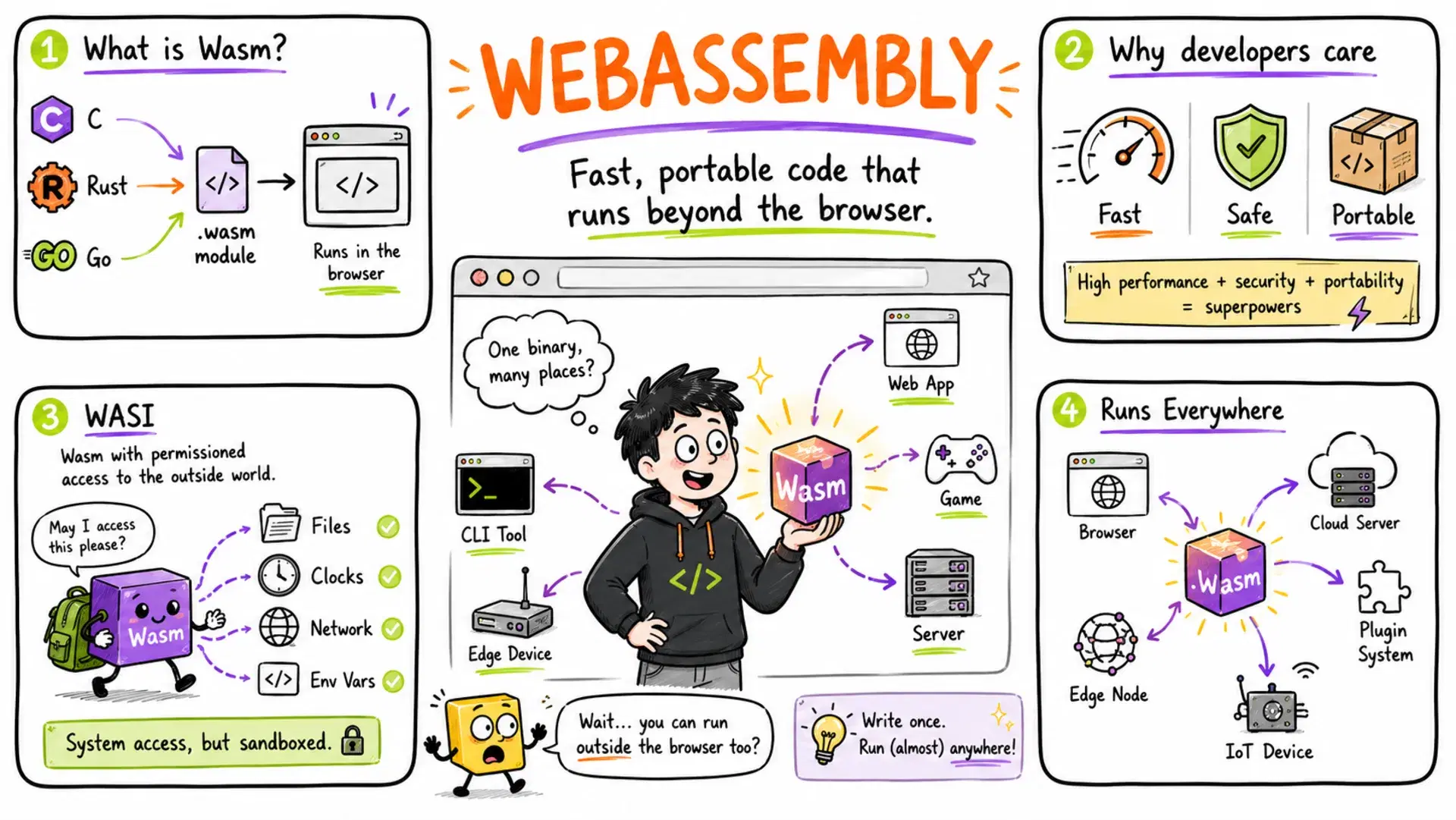
WebAssembly is a binary instruction format that executes inside a sandboxed virtual machine. The VM is embedded in browsers, standalone runtimes like Wasmtime, and cloud platforms ranging from Cloudflare Workers to AWS Lambda. The key properties that make it compelling:
Near-native performance. Wasm executes at 80–95% of native speed with no JIT warmup cost. The binary format is compact and already structured for fast parsing - compared to JavaScript, which the engine must parse, optimize, and compile on every load, Wasm arrives ready to execute.
Language agnosticism. Rust, C/C++, Go, Python, AssemblyScript, C#, and Kotlin all compile to Wasm. You write in the language your team knows; the runtime only sees the .wasm binary.
Deterministic execution. The same Wasm binary produces identical output regardless of the host - Chrome, Firefox, Node.js, Deno, Wasmtime on ARM or x86. This is stronger than "write once, run anywhere" - it is the same computation, not just the same behavior.
Security by default. Wasm modules run in a capability-based sandbox. By default, a module has zero access to the filesystem, network, memory outside its own linear memory, or any system call. It can only do what the host runtime explicitly grants.
Wasm is not a replacement for JavaScript. It works alongside it. JavaScript handles the DOM, event handling, and the majority of application logic. Wasm handles the computation that JavaScript is too slow for.
The two formats: A .wasm file is a compact binary - the format your tools compile to and runtimes execute. A .wat (WebAssembly Text) file is its human-readable equivalent: S-expression syntax that you can inspect with tools like wasm2wat. You will rarely write .wat by hand, but it is useful for understanding what your compiler produced.
A Brief History (2017–2026)
| Year | Milestone |
|---|---|
| 2017 | W3C MVP - all four major browsers ship Wasm support |
| 2019 | WebAssembly becomes an official W3C standard |
| 2020 | WASI announced - Wasm escapes the browser |
| 2022 | WASI Preview 1 - early server-side adoption begins |
| 2023 | WASI Preview 2 draft - Component Model enters the spec |
| 2024 | WasmGC ships in all major browsers; server runtimes mature |
| September 2025 | Wasm 3.0 ratified as W3C standard |
| February 2026 | WASI 0.3.0 - native async I/O with futures and streams |
| 2026 | 70%+ of developers evaluate or use Wasm outside the browser |
The timeline matters because it explains why Wasm feels like it "arrived" recently even though it has been in browsers since 2017. The browser story was compelling but limited. WASI - and then the Component Model - are what turned Wasm from a browser trick into a production runtime.
Real Companies, Real Results
Figma rewrote its rendering engine in C++ and compiled it to Wasm via Emscripten. The result was a 3x improvement in load time, regardless of document size. This was not a browser experiment - it was a production rewrite that millions of designers depend on daily, shipping before the Wasm ecosystem had reached its current maturity.
Google Sheets migrated its calculation engine to WasmGC, achieving 2x faster recalculation than the previous JavaScript implementation. Spreadsheets with millions of cells now recalculate in under a second. WasmGC - the garbage collection extension that shipped in all major browsers in 2024 - made this possible for languages like Kotlin and Java that require managed memory.
Shopify Functions lets merchants write custom discount and checkout logic in Rust or other languages, compiled to Wasm. Shopify executes this logic at the edge with a strict 10ms budget. No Node.js function could reliably meet that latency ceiling at scale. Wasm's predictable startup time and execution profile is exactly what edge enforcement requires.
Adobe Premiere Rush brings video editing to the browser using Wasm-compiled media processing pipelines. No plugin. No Electron wrapper. No desktop app download. The compute-heavy codecs and filters run in Wasm; the UI runs in JavaScript. This is the complementary model in practice.
The Big Shift: Wasm Beyond the Browser
WASI: WebAssembly System Interface
Wasm in a browser has access to JavaScript APIs but nothing else. No filesystem, no network sockets, no clocks, no system calls. That is fine for computation inside a web app, but it means you cannot build a standalone server application or CLI tool with plain Wasm.
WASI solves this. It is a standardized system interface that gives Wasm modules portable access to operating system resources - filesystems, sockets, HTTP, clocks, randomness, and process management - through typed, capability-gated interfaces. A Wasm module compiled for WASI can run on any WASI-compatible runtime without modification.
The insight that frames why this matters came from Solomon Hykes, co-founder of Docker: "If WASM+WASI existed in 2008, we wouldn't have needed to create Docker." The portability problem that containers solve - shipping software that runs the same everywhere - is the same problem WASI addresses, with a significantly smaller footprint.
WASI Preview 2 is the stable version in 2026. It covers the core system interfaces most server applications need. WASI 0.3.0, released in February 2026, added native async I/O using futures and streams. This is the capability that makes Wasm viable for real-world server applications handling concurrent connections - it was the last major gap between Wasm and conventional server runtimes.
The Component Model: The Game-Changer
Before the Component Model, Wasm modules were black boxes. Getting a Rust module to call a Python module meant writing bespoke glue code - manually marshaling data across the memory boundary, converting types, managing lifetimes. In practice, polyglot Wasm compositions were not practical.
The Component Model changes this with WIT (WebAssembly Interface Types). A WIT file defines the interface a component exposes - functions, types, records - in a language-neutral format. A Rust library and a Python library compiled to Wasm components can call each other's functions with automatically generated, type-safe bindings. The toolchain handles the translation.
The result is polyglot applications where you genuinely pick the right language for each component. Your cryptography library can be Rust. Your data processing pipeline can be Python. Your business logic can be TypeScript via Javy. They compose without a translation penalty. This is not a future promise - cargo-component and wit-bindgen ship today.
Edge Computing: Where Wasm Wins
The performance advantage of Wasm is amplified at the edge, where cold starts determine whether a function meets latency requirements or misses them entirely.
| Runtime | Cold Start | Memory per Instance | Startup Model |
|---|---|---|---|
| Container (Docker) | 50–500ms | 10MB+ | Pull → Start → Ready |
| Node.js Lambda | 200–400ms | ~50MB | Download → Init → Ready |
| Wasm Module | 1–5ms | ~1MB | Instantiate → Run |
Cloudflare Workers, Fastly Compute@Edge, and Vercel Edge Functions all support Wasm today. AWS Lambda WebAssembly functions show 10–40x improvement in cold-start times compared to container-based equivalents. At scale, the memory advantage compounds: a Wasm module costs roughly 1MB versus 10MB for a container instance, which matters when your platform runs thousands of isolated tenant functions.
WebAssembly vs JavaScript: When to Use Which
The decision is not about ideology - it is about where JavaScript's speed ceiling becomes your bottleneck.
| Scenario | Recommendation |
|---|---|
| DOM manipulation, UI updates | JavaScript |
| Image/video processing in browser | WebAssembly |
| JSON parsing, light data transformation | JavaScript |
| Cryptographic operations, hashing | WebAssembly |
| Calling APIs, handling events | JavaScript |
| AI/ML inference in the browser | WebAssembly |
| Serverless function under strict latency budget | WebAssembly |
| Complex business logic, CRUD operations | JavaScript/TypeScript |
| Physics simulations, game engines | WebAssembly |
| Server-side rendering | JavaScript (Next.js, etc.) |
The practical framework: use Wasm when JavaScript's speed ceiling is your bottleneck. Use JavaScript for everything else. Most applications will find that 5–10% of their code - the hot paths, the compute-heavy operations - benefits from Wasm, while the remaining 90% should stay in JavaScript where the ecosystem, tooling, and debugging experience are stronger.
Building with WebAssembly: A Practical Quickstart
Path 1: Rust → Wasm (the most common production path)
Rust is the dominant choice for production Wasm for specific reasons: zero-overhead abstractions, no garbage collector (which means no GC pauses inside your Wasm module), and the best-in-class wasm-pack toolchain that handles compilation, JS bindings, and npm packaging in one command.
Bash# Install Rust if you haven't curl --proto '=https' --tlsv1.2 -sSf https://sh.rustup.rs | sh # Add the wasm target rustup target add wasm32-unknown-unknown # Install wasm-pack cargo install wasm-pack # Create a new library cargo new --lib wasm-hello cd wasm-hello
Edit Cargo.toml:
toml[package] name = "wasm-hello" version = "0.1.0" edition = "2021" [lib] crate-type = ["cdylib"] [dependencies] wasm-bindgen = "0.2"
Edit src/lib.rs:
rustuse wasm_bindgen::prelude::*; #[wasm_bindgen] pub fn add(a: i32, b: i32) -> i32 { a + b } #[wasm_bindgen] pub fn greet(name: &str) -> String { format!("Hello, {}! From WebAssembly.", name) }
Build and inspect the output:
Bash# Build for the web wasm-pack build --target web # This generates a pkg/ directory with: # - wasm_hello_bg.wasm (the binary) # - wasm_hello.js (JS glue code) # - wasm_hello.d.ts (TypeScript types)
Load it in JavaScript:
JavaScriptimport init, { add, greet } from './pkg/wasm_hello.js'; async function run() { // Initialize the Wasm module await init(); console.log(add(5, 3)); // 8 console.log(greet("developer")); // "Hello, developer! From WebAssembly." } run();
The await init() call downloads and instantiates the .wasm binary. After that, add and greet are synchronous - they execute at near-native speed with no async overhead.
Path 2: AssemblyScript (if you know TypeScript)
AssemblyScript is a TypeScript-like language that compiles directly to Wasm. If your team is JavaScript-native and you want Wasm without learning a new language paradigm, this is the on-ramp.
Bashnpm init npm install --save-dev assemblyscript npx asinit .
TypeScript// assembly/index.ts export function fibonacci(n: i32): i32 { if (n <= 1) return n; return fibonacci(n - 1) + fibonacci(n - 2); }
npm run asbuild
JavaScriptconst { fibonacci } = await WebAssembly.instantiateStreaming( fetch('./build/release.wasm') ).then(obj => obj.instance.exports); console.log(fibonacci(40)); // Runs at near-native speed
AssemblyScript is not Rust - it does not give you the same performance ceiling or memory safety guarantees. But for developers who want to move a hot path out of JavaScript without a significant context switch, it is a pragmatic choice.
Path 3: Running Wasm on the Server (Wasmtime)
For running Wasm outside browsers with WASI, Wasmtime is the reference runtime from the Bytecode Alliance. It implements WASI Preview 2 and the Component Model.
Bash# Install wasmtime curl https://wasmtime.dev/install.sh -sSf | bash # Compile Rust to the WASI target rustup target add wasm32-wasip2 cargo build --target wasm32-wasip2 --release # Run directly - no container, no VM, just Wasmtime wasmtime target/wasm32-wasip2/release/my-app.wasm
The resulting binary is portable. The same .wasm file you run locally in Wasmtime will run on Cloudflare Workers, in AWS Lambda, or in WasmEdge without recompilation.
Language Support in 2026
| Language | Maturity | Key Tool | Best Use Case |
|---|---|---|---|
| Rust | Production | wasm-pack, cargo-component | Performance-critical, edge functions |
| C/C++ | Production | Emscripten | Porting existing C libraries |
| AssemblyScript | Stable | asc compiler | TypeScript devs, simpler Wasm |
| Go | Stable | TinyGo | Go codebases targeting Wasm |
| Python | Emerging | Pyodide, py2wasm | Data science in the browser |
| JavaScript/TS | Experimental | Javy (Shopify) | Tiny JS runtime inside Wasm |
| C# | Production | Blazor | .NET frontend (43% of .NET devs) |
| Kotlin | Stable | Kotlin/Wasm | JVM codebases, WasmGC required |
The Limitations No One Talks About
Most Wasm guides end with the benchmarks and the use cases. Here is what they omit.
No native multithreading in WASI. WASI lacks the threading model that backend services take for granted. The shared memory and atomics proposal exists for browsers, but server-side Wasm still lacks proper parallel compute. High-throughput servers, databases, and any workload doing real parallel processing are not good Wasm candidates today. If your bottleneck is I/O concurrency, WASI 0.3.0's async model helps. If it is parallel CPU work, Wasm is not the answer yet.
Memory overhead from multiple instances. Each Wasm module starts with a minimum memory allocation. At scale, running thousands of isolated Wasm instances can use more total memory than shared-runtime alternatives. The per-instance cost is low compared to containers, but it is not zero - and it compounds when you run a large fleet of small modules.
DOM access requires a JavaScript bridge. In the browser, Wasm cannot touch the DOM directly. All DOM manipulation goes through JavaScript - the wasm-bindgen overhead is small but non-zero, and complex DOM interactions should still live in JavaScript. If your bottleneck is DOM manipulation, Wasm will not help.
Debugging is harder. Production builds strip debug info. Source maps exist but the debugging experience lags behind native tools significantly. The practical workaround: cargo test runs your Wasm logic in a native binary, which gives you the full Rust debugging experience for unit tests. wasm-pack's test runner adds browser-based integration testing. But the gap between debugging Wasm and debugging native code is real.
Startup cost for large modules. Very large Wasm binaries - ML models embedded in Wasm, for instance - have real instantiation costs. Streaming compilation (supported in all major browsers) mitigates this by compiling while the binary downloads, but for very large modules the startup cost is still meaningful. Use wasm-opt to minimize binary size and consider lazy loading for modules that are not needed on initial page load.
Conclusion
WebAssembly in 2026 is a production runtime with a decade of engineering behind it. Wasm 3.0 is a W3C standard. WASI Preview 2 is stable. The Component Model ships in real tools. Figma, Google, Shopify, and Adobe are running production deployments at scale - not experiments.
Most developers do not need to rewrite anything. Identify the 5–10% of your code that is genuinely performance-constrained and ask whether Wasm closes that gap. For CRUD applications and typical web UIs, the answer is usually no. For image processing, cryptography, ML inference, or strict edge latency budgets, it increasingly is. Start with wasm-pack and the Rust quickstart above - the round-trip from source to JavaScript-callable function is shorter than you expect.
Related Tools
- Base64 Encoder/Decoder - Wasm binaries are often transmitted as Base64; decode and inspect them
- Hash Generator - Test cryptographic operations that Wasm accelerates
- URL Encoder/Decoder - Useful when working with Wasm module URLs and Content Security Policies
- JSON Formatter - Format and inspect the JSON you pass into your Wasm modules